FW-500 Free Weight Series Peru Market – Factory Direct Supplier
Most buyers assume free weight equipment clears customs easily because it has no electronics, no motors, no moving parts. That assumption has cost importers in Peru weeks of storage fees and thousands in demurrage charges.
When sourcing the FW-500 Free Weight Series for Peru, the three critical checkpoints are HS code classification for each weight type, consignee pre-registration at Callao port, and material certification for rubber-coated products. Missing any one of these triggers inspection delays that compound into significant port congestion costs.
I still remember a full container of dumbbells and bumper plates that sat at Callao for nearly three weeks because the local broker classified rubber-coated plates under the same HS code as bare cast iron ones. The Peruvian customs authority pulled the shipment for material verification, and the consignee hadn’t completed pre-registration with SUNAT beforehand. By the time the paperwork was corrected, the warehouse surcharges had nearly matched the ocean freight. That kind of headache is entirely avoidable if you lock down the classification and documentation before the container leaves the loading port. [NEED_CITE: SUNAT tariff classification guidelines for fitness equipment]
Let me walk you through the exact clearance requirements, material certifications, and loading strategies that keep FW-500 Free Weight Series shipments moving smoothly into Peru.
Which HS Codes Apply to Different Free Weight Products?
Dumbbells, barbells, kettlebells, and weight plates each fall under separate tariff headings in Peru’s import classification system, and mixing them under a single code is the fastest way to trigger a customs hold.
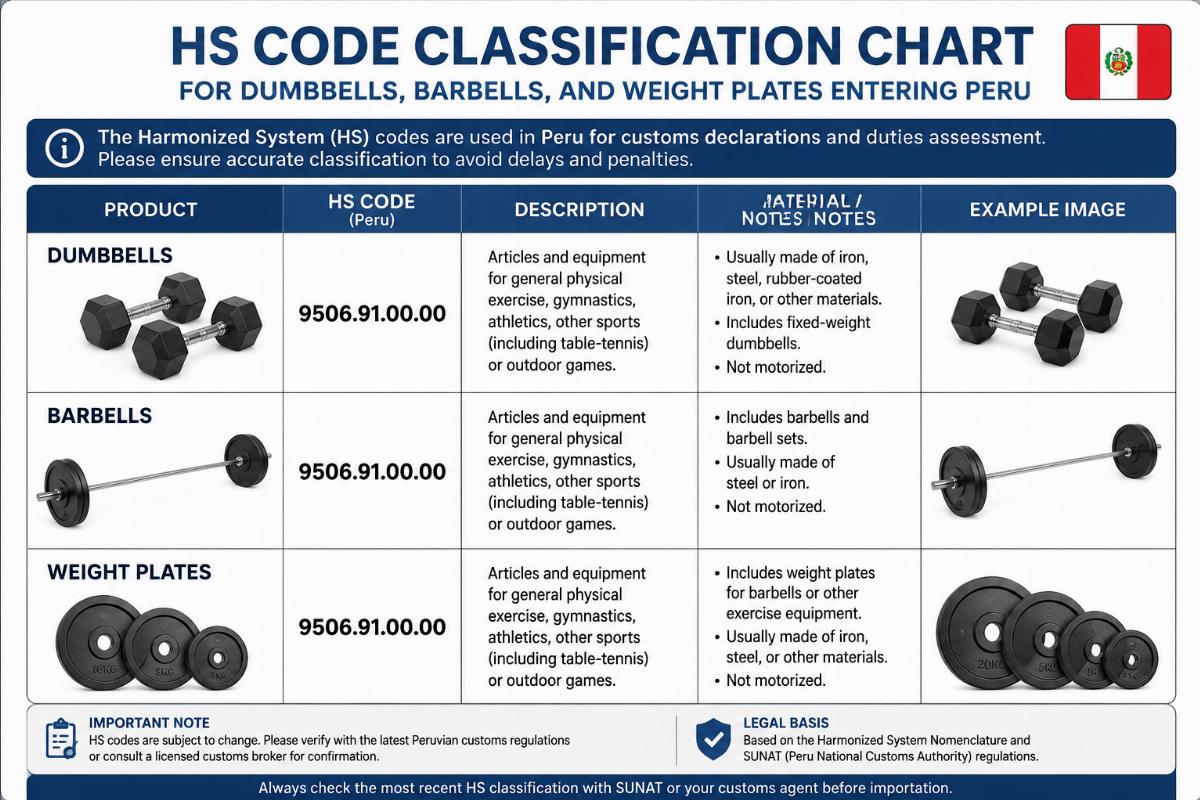
The Peruvian customs authority follows the Andean Community’s Common Nomenclature, which aligns with the international Harmonized System but applies its own eight-digit breakdown at the national level. Here is what matters for the FW-500 Free Weight Series:
| Product Type | General HS Heading Range | Classification Basis |
|---|---|---|
| Hex Dumbbells (rubber-coated) | 9506.91 | Articles and equipment for general physical exercise |
| Olympic Barbells | 9506.91 | Articles and equipment for general physical exercise |
| Rubber Bumper Plates | 9506.91 | Articles and equipment for general physical exercise |
| Cast Iron Weight Plates | 7326.90 / 9506.91 | Material-dependent classification |
| Kettlebells (rubber-coated) | 9506.91 | Articles and equipment for general physical exercise |
| Competition Technique Plates | 9506.91 | Articles and equipment for general physical exercise |
The critical nuance lies with cast iron weight plates. Some Peruvian customs brokers attempt to classify bare cast iron plates under steel articles heading 7326.90 rather than the sports equipment heading 9506.91. The duty rate difference between these two headings is meaningful, and customs officers at Callao have been known to challenge the sports equipment classification for plates that lack any branding or color-coding indicating gym use. [NEED_CITE: Andean Community Common Nomenclature classification disputes for fitness equipment]
A distributor in Lima once received a container of plain cast iron plates with no rubber coating and no gym-specific markings. The broker filed under 9506.91, but customs reclassified under 7326.90, resulting in a different duty calculation and a formal amendment process that delayed release by over a week. The lesson: if your FW-500 Free Weight Series includes any bare cast iron plates, ensure they carry visible gym-use indicators such as color-coded rubber rims or laser-etched weight markings, and confirm the classification with your broker before shipment.
For rubber-coated products, the classification is more straightforward because the rubber coating clearly indicates intended use as fitness equipment. However, you must declare the material composition accurately on the commercial invoice, including the percentage of rubber versus iron core.

How to Prepare Documents for Callao Port Clearance?
Callao port requires consignee pre-registration with SUNAT, a properly formatted commercial invoice with material breakdowns, and a certificate of origin to qualify for any applicable tariff preferences. Missing any document before the vessel arrives guarantees a delay.
The documentation process for importing the FW-500 Free Weight Series into Peru involves several steps that must be completed in sequence:
First, the consignee must be registered in SUNAT’s import system and hold an active RUC (Registro Único de Contribuyentes). Without a valid RUC, the goods cannot clear customs under any circumstances. This sounds basic, but I have seen shipments arrive where the consignee’s RUC had expired or the company name on the bill of lading did not match the RUC registration exactly. Even a minor discrepancy, such as an abbreviation versus the full legal name, forces a bill of lading amendment that costs both time and money. [NEED_CITE: SUNAT consignee registration requirements for importers]
Second, the commercial invoice must include detailed product descriptions with material composition. For the FW-500 Free Weight Series, this means specifying the exact rubber-to-iron ratio for coated products and the steel grade for bars. Vague descriptions like "gym weights" or "fitness equipment" will trigger a customs examination.
Third, a certificate of origin is essential. China and Peru have a free trade agreement in place, and presenting a valid certificate of origin allows the importer to claim preferential tariff rates. Without it, the full MFN duty applies. The certificate must be issued by the authorized body in China and must match the invoice details precisely.
Fourth, if the shipment includes rubber-coated products, customs may request a material safety declaration or test report confirming that the rubber compound complies with environmental standards. This is not always requested for every shipment, but when it is, the importer must produce it immediately or face a hold.
Here is a practical risk checklist I use before every Peru-bound shipment:
- Consignee RUC status verified and active
- Bill of lading consignee name matches RUC registration exactly
- Commercial invoice includes material composition for every SKU
- Certificate of origin issued and details match invoice
- Material safety declarations prepared for rubber-coated items
- Packing list matches container loading plan precisely
- Broker at Callao confirmed receipt of all documents before vessel arrival
A hotel developer in Arequipa was outfitting a new property gym and placed an order for the FW-500 Free Weight Series through a local distributor. The distributor handled the import paperwork but failed to verify that the consignee name on the bill of lading matched their RUC registration. The shipment arrived, customs flagged the mismatch, and the goods sat in the port warehouse while the amendment was processed. The storage fees accumulated daily, and the developer’s gym opening was pushed back. The total cost of the delay, including storage and amendment fees, represented a significant portion of the original product cost. [NEED_CITE: Callao port demurrage and storage fee structure]

What Material Certifications Are Required for Rubber-Coated Weights?
Rubber-coated products in the FW-500 Free Weight Series must comply with environmental and safety standards that go beyond basic fitness equipment requirements, and Peruvian customs increasingly requests test documentation at the point of entry.
The rubber compounds used in hex dumbbells, bumper plates, and kettlebells must meet specific criteria for volatile organic compound emissions and heavy metal content. While Peru does not have its own standalone national standard for fitness equipment rubber, customs authorities frequently reference international benchmarks such as REACH compliance for chemical safety and specific limits on certain phthalates and heavy metals.
| Material Type | Key Compliance Standard | Documentation Required |
|---|---|---|
| Natural Rubber Coating | REACH SVHC list compliance | Test report from accredited lab |
| Recycled Rubber (Bumper Plates) | Heavy metal limits, VOC emissions | Material safety data sheet plus test report |
| Virgin Rubber (Competition Plates) | REACH compliance, odor thresholds | Test report with specific compound breakdown |
| Virgin Rubber (Technique Plates) | REACH compliance | Test report from accredited lab |
The most common issue I encounter with rubber-coated free weights is odor. When rubber compounds are not properly vulcanized or when recycled rubber contains residual contaminants, the finished product emits a strong chemical smell. This is not just a customer complaint issue; it becomes a customs issue when port inspectors open a container and detect unusual chemical odors. In such cases, customs may order a material test, and if the product fails to meet acceptable thresholds, the entire shipment can be held for remediation or rejected.
A gym chain owner in Cusco ordered a large quantity of rubber hex dumbbells and bumper plates for multiple locations. When the container was opened at the warehouse, the odor was overpowering. The owner contacted me, and we arranged for a third-party lab to test the rubber compound. The test revealed that the recycled rubber used in the bumper plates contained elevated levels of certain compounds that exceeded acceptable indoor air quality thresholds. The plates had to be replaced, and the cost of the replacement shipment plus the disposal of the original product was substantial. [NEED_CITE: Indoor air quality standards for recycled rubber fitness products]
For the FW-500 Free Weight Series, all rubber-coated products undergo material testing before shipment. The rubber compound formulations are verified against REACH requirements, and test reports are prepared and available for customs presentation if requested. This proactive approach eliminates the risk of a port hold due to material concerns.
It is also worth noting that polyurethane-coated products, while less common in the free weight category, face even stricter scrutiny because polyurethane compounds can contain isocyanates and other chemicals that are closely regulated. If your order includes any polyurethane-coated items, ensure the test documentation is comprehensive and specifically addresses isocyanate content.

How to Optimize Container Loading for Maximum Cost Efficiency?
Free weight products are extremely dense, and a container loaded with only heavy items will hit weight limits long before it fills the available volume. Strategic mixing of product types within the FW-500 Free Weight Series maximizes both weight utilization and space utilization, reducing the per-unit shipping cost significantly.
A standard twenty-foot container has a maximum payload capacity of approximately twenty-eight metric tons, but the internal volume is roughly thirty-three cubic meters. If you load only cast iron plates or competition bumper plates, you will reach the weight limit while leaving substantial unused space. Conversely, if you load only light items like technique plates or resistance bands, you fill the volume but barely use the weight capacity.
The optimal loading strategy for the FW-500 Free Weight Series involves combining high-density items with lower-density products:
- Bottom layer: Heaviest items such as cast iron plates, competition bumper plates, and loaded barbells. These should be positioned to distribute weight evenly across the container floor and keep the center of gravity low.
- Middle layer: Medium-density items such as rubber hex dumbbells, kettlebells, and dumbbell racks. These fill the gaps between heavier items and add weight without creating unstable stacking.
- Upper layer: Lighter items such as technique plates, barbells (unloaded), bench frames, and accessory items. These utilize the remaining vertical space without adding excessive weight.
This layered approach requires careful planning before loading begins. The loading plan should specify the exact quantity and placement of each product type, and the loading team must follow the plan precisely. Deviations during loading can result in weight distribution problems that trigger additional inspections or even refusal at the port.
| Loading Zone | Product Density | Example FW-500 Products |
|---|---|---|
| Bottom | High | Cast iron plates, competition bumper plates |
| Middle | Medium | Hex dumbbells, kettlebells, dumbbell racks |
| Upper | Low | Technique plates, barbells, bench frames |
A distributor in Santiago was importing the FW-500 Free Weight Series along with a selection of strength machines for a commercial gym project. The initial loading plan placed all the free weight products in one container and the strength machines in another. The free weight container hit the weight limit with only partial volume utilization, while the strength machine container had plenty of unused volume but was far below the weight limit. By redistributing some of the lighter strength machine components into the free weight container and moving additional free weight accessories into the strength machine container, we achieved near-optimal weight and volume utilization in both containers. The result was a noticeable reduction in the per-unit shipping cost across the entire order.
For buyers who need flexibility in order quantities, the FW-500 Free Weight Series covers the full range of free weight products, from individual dumbbells to complete plate sets, allowing you to build a mixed container that optimizes both weight and space. Minimum order quantities are flexible enough to accommodate both full container loads and consolidated shipments that combine free weights with other equipment categories.

Conclusion
Clearing the FW-500 Free Weight Series through Callao port requires precise HS classification, complete documentation, and material compliance verification. Get these three elements right before shipment, and the goods move through customs without delay. Get them wrong, and the costs accumulate quickly at every stage.