Incline Chest Press Manufacturer for Multi-Site Sports Facilities
Heavier steel frames do not automatically mean longer service life — weld penetration depth and certified steel grades matter far more than raw weight.
For multi-site professional sports facilities, deploying a standardized incline chest press across all venues ensures identical training loads, reduces injury risk from equipment variance, and allows batch production with unified container consolidation — cutting per-unit freight costs noticeably while keeping rollout timelines within a single manufacturing window.
I still remember a shipment we handled for a Southeast Asian pro basketball franchise. They needed matching units across four separate training venues. The procurement manager initially assumed ordering a larger total quantity would drive the per-unit price down significantly. What actually saved them money was rethinking the container load plan — mixing plate-loaded units with adjustable benches and spare parts kits into high-cube containers instead of dedicating separate shipments to each site. The frame steel on those units met commercial tensile strength benchmarks, and the padding density was spec’d to withstand extended daily use by elite athletes [NEED_CITE: foam density and upholstery tear-resistance benchmarks for high-usage athletic facilities]. Getting the container consolidation right turned a logistically complex four-venue rollout into a manageable operation.

Let me walk you through what actually matters when you are planning a multi-site deployment of this equipment.
Why Multi-Site Sports Facilities Need Standardized Incline Chest Presses?
Athlete performance data and injury prevention protocols depend on equipment consistency — even minor differences in press angle, seat travel, or resistance curve between venues create measurable training gaps.
When a professional sports franchise operates multiple training facilities, the strength and conditioning coaches need every athlete to experience the same mechanical stimulus regardless of which location they train at that week. I worked with a South American rugby academy that operated three separate venues. Their head of performance flagged that athletes transferring between sites reported subtle differences in how the pressing motion felt. Investigation traced it back to padding compression variance and slight differences in the cam profile on the resistance mechanism between batches produced months apart.
The solution was batch production with unified specifications. All units for that rollout came from the same production cycle, using identical steel grades and foam densities [NEED_CITE: batch production tolerance standards for commercial strength equipment]. The OEM branding was applied uniformly, and each site received an identical spare parts kit so maintenance teams could swap components without cross-referencing different part numbers.
Standardization also simplifies the procurement process. When you spec one incline chest press model for all locations, you negotiate once, approve one set of technical drawings, and conduct one round of pre-shipment inspection. The alternative — letting each venue manager pick their preferred model — creates a fragmented supply chain that complicates warranty claims and spare parts logistics down the line.
From a coaching perspective, consistent equipment means training load data collected at one venue transfers directly to another. If an athlete presses a certain load at Venue A, the sports science team can compare that directly to their performance at Venue B without applying correction factors for equipment differences.

What Specs Matter Most for Professional Team Use?
Commercial-grade frame construction, plate-loaded smoothness, and high-density padding are the three non-negotiable specifications for equipment facing eight or more hours of daily use by elite athletes.
Professional sports facilities operate under conditions that would destroy typical commercial gym equipment within months. The athletes are stronger, more intense, and train with higher volume than the general population. Every rep is controlled, every set is pushed to failure, and the equipment sees continuous use from early morning through evening.
The frame needs to meet commercial tensile strength ranges with certified steel grades. I have seen procurement teams reject units based solely on frame weight, assuming heavier equals better. The reality is that weld penetration depth and steel grade certification tell you far more about durability than a scale reading. A lighter frame with proper weld fusion and certified material will outlast a heavier frame with shallow welds and unverified steel [NEED_CITE: weld penetration and steel grade certification standards for commercial fitness equipment].
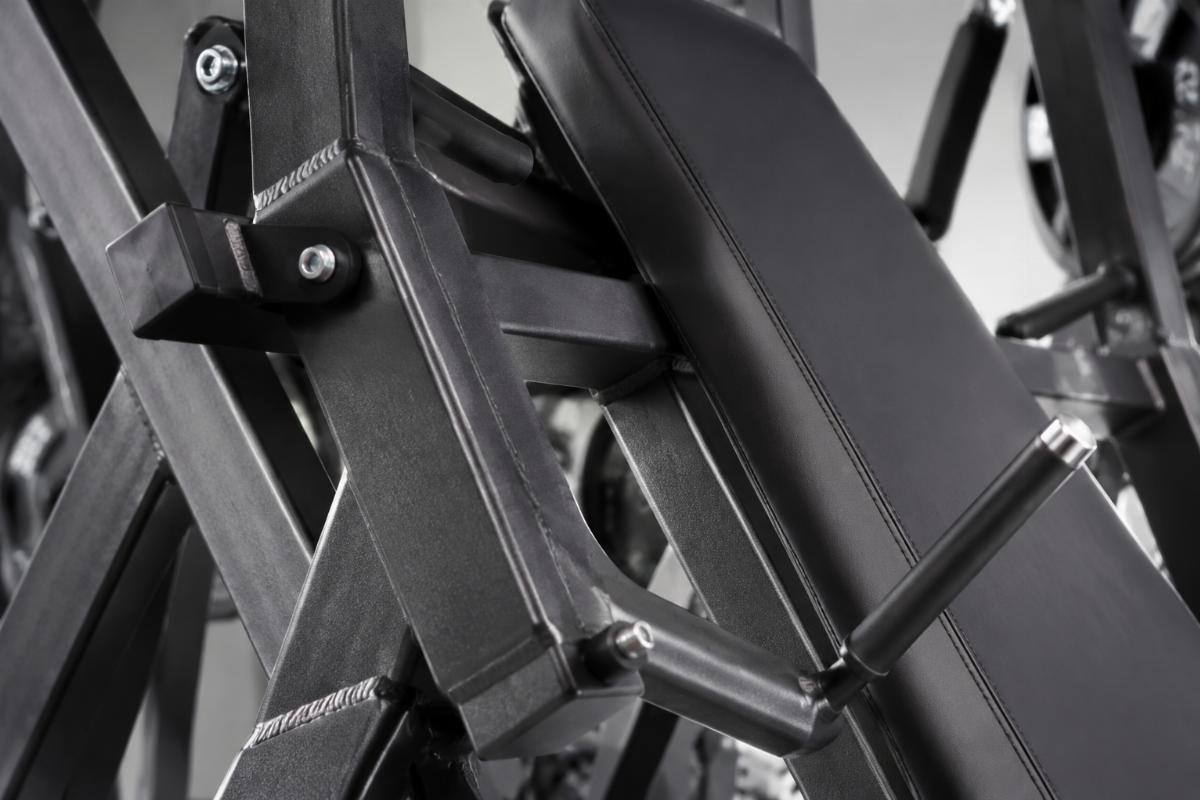
For plate-loaded incline chest press models, the guide rod smoothness and bearing quality determine how the weight stack feels during heavy presses. Athletes notice immediately if the plates catch or drag. The seating adjustment mechanism also needs to withstand constant repositioning — quick-release pins and heavy-duty sliders outperform threaded knobs in high-traffic environments.
Padding specifications deserve serious attention. High-density foam with reinforced upholstery resists compression set and tearing even after extended heavy use. I have seen facilities where low-density padding collapsed within a single season, forcing expensive re-upholstery. The tear-resistance of the vinyl covering matters as much as the foam density underneath [NEED_CITE: padding foam density and upholstery tear-resistance benchmarks for high-usage athletic facilities].
| Specification Area | Commercial-Grade Standard | Basic Grade |
|---|---|---|
| Frame Steel Certification | Certified grade with verifiable tensile range | Self-reported or not provided |
| Weld Quality | Full penetration with inspection records | Sample-level or not provided |
| Padding Density | High-density with compression resistance | Standard density, vulnerable to compression set |
| Upholstery | Reinforced vinyl, tear-resistant | Basic vinyl, vulnerable to tearing |
| Guide Rod System | Precision-ground with sealed bearings | Standard rod with basic bushings |
A Middle East football club we supplied needed equipment for two training venues plus a rehabilitation center. They specified plate-loaded incline presses for the main athlete training zones and selectorized models for the rehab area where load precision matters more than maximum weight capacity. Getting that ratio right during the planning phase prevented costly post-delivery swaps.
How to Consolidate Incline Presses with Other Equipment in Full Containers?
Mixed loading with power racks, free weights, and functional equipment maximizes container cubic meter utilization and cuts per-unit freight costs noticeably compared to dedicated shipments.
This is where I learned the hardest lesson early in my career. A client in Jakarta ordered a full container of Smith machines and a separate container of dumbbell racks from different suppliers. Neither supplier had experience with mixed-product consolidation. When the containers arrived, the Smith machines had shifted during ocean transit because no fixed partitions separated them from the loose weight plates loaded in the same container. The powder coating on several units was chipped and scratched. The client refused to accept delivery, and the financial hit covered repainting, replacement parts, and lost time.
Since then, I approach container load planning with the same rigor as equipment manufacturing. The key is calculating cubic meter utilization across mixed product categories. Incline chest press units are bulky but relatively lightweight compared to their volume. Power racks and cable crossover machines share similar volume characteristics. Free weights — dumbbells, barbells, weight plates — are dense and heavy but compact.
The optimal container plan layers these characteristics. Heavy compact items like weight plates go on the container floor as a stable base. Bulky lightweight items like incline chest presses and benches fill the upper and side spaces. Medium-density items like power rack components fill gaps. This approach maximizes weight utilization without exceeding container payload limits while filling volume efficiently [NEED_CITE: container load planning method with CBM calculation and weight distribution for mixed strength equipment].
For a recent multi-venue rollout, we consolidated incline chest presses with Smith machines, adjustable benches, and dumbbell racks into high-cube containers. The incline presses occupied the upper sections, secured with wooden bracing and strap ties. The Smith machine frames broke down into flat-pack components that slid between the press units. Dumbbell racks loaded vertically along the container walls. Weight plates filled every remaining gap on the floor.
The result was a full order shipped in fewer containers than if each product category traveled separately. Per-unit freight dropped noticeably, and every unit arrived without transit damage.
| Container Load Strategy | CBM Utilization | Freight Cost Impact |
|---|---|---|
| Single-product dedicated containers | Noticeably underutilized | Highest per-unit cost |
| Mixed-product consolidation | Substantially optimized | Noticeably reduced per-unit cost |
| Unplanned mixed loading | Uncontrolled, damage-prone | Hidden costs from transit damage |
Planning the load before production starts also means you can adjust manufacturing sequences to match container loading order. Units destined for the same container get produced in sequence, staged together in the warehouse, and loaded as a batch. This eliminates the chaos of pulling items from different production runs to fill a container at the last minute.

What Rollout Timeline Should Multi-Site Buyers Expect?
Standardized specifications and batch production enable manufacturing completion within a compressed window, with staggered shipping schedules aligned to each venue’s construction or renovation timeline.
Multi-site deployments rarely open all locations simultaneously. Venue construction finishes at different times, local permitting varies, and staffing schedules differ. The equipment rollout needs to match these realities rather than forcing all deliveries into a single window.
The approach that works best is completing manufacturing in one batch while scheduling container loading and shipping in stages. All incline chest press units for the full order get produced together — same steel batch, same foam lot, same powder coating run. This guarantees consistency across every unit regardless of which venue receives it or when it ships.
After production, units enter warehouse storage organized by destination venue. As each facility approaches readiness, the corresponding containers get loaded and shipped. This decouples manufacturing efficiency from delivery timing.
I worked with a professional sports franchise expanding from two venues to five. The new facilities had construction timelines spanning several months. We produced all incline chest press units and complementary equipment in a single manufacturing batch. The first shipment went to the venue with the earliest completion date. Subsequent shipments followed the construction schedule. Every unit across all five venues remained identical in specification and production batch.
This approach also simplifies quality control. One pre-shipment inspection covers the entire order. Any adjustments or corrections happen once, not repeatedly across multiple production runs. Spare parts kits get assembled in bulk and distributed with each venue’s shipment, so maintenance teams at every location have identical inventory from day one.
The timeline from specification approval to final venue delivery typically spans a moderate window when manufacturing and shipping are planned together. Rushing production to meet a single delivery date for all venues creates quality risks and eliminates the flexibility to adjust shipping schedules based on construction progress.

Conclusion
Multi-site sports facility deployments succeed when equipment standardization, container consolidation planning, and phased shipping work together as one system.
Consistent incline chest press specifications across all venues protect athlete training integrity and simplify long-term maintenance. Mixed-product container loading transforms freight economics from a cost center into a controllable variable. Batch production with staggered delivery preserves manufacturing consistency while respecting each venue’s individual timeline.