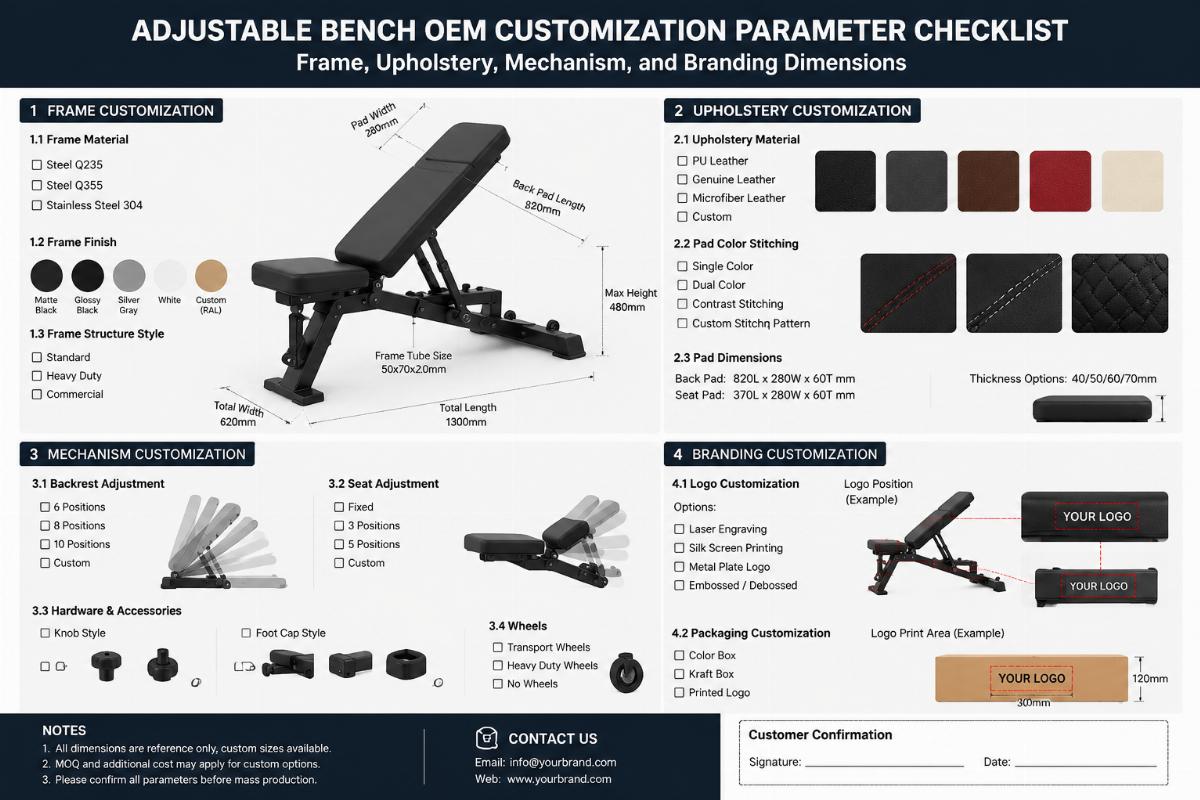
PR-800 Power Rack Sub-Series OEM Customization Wholesale Supplier
Most buyers assume custom branding adds massive cost and months of delay. The reality is quite different.
The PR-800 Power Rack supports extensive OEM customization across branding, finish, attachments, and packaging to meet diverse commercial gym and distributor requirements, with bulk custom orders seeing minimal per-unit cost increases and lead time extensions measured in weeks rather than months.
I still remember a container of strength equipment bound for West Africa years ago. The buyer sourced from a different supplier, handled freight forwarding himself, and assumed CE paperwork was just a formality. When the container hit the port, customs rejected the CE certificate format outright. The cargo sat for weeks. Demurrage fees climbed past the invoice value. The buyer walked away from the entire shipment. That kind of loss doesn’t happen because of product quality—it happens because nobody checked the documentation chain end-to-end. Since then, I’ve built my workflow around tracking orders from the production floor all the way through destination port clearance, especially on certification and customs compliance.
When gym owners or distributors search for a PR-800 Power Rack customization partner, they’re usually juggling three concerns at once: Can the factory actually replicate my brand identity? Will the finish hold up under heavy commercial use? And will the paperwork get my container through customs without surprises? Let me walk through each layer with specifics from real production runs.

If you’re evaluating whether a PR-800 Power Rack customization supplier can handle your private-label requirements, the details below should give you a clear framework for comparison.
What Branding Customization Options Are Available for PR-800?
Full private-label execution goes far beyond slapping a logo on the upright—documentation localization, color matching, and serial number systems all require coordinated customization.
When a Middle East distributor approached us for a PR-800 Power Rack customization order, the request seemed straightforward at first: laser-engrave their logo on the uprights and match a specific RAL color. But the conversation quickly expanded. They needed Arabic-language assembly manuals, localized warranty cards with their service center contacts, and a serialized tracking system tied to their internal inventory software. [NEED_CITE: OEM branding scope requirements for fitness equipment per industry practice]
Here’s what a typical branding customization package for the PR-800 Power Rack actually covers:
| Branding Element | Standard Offering | Full OEM Customization |
|---|---|---|
| Logo Placement | Sticker on packaging | Laser engraving on uprights, J-cups, and safety hardware |
| Color Matching | Stock black/gray/red | Custom RAL or Pantone match with batch consistency verification |
| Documentation | English only | Multi-language manuals, localized warranty cards, country-specific safety labels |
| Serial Numbering | Factory sequential | Buyer-defined format with barcode/QR integration |
| Packaging | Generic carton with factory info | Full-color printed carton with buyer branding, handling icons, and barcodes |
The documentation piece is where most buyers get caught off guard. A gym chain operator in Southeast Asia once received a shipment where the English manuals were perfect—but the destination country required manuals in the local language by law. The containers cleared customs, but the local distributor had to reprint and insert manuals manually before delivering to gym sites. That’s a labor cost nobody budgeted for.
For the PR-800 Power Rack customization process, we prepare documentation drafts in parallel with production tooling. Logo files get confirmed in vector format, color samples ship for approval before batch coating begins, and manual translations go through a final review against the actual hardware configuration. [NEED_CITE: documentation localization requirements vary by destination country import regulations]

How Do Finish and Coating Choices Affect Durability and Cost?
Powder coating is the industry standard for commercial power racks, but the quality gap between a basic coat and a properly validated finish is enormous.
Most people think color customization is just "pick a paint color." In reality, the coating process for a PR-800 Power Rack customization order involves surface preparation, application parameters, curing profiles, and post-application testing—all of which directly affect how the rack performs in a humid commercial gym environment. [NEED_CITE: powder coating durability standards for commercial fitness equipment per ISO 12944 or equivalent]
Here’s how the main finish options compare for the PR-800 Power Rack:
| Coating Type | Durability Profile | Cost Impact | Lead Time Impact | Salt-Spray Resistance |
|---|---|---|---|---|
| Standard Powder Coating | Robust for indoor commercial use | Baseline | No extension | Extended endurance |
| Custom RAL Color Powder Coat | Same durability as standard | Noticeably reduced vs. electroplating | Minimal extension | Extended endurance |
| Electroplating (Zinc/Chrome) | Moderate, prone to chipping on impact | Substantially higher | Noticeably extended | Moderate resistance |
| Wet Paint/Spray | Basic, limited commercial viability | Lowest upfront | Shortest | Vulnerable to chipping |
The critical distinction buyers miss is coating thickness and adhesion testing. A proper commercial-grade powder coat on the PR-800 Power Rack needs to meet specific thickness ranges and pass cross-hatch adhesion tests. [NEED_CITE: coating thickness and adhesion test standards per ASTM D3359 or ISO 2409] Without these checks, you might get a rack that looks perfect on day one but starts showing substrate exposure after a few months of plate loading and bar contact.
A连锁健身房 operator we worked with specified a matte black finish with custom UHMW plastic liners on the J-cups. The liners weren’t just cosmetic—they reduced barbell contact noise and prevented metal-on-metal wear during high-repetition rack pulls. That’s the kind of detail that separates a finish specification written by someone who’s actually run a gym floor from one pulled off a generic spec sheet.

Which Attachments and Accessories Can Be Customized?
Attachment compatibility hinges on hole spacing standards, and customization here directly affects your end-user’s training experience.
The PR-800 Power Rack customization extends well beyond the frame itself. J-cups, safety straps, pull-up bar configurations, and liner materials all have customization options—but they must align with the rack’s hole spacing specification to maintain structural integrity and accessory compatibility. [NEED_CITE: hole spacing standards for commercial power racks and attachment interoperability]
| Attachment Category | Customization Options | Compatibility Consideration |
|---|---|---|
| J-Cups | UHMW liner color, quantity per rack, mounting pin diameter | Must match hole spacing (standard 1-inch or 2-inch center-to-center) |
| Safety Straps/Monolift | Strap width, pull pin style, color coding | Pin diameter must match upright hole specification |
| Pull-Up Bar | Grip diameter, width, shape (straight/multi-grip) | Mounting plate bolt pattern must match upright top |
| Weight Storage | Peg quantity, orientation (horizontal/vertical), plate diameter capacity | Mounting bracket alignment with frame base |
| Liner Kits | UHMW color, coverage areas (J-cups, safety arms, band pegs) | Adhesive backing compatibility with powder-coated surface |
A distributor in the Middle East ordered a full container of PR-800 Power Rack units with a specific request: increase the J-cup count from the standard pair to three pairs per rack, and switch the safety arms from pin-and-pipe design to Westside-style strap safeties. The J-cup increase was straightforward—just adjust the bill of materials. The safety strap switch required confirming that the upright hole pattern supported the strap width and that the pin holes aligned correctly. [NEED_CITE: Westside hole pattern compatibility with strap safety systems]
The mistake we see repeatedly is buyers specifying attachments without confirming hole spacing. A 1-inch hole spacing rack won’t accept 2-inch spacing attachments without modification, and forcing compatibility creates a safety hazard under load. Always confirm the hole spacing specification before finalizing attachment customization for your PR-800 Power Rack customization order.

What Are the Lead Time and MOQ Implications of Customization?
Customization doesn’t automatically mean long lead times—volume thresholds and packaging choices determine the actual timeline impact.
There’s a persistent myth that any custom order means months of waiting. For the PR-800 Power Rack customization, the lead time impact depends heavily on what you’re customizing and how many units you’re ordering.
| Customization Scope | MOQ Threshold | Typical Lead Time Impact |
|---|---|---|
| Logo engraving only | Low (single-digit units feasible) | Minimal extension |
| Custom color powder coat | Moderate batch size recommended | Noticeably extended due to coating line scheduling |
| Full branding package (logo + color + docs + packaging) | Higher volume recommended | Substantially extended if below threshold |
| Attachment specification changes | Depends on tooling requirements | Varies from minimal to extended |
A European distributor once placed a PR-800 Power Rack customization order for a boutique gym chain. They wanted custom branding, a non-standard color, and modified packaging for retail display. The order volume was modest—just enough to fill partial containers. The color match required a dedicated coating run, which added time. But because the branding and documentation were prepared in parallel, the overall delay stayed manageable.
The packaging dimension deserves special attention for PR-800 Power Rack customization. You can ship fully disassembled (flat pack), partially assembled, or fully assembled. Flat pack maximizes container load density and minimizes freight cost per unit. Fully assembled reduces on-site labor for the gym but eats up container space fast. [NEED_CITE: container loading optimization for fitness equipment packaging formats] We’ve seen buyers save substantially on per-unit freight by choosing flat-pack packaging for their PR-800 Power Rack customization order, even when the end-user preferred assembled delivery—because the assembly labor cost at destination was still lower than the ocean freight savings.

How to Ensure Compliance and Avoid Clearance Issues?
CE certification format errors cause more shipment delays than product quality issues—pre-shipment document verification is non-negotiable.
Let me return to that West Africa example. The CE certificate itself was valid—the equipment met the essential health and safety requirements. But the certificate format didn’t match what the destination country’s customs authority expected. Specifically, the issuing body’s accreditation details weren’t presented in the format that country recognized. The result: weeks of demurrage, a mid-six-figure loss in fees and abandoned cargo, and a buyer who swore off that supplier permanently.
For any PR-800 Power Rack customization order bound for markets requiring CE marking, the documentation chain must be verified before the container leaves the port. [NEED_CITE: CE certification format requirements vary by destination country and product category]
| Document Type | Common Pitfall | Verification Step |
|---|---|---|
| CE Certificate | Format not recognized by destination customs | Confirm issuing body accreditation matches destination requirements |
| Declaration of Conformity | Missing product model or manufacturer details | Cross-reference against actual shipped models and branding |
| Test Reports | Outdated standards or missing test parameters | Verify test standards match current regulatory requirements |
| Commercial Invoice | HS code mismatch with product description | Confirm HS code aligns with customs classification for strength equipment |
| Packing List | Quantity or weight discrepancy with actual shipment | Reconcile against final loading inspection records |
The lesson from years of tracking shipments from Qingdao’s Qianwan Port to destinations across multiple regions is simple: don’t assume the factory’s standard documentation package will clear every port. Destination-specific verification is a small upfront cost compared to the alternative.
For our PR-800 Power Rack customization orders, we run a pre-shipment documentation review that checks certificate formats against destination requirements, confirms that branded documentation matches the actual shipment configuration, and verifies that HS codes align with the product description on the commercial invoice. This process has prevented clearance delays on shipments bound for markets with strict import documentation standards.

Conclusion
Successful PR-800 Power Rack customization requires coordinated execution across branding, finish, attachments, packaging, and compliance documentation.
The PR-800 Power Rack customization process delivers private-label branding, durable commercial-grade finishes, compatible attachment configurations, and optimized packaging—provided the buyer and manufacturer align on specifications early and verify compliance documentation before shipment. Volume thresholds and packaging choices drive the real cost and timeline impact, not the customization scope itself.