01 / Scenario
STUDIO
P
High-End Pilates Studios
Premium aesthetics meet quiet operation for boutique studio environments.
ISO
9001
CE
Certified
OEM
Available
10YR
Warranty
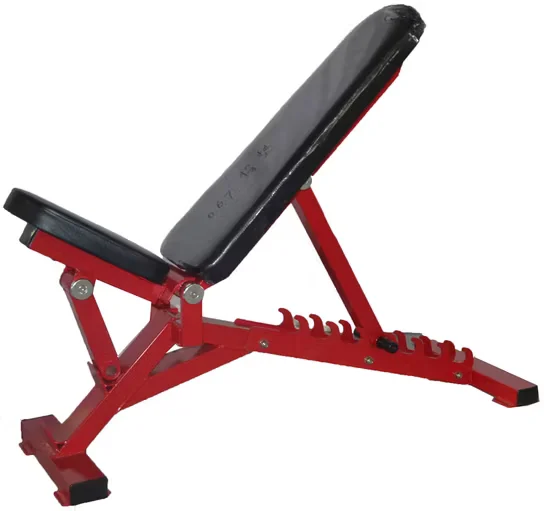
Adjustable Bench, 38 kg Net Weight, Incline/Flat/Decline Positions — engineered with steel frame construction for commercial free-weight zones, featuring multi-angle backrest adjustment and high-density upholstery rated for daily heavy dumbbell and barbell pressing work. Each unit undergoes per-piece load testing before shipment, backed by a 10-year frame warranty and mill-certified steel traceability for procurement confidence.
// Spec Highlights
• Direct from Manufacturer · No Middlemen · Worldwide Shipping
01
// Material
Imported Solid Wood
Premium hardwood frames sourced for density and visual warmth.
02
// Hardware
Medical-Grade Silent
Whisper-quiet pulleys and springs for clinical environments.
03
// Customization
Appearance OEM
Color, upholstery, and branding tailored to your studio.
04
// Service
Layout Design
Free venue planning for studios and rehab institutions.
Every component is selected for longevity, performance, and aesthetic harmony - from imported hardwood frames to silent medical-grade accessories.
// Features
11-Gauge Traceable Steel — Every Commercial Adjustable Bench frame is built from mill-certified 11-gauge tubing with coil-level traceability, ensuring structural consistency across production runs.
| Parameter | Value |
|---|---|
| Product Type | Adjustable Bench |
| Frame Steel Gauge | 11-gauge |
| Frame Tube Size | 3×3 inch |
| Steel Grade | Q235 / Q345 industrial steel |
| Welding Type | Robotic MIG continuous weld |
| Adjustment Positions | Incline / Flat / Decline |
| Product Dimensions | 1673×706×1390 mm |
| Net Weight | 38 Kg |
| Powder Coating | 200μm scratch-resistant |
| Upholstery | Standard or high-density options |
| Color | Optional |
| Certification | ISO 9001, CE |
| OEM | Available |
| Facility Type | Typical Use |
|---|---|
| Commercial gym strength floor | Dumbbell and barbell pressing stations in free-weight zones |
| Hotel and resort fitness center | Multi-angle bench for guest strength training areas |
| University strength and conditioning room | Adjustable bench work for collegiate athlete programs |
| CrossFit box functional zone | Incline and decline bodyweight or loaded accessory movements |
| Rehabilitation and performance center | Graded loading positions for return-to-training protocols |
An adjustable bench lives or dies at the hinge — not the steel itself.
Many suppliers quote "commercial grade" without specifying tube wall thickness or welding protocol. Under repeated incline-press loading, spot-welded joints at the ladder bracket and rear hinge develop micro-fractures that compound into visible play within months. A bench that wobbles mid-set is not just annoying; it shifts the user’s center of gravity unpredictably, increasing injury risk and driving premature equipment replacement. [NEED_CITE: weld classification and fatigue performance in structural steel]
I have personally seen a batch of adjustable benches returned after six months because the hinge pin housing cracked under high-frequency angle adjustments — the cost-cutting move was dropping the tube gauge on the base frame. That failure taught me that every tube in the load path matters, not just the uprights.
The commercial adjustable incline decline bench anchors the dumbbell pressing area, covering incline, flat, and decline angles for chest, shoulder, and triceps work. It pairs naturally with adjustable dumbbell racks and plate-loaded chest press stations, filling the gap between fixed-angle benches and cable-based movements. Facilities with moderate to high member traffic benefit from a multi-position design that reduces the total bench count needed on the floor. The wide adjustment range accommodates users across varying torso lengths and shoulder mobility levels.
Every angle change subjects the rear hinge pin and ladder-style bracket to eccentric shear. In a busy free-weight zone, a single commercial adjustable incline decline bench may cycle through positions dozens of times per day, accumulating fatigue at the pivot bore and weld toe. Continuous MIG welds distribute this stress along the full joint length rather than concentrating it at discrete spot-weld nodes. [NEED_CITE: cyclic shear fatigue at pinned joints in steel frames] The powder-coated surfaces around the hinge must also resist abrasion from repeated pin insertion and sweat-driven corrosion, which thin coatings fail to protect against over extended service periods.
The 11-gauge frame wall thickness provides a deformation threshold well above the loads generated by heavy dumbbell pressing, maintaining rigidity where thinner tubes would deflect under off-center forces. The 3×3 inch tube cross-section resists torsional twist when users load one side more heavily — a common scenario during single-arm incline rows or unilateral presses. Robotic MIG continuous welding eliminates the cold-joint and incomplete-penetration risks inherent in manual spot welding, producing uniform bead geometry along every seam. The 200μm powder coating, applied after sandblast preparation, creates a barrier thick enough to withstand contact-point abrasion from plate loading and cleaning chemicals. Multi-position adjustment via ladder-style pins keeps the backrest locked firmly at each angle without the gradual slippage that pop-pin mechanisms can develop under vibration.
Thinning the base tube gauge to reduce unit cost creates a bench that flexes visibly when a user sits upright, undermining confidence and accelerating fatigue cracking at the seat-to-frame bolts. Spot-welded hinges fail catastrophically rather than gradually, meaning the first warning is often a complete separation under load — a liability no gym operator wants to manage. Low-density upholstery compresses and splits within months of commercial use, forcing frequent re-covering that adds labor cost and downtime. Undersized powder coating chips at contact edges, exposing bare steel to humidity and sweat that trigger surface rust and eventual section loss.
The 11-gauge steel frame with mill certification means you can trace the tubing back to the coil it was cut from — no mystery sourcing. Robotic MIG continuous welding runs full-length beads at every structural joint, eliminating the weak-link problem of spot welds. Every unit undergoes load testing before leaving the factory, not sample-based spot checks. The 200μm industrial powder coating protects high-contact zones from chipping and chemical exposure. A 10-year frame warranty backs the structural integrity. For floor planning, we provide 2D and 3D CAD layouts that account for this bench’s footprint and safe user clearance in your free-weight zone. OEM customization covers color, upholstery, and logo application.
Provide your free-weight zone floor area and current equipment list so we can generate a 2D or 3D layout showing this commercial adjustable incline decline bench positioned with proper user clearance. Specify expected daily traffic volume to confirm the structural grade matches your usage pattern. Indicate the user population’s size range to verify the adjustment positions cover the necessary incline and decline angles. Note any customization requirements including frame color, upholstery material, and logo placement.
Q: How do I tell a true commercial adjustable bench from a light-commercial model?
A: Request the mill-certified steel specification and frame tube gauge. True commercial benches use 11-gauge or thicker tubing with continuous welds at all joints. Light-commercial models typically use thinner gauge steel and spot welds that fatigue under daily gym traffic. Check whether the supplier provides per-unit load test records rather than sample-based certifications.
Q: What frame specifications are needed for heavy dumbbell and barbell pressing?
A: The frame should use 11-gauge steel tubing with a cross-section of at least 3×3 inches to resist torsional twist during unilateral loading. Continuous MIG welding at the hinge and seat brackets ensures fatigue resistance under repeated heavy pressing. Ladder-style adjustment pins maintain positional stability better than spring-loaded pop pins under sustained loads.
Q: How does the adjustment mechanism affect long-term stability?
A: Ladder-style pin mechanisms lock the backrest into positive engagement at each angle, resisting gradual slippage under vibration and repeated loading. Pop-pin systems rely on spring tension that degrades over time, introducing play at the hinge. Inspect pins and engagement slots quarterly, and replace worn pins before they allow backrest movement during use.
Q: What spacing is needed between benches for safe commercial floor planning?
A: Allow sufficient clearance on all sides for users to handle dumbbells safely and for spotters to move freely. A typical commercial adjustable incline decline bench footprint combined with dumbbell arc requires lateral spacing that prevents adjacent users’ weights from overlapping. Request a 2D CAD layout to optimize density without compromising safe movement corridors.
Q: How often should upholstery and adjustment pins be inspected in high-traffic use?
A: In facilities with heavy daily use, inspect upholstery for surface cracking and seam separation monthly. Adjustment pins and ladder bracket engagement surfaces should be checked quarterly for wear that could allow backrest slippage. High-density upholstery options extend replacement intervals significantly compared to standard-density foam under commercial loading conditions.
Premium aesthetics meet quiet operation for boutique studio environments.
Medical-grade silence and precision for sports & postpartum recovery.
Furniture-grade craftsmanship for premium residential installations.
Compact premium setups for one-on-one and small-group training.
Aesthetic Pilates integration for hybrid wellness studio programming.
Multi-unit deployment with instructor-grade reliability for certification programs.
Tell us about your project. Our team will respond within 24 hours with pricing, customization options, and shipping details.
// Sales Director
William
+86 132 2531 1800
// Export Manager
Bella
+86 198 5412 8032
william@bickfit.com