
01 / Scenario
STUDIO
P
High-End Pilates Studios
Premium aesthetics meet quiet operation for boutique studio environments.
ISO
9001
CE
Certified
OEM
Available
10YR
Warranty
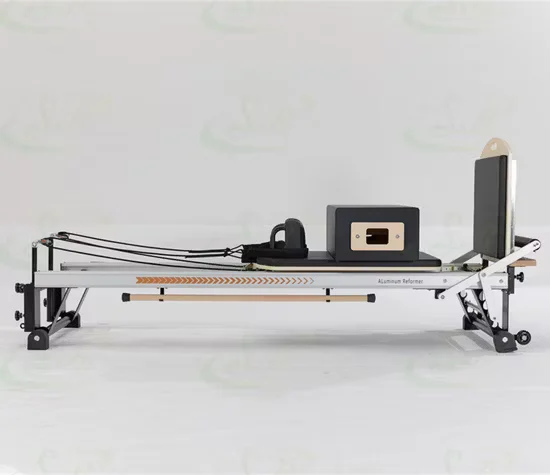
Aluminum Pilates Reformer, 2570×730×1100 mm, 110 kg, with Long Box, Jump Board, Platform — aircraft-grade aluminum alloy frame eliminates moisture warping and wood splitting common in high-traffic studios, maintaining carriage rail flatness for smooth glide over years of daily use. Sealed bearing pulleys and reinforced spring resistance deliver consistent tension across 8+ hours of commercial operation. Direct from a 15,000㎡ integrated factory with 17 years of manufacturing heritage, full OEM branding and custom color options available.
// Spec Highlights
• Direct from Manufacturer · No Middlemen · Worldwide Shipping
01
// Material
Imported Solid Wood
Premium hardwood frames sourced for density and visual warmth.
02
// Hardware
Medical-Grade Silent
Whisper-quiet pulleys and springs for clinical environments.
03
// Customization
Appearance OEM
Color, upholstery, and branding tailored to your studio.
04
// Service
Layout Design
Free venue planning for studios and rehab institutions.
Every component is selected for longevity, performance, and aesthetic harmony - from imported hardwood frames to silent medical-grade accessories.
// Features
Structural Aluminum Integrity — Every alloy extrusion is batch-traced to the mill certificate before it enters our CNC line.
| Parameter | Value |
|---|---|
| Product Type | Pilates Reformer |
| Frame Material | Aluminium Alloy |
| Frame Color | Black (custom colors available) |
| Product Dimensions | 2570 × 730 × 1100 mm |
| Net Weight | 110 kg |
| Standard Accessories | Long Box, Jump Board, Platform |
| Upholstery | Standard commercial-grade vinyl (high-density options available) |
| Logo & Branding | Custom logo application allowed |
| Target User | Adult, Unisex |
| Warranty | 3 Years |
| Facility Type | Typical Use |
|---|---|
| Commercial Pilates studio | Group class reformer stations, private sessions |
| Gym mind-body zone | Complement to strength floor for mobility and core programming |
| Rehabilitation and physiotherapy center | Low-impact resisted movement for injury recovery |
| Hotel and resort wellness facility | Premium guest class offering in spa or fitness suite |
A reformer that stays flat after ten thousand carriage cycles is a structural decision, not a cosmetic one.
Most studio owners have seen it: a wooden-frame reformer that looks beautiful on day one develops rail misalignment within months of eight-hour daily scheduling. The wood swells with humidity, contracts in dry winter air, and the carriage begins to bind or drift off-track. The soft cover splits at the shoulder block contact point, and replacement parts are unavailable because the original manufacturer sources frames from a woodworking shop with no engineering drawings. In a commercial aluminum pilates reformer, the alloy extrusion does not absorb moisture, does not warp, and holds its rail plane within machining tolerance for the life of the unit [NEED_CITE: dimensional stability of extruded aluminum under cyclic loading in humid environments].
The reformer covers sagittal-plane resisted movement across the full kinetic chain — hip flexion, spinal articulation, shoulder stabilization, and ankle mobility in a single station. In a studio layout, it pairs with the cadillac for supine and hanging work, and with the chair for upright load-bearing patterns, completing the classical apparatus triad. A commercial aluminum pilates reformer fits facilities running four to eight classes per day, and its 730 mm width accommodates users from petite to above-average stature when paired with adjustable rope and spring anchor points.
Every carriage return generates an impact load at the stopper — hundreds of times per class, multiple classes per day. Over a year that accumulates into tens of thousands of low-velocity impact cycles concentrated at the carriage end-cap and the frame rail terminus. The aluminum extrusion must resist micro-cracking at the mounting holes, while the carriage wheels and their bearings must maintain smooth rolling contact without developing lateral play. Upholstery at the shoulder blocks and headrest compresses under body weight roughly six to eight hours daily, and sweat plus cleaning solvents attack the vinyl surface continuously [NEED_CITE: fatigue performance of aluminum extrusions under repeated low-velocity impact].
The alloy grade determines whether the extrusion resists deflection when a 90 kg user performs a full long-box stretch at maximum spring tension. A structural-grade aluminum profile maintains its cross-section geometry under load, keeping the rail parallel and the carriage tracking true. The carriage wheel diameter and bearing seal grade dictate how smoothly the glide feels after six months of chalk dust and sweat infiltration — sealed bearings prevent particulate ingress that would otherwise grind the raceway. Upholstery density and foam compression rating decide whether the shoulder block flattens after a season or holds its shape through thousands of sessions. Spring anchor positioning and the number of resistance levels govern how finely an instructor can scale load between a post-surgery client and an advanced practitioner.
A thinner aluminum wall saves material cost at the extrusion stage but allows the rail channel to flex under eccentric loads — the carriage tilts, the glide becomes uneven, and the instructor hears the knock during a quiet class. Non-sealed carriage bearings require quarterly cleaning and re-lubrication in a busy studio, pulling the reformer off the schedule and costing revenue per hour of downtime. Low-density foam in the shoulder blocks compresses permanently within months, forcing a full upholstery replacement that costs more than the original savings on foam grade. Thin vinyl without a commercial tear rating splits at the stitching line under daily strap tension, and if the manufacturer no longer stocks replacement covers, the entire reformer sits idle [NEED_CITE: lifecycle cost comparison of commercial-grade versus light-duty upholstery in fitness environments].
The aluminum extrusions are sourced with mill-certified material documentation, so alloy composition is traceable to the production coil. Every weld joint on the accessory mounting brackets is completed by robotic MIG for continuous penetration — no spot-weld shortcuts that crack under jump board impact. Each unit undergoes a load test with the carriage driven through full travel under weighted conditions before packing. The 200 μm powder-coated finish on all steel hardware resists sweat corrosion and cleaning-agent attack for years. A three-year frame warranty backs the structural claim, and OEM branding — custom color, logo placement, and upholstery spec — is handled in-house. Studio layout CAD files are available so reformer spacing, instructor walkways, and wall-mount storage can be planned before equipment arrives.
Provide your studio floor dimensions and target station count to receive a 2D-3D layout showing reformer placement with safe instructor corridors. Specify your daily class schedule and average user profile so we can confirm the spring resistance range and accessory configuration match your programming. Submit branding requirements — frame color, logo position, upholstery grade — for a production-ready mockup before order confirmation.
Q: How does an aluminum-frame reformer compare to wood in a commercial studio setting?
A: Aluminum does not absorb moisture or expand with humidity changes, so the rail stays flat and the carriage glides consistently through seasonal shifts. Wood frames can warp or crack under daily commercial scheduling, leading to rail misalignment and carriage binding that requires workshop intervention. An aluminum frame maintains its machining tolerance over years of high-frequency use, reducing maintenance downtime and keeping class schedules intact.
Q: What should I check to evaluate carriage glide quality before committing to a purchase?
A: Request a rail flatness tolerance report and ask whether carriage wheels use sealed bearings. Run the carriage through full travel with a weighted load and listen for knocking or uneven resistance. Check the wheel-to-rail contact pattern — it should be centered and consistent across the entire stroke length. Sealed bearings resist dust and sweat infiltration, extending service intervals in a busy studio environment.
Q: Are third-party accessories compatible with this reformer’s attachment points?
A: The long box, jump board, and platform included with the unit use standardized mounting interfaces machined into the aluminum frame. Third-party accessories may fit if their mounting geometry matches, but tolerance mismatches can create wobble or unsafe play during dynamic movements. We recommend confirming attachment dimensions against the provided CAD drawing before sourcing non-original components to ensure safe, rattle-free operation.
Q: How often does commercial-grade upholstery need replacement on a reformer?
A: Upholstery lifespan depends on foam density and vinyl tear rating relative to daily session volume. In studios running six or more hours of classes daily, standard-density foam may compress and require replacement sooner, while high-density options maintain their shape through significantly longer service periods. Replacement covers are available as spare parts, and swapping them is a straightforward on-site task that does not require specialized tools.
Q: What floor spacing is needed between reformers for safe group class operation?
A: Plan a minimum of 900 mm between adjacent reformer frames to allow the instructor to walk through and cue participants safely. At the head and foot ends, allow enough room for users to mount and dismount without stepping onto neighboring equipment. Providing the studio dimensions enables us to generate a layout showing exact station count, instructor pathways, and emergency egress routes compliant with local facility regulations.
Premium aesthetics meet quiet operation for boutique studio environments.
Medical-grade silence and precision for sports & postpartum recovery.
Furniture-grade craftsmanship for premium residential installations.
Compact premium setups for one-on-one and small-group training.
Aesthetic Pilates integration for hybrid wellness studio programming.
Multi-unit deployment with instructor-grade reliability for certification programs.
Tell us about your project. Our team will respond within 24 hours with pricing, customization options, and shipping details.
// Sales Director
William
+86 132 2531 1800
// Export Manager
Bella
+86 198 5412 8032
william@bickfit.com


