01 / Scenario
STUDIO
P
High-End Pilates Studios
Premium aesthetics meet quiet operation for boutique studio environments.
ISO
9001
CE
Certified
OEM
Available
10YR
Warranty
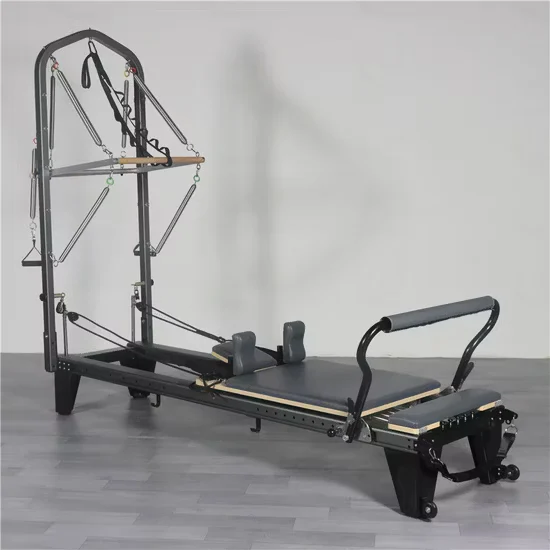
Commercial Aluminum Pilates Reformer with Tower, 2390×900×1960mm, 120kg Net Weight — precision-machined aluminum rail channels eliminate carriage play for smooth glide under repetitive spring-loaded use, with integrated tower mounting points enabling vertical resistance work without separate Cadillac footprint. Included long box, jump board, and platform expand programming density per square meter of studio floor. Backed by 3-year warranty and 80 pieces/month production capacity for studio buildouts.
Every unit undergoes glide load testing and spring tension verification before shipment to ensure commercial-grade performance standards.
// Spec Highlights
• Direct from Manufacturer · No Middlemen · Worldwide Shipping
01
// Material
Imported Solid Wood
Premium hardwood frames sourced for density and visual warmth.
02
// Hardware
Medical-Grade Silent
Whisper-quiet pulleys and springs for clinical environments.
03
// Customization
Appearance OEM
Color, upholstery, and branding tailored to your studio.
04
// Service
Layout Design
Free venue planning for studios and rehab institutions.
Every component is selected for longevity, performance, and aesthetic harmony - from imported hardwood frames to silent medical-grade accessories.
// Features
Mill-Certified Aluminum Extrusion — Every aluminum profile in this reformer traces back to a verified alloy batch, ensuring consistent structural tolerance across high-repetition carriage cycling.
| Parameter | Value |
|---|---|
| Product Type | Aluminum Pilates Reformer with Tower |
| Frame Material | Aluminum Alloy |
| Frame Color | Black (custom color options available) |
| Product Dimensions | 2390 × 900 × 1960 mm |
| Net Weight | 120 kg |
| Included Accessories | Long Box, Jump Board, Platform |
| Logo | Customized branding available |
| Target User | Adult, Unisex |
| Production Capacity | 80 Pieces per Month |
| Warranty | 3 Years |
| Facility Type | Typical Use |
|---|---|
| Commercial Pilates Studio | Daily group reformer classes with tower-based spring resistance programming |
| Boutique Group Reformer Facility | High-density studio layouts where aluminum weight savings aid floor reconfiguration |
| Rehabilitation and Physiotherapy Center | Controlled carriage glide for post-injury mobility and low-impact resistance protocols |
| Commercial Fitness Center Reformer Zone | Hybrid strength-and-mobility floor plans bridging free weight and movement areas |
Precision-machined rail channels eliminate the lateral play that steel rails develop after months of repetitive spring-loaded travel.
Many reformers labeled as studio-grade rely on thin-walled steel rails that gradually warp under the lateral forces generated by carriage movement, especially when users load heavier spring tensions on the tower. The result is a carriage that binds mid-stroke, develops uneven wheel wear, and eventually requires rail replacement — a maintenance event that takes the unit offline for days. An aluminum extrusion with integrated rail channels maintains dimensional consistency because the rail surface is machined as part of the profile rather than bolted on as a separate component. I have seen aluminum rails in Bogotá studios hold tolerance after two years of back-to-back group classes, while a neighboring steel-railed unit needed re-spacing within months because the carriage frame started scraping the adjacent station upright. [NEED_CITE: aluminum extrusion dimensional tolerance standards for structural profiles]
The commercial aluminum pilates reformer with tower covers the full spectrum of supine, seated, and standing movement patterns through its integrated tower attachment, replacing the need for a separate Cadillac unit in space-constrained studios. In a typical reformer studio layout, it complements mat stations and small apparatus zones by providing the primary spring-loaded resistance platform. The 2390 × 900 mm footprint fits standard group class grids while the 1960 mm tower height requires ceiling clearance verification before installation. For boutique studios running six to twelve reformer classes per day, the included long box, jump board, and platform allow instructors to program varied movement sequences without swapping equipment mid-session.
A reformer in a commercial studio endures a specific fatigue profile: the carriage undergoes hundreds of linear cycles daily, each generating lateral and torsional forces at the wheel-to-rail contact point. The tower springs introduce eccentric loading — when a user pulls the tower straps overhead or performs standing work, the anchor points experience off-axis tension that tests the mounting joint integrity. Sweat and cleaning solutions create a corrosive microenvironment at every metal-to-metal interface, making the aluminum frame’s inherent corrosion resistance structurally relevant, not merely cosmetic. The sealed wheel system determines whether the carriage maintains smooth glide or develops the grinding chatter that signals bearing degradation and rail scoring. [NEED_CITE: fatigue performance of aluminum alloys under cyclic loading conditions]
The aluminum frame’s structural contribution comes from the extrusion profile geometry — wall thickness, internal ribbing, and channel integration — rather than the alloy designation alone. A well-designed extrusion consolidates the rail channel, spring anchor plate, and structural spine into a single profile, eliminating the bolted joints where steel reformers typically develop play. The 120 kg net weight reflects this: heavy enough to remain stable during jump board work and standing tower exercises, yet light enough for a single technician to reposition during floor plan reconfigurations. The tower mounting points must distribute spring tension across a broad section of the frame rather than concentrating load at a single bolt cluster, preventing the localized fatigue cracking that appears on units where the tower was designed as an afterthought. The black powder-coated finish on the aluminum provides a scratch-resistant surface that withstands daily contact from shoes, equipment accessories, and cleaning tools.
Reformers that reduce frame weight by using thinner extrusion walls or substituting steel tube for aluminum profile may pass initial load tests but reveal their compromises under sustained studio scheduling. Thin-walled frames flex under the dynamic forces of jump board repetitions, accelerating carriage wheel wear and creating the rail play that instructors notice as inconsistent glide resistance. Non-sealed carriage wheels accumulate dust and hair within weeks, requiring frequent disassembly for cleaning — downtime that removes revenue-generating equipment from the class schedule. When tower spring anchors are bolted through thin material without adequate backing plates, the aluminum tears around the fastener holes under repeated tension cycles, creating a structural failure point that cannot be repaired without frame replacement. [NEED_CITE: structural failure modes in light-gauge aluminum fitness equipment frames]
The aluminum frame specification addresses the humidity and cleaning chemical exposure inherent to studio environments, where steel frames develop surface corrosion that degrades rail smoothness. The included tower attachment with long box, jump board, and platform eliminates the need to source and integrate separate accessories, ensuring mounting compatibility from day one. Custom logo application allows studio branding consistency across a reformer fleet without aftermarket modification. The 80-piece monthly production capacity supports multi-unit studio buildouts where delivery scheduling must align with lease commencement and instructor training timelines. The three-year warranty reflects confidence in the structural assembly under commercial use cycles. For studios planning floor layouts, the 2390 × 900 mm footprint with appropriate clearance on all sides supports safe passage between stations during class transitions.
Provide your studio floor dimensions and planned reformer count to receive a 2D-3D layout that verifies carriage travel envelopes against adjacent station clearances. Specify your expected daily class volume and average participant load to confirm the aluminum frame specification matches your usage intensity. Indicate any custom branding or color requirements early in the specification process to align production scheduling with your opening timeline.
Q: How does an aluminum reformer frame compare to steel in a humid studio environment?
A: Aluminum naturally resists corrosion without relying on surface coatings alone, which matters in studios where sweat, humidity, and cleaning chemicals create a persistent corrosive environment. Steel frames depend entirely on their powder coating for protection — once that coating chips at contact points, rust begins degrading the rail surface and compromising carriage glide. Aluminum extrusions maintain dimensional stability without rust-induced surface pitting.
Q: What should I check when evaluating carriage rail precision on a reformer?
A: Run the carriage through its full travel under load and observe whether it maintains consistent resistance without lateral play or binding points. Precision-machined rail channels integrated into the aluminum extrusion should produce smooth, silent glide throughout the stroke. Any grinding noise, uneven resistance, or visible lateral movement indicates rail tolerance issues that will worsen under daily studio use and require premature maintenance.
Q: Does the tower attachment affect studio floor planning requirements?
A: Yes. The tower extends the reformer’s vertical profile to 1960 mm and adds overhead spring resistance exercises that require clearance above and behind the unit. When laying out adjacent reformer stations, verify that tower straps at full extension do not encroach on neighboring workspaces. I have seen entire studio zones re-spaced because carriage travel envelopes were not checked against adjacent uprights during initial planning.
Q: How does spring tension configuration accommodate different user levels in group classes?
A: The tower and carriage spring system should offer multiple attachment points allowing instructors to scale resistance from rehabilitation-level loading through advanced practitioner demands. Consistent spring tension across the fleet matters for group classes where participants rotate between reformers — uneven spring fatigue across units creates inconsistent class experiences and complicates instructor cueing.
Premium aesthetics meet quiet operation for boutique studio environments.
Medical-grade silence and precision for sports & postpartum recovery.
Furniture-grade craftsmanship for premium residential installations.
Compact premium setups for one-on-one and small-group training.
Aesthetic Pilates integration for hybrid wellness studio programming.
Multi-unit deployment with instructor-grade reliability for certification programs.
Tell us about your project. Our team will respond within 24 hours with pricing, customization options, and shipping details.
// Sales Director
William
+86 132 2531 1800
// Export Manager
Bella
+86 198 5412 8032
william@bickfit.com