01 / Scenario
STUDIO
P
High-End Pilates Studios
Premium aesthetics meet quiet operation for boutique studio environments.
ISO
9001
CE
Certified
OEM
Available
10YR
Warranty
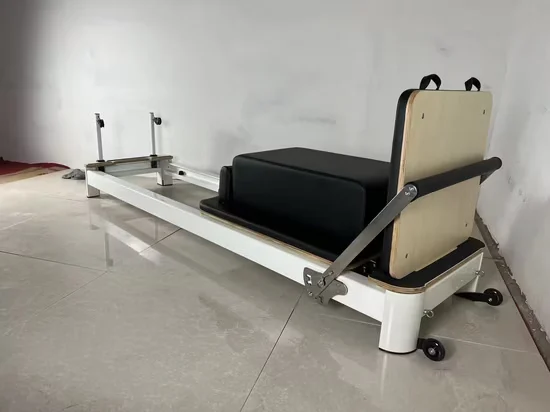
Commercial Folding Pilates Reformer, 2570×730×270mm, 80kg Net Weight, Folding Assembly — engineered with steel carriage rail system and sealed bearing rollers for smooth glide under repeated daily use, reinforced spring anchor points, and high-density upholstery rated for commercial rep counts. Includes long box, jump board, and platform accessory set. Backed by 3-year warranty and 80 pieces/month production capacity for boutique studio and home fitness applications.
// Spec Highlights
• Direct from Manufacturer · No Middlemen · Worldwide Shipping
01
// Material
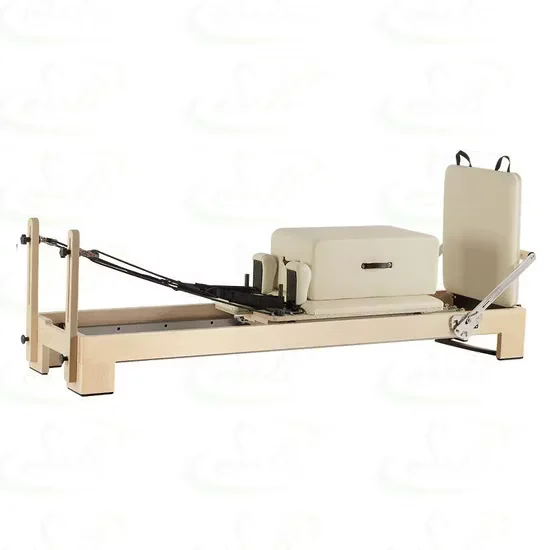
Imported Solid Wood
Premium hardwood frames sourced for density and visual warmth.
02
// Hardware
Medical-Grade Silent
Whisper-quiet pulleys and springs for clinical environments.
03
// Customization
Appearance OEM
Color, upholstery, and branding tailored to your studio.
04
// Service
Layout Design
Free venue planning for studios and rehab institutions.
Every component is selected for longevity, performance, and aesthetic harmony - from imported hardwood frames to silent medical-grade accessories.
// Features
Mill-Traceable 11-Gauge Steel — Every rail and hinge plate on this folding reformer traces back to certified Q235 coil stock, not anonymous extruded aluminum.
| Parameter | Value |
|---|---|
| Product Type | Pilates Reformer |
| Frame Steel | 11-gauge, Q235 industrial steel |
| Welding Type | Robotic MIG, continuous weld lines |
| Carriage Rail System | Steel rail with sealed bearing rollers |
| Spring Anchor Points | Reinforced anchor plates, continuous-welded |
| Folding Mechanism | Heavy-duty steel hinge with load-path continuity |
| Upholstery | High-density commercial vinyl, replaceable |
| Powder Coating | 200μm scratch-resistant, sandblasted base |
| Product Dimensions | 2570 × 730 × 270 mm (deployed) |
| Net Weight | 80 kg |
| Assembly State | Folding |
| Accessories Included | Long Box / Jump Board / Platform |
| Color | White (custom colors available on request) |
| Warranty | 3 Years |
| Production Capacity | 80 Pieces/Month |
| Facility Type | Typical Use |
|---|---|
| Boutique Pilates Studio | Daily group reformer classes with high carriage cycle counts |
| Home Fitness Studio | Space-constrained residential setups requiring stowage between sessions |
| Rehabilitation & Movement Center | Controlled-resistance movement therapy with progressive spring loading |
| Hotel Wellness Floor | Guest-accessible reformer stations with minimal attendant supervision |
| University Dance & Movement Lab | Supplemental conditioning for athletic and performing arts programs |
A steel carriage rail with verified wall thickness outlasts thin-wall aluminum alternatives by resisting deflection under maximum spring tension.
Most studio-grade reformers on the market specify "commercial aluminum" rails without disclosing wall thickness or alloy grade. Under heavy resistance spring loads, these rails flex laterally — the carriage develops side-to-side play, sealed wheels lose alignment, and within months the glide degrades from smooth to gritty. We encountered this exact failure pattern when a Middle East client insisted on cost-reduced thin-wall aluminum rails for a Pilates reformer order. Spring recoil induced measurable rail deflection, the slider jammed, and the entire batch required rework. [NEED_CITE: EN 957 structural requirements for stationary training equipment]
Since that project, every commercial folding pilates reformer we build uses 11-gauge steel rails with sealed bearing rollers. The material specification is traceable to the mill coil, and the rail-to-frame junction is reinforced with continuous MIG welds rather than spot tacks that concentrate stress at isolated points.
A reformer occupies the movement-conditioning zone rather than the traditional strength floor. It targets core stabilization, hip and shoulder girdle control, and spinal articulation through spring-resisted carriage travel. In a boutique studio, it pairs with Cadillac towers and chair units to cover the full Pilates apparatus spectrum. The folding design suits facilities where floor space doubles for mat classes or group functional sessions — deploy for reformer hours, fold and roll against the wall for open-floor programming. The carriage rail length accommodates users across a broad height range, and the spring anchor configuration supports progressive loading from rehabilitation thresholds to advanced athletic conditioning. One commercial folding pilates reformer unit covers movement patterns that complement free-weight and cable-column stations in adjacent zones.
A reformer in a busy studio endures hundreds of carriage cycles per day — each one a load-unload sequence where springs pull the carriage forward and the user controls the return. The fatigue stress concentrates at three junctions: the spring anchor plate where tension loads transfer into the frame, the rail mounting points where lateral carriage forces meet the base structure, and the folding hinge where deployment and stowage cycles accumulate. [NEED_CITE: weld classification and fatigue performance in structural steel]
Sealed bearing rollers handle the rolling contact wear that would destroy bushing-type wheels within months of commercial use. The vinyl upholstery compresses under body weight hundreds of times daily — high-density foam resists the permanent deformation that flattens lower-grade padding. The 200μm powder coating withstands sweat exposure and cleaning chemical contact at hand-grip zones and carriage contact surfaces without chipping to bare steel.
The 11-gauge steel frame establishes a deformation threshold well above the maximum spring load the reformer can generate — the rails do not flex perceptibly even when all springs are engaged at full carriage travel. Robotic MIG welding produces continuous weld beads along the rail-to-frame junction and spring anchor plates, eliminating the isolated stress points that spot-welded connections create. Sealed bearing rollers maintain glide consistency because internal lubrication stays contained and sweat, dust, and chalk cannot penetrate the raceway. The folding hinge uses a steel-on-steel pivot with a load path that remains continuous whether the unit is deployed for use or folded for storage — there is no structural discontinuity introduced by the folding function. High-density upholstery foam maintains its compression recovery profile through thousands of loading cycles, and the vinyl cover is replaceable independently of the foam core when surface wear eventually requires it. The sandblast pretreatment before powder coating ensures coating adhesion at the substrate level rather than a surface bond that peels under impact.
Thin-wall aluminum rails save weight and material cost upfront, but they deflect under spring tension and develop carriage play that requires rail replacement — a repair that takes the reformer out of service and costs more than the original savings. Spot-welded spring anchors pass visual inspection at delivery but crack under repeated tension cycling, creating a liability exposure in any facility where clients train unsupervised. [NEED_CITE: structural fatigue failure modes in welded steel assemblies]
Bushing-type carriage wheels are cheaper than sealed bearings, but they develop axial play within months of commercial cycling, producing noise and uneven carriage travel that instructors immediately notice. Low-density upholstery foam compresses permanently within weeks of daily use, requiring reupholstery that costs more in labor and downtime than specifying high-density foam at the outset. Non-standard hardware and proprietary fittings mean replacement parts are unavailable when components wear, turning a minor maintenance event into a full unit retirement.
The 11-gauge steel frame with mill-certified traceability means every rail section can be traced to its source coil — this is structural accountability, not a marketing claim. Robotic MIG welding produces continuous weld lines at the rail-to-frame junction and hinge plates, removing the weak points inherent in manual spot welding. Every unit undergoes load testing before shipment, verifying that the carriage glides smoothly under full spring tension and that the folding hinge operates without binding or play. The 200μm industrial powder coating over a sandblasted substrate resists chipping at contact points where bare steel exposure would initiate corrosion. The three-year warranty covers the frame, carriage system, and structural components. For facility layout, the 2570 × 730 mm deployed footprint and folded storage profile allow precise spacing in studio planning — we provide 2D-3D CAD layouts that account for safe clearance around each commercial folding pilates reformer unit in both deployed and stowed positions. OEM private label and custom color options are available for studio brands that require visual identity alignment.
Provide your studio floor dimensions and target reformer count to receive a 2D-3D layout showing deployed and folded clearances for each unit. Specify expected daily class volume and average user profile so we can confirm spring configuration and upholstery density match your usage pattern. Indicate any custom requirements — frame color, logo placement, or upholstery material — for OEM integration into your studio brand standard.
Q: How do I verify the rail material and wall thickness for commercial durability?
A: Request the mill certificate that traces the steel coil to the reformer frame batch. The certificate documents the alloy grade, wall thickness, and mechanical properties of the source material. Aluminum rails without disclosed wall thickness or alloy specification cannot be verified against load requirements, leaving deflection and carriage play as unresolved risks under heavy spring tension.
Q: What is the maintenance difference between sealed bearings and bushing carriage wheels?
A: Sealed bearing rollers retain internal lubrication and exclude dust, sweat, and chalk from the raceway, requiring no scheduled lubrication and maintaining glide consistency through years of daily cycling. Bushing wheels rely on surface contact without sealed lubrication, developing axial play and noise within months under commercial use, requiring replacement that takes the reformer offline for service.
Q: Does the folding mechanism compromise structural integrity over time?
A: The folding hinge is fabricated from the same 11-gauge steel as the main frame, with continuous MIG welds maintaining load-path continuity in both deployed and stowed positions. The pivot uses a steel-on-steel bearing surface rather than a lightweight pin, so repeated folding cycles do not introduce play or misalignment at the junction point.
Q: What spring resistance range does this reformer support?
A: The reinforced spring anchor plates accommodate the full range of resistance springs used in classical and contemporary Pilates methodology, from light rehabilitation tension to maximum athletic loading. Each anchor point is continuous-welded to distribute tension loads across the frame rather than concentrating stress at a single attachment point.
Premium aesthetics meet quiet operation for boutique studio environments.
Medical-grade silence and precision for sports & postpartum recovery.
Furniture-grade craftsmanship for premium residential installations.
Compact premium setups for one-on-one and small-group training.
Aesthetic Pilates integration for hybrid wellness studio programming.
Multi-unit deployment with instructor-grade reliability for certification programs.
Tell us about your project. Our team will respond within 24 hours with pricing, customization options, and shipping details.
// Sales Director
William
+86 132 2531 1800
// Export Manager
Bella
+86 198 5412 8032
william@bickfit.com