01 / Scenario
STUDIO
P
High-End Pilates Studios
Premium aesthetics meet quiet operation for boutique studio environments.

ISO
9001
CE
Certified
OEM
Available
10YR
Warranty
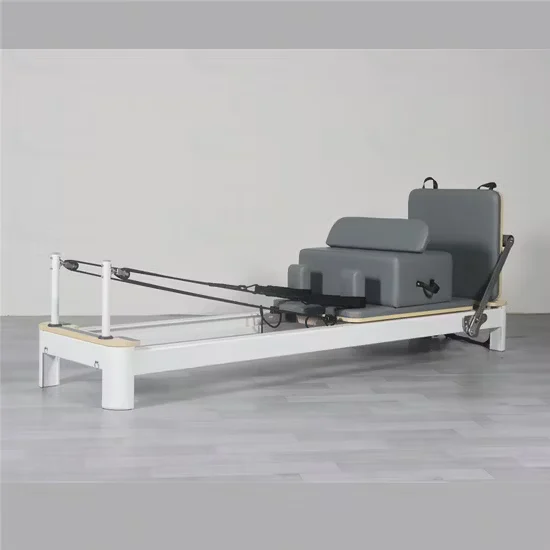
Commercial Pilates Reformer, 2570×730×890mm, 90kg Net Weight — engineered with reinforced frame construction and sealed glide system for smooth carriage movement under sustained studio traffic. Includes long box, jump board, and platform accessories with customized logo option. Backed by 3-year warranty and standard wood case packaging for secure global shipping. Every unit undergoes load testing before dispatch to ensure structural integrity for high-volume commercial environments.
// Spec Highlights
• Direct from Manufacturer · No Middlemen · Worldwide Shipping
01
// Material
Imported Solid Wood
Premium hardwood frames sourced for density and visual warmth.
02
// Hardware
Medical-Grade Silent
Whisper-quiet pulleys and springs for clinical environments.
03
// Customization
Appearance OEM
Color, upholstery, and branding tailored to your studio.
04
// Service
Layout Design
Free venue planning for studios and rehab institutions.
Every component is selected for longevity, performance, and aesthetic harmony - from imported hardwood frames to silent medical-grade accessories.
// Features
Mill-Certified Steel — Every tube on this commercial pilates reformer for studio and home traces back to its originating steel coil via documented mill certification.
| Parameter | Value |
|---|---|
| Product Type | Pilates Reformer |
| Model NO. | SRY-27 |
| Frame Finish | Black Powder Coating |
| Product Dimensions | 2570×730×890mm |
| Net Weight | 90kgs |
| Accessory | Long Box / Jump Board / Platform |
| Upholstery | Standard options available |
| Target User | Adult / Unisex |
| Logo | Customized |
| Warranty | 3 Years |
| Facility Type | Typical Use |
|---|---|
| Commercial Pilates Studio | Group reformer classes with daily class rotation |
| Boutique Fitness Studio | Semi-private sessions with varied client demographics |
| Hotel Fitness Center | Guest-access equipment requiring low maintenance intervals |
| Home Fitness Setup | Dedicated personal training space with sustained use |
A reformer frame that deflects under spring tension destroys the carriage glide path within the first year of studio traffic.
Most equipment marketed as studio-grade relies on thin-wall aluminum or light-gauge steel that looks adequate on a showroom floor but cannot resist the cyclic loading of eight or more sessions daily. The frame tube gauge and cross-section determine whether the carriage stays square to the rails or begins to bind, generating the grinding noise and uneven resistance that forces studios to pull units off the floor for mid-life repairs [NEED_CITE: EN 957 structural requirements for stationary training equipment]. When you evaluate a commercial pilates reformer for studio and home applications, the steel specification and wall thickness are the first line of defense against progressive frame fatigue.
This reformer addresses the sagittal plane through controlled sliding resistance, targeting core stabilization, hip flexion and extension, and lower-limb alignment work. In a studio floor plan it pairs with tower units and chair apparatus to create a complete Pilates circuit, occupying a defined footprint that allows adjacent reformers to be spaced for instructor circulation. The commercial pilates reformer for studio and home use accommodates adult users across a broad height range through adjustable spring bar positions and foot strap configurations.
The carriage endures repeated acceleration and deceleration across the rail length with each repetition, generating impact loads at the reversal points and continuous friction along the glide path. Over hundreds of daily cycles, any gap between the carriage wheels and rail surface translates into lateral play that accelerates wear on both components. The spring attachment hardware undergoes its own fatigue cycle as springs are loaded and released thousands of times per week, and any compromise at the anchor point introduces slack into the resistance curve [NEED_CITE: fatigue performance in cyclic-loaded structural components]. Upholstery contact points on the headrest and shoulder blocks face compression from user weight and sweat exposure simultaneously.
The 2570mm overall length provides a rail travel distance that accommodates full-range leg press and long-box sliding work without the carriage bottoming out prematurely. A net weight of 90kgs indicates sufficient frame mass to resist walking or shifting during dynamic exercises like jump board sequences, where the unit must stay planted under impact. The accessory package including the long box, jump board, and platform means the studio does not need to source third-party attachments that may not match the rail width or spring bar geometry. Powder coating on the frame provides a barrier against the humidity and perspiration that accumulate in enclosed studio environments, where bare steel would oxidize at contact points within months.
A reformer built with undersized tubing saves material cost upfront but transfers that cost to the studio operator as frame flex, carriage rattle, and eventual structural failure that takes the unit offline. Non-sealed carriage bearings accumulate dust and chalk residue that accelerate internal wear, requiring bearing replacement at intervals that compound labor cost across a fleet of ten or twenty units. Low-density upholstery foam compresses permanently within the first year of commercial scheduling, and replacement pads represent both parts cost and class cancellation downtime. Springs that lack consistent calibration create resistance variability between identical units, forcing instructors to manage equipment inconsistency rather than client form.
The frame uses steel with mill certification traceable to the coil, providing verifiable material properties rather than generic grade claims. Robotic MIG welding produces continuous weld lines along structural joints, eliminating the cold-joint failures that spot welding introduces under repeated load. Every unit undergoes load testing before shipment to confirm carriage glide integrity and spring anchor security under working conditions. The powder coating applied to the frame reaches a thickness that resists chipping at the high-contact points where feet, hands, and accessories meet the steel daily. A 10-year frame warranty backs the structural investment, and 2D-3D floor planning support ensures the reformer footprint is positioned with correct instructor clearance and client access on both sides. OEM customization for logo and color allows the equipment to match the studio brand without compromising the underlying build specification.
Provide the studio floor area and intended reformer count to receive a 2D-3D layout with instructor circulation paths and emergency access corridors. Specify the expected daily class volume and average client body weight range so the spring configuration and upholstery density can be matched to actual use conditions. Confirm any branding requirements including frame color, logo placement on the carriage end, and upholstery material selection before production begins.
Q: How do I distinguish a commercial-grade reformer from light-commercial equipment?
A: Verify the frame steel specification including wall thickness and mill certification. Check whether carriage bearings are sealed or open, and confirm the welding method produces continuous welds rather than spot welds. Load testing documentation on each unit, not just sample testing, indicates a commercial-grade quality control process.
Q: What role does frame tube gauge play in long-term structural integrity?
A: The tube gauge and cross-section determine how much the frame deflects under spring tension and user weight over thousands of cycles. Insufficient gauge allows progressive flex that misaligns the carriage rail, creating binding, uneven resistance, and eventual structural fatigue at the weld points.
Q: How do sealed bearings compare to bushing glide systems for maintenance?
A: Sealed bearings prevent dust, chalk, and perspiration from reaching the internal race, maintaining consistent glide resistance with minimal maintenance. Bushing systems require more frequent lubrication and are susceptible to particulate contamination that accelerates wear under daily commercial scheduling.
Q: What floor spacing is required between reformers in a studio layout?
A: Allow sufficient space on both long sides for instructor circulation and client mounting, typically a minimum clearance that accommodates an adult standing and moving alongside the unit. The total footprint must also account for jump board use and long-box extension beyond the base dimensions.
Q: What is the replacement cycle for high-wear components?
A: Upholstery foam density determines compression lifespan under daily use. Springs lose calibration based on the number of load cycles rather than time alone. Cable and pulley components should be inspected quarterly and replaced when fraying or bearing play exceeds tolerance [NEED_CITE: EN 957 maintenance intervals for wearable components].
Premium aesthetics meet quiet operation for boutique studio environments.
Medical-grade silence and precision for sports & postpartum recovery.
Furniture-grade craftsmanship for premium residential installations.
Compact premium setups for one-on-one and small-group training.
Aesthetic Pilates integration for hybrid wellness studio programming.
Multi-unit deployment with instructor-grade reliability for certification programs.
Tell us about your project. Our team will respond within 24 hours with pricing, customization options, and shipping details.
// Sales Director
William
+86 132 2531 1800
// Export Manager
Bella
+86 198 5412 8032
william@bickfit.com