01 / Scenario
STUDIO
P
High-End Pilates Studios
Premium aesthetics meet quiet operation for boutique studio environments.

ISO
9001
CE
Certified
OEM
Available
10YR
Warranty
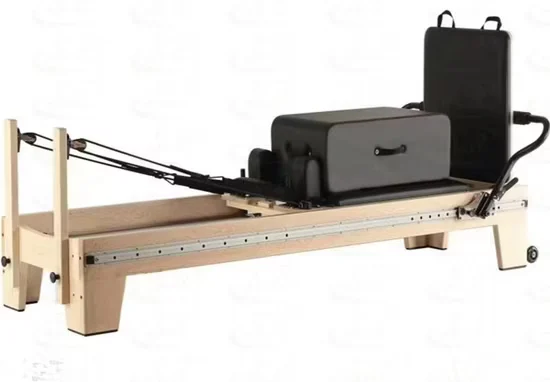
Pilates Reformer, 2570×730×1100mm, 110kg Net Weight — engineered with reinforced aluminium frame and sealed carriage system for smooth, wobble-free travel across high-traffic studio sessions. Includes long box, jump board, and platform as standard, eliminating aftermarket add-ons for complete programming from day one. Backed by 3-year warranty and 80-piece monthly production capacity for scalable studio rollouts.
// Spec Highlights
• Direct from Manufacturer · No Middlemen · Worldwide Shipping
01
// Material
Imported Solid Wood
Premium hardwood frames sourced for density and visual warmth.
02
// Hardware
Medical-Grade Silent
Whisper-quiet pulleys and springs for clinical environments.
03
// Customization
Appearance OEM
Color, upholstery, and branding tailored to your studio.
04
// Service
Layout Design
Free venue planning for studios and rehab institutions.
Every component is selected for longevity, performance, and aesthetic harmony - from imported hardwood frames to silent medical-grade accessories.
// Features
Continuous Welded Rails — Aluminium carriage rails TIG-welded in continuous passes eliminate the micro-deformation and slider misalignment that plague spot-welded joints within months of studio use.
| Parameter | Value |
|---|---|
| Product Type | Pilates Reformer |
| Model NO. | SRY-27 |
| Frame Construction | Aluminium alloy with reinforced carriage channel |
| Carriage System | Sealed bearing wheels on precision aluminium rail |
| Overall Dimensions | 2570 × 730 × 1100 mm |
| Net Weight | 110 kg |
| Included Accessories | Long Box, Jump Board, Platform |
| Upholstery | Commercial-grade vinyl, standard or high-density options |
| Logo | Customized is allowed |
| Warranty | 3 Years |
| Facility Type | Typical Use |
|---|---|
| Commercial Pilates studio | Group reformer classes with high turnover between sessions |
| Yoga and barre studio | Cross-modality programming combining reformer with mat work |
| Rehabilitation and conditioning center | Post-injury mobility and core stabilization protocols |
| Boutique fitness facility | Small-group personal training with individualized spring loading |
Many units marketed as commercial pilates reformers rely on spot-welded aluminium rail joints to cut assembly time. Under repetitive spring-loaded carriage cycles — hundreds per day in a busy studio — those intermittent welds concentrate stress at discrete points. Within months, micro-deformation appears at the rail seam, the carriage drifts off-axis, and the wheel bearings bind. The result is a rough, unpredictable glide that instructors compensate for by reducing spring tension, limiting exercise range for every client who uses that station. [NEED_CITE: fatigue classification for cyclic loading on aluminium structural joints]
Continuous TIG welds along the full rail length distribute carriage load across the entire joint, not just four or five tack points.
This commercial pilates reformer uses a continuous-weld approach on the aluminium carriage channel, matched to sealed bearing wheels that resist sweat and chalk ingress. The rail tolerance is held tight enough to prevent lateral carriage play while allowing the smooth travel that precision-based cueing demands.
This unit anchors the primary reformer zone in a Pilates studio and pairs with complementary apparatus — cadillacs, chairs, and barrels — to cover all movement planes from supine leg work to standing balance progressions. The included long box, jump board, and platform remove the need for aftermarket add-ons, allowing full programming from day one. In studios running back-to-back group classes, the 2570 × 730 mm footprint fits standard studio grids with adequate clearance for instructor circulation. The commercial pilates reformer accommodates a wide range of user heights and body weights through its spring configuration and upholstery surface.
Each class session places the carriage through hundreds of loaded and unloaded cycles, with peak stress arriving during jump board plyometrics and long box leverage work. The aluminium frame must resist flex at the mid-span under eccentric loading — when a client presses the carriage out and returns slowly against spring resistance. Sealed bearings on the carriage wheels prevent sweat and studio humidity from penetrating the race, which is where open bearings develop play and require frequent servicing. [NEED_CITE: EN 957 structural requirements for stationary training equipment] The vinyl upholstery absorbs repeated compression from client weight and must retain density across sustained daily use without flattening at high-contact zones.
The aluminium alloy frame on this reformer is built around a reinforced carriage channel rather than thin extruded rail. Wall thickness in the channel walls determines how much the frame resists lateral flex when a client loads the carriage asymmetrically — such as during single-leg footwork or standing exercises on the platform. The sealed bearing wheels ride on a precision-machined rail surface, which keeps the carriage tracking straight even after extended use cycles. Spring housing construction affects how resistance feels through the full range of motion: a durable housing maintains consistent spring alignment and prevents the rattle and friction that develop when springs scrape against deformed guides. Upholstery foam density determines whether the surface holds firm through a full day of classes or compresses enough to alter spinal positioning cues for later clients.
Spot-welded rail joints reduce upfront manufacturing cost but shift the expense forward in time. Once a carriage rail deforms at a weld gap, the entire unit goes offline until the rail is replaced — lost class revenue, frustrated clients, and an emergency parts order. Open bearings require regular disassembly and cleaning in humid studio environments, adding maintenance hours that compound across a fleet of reformers. Low-density foam on the carriage and long box compresses within months, forcing upholstery replacement far sooner than a high-density core would demand. [NEED_CITE: bearing service intervals in high-humidity fitness environments] A thin vinyl surface splits at seam lines under daily use, exposing foam to sweat and bacteria — a hygiene concern that clients notice immediately.
The continuous-weld rail approach was adopted after seeing spot-welded aluminium reformers develop carriage misalignment in under six months of studio use. Sealed bearings on this commercial pilates reformer eliminate the routine teardown-and-rebuild cycle that open bearings demand. The 11-gauge steel philosophy from our strength equipment division — traceable material certification, continuous welds, and load testing before shipment — extends directly into how this reformer frame is fabricated and inspected. The 200 μm industrial powder coating process used on our plate-loaded and selectorized lines is applied here to all steel hardware components for corrosion resistance. The three-year warranty reflects confidence in structural longevity under continuous studio scheduling, and OEM logo customization allows branding consistency across a studio’s equipment fleet.
Provide your studio floor dimensions and planned class capacity to receive a 2D or 3D layout showing reformer spacing with instructor circulation paths. Specify your average daily class count to confirm the structural grade matches your usage volume. Indicate any branding or upholstery color preferences so the custom logo and vinyl options align with your studio interior.
Q: How do I distinguish a commercial-grade reformer from a light-commercial one based on frame specs?
A: Request the frame alloy grade and wall thickness documentation. Commercial-grade units specify alloy series and channel dimensions, while light-commercial products often describe the frame vaguely as aluminium without traceable certifications. Also verify whether carriage bearings are sealed — open bearings signal lighter-duty construction unsuitable for high-turnover studio scheduling.
Q: Aluminium versus steel frame on a reformer — what are the trade-offs?
A: Aluminium frames reduce overall unit weight, making reformers easier to reposition during studio reconfiguration. Steel frames offer higher rigidity under eccentric loading and may require less mid-span reinforcement. The choice depends on your studio’s reconfiguration frequency, floor load limits, and whether portability or maximum structural stiffness is the higher priority for your programming.
Q: What accessory inclusions indicate a studio-ready reformer versus a bare unit?
A: A complete studio-ready unit ships with the long box for supine and seated exercises, the jump board for plyometric conditioning, and the platform extension for standing work. Requiring aftermarket purchases for these essentials increases total cost and delays full programming capability after initial delivery.
Q: What are the carriage rail and wheel maintenance intervals in a busy studio?
A: With sealed bearings, the primary maintenance task is visual inspection for rail debris and surface wear every quarter. Wipe rails with a clean cloth and verify smooth carriage travel without lateral play. Open bearings require full disassembly, cleaning, and re-greasing at similar intervals — a task that takes each unit offline for a significant maintenance window.
Q: How often does reformer upholstery need replacement under daily commercial use?
A: Commercial-grade vinyl with high-density foam core typically holds structural integrity across years of daily class rotation. Low-density foam compresses and flattens within months, altering client positioning and forcing premature upholstery swaps. Confirm that your manufacturer stocks replacement pads and covers to keep turnaround times short when service is needed.
Premium aesthetics meet quiet operation for boutique studio environments.
Medical-grade silence and precision for sports & postpartum recovery.
Furniture-grade craftsmanship for premium residential installations.
Compact premium setups for one-on-one and small-group training.
Aesthetic Pilates integration for hybrid wellness studio programming.
Multi-unit deployment with instructor-grade reliability for certification programs.
Tell us about your project. Our team will respond within 24 hours with pricing, customization options, and shipping details.
// Sales Director
William
+86 132 2531 1800
// Export Manager
Bella
+86 198 5412 8032
william@bickfit.com