01 / Scenario
STUDIO
P
High-End Pilates Studios
Premium aesthetics meet quiet operation for boutique studio environments.
ISO
9001
CE
Certified
OEM
Available
10YR
Warranty
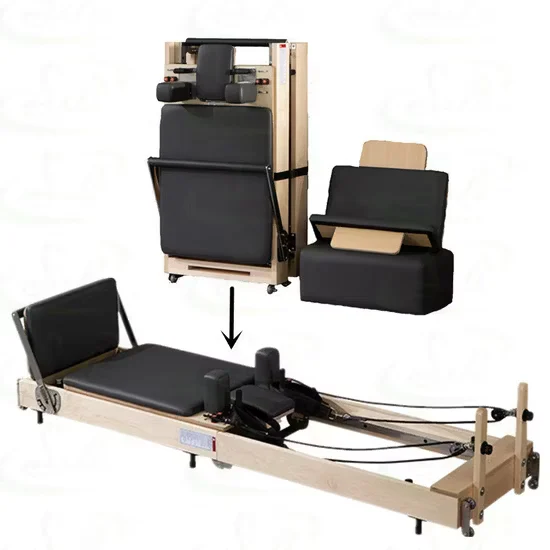
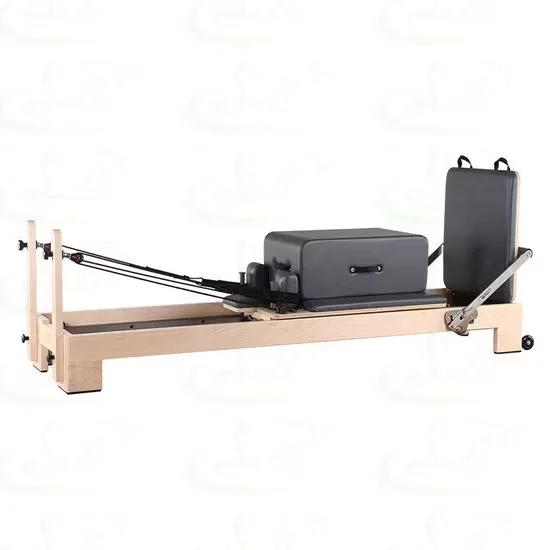
Oak Wood Pilates Reformer, 2460×730×680mm, 100kg Net Weight — solid oak frame resists warping under repeated spring-loaded cycling, with integrated jump board, long box, and platform mounting for dynamic studio work. Ships with 3-year frame warranty from a 15,000㎡ vertically integrated plant with 17 years manufacturing heritage and ISO 9001 certification.
// Spec Highlights
• Direct from Manufacturer · No Middlemen · Worldwide Shipping
01
// Material
Imported Solid Wood
Premium hardwood frames sourced for density and visual warmth.
02
// Hardware
Medical-Grade Silent
Whisper-quiet pulleys and springs for clinical environments.
03
// Customization
Appearance OEM
Color, upholstery, and branding tailored to your studio.
04
// Service
Layout Design
Free venue planning for studios and rehab institutions.
Every component is selected for longevity, performance, and aesthetic harmony - from imported hardwood frames to silent medical-grade accessories.
// Features
Verified Oak Density — straight-grain solid oak rails maintain dimensional stability through repeated carriage cycling, with factory-level ISO 9001 process control ensuring repeatable build quality.
| Parameter | Value |
|---|---|
| Product Type | Pilates Reformer |
| Frame Material | Oak Wood |
| Product Dimensions | 2460×730×680mm |
| Net Weight | 100kgs |
| Accessories | Long Box, Jump Board, Platform |
| Color Options | Solid Color |
| Logo | Customized |
| Warranty | 3 Years |
| Production Capacity | 80 Pieces/Month |
| Certification | ISO 9001 |
| Facility Type | Typical Use |
|---|---|
| Commercial Pilates studio | Group reformer classes with continuous spring-loaded cycling across multiple sessions daily |
| Rehabilitation and physiotherapy center | Low-impact controlled resistance work for post-injury and mobility recovery programs |
| Boutique fitness and wellness facility | Mixed-format classes blending reformer sequences with mat and accessory work |
| Hotel and resort wellness space | Guest-accessible reformer sessions with durable surfaces that withstand frequent cleaning |
| Home studio | Private practice with full accessory kit for comprehensive movement programming |
Solid oak resists rail delamination and carriage wobble that plague laminated or veneer-over-plywood constructions under daily studio use.
Buyers often see "wood frame" on a spec sheet and assume structural equivalence across products. The reality is that laminated plywood rails delaminate along the glue line after repeated spring tension cycles, particularly where the carriage wheel bearings press against the rail edge. In one project I worked on, a studio chain tried to save cost by switching to thin-wall framing with laminated rails — the oak-look veneer chipped within months and the carriage began binding mid-track. Solid oak holds its grain orientation under load, keeping the carriage path predictable. [NEED_CITE: wood species density and dimensional stability under cyclic loading]
The reformer addresses supine, prone, seated, and standing movement planes, targeting core stabilization, hip and knee extension chains, and upper-body pulling patterns through spring resistance. In a studio layout, it pairs with Cadillac or tower units for decompression work and mat zones for unresisted mobility sequences. It suits high-throughput boutique studios running back-to-back group classes as well as lower-volume rehabilitation spaces. The 2460mm length and 730mm width accommodate users across a broad height range without requiring frame modification, while the 100kg net mass anchors the unit against lateral drift during jump-board and standing exercises. This commercial oak wood pilates reformer integrates into dense studio floors where every square meter must justify its footprint.
The reformer frame absorbs cyclic tension from spring anchors and impact loads from jump-board landings hundreds of times per day in a busy studio. Each carriage return drives force into the rail end-stop and the frame joint where the rail meets the cross-member. Spring anchors experience eccentric pull when users load one side of the bar, concentrating stress at the anchor mounting point. The carriage wheels or bearings ride along the oak rail surface, generating friction wear that accelerates if rail straightness drifts. Upholstery on the carriage platform and headrest compresses under body weight and releases thousands of times weekly, testing adhesive bond and foam recovery. [NEED_CITE: cyclic fatigue behavior in solid wood structural members]
The 100kg net weight is not arbitrary — it provides sufficient inertia mass to resist lateral shift during dynamic jump-board work and standing lunge sequences without requiring floor anchoring. Oak wood density directly affects rail straightness tolerance: denser grain structure resists micro-deformation under carriage wheel pressure, keeping the carriage travel smooth over years of use. The 200μm powder coating is irrelevant here; instead, wood surface finish quality determines how well the frame resists sweat absorption and cleaning chemical exposure. Accessory mounting interfaces — jump board brackets, long box rails, platform attachment points — must maintain rigidity under off-center loading, or the force transfer becomes unpredictable and user safety degrades. Color options in solid finish allow studios to standardize across fleet purchases.
Laminated plywood rails save material cost upfront but introduce delamination risk along the glue seam, particularly in humid studio environments where moisture cycles weaken adhesive bonds. Lightweight frames under 80kg shift during jump-board drills, forcing operators to bolt units to the floor — adding installation labor and limiting layout flexibility. Non-standard spring grades lose tension consistency after a few months of commercial cycling, requiring full spring set replacement rather than individual spring swaps. Veneer-over-ply construction chips at contact edges, exposing substrate that absorbs sweat and swells. When accessory mounting points use undersized hardware, jump boards and long boxes develop play that transfers vibration into the frame and degrades the joint over time. [NEED_CITE: failure modes in laminated wood under cyclic moisture exposure]
Oak rail selection starts with grain orientation inspection to ensure straightness tolerance holds under carriage cycling. Every accessory mounting interface — jump board, long box, platform — is load-tested at the joint to confirm rigidity under off-center force application. The 3-year warranty reflects confidence in wood joint integrity and spring fatigue life under commercial conditions. Factory-level ISO 9001 process control governs each production step from timber sourcing through final assembly. Layout planning support helps studio operators determine safe clearance between reformer units, ensuring users can transition between exercises without collision risk. OEM customization including logo and color allows brand consistency across multi-location studio rollouts.
Provide your studio floor area and target unit count to receive a 2D layout with safe clearance zones mapped around each reformer position. Specify average daily class volume and session frequency so we can confirm the frame and spring specification matches your throughput requirements. Share your user demographic and body-size range to verify the carriage travel and accessory configuration covers your clientele. Indicate any custom color, logo, or upholstery requirements for brand-aligned studio fit-out.
Q: How can buyers tell solid oak reformers apart from laminated or veneer-over-plywood builds?
A: Inspect the rail cross-section at an end cut or hardware mounting hole. Solid oak shows continuous grain running through the full thickness, while laminated plywood reveals alternating grain layers bonded with adhesive. Veneer constructions display a thin decorative surface layer over a different substrate. Weight is another indicator — solid oak reformers typically sit heavier due to wood density, and the 100kg net mass of this unit reflects that material choice.
Q: What rail straightness tolerance should operators expect, and how does it affect carriage feel?
A: Rail straightness directly controls how smoothly the carriage glides under spring tension. A rail that drifts even slightly along its length creates binding spots where carriage wheels press harder against one side, producing uneven resistance and accelerating wheel wear. Solid oak with proper grain orientation maintains tighter straightness over time compared to laminated alternatives, where glue-line movement introduces micro-warping under humidity and temperature cycling.
Q: How often do springs need replacement under daily commercial studio use?
A: Spring fatigue depends on session volume, resistance levels selected, and spring grade. In high-throughput studios running multiple group classes daily, springs gradually lose tension consistency, and operators typically notice resistance feel changing before springs fail outright. Replacing springs individually rather than as a full set helps manage cost. The spring grade and fatigue rating should be documented so replacement parts match the original resistance profile.
Q: What should buyers check on accessory mounting interfaces before ordering a configured reformer?
A: Verify that jump board brackets, long box guide rails, and platform attachment points use through-bolted hardware rather than surface-mounted screws. Test the mounting rigidity by applying lateral force to each accessory — any detectable play indicates undersized hardware or loose tolerances that will worsen under repeated use. Confirm that replacement accessory parts are available from the manufacturer to avoid downtime if a component wears or breaks.
Premium aesthetics meet quiet operation for boutique studio environments.
Medical-grade silence and precision for sports & postpartum recovery.
Furniture-grade craftsmanship for premium residential installations.
Compact premium setups for one-on-one and small-group training.
Aesthetic Pilates integration for hybrid wellness studio programming.
Multi-unit deployment with instructor-grade reliability for certification programs.
Tell us about your project. Our team will respond within 24 hours with pricing, customization options, and shipping details.
// Sales Director
William
+86 132 2531 1800
// Export Manager
Bella
+86 198 5412 8032
william@bickfit.com