
01 / Scenario
STUDIO
P
High-End Pilates Studios
Premium aesthetics meet quiet operation for boutique studio environments.
ISO
9001
CE
Certified
OEM
Available
10YR
Warranty
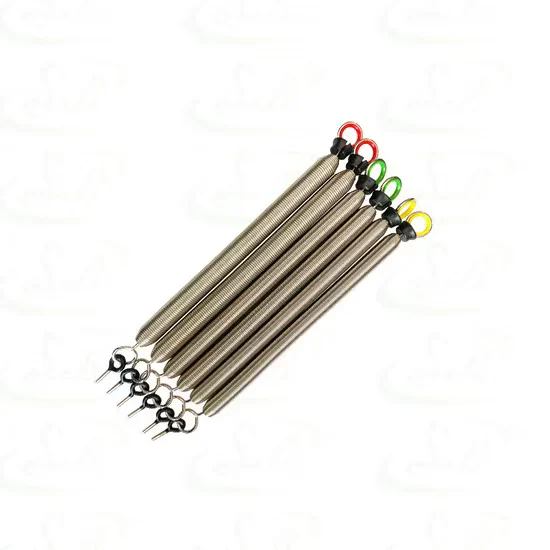
Pilates Cadillac Spring, 2.2×25×450mm, 1.2kg Net Weight — industrial-grade steel wire with precision heat treatment ensures consistent tension retention across high-frequency studio use. Corrosion-resistant surface finish maintains appearance and structural integrity under daily commercial conditions. Each batch undergoes load testing with material traceability verified from coil to finished spring.
Every spring passes tension consistency checks and surface treatment inspection before shipment, backed by full OEM capability and direct factory supply.
// Spec Highlights
• Direct from Manufacturer · No Middlemen · Worldwide Shipping
01
// Material
Imported Solid Wood
Premium hardwood frames sourced for density and visual warmth.
02
// Hardware
Medical-Grade Silent
Whisper-quiet pulleys and springs for clinical environments.
03
// Customization
Appearance OEM
Color, upholstery, and branding tailored to your studio.
04
// Service
Layout Design
Free venue planning for studios and rehab institutions.
Every component is selected for longevity, performance, and aesthetic harmony - from imported hardwood frames to silent medical-grade accessories.
// Features
Industrial-Grade Spring Steel — Heat-treated Pilates Cadillac springs with mill-certified wire sourcing and batch tension consistency testing.
| Parameter | Value |
|---|---|
| Product Type | Pilates Accessories |
| Material | Industrial Spring Steel |
| Wire Specification | 2.2×25×450mm |
| Net Weight | 1.2kgs |
| Color Options | Solid color, customization available |
| Logo | Customized logo allowed |
| Surface Treatment | Corrosion-resistant finish |
| Production Capacity | 80,000 pieces per month |
| Certification | CE, ISO 9001:2015, SGS |
| Warranty | 3 Years |
| Facility Type | Typical Use |
|---|---|
| Pilates studio | Cadillac trapeze table spring replacement and tension grading |
| Commercial fitness center | Dedicated Pilates zone spring maintenance and inventory rotation |
| Rehabilitation center | Controlled resistance progression for therapeutic movement protocols |
| Hotel gym | Multi-purpose Pilates area with reformer and combo chair configurations |
Most suppliers print "commercial grade" on the box with zero material traceability behind it.
When a Pilates studio runs six classes a day on the same Cadillac, the springs cycle through thousands of stretch-and-release sequences weekly. Wire that lacks proper heat treatment loses tension consistency within months — the resistance feels different on the left side versus the right, and clients notice before instructors do. In dusty environments like the venues I’ve worked across Africa and South Asia, unsealed spring coils accumulate particulate between the windings, accelerating fatigue at the hook attachment point. I’ve pulled springs off trapeze tables where the hook end showed visible deformation while the coil body still looked intact — a classic sign that the wire diameter and temper were mismatched to the load cycle [NEED_CITE: spring fatigue failure modes under cyclic tensile loading]. That’s when I stopped trusting labels and started asking for mill certificates.
A commercial pilates cadillac spring serves as the primary resistance interface between the trapeze table frame and the practitioner’s movement. On a typical studio floor, the Cadillac anchors one wall alongside reformers and combo chairs, meaning spring tension consistency directly affects how instructors sequence clients across stations. The spring’s 450mm length and 2.2mm wire diameter place it in the mid-range resistance category, suitable for both foundational exercises and advanced suspension work. For facilities running high-throughput group sessions, maintaining a graduated inventory of springs across different tension ratings ensures instructors can swap quickly between client capability levels without searching through unlabeled bins.
Every full-range trapeze exercise pulls the spring through a tension cycle that peaks at maximum elongation and returns to resting length. Multiply that by eight or more hours of daily studio operation, and the fatigue accumulation becomes the defining factor in service life. The hook ends concentrate stress at the bend radius — this is where micro-cracks initiate long before the coil body shows any deformation. In high-humidity environments, perspiration and cleaning agents corrode the hook-to-coil transition first, creating pitting that accelerates crack propagation. Surface finish quality directly determines how long the spring resists this combined mechanical and chemical degradation [NEED_CITE: corrosion fatigue interaction in spring steel under cyclic loading]. Springs that look fine visually can still harbor subsurface fatigue damage, which is why replacement schedules should follow cycle counts rather than visual inspection alone.
The 2.2mm wire diameter governs the spring’s load-deflection curve — thicker wire increases stiffness but reduces the total elongation range before the coil reaches solid height. The 25mm outer diameter and 450mm free length together define the spring index, which determines how evenly stress distributes across each coil during stretch. Heat treatment after coiling relieves residual stress from the forming process and sets the temper that governs fatigue resistance. Without this thermal stabilization, the spring takes a permanent set after repeated loading, meaning it no longer returns to its original free length — the tension an instructor expects at full stretch quietly degrades session after session. The corrosion-resistant finish adds a sacrificial layer that protects the wire surface from pitting initiated by sweat acids and studio cleaning chemicals, particularly in the tight spaces between coils where moisture traps and evaporates slowly.
Thin wire that meets the minimum dimensional tolerance but lacks proper tempering will stretch beyond recovery within the first year of high-frequency use. Studios then face a choice: replace springs individually as they fail, creating a patchwork of different tension ratings across one Cadillac, or replace the entire set at once — both options cost more than sourcing correctly specified springs initially. Non-uniform tension across the trapeze table compromises exercise integrity and creates liability exposure when a spring snaps mid-session. The hook end is the failure point in nearly every case, and a poorly formed hook with insufficient bend radius concentrates stress at a single point rather than distributing load through the coil geometry [NEED_CITE: stress concentration factors in spring hook geometries]. Facilities running multiple Cadillacs absorb this cost repeatedly until they standardize on springs with verified heat treatment documentation.
Every commercial pilates cadillac spring we supply traces its wire back to a mill certificate, confirming the steel grade and chemical composition before coiling begins. The robotic coiling process maintains consistent pitch and outer diameter across production runs, eliminating the unit-to-unit variation that causes instructors to favor one station over another. Each batch undergoes load-deflection testing at multiple elongation points to confirm tension consistency before packaging. The corrosion-resistant finish is applied to a controlled thickness, covering the critical hook-to-coil transition where fatigue cracks initiate. OEM customization including logo marking and color identification allows studios to maintain a visual grading system for tension levels without relying on printed labels that degrade with handling. Three-year warranty coverage reflects confidence in the fatigue life of properly heat-treated wire under documented commercial use conditions.
Provide your Cadillac and reformer count along with average daily class frequency so we can calculate recommended spring rotation schedules and inventory levels. Specify the tension grading system your instructors use so we can match wire specifications to your resistance color-coding scheme. Share any custom color or logo requirements for visual tension identification across your equipment fleet. Describe your studio’s climate conditions and cleaning protocols so we can confirm the surface finish specification matches your environment.
Q: How do I determine which spring tension level to order for my Cadillac?
A: Tension level depends on your client population and the exercise repertoire your instructors teach most frequently. We recommend starting with a mid-range wire specification and ordering sample springs for instructor evaluation before committing to a full studio set. Provide your current spring’s free length and wire diameter, and we can cross-reference to the equivalent tension rating in our range.
Q: What is the relationship between spring material and service life?
A: Service life in high-frequency studio use is governed primarily by heat treatment quality rather than raw wire diameter alone. Properly tempered spring steel maintains its load-deflection curve through significantly more fatigue cycles than untreated wire of identical dimensions. Mill certification confirms the steel grade, but thermal processing after coiling is what actually determines how long the spring resists permanent set under daily commercial loading.
Q: Can springs of different lengths be used interchangeably on the same Cadillac?
A: Length affects the total elongation range available before the coil reaches solid height, which changes the resistance feel at different points in the movement. Mixing lengths on one station creates uneven tension that instructors will notice immediately. We recommend standardizing on one free length per attachment position and maintaining matched sets across your entire Cadillac fleet.
Q: How do I prevent surface corrosion on springs in a humid studio environment?
A: Wipe springs with a pH-neutral cleaner after each session to remove sweat residue and cleaning chemical buildup, paying attention to the spaces between coils where moisture traps. Store spare inventory in sealed packaging until installation. The corrosion-resistant finish on our springs provides baseline protection, but environmental humidity accelerates surface degradation regardless of coating quality without consistent maintenance.
Q: What consistency checks should I expect when ordering springs in bulk?
A: Every batch ships with load-deflection test records confirming tension at multiple elongation points. Wire diameter and free length measurements are documented per production lot. You can request sample springs from your specific batch for hands-on evaluation before the full shipment releases. This ensures every spring in a bulk order delivers the same resistance feel across your entire equipment fleet.
Premium aesthetics meet quiet operation for boutique studio environments.
Medical-grade silence and precision for sports & postpartum recovery.
Furniture-grade craftsmanship for premium residential installations.
Compact premium setups for one-on-one and small-group training.
Aesthetic Pilates integration for hybrid wellness studio programming.
Multi-unit deployment with instructor-grade reliability for certification programs.
Tell us about your project. Our team will respond within 24 hours with pricing, customization options, and shipping details.
// Sales Director
William
+86 132 2531 1800
// Export Manager
Bella
+86 198 5412 8032
william@bickfit.com


