
01 / Scenario
STUDIO
P
High-End Pilates Studios
Premium aesthetics meet quiet operation for boutique studio environments.
ISO
9001
CE
Certified
OEM
Available
10YR
Warranty
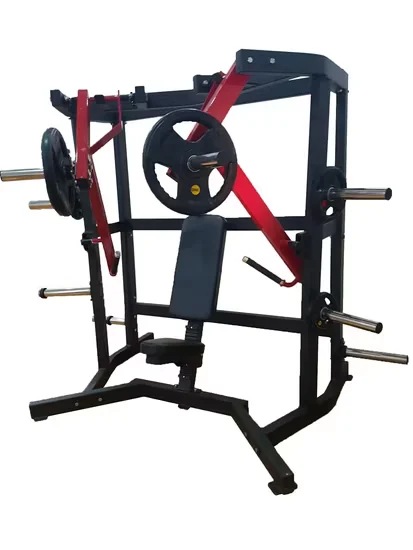
Plate Loaded Wide Chest Press, 3×3 Inch Frame Tube, 141 kg Net Weight — constructed with Q235/Q345 industrial steel and robotic MIG continuous welding to eliminate spot-weld fatigue under repeated heavy loading. Sealed industrial bearings ensure smooth plate-guided motion with minimal maintenance in high-traffic environments. Every unit undergoes individual load testing before shipment, backed by a 10-year frame warranty and free floor planning support.
// Spec Highlights
• Direct from Manufacturer · No Middlemen · Worldwide Shipping
01
// Material
Imported Solid Wood
Premium hardwood frames sourced for density and visual warmth.
02
// Hardware
Medical-Grade Silent
Whisper-quiet pulleys and springs for clinical environments.
03
// Customization
Appearance OEM
Color, upholstery, and branding tailored to your studio.
04
// Service
Layout Design
Free venue planning for studios and rehab institutions.
Every component is selected for longevity, performance, and aesthetic harmony - from imported hardwood frames to silent medical-grade accessories.
// Features
Mill-Certified Steel — Every tube traced to the Q235/Q345 coil that formed the mainframe of this wide chest press.
| Parameter | Value |
|---|---|
| Product Type | Plate Loaded Chest Press |
| Frame Tube Size | 3×3 inch |
| Steel Grade | Q235 / Q345 |
| Frame Steel Gauge | 11-gauge |
| Welding Type | Robotic MIG continuous weld |
| Loading Type | Plate loaded |
| Bearing Type | Sealed industrial bearings |
| Powder Coating | 200μm scratch-resistant |
| Product Dimensions | 1343×1981×1761 mm |
| Net Weight | 141 kg |
| Certification | ISO 9001, CE |
| Warranty | 10-year frame |
| Facility Type | Typical Use |
|---|---|
| Commercial gym strength floor | Primary horizontal pressing station in the plate loaded zone |
| Hotel and resort fitness center | High-durability chest machine for unsupervised guest use |
| University strength and conditioning room | Athletic pressing development for field and court sports |
| Community fitness center | Accessible wide-grip pressing for diverse membership base |
An 11-gauge frame holds its geometry under plate loads that twist lighter tubes out of alignment.
Most suppliers label equipment "commercial grade" without disclosing the actual wall thickness or steel grade. In a busy strength floor, that vagueness shows up as flex at the pivot points, misaligned movement arms, and eventually cracked welds where the loading horn meets the mainframe. I have walked into facilities where a plate loaded wide chest press barely eighteen months old had visible frame deflection under moderate loading — the uprights bowing outward just enough to throw the converging arm path off its intended track [NEED_CITE: EN 957 structural requirements for stationary training equipment]. When the steel itself is undersized, no amount of gusseting compensates. The press arm starts to wander, users feel the instability, and the machine earns a reputation for being "off" without anyone pinpointing why.
This commercial plate loaded wide chest press targets the pectoralis major with emphasis on the sternal and costal fibers through a converging arm path. It pairs naturally with an incline press and a narrow-grip or iso-lateral variant to cover the full horizontal pressing spectrum. In high-traffic facilities, dedicating a wide-grip station prevents bottlenecking at the standard chest press during peak hours. The seat and arm geometry accommodates users from the fifth percentile female to the ninety-fifth percentile male without requiring excessive adjustment steps.
Every rep on a plate loaded wide chest press sends a compound stress through the pivot bearings, the loading horn sleeve, and the weld seams connecting the press arms to the mainframe. In a commercial gym running ten or more hours daily, that fatigue cycle accumulates fast. Sealed industrial bearings resist sweat and chalk intrusion at the pivot, while unsealed bushings develop play that users feel as wobble in the arm path. The powder coating at contact points — where plates scrape the horn, where feet brace against the floor — takes constant abrasion and chemical exposure from cleaning agents [NEED_CITE: coating durability standards for commercial fitness equipment]. Weld seams at the arm-to-frame junction bear the highest cyclic stress and are the first to reveal whether the joint was continuous or merely tacked.
The 3×3 inch tube profile and 11-gauge wall thickness set the deformation threshold — thicker walls and larger cross-sections resist bending moments that lighter frames cannot handle. Robotic MIG continuous welding eliminates the cold joints and incomplete penetration typical of manual spot welding, keeping the fatigue life predictable across every seam. A 200μm powder coating applied over sandblasted pretreatment bonds to the steel substrate rather than sitting on mill scale, which means chips and scratches at high-contact zones do not propagate into rust creep. The 141 kg net weight reflects the steel mass in the mainframe, and that mass directly correlates to stability under asymmetric loading when a user stacks plates on one side of the horn.
Thin-wall tubing on a wide chest press may pass a static load test but deforms under the dynamic eccentric phase of a heavy set, shifting the arm geometry and altering the resistance curve. Spot-welded joints that look clean on the surface harbor incomplete fusion underneath, and when they crack, the liability falls on the facility owner. Non-sealed bearings require scheduled teardowns and repacking — downtime that pulls the machine off the floor and frustrates members. Low-density upholstery compresses within months of commercial use, exposing the backing board and creating a replacement cycle that compounds labor costs. Undersized powder coating chips at the plate horn and floor-contact feet, letting moisture reach bare steel and triggering corrosion that spreads beneath the surface [NEED_CITE: corrosion propagation under thin powder coatings in high-humidity environments].
The 11-gauge Q235/Q345 steel with mill certification traceable to the coil means the material pedigree is documented, not just claimed. Robotic MIG welding delivers continuous weld lines at every arm-to-frame junction, eliminating the spot-weld weak points that fail under repeated heavy loading. Every unit undergoes load testing before shipment rather than relying on sample-based inspection. The 200μm industrial powder coating resists chipping at the plate horn and foot contact zones where abrasion is constant. A 10-year frame warranty backs the structural commitment. For floor planning, this unit’s 1343×1981 mm footprint requires safe clearance on both sides for plate loading and user passage — something we verify against your actual CAD layout to prevent the interference issues that force expensive relocations after installation.
Provide your strength zone dimensions and current equipment list so we can generate a 2D or 3D layout that confirms clearance and traffic flow around this unit. Specify your expected daily user volume to validate that the structural grade matches your traffic pattern. Indicate the body-size range of your primary user population so we can confirm the seat and arm adjustment coverage meets their needs. Share any custom requirements including frame color, logo placement, or upholstery material so we can scope the OEM options available.
Q: How do I tell if a plate loaded chest press is truly commercial grade?
A: Request the steel gauge, tube dimensions, and mill certification. True commercial frames use 11-gauge or thicker steel with verifiable origin. Ask for the welding method — continuous robotic MIG welds outperform spot welds under cyclic loading. Insist on load testing documentation for the specific unit, not just a sample report from a different batch.
Q: What is the relationship between frame gauge and load capacity?
A: Thicker gauge steel and larger tube cross-sections raise the threshold before the frame deforms under load. An 11-gauge 3×3 inch tube resists bending moments that would twist a lighter frame, keeping the press arm path consistent. The net weight of the frame correlates directly with the steel mass present, which is why heavier units tend to hold geometry longer under repeated heavy loading.
Q: How much floor space should I allocate around this machine?
A: The unit footprint is 1343×1981 mm, but you must add clearance on both sides for users loading and unloading plates and for safe passage between stations. We verify these clearances against your actual floor plan during the CAD layout phase to prevent trajectory interference with adjacent equipment — a problem that forces costly relocations if caught only after installation.
Q: What maintenance does a plate loaded wide press require in a high-traffic gym?
A: Sealed industrial bearings at the pivot points resist chalk and sweat intrusion, reducing the teardown frequency compared to unsealed bushings. Quarterly checks should cover bearing play, bolt torque on all frame connections, powder coating condition at plate contact zones, and upholstery compression. Replacing wear items on schedule prevents small issues from becoming machine-down events.
Premium aesthetics meet quiet operation for boutique studio environments.
Medical-grade silence and precision for sports & postpartum recovery.
Furniture-grade craftsmanship for premium residential installations.
Compact premium setups for one-on-one and small-group training.
Aesthetic Pilates integration for hybrid wellness studio programming.
Multi-unit deployment with instructor-grade reliability for certification programs.
Tell us about your project. Our team will respond within 24 hours with pricing, customization options, and shipping details.
// Sales Director
William
+86 132 2531 1800
// Export Manager
Bella
+86 198 5412 8032
william@bickfit.com


