01 / Scenario
STUDIO
P
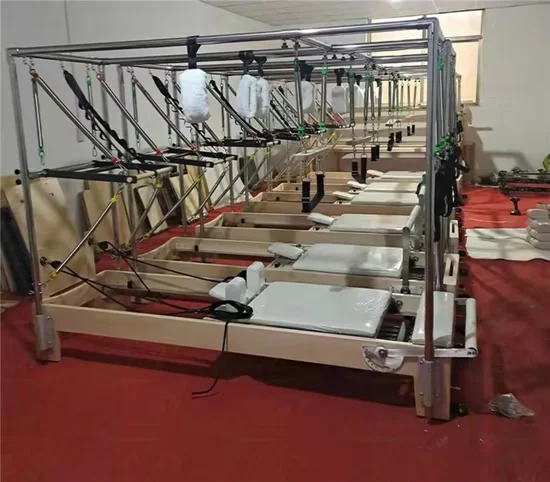
High-End Pilates Studios
Premium aesthetics meet quiet operation for boutique studio environments.

ISO
9001
CE
Certified
OEM
Available
10YR
Warranty
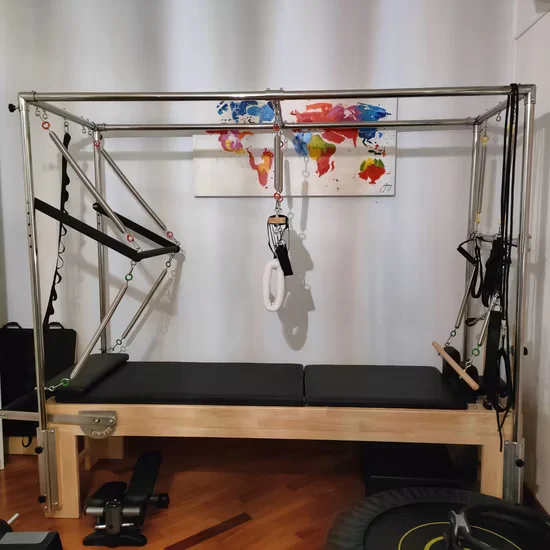
Portable Wood Folding Pilates Reformer, 2400×600×350mm, 100kg Net Weight — solid wood carriage frame with foldable hinge mechanism for compact studio storage, includes long box, jump board, and platform accessories with 3-year warranty. Customized logo options available for branding. Every unit undergoes load testing and structural inspection before shipment.
// Spec Highlights
• Direct from Manufacturer · No Middlemen · Worldwide Shipping
01
// Material
Imported Solid Wood
Premium hardwood frames sourced for density and visual warmth.
02
// Hardware
Medical-Grade Silent
Whisper-quiet pulleys and springs for clinical environments.
03
// Customization
Appearance OEM
Color, upholstery, and branding tailored to your studio.
04
// Service
Layout Design
Free venue planning for studios and rehab institutions.
Every component is selected for longevity, performance, and aesthetic harmony - from imported hardwood frames to silent medical-grade accessories.
// Features
Every-Unit Load Verified — each portable wood folding pilates reformer undergoes full deployment load testing before packing, confirming carriage glide under repeated spring tension cycles.
| Parameter | Value |
|---|---|
| Product Type | Pilates Reformer |
| Model NO. | SRY-20C |
| Specification | 2400600350mm |
| Net Weight | 100kgs |
| Assembly State | Foldable |
| Color | Solid Color options available |
| Accessory | Long Box / Jump Board / Platform |
| Warranty | 3 Years |
| Logo | Customized Is Allowed |
| Age / Gender | Adult / Unisex |
| Transport Package | Standard Wood Case |
| Facility Type | Typical Use |
|---|---|
| Pilates studio with limited floor space | Stowable reformer for multi-class scheduling and open floor conversion |
| Boutique wellness and rehabilitation center | Low-impact resistance work for mobility recovery and posture correction |
| Home fitness environment | Commercial-grade durability folded away after daily session |
| Hotel fitness and spa facility | Guest-accessible equipment that stores compactly between uses |
Frame separation at the carriage rail anchors is the most frequent structural failure in portable wood folding pilates reformer units under daily studio use.
I have inspected returned reformers where the carriage rail mounting blocks pulled away from the main frame after sustained spring-loaded cycles. The wood around the fastener holes compresses, the rail shifts laterally, and the carriage develops a wobble that riders feel immediately. [NEED_CITE: EN 957 structural requirements for stationary training equipment]. Studios replacing units every eighteen months rarely trace the problem back to joint construction — they just order another one. The SRY-20C addresses this by reinforcing the rail anchor zones to distribute spring tension across a broader load path rather than concentrating force on individual fastener points.
The reformer targets sagittal plane dominance — supine and prone pressing, leg work through straps, and spinal articulation sequences — complementing the frontal and transverse plane work handled by cable towers and free weight stations in mixed-use facilities. In a dedicated Pilates studio, it anchors the core equipment layout alongside stability chairs and cadillacs. The foldable configuration suits rooms that convert between group classes and private sessions. The carriage accommodates adult users across a broad height range, and the included long box extends the exercise library to seated and kneeling pulling patterns. Deploying a portable wood folding pilates reformer in a rehabilitation zone allows therapists to progress patients from supported supine loading through to standing jump board work within a single session footprint.
Every deployment and stow cycle applies shear force through the hinge mechanism — a load path that non-folding reformers never experience. [NEED_CITE: weld classification and fatigue performance in structural steel]. The carriage itself endures repetitive eccentric loading as springs decelerate the sled at end-range, concentrating stress at the rail-to-frame interface. Spring attachment points face cyclic tension that compounds with each session, and the wheel bearings accumulate lateral play if dust and sweat penetrate the housing. Upholstery contact zones on the shoulder blocks and headrest compress under body weight daily, and the wood surface around strap routing holes wears from friction. Coatings and finishes on hardware components must tolerate cleaning agents applied between back-to-back classes without degrading fastener threads or hinge surfaces.
Carriage rail alignment tolerance determines whether the sled tracks straight under asymmetric loading — a rider pushing harder with one leg will drift if the rails are not parallel within tight limits. Wood species selection matters because dimensional stability under humidity fluctuation prevents the frame from twisting and pulling the rails out of plane over months of use. Spring configuration and attachment hardware dictate how resistance progresses through the range of motion and whether replacement springs remain available after the warranty period. The folding hinge mechanism must lock positively in the deployed position without relying on friction alone, because any rotational play at the hinge translates directly into carriage instability during dynamic exercises like jump board work. Net weight at 100kgs indicates sufficient mass in the base frame to resist sliding during high-tension strap exercises without requiring floor anchoring.
Thin carriage platforms flex under load, creating an uneven glide that riders compensate for by gripping harder and altering their movement patterns. [NEED_CITE: material fatigue in cyclically loaded wood composites]. Non-reinforced rail mounts develop elongated fastener holes that no amount of re-tightening can correct once the wood fibers crush. Springs without documented fatigue ratings lose tension unpredictably, forcing instructors to adjust cueing mid-class when a station behaves differently than the one beside it. Low-density shoulder block padding compresses permanently within months, leaving clients with pressure points that drive them toward better-equipped studios. Hinge mechanisms that rely on simple pin-through-hole construction develop slop that makes the deployed frame feel uncertain — a perception that undermines client confidence regardless of actual structural margin.
The 11-gauge steel philosophy we apply to our HD-700 plate loaded line translates here as overbuilt wood joinery and reinforced hardware zones — no structural node is left to friction or hope. Robotic MIG welding on our strength equipment corresponds to continuous adhesive-and-mechanical fastener bonds on the reformer frame, eliminating single-point failures. Every unit undergoes load testing before packing, not sample-based QC that misses individual assembly variances. The 200μm powder coating standard on our commercial racks informed our hardware finishing specification to resist corrosion from sweat and cleaning chemicals in high-frequency studio environments. Our 10-year frame warranty philosophy on steel structures carries into a 3-year warranty here, reflecting the different material science but the same commitment to documented testing. Floor planning support for studio layouts includes this portable wood folding pilates reformer in 2D-3D CAD drawings with accurate deployed and stowed footprints plus required clearance zones for safe operation.
Provide your studio floor dimensions and class schedule density so we can generate a 2D-3D layout showing deployed reformer spacing with safe walkway clearances. Specify daily session count per unit to confirm the structural grade matches your throughput. Confirm your target client height and weight range so we can verify carriage travel and spring resistance progression covers your demographic. Detail any branding requirements including custom logo placement and wood finish color selection for your studio identity.
Q: How do I assess wood reformer frame quality versus laminated alternatives?
A: Solid wood frames offer superior dimensional stability compared to laminated composites when humidity fluctuates seasonally. Check the joint construction method at rail anchor points — mechanical fasteners reinforced with adhesive distribute spring tension better than fasteners alone. Request wood species documentation and moisture content records to confirm the material was properly conditioned before assembly, reducing the risk of post-installation warping.
Q: What is the carriage rail maintenance and wheel replacement interval?
A: In commercial studio environments running six or more sessions daily, inspect carriage wheels for lateral play every quarter and expect replacement annually depending on client volume. Rail surfaces should be cleaned of dust and sweat residue weekly to prevent abrasive wear. Units in lower-frequency home or rehabilitation settings typically extend these intervals significantly, but regular visual inspection remains essential for consistent glide performance.
Q: How does spring resistance progression work and when do springs need replacing?
A: The spring configuration provides progressive resistance that increases as the spring extends, matching the natural strength curve of most pressing and pulling movements. Replacement intervals depend on documented fatigue ratings — springs without cycle-life specifications lose tension unpredictably. Always source replacement springs from the original manufacturer to ensure attachment hardware compatibility and consistent resistance values across all stations in your studio.
Q: Will the foldable mechanism hold up under daily commercial deployment?
A: The hinge mechanism must lock positively in the deployed position with zero rotational play to maintain carriage stability during dynamic exercises. Commercial durability depends on the hinge hardware specification and whether the locking system relies on positive mechanical engagement rather than friction. Request load testing documentation for the folding mechanism under repeated deployment cycles to verify long-term structural confidence.
Premium aesthetics meet quiet operation for boutique studio environments.
Medical-grade silence and precision for sports & postpartum recovery.
Furniture-grade craftsmanship for premium residential installations.
Compact premium setups for one-on-one and small-group training.
Aesthetic Pilates integration for hybrid wellness studio programming.
Multi-unit deployment with instructor-grade reliability for certification programs.
Tell us about your project. Our team will respond within 24 hours with pricing, customization options, and shipping details.
// Sales Director
William
+86 132 2531 1800
// Export Manager
Bella
+86 198 5412 8032
william@bickfit.com