01 / Scenario
STUDIO
P
High-End Pilates Studios
Premium aesthetics meet quiet operation for boutique studio environments.
ISO
9001
CE
Certified
OEM
Available
10YR
Warranty
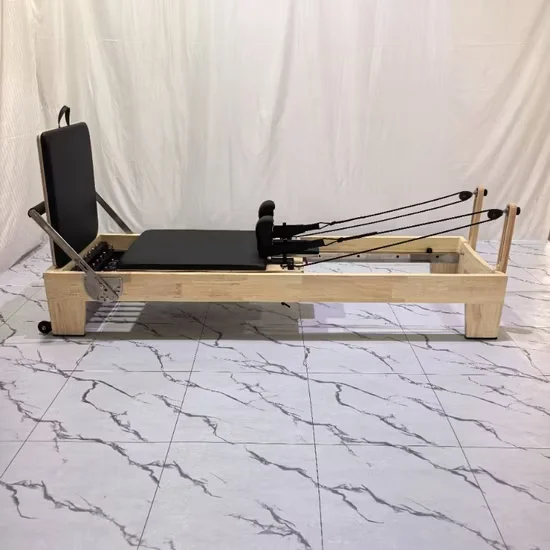
Pilates Reformer Tower with Cadillac, Maple/Oak Wood Frame, 2460×730×680mm — solid hardwood construction delivers vibration-free rigidity under repeated spring-load cycling, with integrated tower and Cadillac attachments for full-range spinal articulation. Includes long box, jump board, and platform; CE and ISO 9001 certified with OEM customization available. Every unit undergoes 32-point inspection and 100% load testing before shipment.
// Spec Highlights
• Direct from Manufacturer · No Middlemen · Worldwide Shipping
01
// Material
Imported Solid Wood
Premium hardwood frames sourced for density and visual warmth.
02
// Hardware
Medical-Grade Silent
Whisper-quiet pulleys and springs for clinical environments.
03
// Customization
Appearance OEM
Color, upholstery, and branding tailored to your studio.
04
// Service
Layout Design
Free venue planning for studios and rehab institutions.
Every component is selected for longevity, performance, and aesthetic harmony - from imported hardwood frames to silent medical-grade accessories.
// Features
Continuous Robotic Welding — Every structural joint on this Pilates apparatus is fully welded rather than spot-tacked, eliminating the hairline cracks that emerge under repeated spring-tension cycling in humid studio environments.
| Parameter | Value |
|---|---|
| Product Type | Pilates Reformer with Tower/Cadillac |
| Frame Material | Solid Maple or Oak Hardwood |
| Product Dimensions | 2460 × 730 × 680 mm |
| Net Weight | 100 kg |
| Accessories Included | Long Box, Jump Board, Platform |
| Upholstery | Standard or high-density options available |
| Color Options | Solid color range with custom selection available |
| Customization | Logo placement and color matching available on request |
| Certification | CE, ISO 9001, SGS |
| Warranty | 3 Years |
| Facility Type | Typical Use |
|---|---|
| Pilates studio | Mat and apparatus group classes, private sessions |
| Rehabilitation and physical therapy center | Spinal decompression, joint mobilization protocols |
| Boutique fitness studio | Small-group reformer sessions, tower-based circuits |
| Hotel and resort wellness facility | Guest-accessible Pilates programming |
| Private home gym | Full-body resistance training with integrated tower |
A solid hardwood frame is the only material that resists flex under cumulative spring-load cycling without introducing carriage play or joint misalignment.
Most reformers reaching commercial studios use laminated plywood or softwood frames that compress under heavy spring tension. This compression creates inconsistent resistance feel at the carriage, accelerates wheel wear on the rail, and eventually produces a rattle that clients notice before the operator does. The frame on this unit uses solid maple or oak stock — species selected for density and dimensional stability — which maintains a rigid platform for the spring-anchor points and the integrated tower assembly throughout daily class schedules. [NEED_CITE: hardwood density and dimensional stability under cyclic mechanical loading]
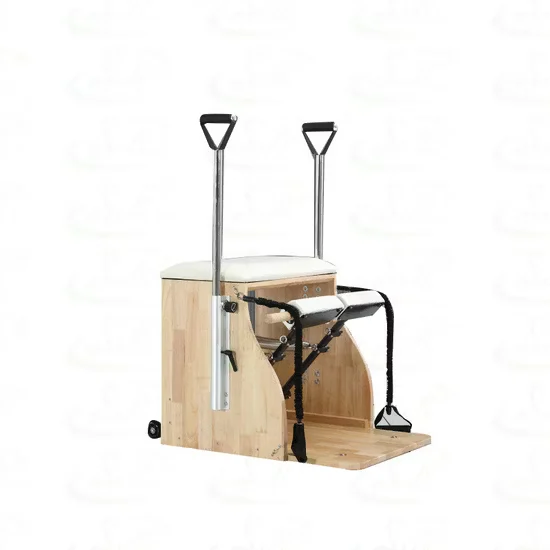
This commercial wood pilates reformer with tower and cadillac machine serves as a single-footprint replacement for a separate reformer and full Cadillac rig. The integrated tower provides push-through bar, roll-down bar, and leg spring attachments that cover sagittal and frontal plane articulation work, while the reformer bed handles supine, prone, and seated resistance training. In a studio configured for both apparatus classes and rehabilitation sessions, this unit pairs with a Wunda Chair and a Spine Corrector to round out the full equipment progression. The 2460 mm length fits standard studio bay spacing, leaving adequate clearance for client entry and instructor circulation on both sides.
Reformer frames endure a compound load profile: static spring tension when the carriage is locked, impact loading during jump board sequences, and eccentric pulling through the tower bar attachments. The spring anchors concentrate force at discrete points on the frame bed, and any material compressibility at those anchors translates into lateral carriage drift over time. The tower uprights carry their own moment load when a client hangs from the roll-down bar or pushes through the bar against spring resistance, and those uprights must resist torsional twist independent of the reformer bed beneath. [NEED_CITE: cyclic fatigue performance in wood and composite structural members under multi-axis loading]
Maple and oak differ in grain density and moisture-response behavior, both of which matter in climate-variable studio environments. Maple offers tighter grain structure and higher surface hardness, which translates to cleaner rail interfaces and slower wear at the carriage wheel contact zone. Oak provides greater overall mass and a stiffer resistance to torsional flex in the tower uprights. Both species must be kiln-dried to a specified moisture content before machining — stock that ships above that threshold will warp as it equilibrates to studio humidity, throwing the carriage rail out of parallel and creating binding at the wheel. The rail flatness tolerance and the carriage wheel material hardness together determine whether the system stays smooth through thousands of cycles or develops play that requires rail replacement.
A reformer built on laminated plywood saves material cost upfront but accumulates expense through premature carriage wheel replacement, rail resurfacing, and spring-anchor reinforcement when the frame compresses around the anchor bolts. Non-sealed pulleys in the tower system ingest dust and humidity, developing rotational play that makes bar movements feel uneven — a complaint that surfaces in client feedback before it appears on a maintenance checklist. Low-density upholstery on the reformer bed and tower pads compresses visibly within months of daily class use, and pads without available replacement stock force the studio to pull the unit from rotation entirely. [NEED_CITE: maintenance cost escalation in fitness apparatus with unsealed bearing and pulley systems]
The solid hardwood frame provides a verifiable structural baseline — each unit is traceable by wood species and moisture content at time of manufacture, not by a generic commercial-grade label. The tower and Cadillac attachment points are structurally independent from the reformer bed, meaning a heavy client working the push-through bar does not introduce flex into the carriage rail beneath. Each unit ships with spring tension documentation and a load test record for the tower anchors. The upholstery is offered in standard or high-density options to match the expected daily session count of the installing studio. For facilities planning a multi-unit purchase, 2D and 3D CAD layout support ensures proper clearance between adjacent reformers and safe instructor circulation paths. OEM customization on logo placement and color matching allows the unit to align with studio branding without compromising the structural specification.
Provide your studio floor area and planned apparatus count to receive a 2D-3D layout that positions this reformer with proper clearance for group class circulation. Specify your expected daily session volume so the appropriate upholstery density and spring configuration can be matched to your traffic profile. If you operate a rehabilitation clinic, note any client mobility requirements that affect the tower bar adjustment range. For branding alignment, submit your color palette and logo files to confirm customization options on the frame finish and pad upholstery.
Q: Is a maple or oak frame more suitable for a high-traffic commercial studio?
A: Maple offers a harder surface at the carriage rail interface, which slows wheel wear and maintains smooth travel under heavy daily use. Oak provides greater overall mass and stiffness in the tower uprights, which benefits studios running intensive spring-loaded bar work. Both are viable for commercial environments — the choice depends on whether your programming emphasizes carriage-based repetition or tower-based resistance.
Q: How do you assess carriage wheel and rail condition after extended use?
A: Lift the carriage and check for lateral play against the rail. Visible scoring on the rail surface or uneven wear patterns on the wheel contact face indicate the interface needs attention. A properly maintained hardwood rail and matched wheel material should remain smooth without binding or rattle through regular inspection intervals.
Q: What are the spatial trade-offs between a tower configuration and a full Cadillac?
A: A tower integrates the essential bar and spring attachments onto the reformer footprint, requiring less ceiling height and floor space than a standalone Cadillac rig. This configuration suits studios maximizing apparatus count within a limited floor plan. A full Cadillac offers additional hanging and suspension points but demands dedicated clearance and is typically specified for larger rehabilitation or private facilities.
Q: How should spring replacement and tension calibration be managed in group class settings?
A: Springs lose tension consistency over repeated cycling, and group class environments accelerate this through frequent load changes between clients. Document the spring set installed on each unit and rotate springs across positions to distribute fatigue evenly. Replace springs that no longer return to their resting length or that produce inconsistent resistance feel during instructor testing.
Premium aesthetics meet quiet operation for boutique studio environments.
Medical-grade silence and precision for sports & postpartum recovery.
Furniture-grade craftsmanship for premium residential installations.
Compact premium setups for one-on-one and small-group training.
Aesthetic Pilates integration for hybrid wellness studio programming.
Multi-unit deployment with instructor-grade reliability for certification programs.
Tell us about your project. Our team will respond within 24 hours with pricing, customization options, and shipping details.
// Sales Director
William
+86 132 2531 1800
// Export Manager
Bella
+86 198 5412 8032
william@bickfit.com