01 / Scenario
STUDIO
P
High-End Pilates Studios
Premium aesthetics meet quiet operation for boutique studio environments.
ISO
9001
CE
Certified
OEM
Available
10YR
Warranty
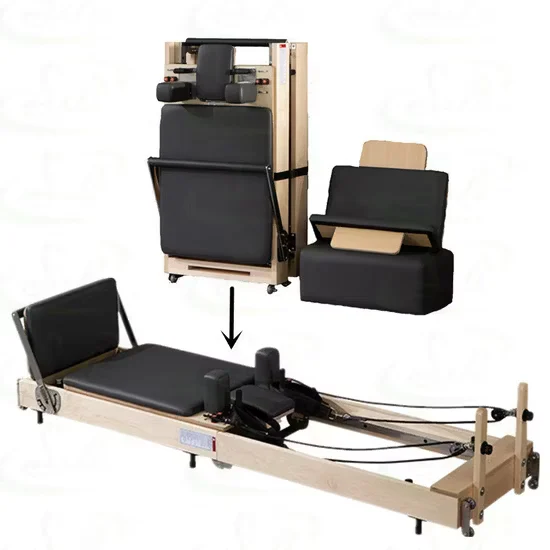
Wooden Folding Pilates Reformer, Solid Oak & Maple Frame, 2400×600mm Working Surface — engineered with solid hardwood rails and frame to resist warping and carriage groove deformation under continuous studio use; folding hinge mechanism with reinforced locking hardware maintains full-length rigidity for high-density floor planning. Includes long box, jump board, and platform with structurally reinforced mounting interfaces. 100kg net weight, 3-year warranty, customized logo available. Every unit undergoes 32-point inspection and full dynamic load testing before shipment.
// Spec Highlights
• Direct from Manufacturer · No Middlemen · Worldwide Shipping
01
// Material
Imported Solid Wood
Premium hardwood frames sourced for density and visual warmth.
02
// Hardware
Medical-Grade Silent
Whisper-quiet pulleys and springs for clinical environments.
03
// Customization
Appearance OEM
Color, upholstery, and branding tailored to your studio.
04
// Service
Layout Design
Free venue planning for studios and rehab institutions.
Every component is selected for longevity, performance, and aesthetic harmony - from imported hardwood frames to silent medical-grade accessories.
// Features
Full-Length Solid Wood Rail — Solid oak and maple hardwood carriage rail maintains dimensional stability across thousands of commercial sliding cycles without groove deformation.
| Parameter | Value |
|---|---|
| Product Type | Pilates Reformer |
| Model NO. | SRY-20B |
| Frame & Rail Material | Solid Oak / Maple Wood |
| Product Dimensions | 2400×600×350mm |
| Net Weight | 100kgs |
| Folding Mechanism | Yes |
| Accessory Compatibility | Long Box / Jump Board / Platform |
| Color Options | Solid Color |
| Logo | Customized Is Allowed |
| Warranty | 3 Years |
| Production Capacity | 80 Pieces/Month |
| Facility Type | Typical Use |
|---|---|
| Commercial Pilates Studio | Daily group and private reformer sessions across full operating hours |
| Rehabilitation & Physiotherapy Center | Controlled resistance movement therapy with adjustable spring tension |
| Boutique Fitness & Wellness Facility | Premium reformer classes in high-density floor layouts |
| Home Training Space | Full-size reformer folded for storage between sessions |
Solid hardwood rails resist the groove wear that laminated alternatives cannot survive.
Walk into any studio running reformers built on laminated plywood or veneer-over-particle-board rails, and you will feel the carriage wobble within months of daily commercial use. The rail surface compresses under repeated sliding loads, the groove profile deforms, and hardware loosens at the laminate-to-core interface. Folding mechanisms on these units add another failure point — thin stamped hinges flex under dynamic exercises, and locking pins shear under off-center carriage loading [NEED_CITE: EN 957 structural requirements for stationary training equipment]. A commercial wooden folding pilates reformer solid oak maple frame eliminates these failure modes by using through-and-through hardwood at every structural interface.
This reformer addresses the full sagittal plane through spring-resisted carriage travel, targeting core stabilizers, hip flexors and extensors, and lower limb musculature across a continuous resistance curve. In a studio layout, it pairs with mat zones and tower-based apparatus to balance equipment density against class flow. The 2400mm working surface accommodates taller practitioners without truncating carriage travel or compromising spring tension geometry, while the folding mechanism allows operators to reclaim floor space between scheduled sessions.
The carriage rail endures cyclical eccentric loading every time a practitioner pushes against spring resistance — each repetition generates lateral forces at the wheel-to-groove contact point. Solid oak and maple hardwood distributes these loads through the full rail cross-section rather than concentrating stress at a thin veneer layer. The folding hinge joint bears the entire reformer weight plus dynamic carriage momentum when the unit is moved between folded and deployed positions [NEED_CITE: fatigue performance in solid hardwood structural joints]. Accessory mounting points for the jump board and platform transfer impact loads directly into the frame, demanding reinforced hardware interfaces rather than friction-fit connections.
Solid oak and maple hardwood rails resist compression set far better than laminated alternatives, meaning the carriage groove profile retains its original geometry through extended commercial use. The full 2400mm rail length is machined from continuous hardwood stock, eliminating mid-rail joints where differential movement introduces play. Folding hardware at the frame hinge must be sized to handle both the static weight of the deployed reformer and the dynamic forces generated during jump board exercises. Accessory mounting interfaces — long box slots, jump board brackets, platform attachment points — rely on through-bolted hardwood connections that maintain clamping force under vibration and repeated mounting cycles.
Laminated plywood rails compress at the groove surface under daily carriage travel, developing lateral play that worsens with every session until the carriage feels unstable under load. Veneer-over-particle-board construction hides a weak core behind an attractive surface — once moisture from studio humidity penetrates a chip or edge seam, the core swells and the rail surface lifts. Thin stamped folding hinges bend under dynamic jump board use, and replacement parts are unavailable because the hinge was sourced as a generic hardware catalog item rather than engineered for reformer-specific loads [NEED_CITE: structural failure modes in composite wood fitness equipment]. Non-reinforced accessory mounting points loosen within weeks, creating wobble that transfers uneven wear back into the rail groove.
Solid oak and maple hardwood selection ensures every rail and frame member is traceable to its species origin, not a composite blend with variable density. The folding mechanism uses through-bolted hinge hardware sized for dynamic loading, not static display weight. Each unit undergoes functional testing of carriage travel smoothness, folding deployment, and accessory mounting integrity before release. The 2400×600mm footprint supports studio floor planning with defined clearance zones for safe practitioner movement around deployed units. OEM customization including color finish and logo placement allows studio operators to maintain brand consistency across their equipment fleet.
Provide your studio floor area and planned reformer count to receive a 2D or 3D layout showing safe clearance zones and traffic flow around deployed and folded units. Specify your average daily session volume so we can confirm the solid hardwood specification matches your usage intensity. Indicate your practitioner height range to verify the 2400mm working surface accommodates your client base. Submit color and logo requirements for OEM customization alignment with your studio identity.
Q: How do I confirm a reformer uses solid hardwood rather than laminate or veneer?
A: Request a cross-section sample of the rail material. Solid oak and maple shows continuous grain through the entire thickness, while laminated construction reveals layered ply lines and veneer shows a thin decorative face over a composite core. Verify the supplier provides species documentation rather than generic "wood" material descriptions on the specification sheet.
Q: What makes a folding reformer maintain rigidity at the hinge joint over time?
A: The hinge must use through-bolted hardware sized for dynamic loading — not just the static weight of the reformer frame. Look for reinforced hardwood at the hinge mounting zone and locking pins that engage positively rather than relying on friction. Hinge integrity should be tested under carriage movement, not just static deployment.
Q: How does rail surface finish affect carriage smoothness and maintenance intervals?
A: A precisely machined hardwood groove with consistent surface finish reduces wheel wear and prevents the lateral play that develops when groove geometry degrades unevenly. Smooth rail surfaces also resist moisture absorption from studio humidity, which can cause grain raise and increased friction. Periodic inspection of groove wear patterns indicates when maintenance is needed.
Q: What accessory mounting standards prevent wobble during commercial reformer classes?
A: Long box, jump board, and platform interfaces should use through-bolted connections into solid hardwood rather than friction-fit or press-in hardware. Reinforced mounting zones distribute impact loads across a wider frame area. Verify that each accessory locks positively with no lateral movement when subjected to off-center forces typical of dynamic exercises.
Q: How do I plan floor layout with folding reformers to maximize studio density safely?
A: Calculate the deployed footprint of 2400×600mm plus clearance zones for practitioner movement and carriage access on all sides. Folding capability lets you reclaim space between sessions, but deployed units need defined safety corridors. Provide your room dimensions to receive a layout showing optimal reformer spacing that maintains traffic flow and emergency egress paths.
Premium aesthetics meet quiet operation for boutique studio environments.
Medical-grade silence and precision for sports & postpartum recovery.
Furniture-grade craftsmanship for premium residential installations.
Compact premium setups for one-on-one and small-group training.
Aesthetic Pilates integration for hybrid wellness studio programming.
Multi-unit deployment with instructor-grade reliability for certification programs.
Tell us about your project. Our team will respond within 24 hours with pricing, customization options, and shipping details.
// Sales Director
William
+86 132 2531 1800
// Export Manager
Bella
+86 198 5412 8032
william@bickfit.com