SX-900 Selectorized Series Container Loading and MOQ Reference
Most buyers assume selectorized machines must be shipped fully assembled or that MOQs require single-model full containers. The reality is far more flexible—and far more cost-effective.
A standard 40HQ container can accommodate 15-25 units of selectorized series equipment when models are strategically mixed, with per-model MOQs as low as 1-3 units. By combining core strength machines with compact auxiliary models and utilizing knock-down packaging for weight stacks, CBM utilization reaches 85% or higher while meeting factory requirements.
When I first started exporting selectorized equipment from our Shandong facility, I learned the hard way that container loading isn’t just about fitting machines into a box. Years ago, we shipped a full container of selectorized machines to a distributor in the Middle East. The customer received the shipment at Jebel Ali Port only to discover that the weight stack mounting holes didn’t align with the guide rods on several units. The entire container was held up in customs for weeks. I flew out with an engineer, and we spent days re-drilling holes on the dock. That experience fundamentally changed how I approach packing lists and MOQ combinations. Now, every container loading plan starts with a detailed CBM calculation and model mix strategy before a single machine leaves the production floor.

The key to successful selectorized series container loading lies in understanding three variables: per-model MOQ flexibility, CBM optimization through model mixing, and packaging configuration that reduces volume without compromising protection. Let’s break down each element with practical guidance drawn from real procurement scenarios.
What Is the Standard MOQ for SX-900 Selectorized Series Per Model?
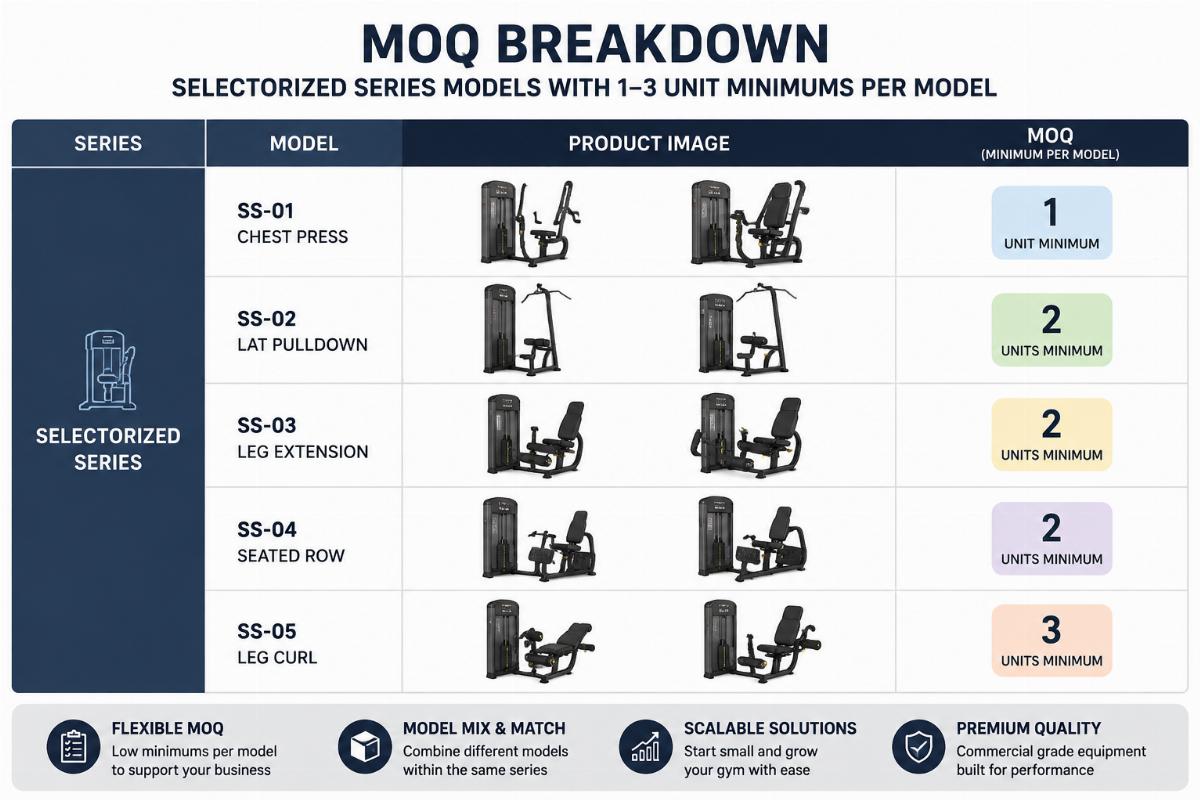
The MOQ for SX-900 selectorized series is 1-3 units per model, with full container orders typically requiring 15-25 total units across mixed models.
This flexibility exists because selectorized machines share common frame dimensions and weight stack configurations across the series. The manufacturing process allows for batch production of frames and components, then assembly into different models based on order requirements. This means the factory doesn’t need to run separate production lines for each model—components are produced in bulk, then customized during final assembly.
For a first-time buyer testing a new market, this MOQ structure allows you to order a representative sample of your most popular models without committing to massive inventory. A typical starter order might include 2 units each of chest press, leg press, lat pulldown, and cable crossover, plus 1 unit each of pec deck, leg extension, and bicep curl. That’s 15 units total, meeting the container MOQ while giving you product variety to gauge market response.
The per-model MOQ of 1-3 units also applies to repeat orders. Distributors in Africa frequently place orders where high-demand models like leg press and cable crossover account for the majority of units, while niche models like lat raise or ab crunch are ordered as single units to complete the product line. This approach keeps inventory risk low while maintaining a full catalog offering.
However, there are practical limits to consider. Ordering just 1 unit of a model means you’re paying the same setup and packaging costs as if you ordered 3 units. The per-unit shipping cost doesn’t decrease significantly until you reach higher volumes. For this reason, most experienced buyers aim for at least 2 units per model to justify the logistical overhead.
How to Mix Selectorized Models in a 40HQ Container for Maximum CBM?
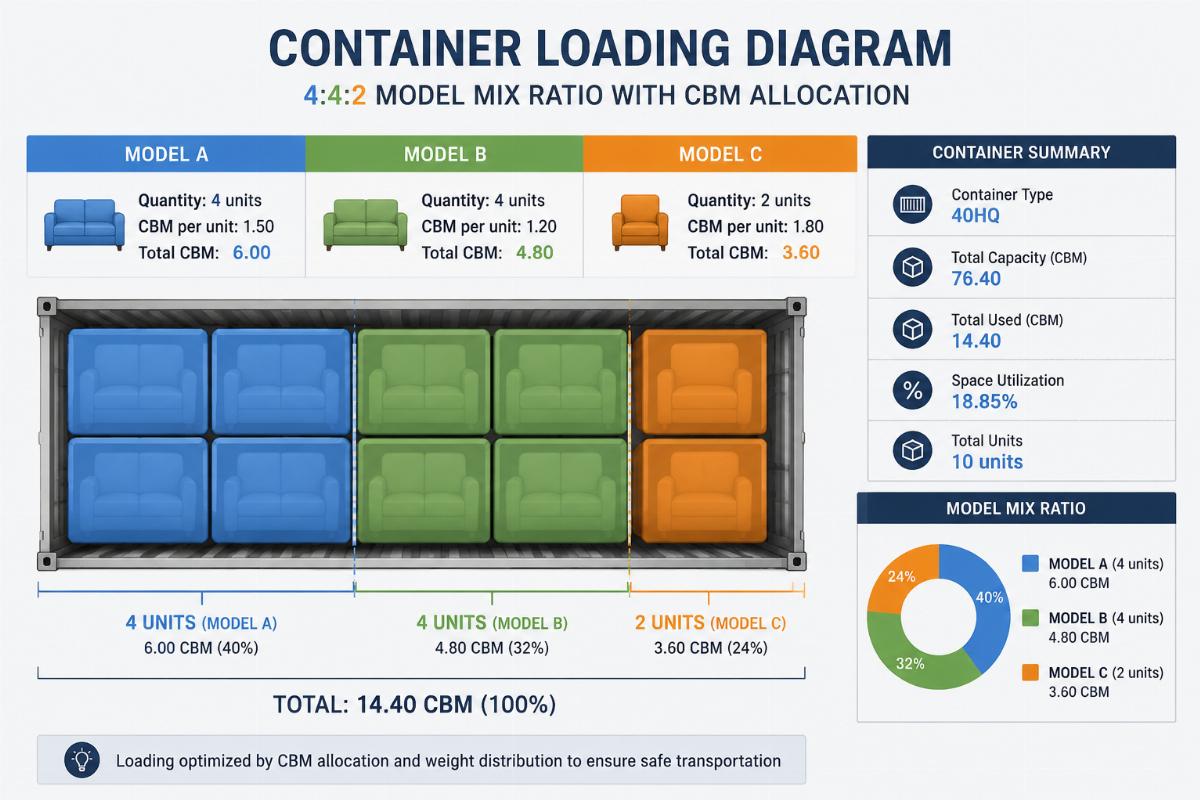
Strategic model mixing follows a 4:4:2 ratio—40% core machines, 40% auxiliary models, 20% compact or niche units—to maximize CBM utilization while balancing market demand.
A 40HQ container offers approximately 68-72 CBM of usable space. Selectorized machines vary significantly in footprint and weight. A leg press or smith machine might consume 1.5 CBM when fully assembled, while a compact model like a pec fly or lat raise occupies only 0.8-1.0 CBM. If you load only large machines, you’ll hit the weight limit before filling the volume. If you load only small machines, you’ll fill the space but miss out on high-margin core equipment.
The 4:4:2 ratio solves this by ensuring you have enough core machines to meet primary demand, enough auxiliary models to round out the product line, and enough compact units to fill gaps without exceeding weight limits.
Here’s how this works in practice. Core machines like chest press, leg press, and lat pulldown are your bestsellers and highest-margin items. They should represent the largest portion of your order. Auxiliary models like cable crossover, shoulder press, and row machine are important for a complete gym setup but may have lower turnover. Compact models like pec fly, lat raise, and ab crunch are essential for product line completeness but take up minimal space.
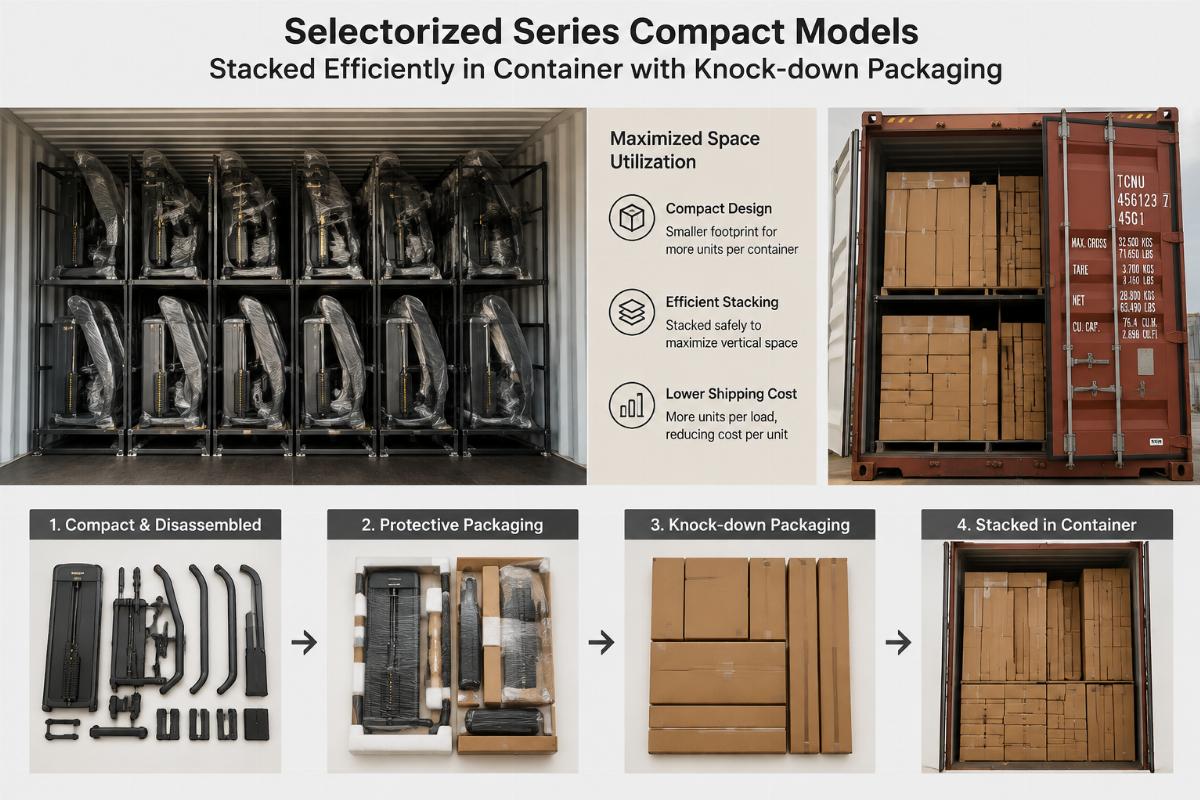
When mixing models, consider the packaging configuration. Our SX-900 series uses a knock-down design where weight stacks can be separated from the main frame. This reduces the CBM per unit by a noticeable margin compared to fully assembled shipping. The weight stacks are packed in separate cartons, and the main frame is partially disassembled. This approach requires more labor at the destination for reassembly, but the space savings are substantial—especially when loading a full container.
A Middle East distributor recently placed an order for 20 units across 8 different models. The loading plan allocated 8 units to core machines (chest press, leg press, lat pulldown), 8 units to auxiliary models (cable crossover, shoulder press, row machine, smith machine), and 4 units to compact models (pec fly, lat raise). The total CBM came to approximately 60 CBM, leaving room for proper weight distribution and securing. The container arrived without damage, and the customer was able to assemble all units within a week using the provided instructions and hardware kits.
Which Selectorized Models Are Best for Container Loading Efficiency?
Compact models with smaller footprints paired with high-demand core machines create the most efficient loading combinations, balancing space utilization with market appeal.
Not all selectorized models are created equal when it comes to container loading. Some machines have inherent design advantages that make them easier to pack and ship. Understanding these differences helps you optimize your order mix.
Compact models like pec fly, lat raise, and ab crunch typically have smaller frames and lighter weight stacks. They can be stacked or nested more efficiently in a container. These models are also popular in boutique studios and hotel gyms where space is at a premium, so they have strong market demand despite their smaller size.
Core models like leg press, chest press, and cable crossover are larger but essential for any commercial gym. They have higher weight stacks and more robust frames, which means they consume more CBM. However, they’re also your highest-margin items and the machines customers expect to see in a well-equipped facility.
When planning your order, consider the destination market. A commercial gym in a major city will need more core machines and fewer compact models. A hotel fitness center or apartment complex gym might prioritize compact models due to space constraints. A distributor stocking for resale will want a balanced mix to serve different customer segments.
The SX-900 series is designed with modularity in mind. The frames share common dimensions across models, which simplifies packaging and loading. The weight stacks are standardized, meaning you can mix and match models without worrying about incompatible components. This modularity also extends to the knock-down packaging system, where weight stacks and frame components are packed separately to reduce CBM.
A hotel project in South America required fitness equipment for multiple properties with limited space. The loading plan focused on compact selectorized models—pec fly, lat raise, leg extension, and bicep curl—along with a few core machines like chest press and leg press. Each container held 12-15 units, and the knock-down packaging allowed for efficient stacking. The customer reported that the space savings from compact models made the difference between fitting all required equipment and having to leave items behind.
What Are the Common Container Loading Mistakes to Avoid?
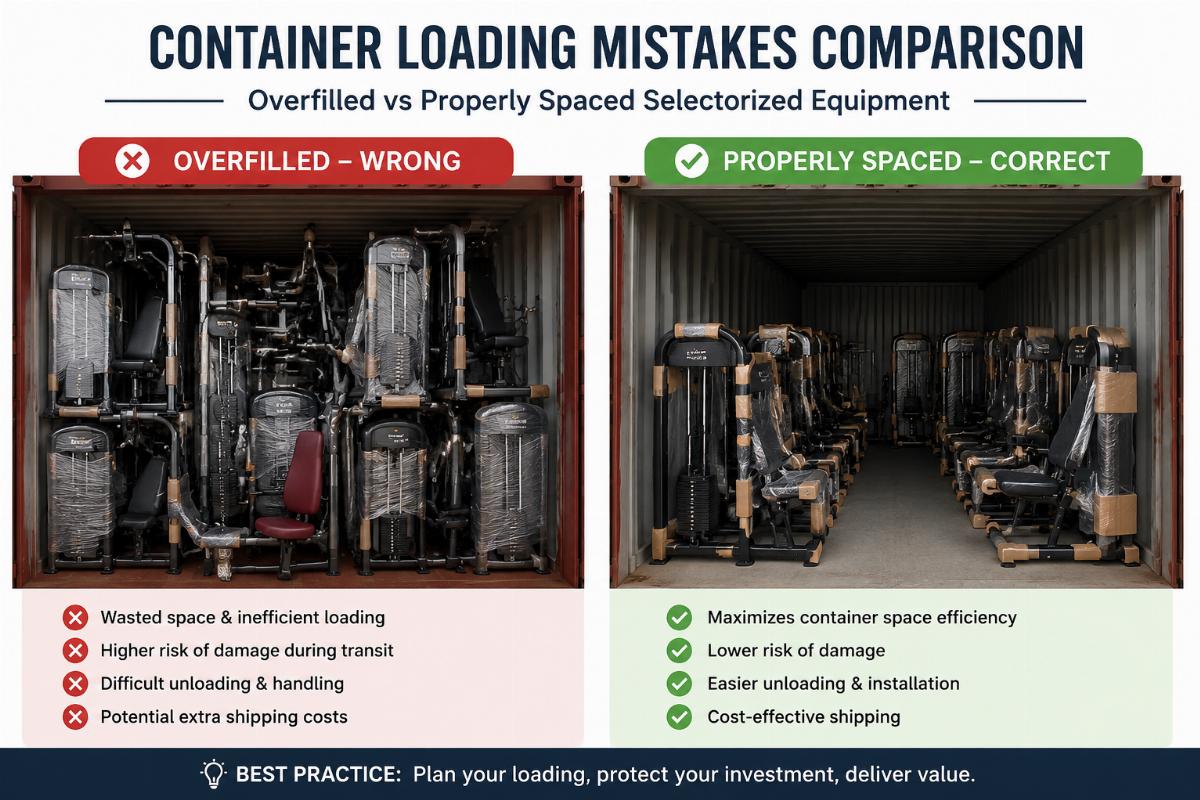
Avoid single-model stacking, ignoring knock-down packaging options, and overfilling without预留 space for destination handling—these errors lead to damaged goods, wasted CBM, and costly delays.
The most common mistake buyers make is ordering a single model in large quantities to meet MOQ requirements. While this seems logical from a production standpoint, it creates problems during loading and at destination. A container full of leg presses, for example, will hit the weight limit quickly, leaving unused volume. Worse, if the market demand for that single model is lower than expected, you’re stuck with excess inventory.
Another frequent error is shipping machines fully assembled to save on destination labor. This approach ignores the significant CBM savings available through knock-down packaging. A fully assembled selectorized machine might occupy 1.5 CBM, while the same machine in knock-down configuration takes only 1.0-1.2 CBM. Over a full container, that difference adds up to several additional units you could have shipped.
Overfilling the container is also problematic. While it seems counterintuitive, leaving 10-15% of the container space empty is actually beneficial. This space allows for proper weight distribution, securing of loads, and room for destination handling. A tightly packed container is more likely to suffer damage during transit, and unloading becomes more difficult and time-consuming.
A distributor in Southeast Asia learned this lesson the hard way. They ordered a full container of selectorized machines, fully assembled, with no预留 space. The container was so tightly packed that when it arrived at the port, the doors couldn’t be opened fully. The unloading crew had to carefully extract machines one by one, and several units were damaged in the process. The customer filed a claim, and the insurance process took months. Now, that distributor always orders with knock-down packaging and预留 space for handling.
Conclusion
Successful selectorized series container loading requires strategic model mixing, understanding of CBM optimization, and attention to packaging details.
By following a 4:4:2 model ratio, utilizing knock-down packaging, and avoiding common loading mistakes, you can maximize container efficiency while meeting market demand. The SX-900 series is designed with these principles in mind, offering modularity, standardized components, and flexible MOQs that support efficient procurement and shipping.