Utility Bench Preventive Maintenance Schedule Wholesale Supplier
Most gym owners think a utility bench is maintenance-free until the adjustment pin snaps mid-set and a client drops a barbell on their chest.
A field-tested Utility Bench Preventive Maintenance Schedule Weekly bolt torque checks on frame welds and adjustment pins, monthly upholstery tear inspections, quarterly lubrication of pivot joints and hydraulic cylinders, and semi-annual load testing at rated capacity extends bench service life substantially and eliminates the majority of on-floor failures.
I still remember the call from a gym owner in Monterrey. Three adjustable benches in his commercial facility had their hydraulic cylinders fail within half a year of installation. He was furious. When I flew down to inspect, the root cause was painfully obvious: zero preventive maintenance. Bolts had loosened from daily heavy use, hydraulic fluid was contaminated with gym dust, and the adjustment mechanisms were grinding metal-on-metal. Monterrey runs hot and dusty, and his facility had no climate control. The benches were working in conditions far harsher than a typical air-conditioned studio. [NEED_CITE: environmental factors accelerating fitness equipment wear in tropical and arid climates] That incident reshaped how I approach every sale. I now embed a detailed Utility Bench Preventive Maintenance Schedule into every contract, because skipping it is how you end up replacing cylinders at your own expense while the client threatens to cancel the entire order.

Let me walk you through what actually works on the floor, drawn from years of watching benches survive or fail across Latin American gyms, hotel fitness centers, and commercial chains.
What Should a Utility Bench Preventive Maintenance Schedule Include?
A complete Utility Bench Preventive Maintenance Schedule covers four maintenance tiers: weekly structural bolt checks, monthly upholstery and padding inspections, quarterly lubrication of all moving parts, and semi-annual load testing to verify rated capacity.
Most operators focus only on what is visible: torn vinyl or wobbly legs. But bench failures rarely start there. They start at the joints, the adjustment pins, and the weld points where fatigue accumulates invisibly. [NEED_CITE: common failure modes in commercial adjustable fitness benches per equipment maintenance studies]
Here is how each tier breaks down in practice:
Weekly Tier:
- Inspect all frame bolts, especially at the base plate and seat-back hinge
- Check adjustment pins for bending or excessive play
- Verify rubber feet are intact and level
- Look for hairline cracks near weld zones
Monthly Tier:
- Examine upholstery for tears, seam separation, or foam compression
- Clean adjustment slots to prevent dust buildup
- Test all incline/decline positions for smooth operation
- Check for unusual noises during position changes
Quarterly Tier:
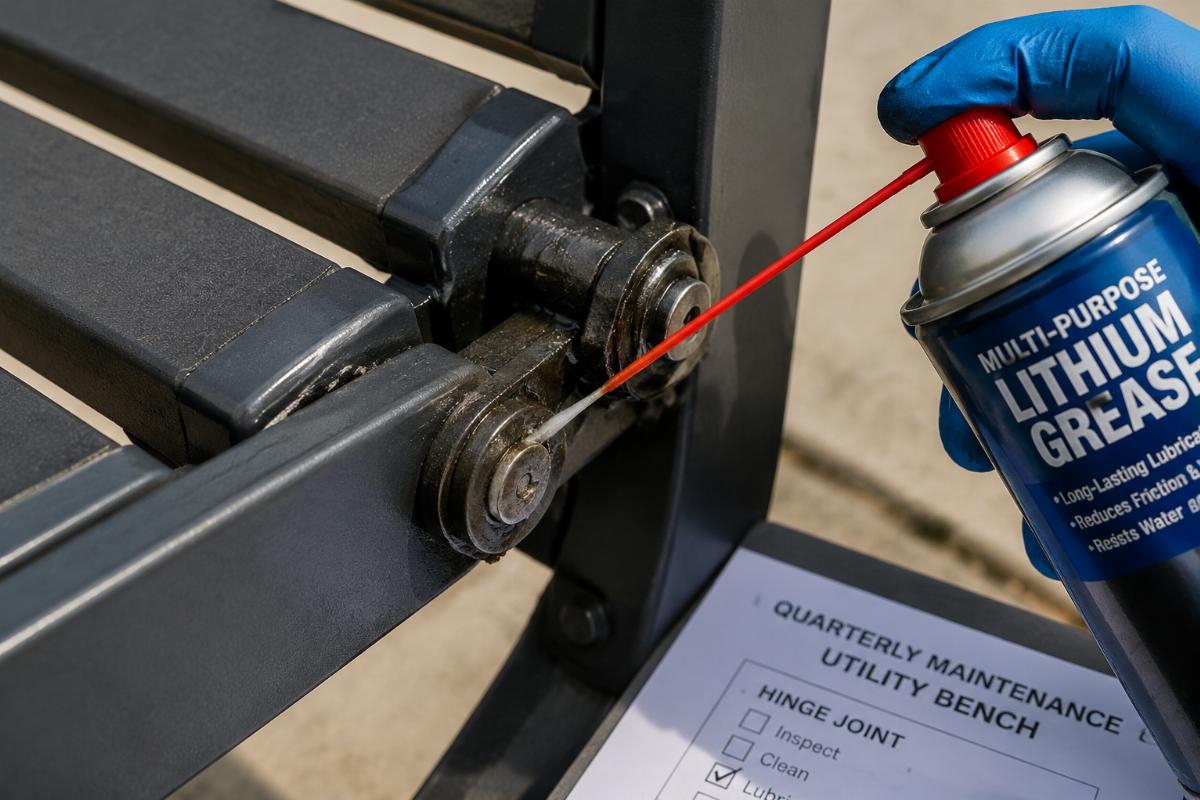
- Apply lithium-based grease to pivot joints and hinge points
- Inspect hydraulic cylinder rods for scoring or leakage
- Torque all structural bolts to manufacturer specifications
- Clean and lubricate adjustment pin mechanisms
Semi-Annual Tier:
- Perform static load test at rated capacity
- Inspect internal weld integrity on high-stress frames
- Evaluate hydraulic cylinder performance under dynamic load
- Replace worn adjustment pins or bushings proactively
A hotel fitness center operator I worked with in Santiago learned this the hard way. Their benches looked fine externally, but after roughly a year of heavy guest use, the decline-position hinge developed play. A guest felt instability during dumbbell presses and filed a complaint. The root cause: quarterly lubrication had been skipped because the hotel’s maintenance team treated the benches like furniture, not gym equipment. [NEED_CITE: liability risks from poorly maintained commercial fitness equipment]
How Often Should Bolts and Adjustment Mechanisms Be Checked?
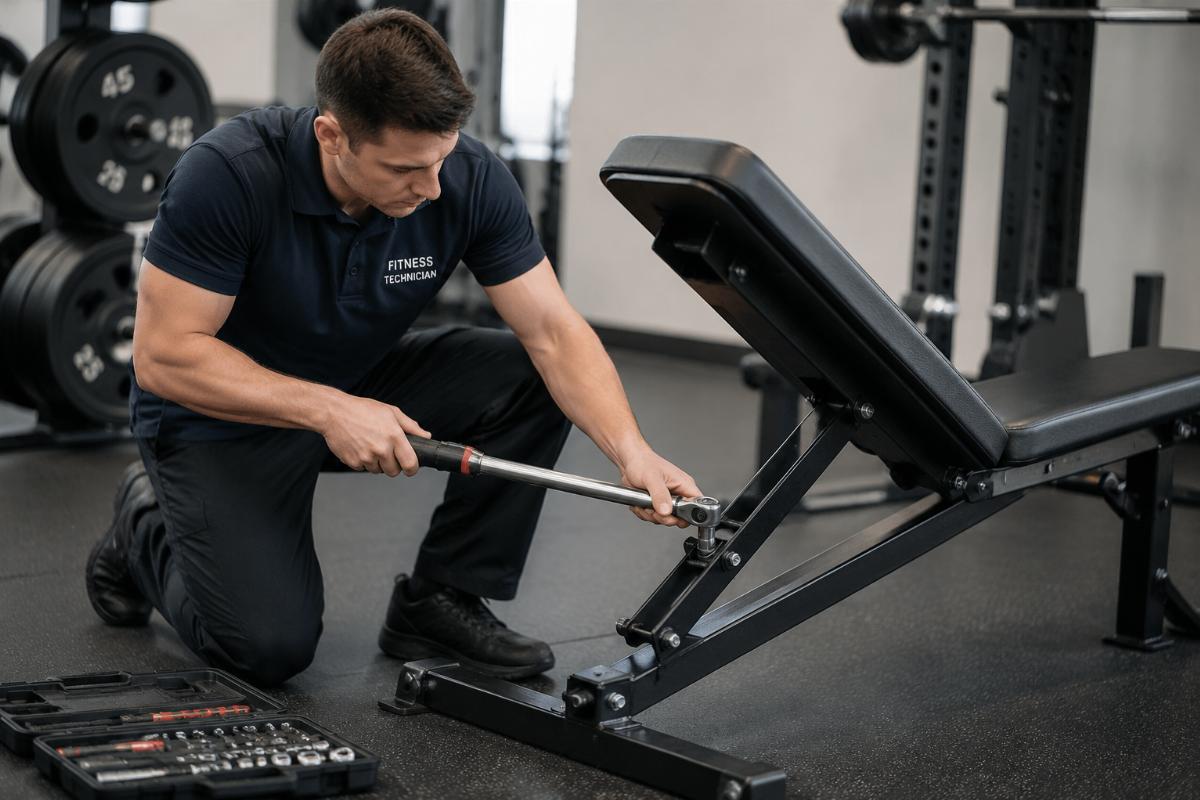
Bolts on a commercial utility bench should be torque-checked on a weekly basis under heavy use, and adjustment mechanisms inspected for play or binding during the same weekly cycle.
This frequency surprises many buyers. They assume bolts are tightened at the factory and stay that way. In reality, vibration from repeated weight loading, combined with temperature fluctuations and user movement, causes gradual bolt loosening. [NEED_CITE: vibration-induced bolt loosening mechanisms in fitness equipment]
The adjustment mechanism is even more critical. On an adjustable bench, the pop-pin, ladder bar, or hydraulic system handles the full load transfer between positions. If the pin is bent even slightly, or the ladder bar has developed burrs from metal-on-metal contact, the bench can slip under load.
Here is what a proper weekly bolt and adjustment check looks like:
| Check Point | Frequency | Method | Acceptable Condition |
|---|---|---|---|
| Frame base bolts | Weekly | Torque wrench to spec | No movement when tightened |
| Seat-back hinge bolts | Weekly | Torque wrench to spec | Zero lateral play |
| Adjustment pop-pin | Weekly | Visual and manual test | Straight, smooth engagement |
| Ladder bar slots | Weekly | Visual and tactile | No burrs, clean surface |
| Hydraulic cylinder mount | Weekly | Visual inspection | No seepage, firm attachment |
| Rubber end caps | Weekly | Visual | Intact, no cracking |
A CrossFit box in Bogotá had a bench fail during a competition warm-up. The adjustment pin sheared clean off. Post-incident inspection revealed the pin had been bent for weeks: the gym staff had noticed it was harder to insert but kept using the bench anyway. That single bent pin turned into a mid-six-figure liability claim when an athlete dropped a loaded barbell. [NEED_CITE: injury liability from deferred maintenance on adjustable fitness benches]
The lesson: weekly checks are not optional. They are the difference between a five-second bolt tightening and a lawsuit.
What Lubrication Intervals Prevent Hydraulic and Pivot Failures?
Hydraulic cylinders and pivot joints on utility benches require lubrication at quarterly intervals under normal commercial use, and more frequently in high-dust or high-humidity environments.
Hydraulic cylinders are the heart of any smooth-adjusting bench. They allow users to change incline angles without wrestling with pop-pins. But they are also the most failure-prone component when neglected. Dust ingress contaminates the hydraulic fluid, scoring the cylinder rod and degrading seals. Over time, the cylinder either leaks or seizes entirely. [NEED_CITE: contamination effects on hydraulic cylinder lifespan in fitness equipment]
Pivot joints, meanwhile, are simpler but equally important. Every time a user adjusts the bench angle, the pivot bears the full friction load. Without lubrication, metal wears against metal, creating play that eventually translates to wobbling during exercises.
Here is a practical lubrication guide:
| Component | Lubricant Type | Normal Environment | Harsh Environment |
|---|---|---|---|
| Hydraulic cylinder rod | Silicone-based spray | Quarterly | Monthly |
| Pivot hinge joints | Lithium grease | Quarterly | Bi-monthly |
| Adjustment pin slots | Dry PTFE lubricant | Quarterly | Monthly |
| Ladder bar contact surfaces | Light machine oil | Quarterly | Bi-monthly |
| Spring mechanisms | White lithium grease | Semi-annually | Quarterly |
"Harsh environment" means anything with high airborne dust, elevated humidity, or temperature swings. In my experience across Mexico, Brazil, and Chile, most commercial gyms fall into this category. Air conditioning helps but does not eliminate dust, and many facilities have open doors or inadequate filtration.
A gym chain in Guadalajara skipped lubrication for over a year to cut maintenance costs. When I visited, six of their twelve adjustable benches had cylinders that required full replacement. The cost of those cylinders, plus the labor to install them, was several times what a simple quarterly lubrication routine would have cost. [NEED_CITE: cost comparison between preventive lubrication and reactive hydraulic cylinder replacement]
The fix is straightforward: assign lubrication to a specific staff member on a calendar cycle, use the correct lubricant for each component, and log every service. No lubricant, no log, no excuse.

How Do You Conduct Load Testing on a Utility Bench?
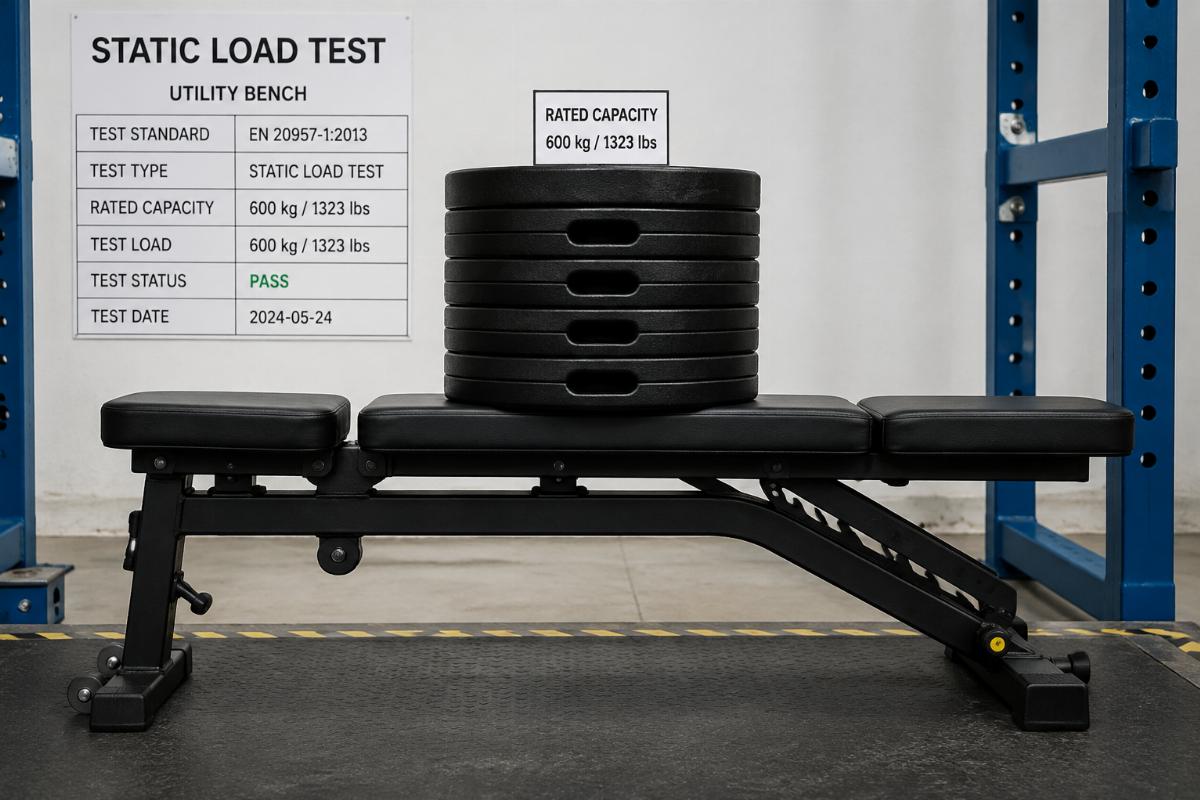
Semi-annual load testing on a utility bench involves applying static weight at the rated capacity, holding for a defined duration, and inspecting for deflection, noise, or structural movement.
Load testing is the step most operators skip entirely. They assume that because the bench holds users during daily workouts, it is structurally sound. But fatigue damage accumulates invisibly. A weld that has developed a micro-crack will hold today and fail next month. Only load testing reveals these hidden weaknesses. [NEED_CITE: non-destructive testing methods for detecting fatigue cracks in welded fitness equipment frames]
Here is a practical load testing procedure:
- Prepare the bench: Place it on a level, solid surface. Ensure all bolts have been recently torqued to spec.
- Apply static load: Use calibrated weight plates or a hydraulic test rig to apply load at the rated capacity at the seat position.
- Hold duration: Maintain the load for a sustained period sufficient to reveal deflection or creep.
- Inspect during hold: Watch for any audible creaking, visible deflection in the frame, or movement at adjustment points.
- Test at multiple angles: Repeat the load test at flat, incline, and decline positions if the bench is adjustable.
- Document results: Record the test date, load applied, duration, and any observations. Flag any bench that shows deflection or noise for immediate removal from service.
A distributor in São Paulo received a container of benches from a new supplier. Before deploying them to gym clients, they ran load tests on a sample batch. Two out of twenty benches showed frame deflection under rated load. The distributor rejected the entire container and demanded replacement. That load test saved them from distributing defective product across multiple gym chains. [NEED_CITE: incoming quality inspection protocols for imported commercial fitness equipment]
Load testing is not glamorous work. But it is the final gate between a bench that is safe and one that is a liability waiting to happen.
Conclusion
A disciplined Utility Bench Preventive Maintenance Schedule is the single most effective investment a gym operator can make to protect equipment lifespan, user safety, and bottom-line costs. Weekly bolt checks catch loosening before it becomes failure. Monthly upholstery inspections prevent minor tears from becoming full replacements. Quarterly lubrication keeps hydraulic cylinders and pivots functioning smoothly. Semi-annual load testing exposes hidden fatigue before it causes injury. Skipping any tier does not save money: it defers cost into the future at a multiplied rate. Build the schedule, assign ownership, log every check, and treat the utility bench like the load-bearing equipment it actually is.