
Buy Commercial Gym Equipment with CE Certificate | Wholesale Supplier
A CE certificate is not just a piece of paper—it is an entire technical compliance dossier, and buyers who only check the certificate scan are setting themselves up for customs seizures, liability exposure, and warranty voids.
When you set out to buy exercise equipment with CE certificate documentation, the single most important thing to understand is that genuine CE compliance for commercial fitness machinery involves a complete technical file: design drawings, risk assessments, test reports aligned with the Machinery Directive (2006/42/EC), and a signed EU Declaration of Conformity. A standalone certificate with no supporting technical package is essentially worthless at the port of entry. [NEED_CITE: EU Machinery Directive 2006/42/EC technical file requirements] I learned this the hard way after a Middle East hotel project nearly stalled at customs because the supplier’s "CE certificate" turned out to be a self-declared label with zero third-party test backing. Since then, I never approve a container load without first auditing the full compliance file.
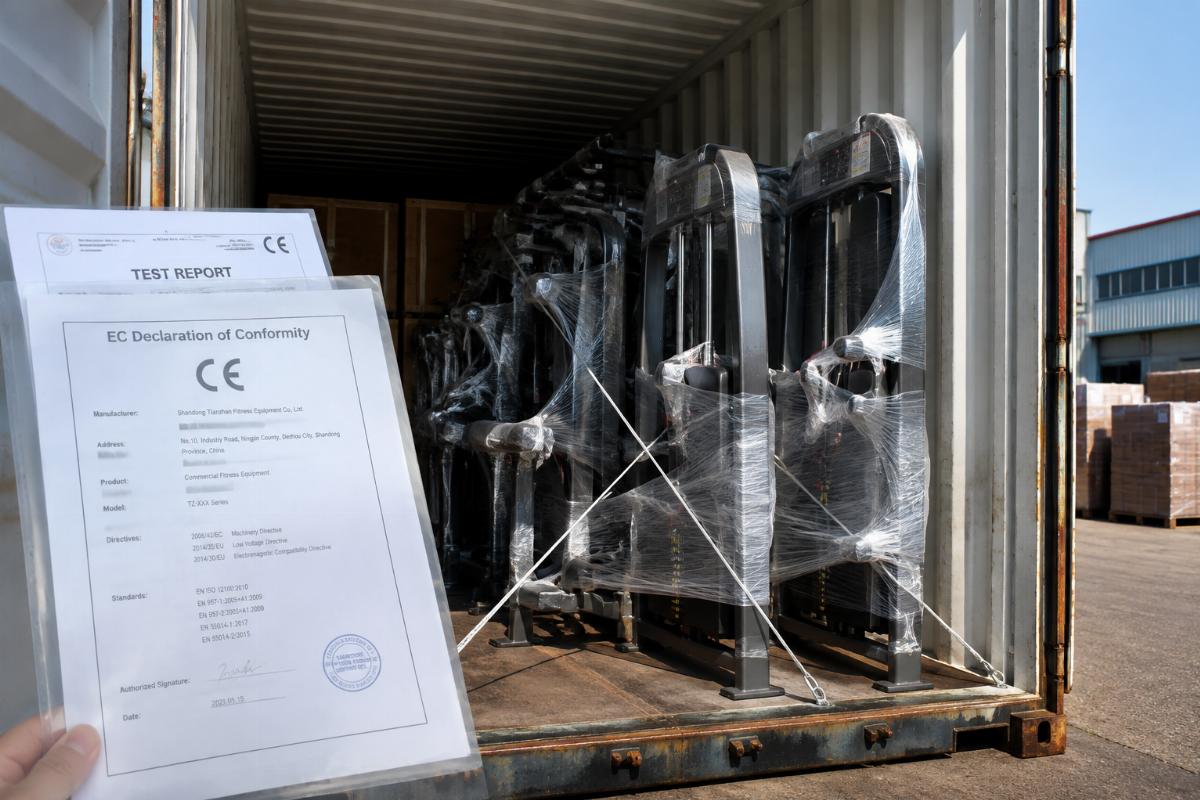
Let me walk you through what actually matters when sourcing commercial-grade fitness equipment from overseas manufacturers, based on years of standing on factory floors and watching containers get sealed.
What Does CE Certification Actually Mean for Exercise Equipment?
CE marking on commercial gym equipment confirms that the machine meets essential health, safety, and environmental protection requirements set by the European Union, but the real substance lies in the technical construction file behind the mark.
Many importers treat CE as a sticker to slap on a product listing. The reality is far more layered. Under the Machinery Directive, any motorized or mechanically complex fitness equipment—commercial treadmills, cable crossover machines, Smith machines with load-bearing frames—falls under Category II or higher machinery, meaning a notified body assessment may be required for certain risk components. [NEED_CITE: Notified body requirements under EU Machinery Directive for fitness equipment]
Here is what a legitimate CE compliance package should contain:
| Document Type | Purpose | Verification Level |
|---|---|---|
| EU Declaration of Conformity | Manufacturer’s legal commitment to compliance | Must reference specific directives and harmonized standards |
| Technical Construction File | Design drawings, BOM, calculations | Should be requestable and auditable |
| Risk Assessment Report | Hazard identification and mitigation measures | Must cover all user-accessible moving parts |
| Test Reports | Load testing, electrical safety, EMC | Preferably from accredited third-party labs |
| User Manual (EU languages) | Safety instructions in required languages | Mandatory for market access |
When a supplier hands you a single-page certificate and calls it a day, that is a red flag. I once reviewed a batch of plate-loaded machines where the "CE certificate" listed product categories that did not even match the equipment being shipped—someone had clearly copied a template. [NEED_CITE: Common CE certificate fraud patterns in fitness equipment imports]
The practical implication for buyers: always request the full technical file before committing to production. If a supplier hesitates or claims the documents are "confidential," you are likely dealing with a workshop that has never gone through genuine conformity assessment.

How to Verify a Supplier’s CE Claims Before Placing Orders
Verification is a multi-step process that goes far beyond asking for a certificate scan—you need to cross-reference the issuing body, audit the test report scope, and confirm the technical file covers your exact product configuration.
The first move is checking whether the certificate was issued by a legitimate notified body or if it is merely a self-declaration. The European Commission maintains a public database of notified bodies under the NANDO system, and any serious supplier should be able to provide a certificate number that traces back to an entry in that system. [NEED_CITE: NANDO database verification for CE notified bodies]
Here is a practical verification workflow I use for every new sourcing relationship:
-
Request the full technical file package—not just the certificate, but the Declaration of Conformity, test reports, and risk assessment. A supplier who cannot produce these within a reasonable timeframe is not CE-compliant.
-
Cross-check the notified body number against the NANDO database. Self-declared CE for high-risk machinery categories is a compliance violation, not a shortcut.
-
Verify test report scope matches your product. I have seen cases where a supplier’s test report covered a basic flat bench, but the buyer was ordering a motorized Smith machine with entirely different risk profiles. The test report must cover the specific model and configuration you are purchasing.
-
Request electrical safety and EMC test documentation for any motorized equipment. Commercial treadmills and ellipticals require specific low-voltage directive compliance and electromagnetic compatibility testing. [NEED_CITE: Low Voltage Directive and EMC Directive requirements for motorized fitness equipment]
-
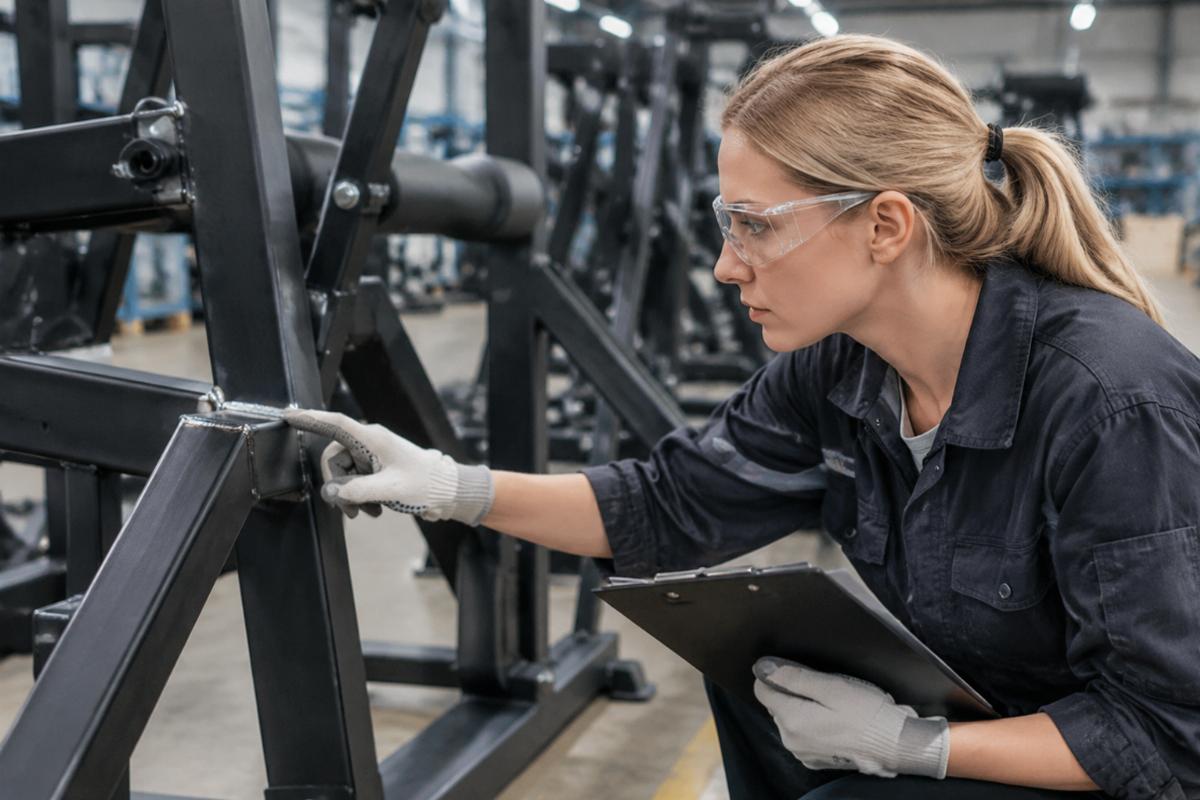
Ask for sample units or factory audit access before committing to a full container order. Physical inspection of weld quality, frame thickness, and cable routing tells you more than any document.
A distributor in North Africa once shared a painful lesson with me: they imported a full container of selectorized machines based solely on a PDF certificate. At the port, customs requested the underlying test reports, which the supplier could not produce. The entire shipment was held for months, incurring demurrage charges that dwarfed the original equipment cost. That is the kind of hidden expense that destroys margins.
What Specifications Should You Compare When Buying Commercial Equipment
Steel gauge, welding工艺, load rating, and motor specifications form the core comparison matrix—surface-level features and cosmetic differences are distractions from what actually determines equipment lifespan.
When you are evaluating competing quotes to buy exercise equipment with CE certificate backing, the temptation is to compare feature lists and price tags. But in commercial environments where machines run twelve to sixteen hours daily, the structural and mechanical specifications are what separate equipment that lasts a decade from equipment that needs replacement in two years.
Here is the comparison framework I apply:
| Specification | Entry-Level | Commercial-Grade | What to Verify |
|---|---|---|---|
| Frame Steel Thickness | Thin-wall tubing | Heavy-gauge rectangular steel | Request mill certificates or ultrasonic thickness measurement |
| Welding Process | Manual spot welds | Continuous MIG/TIG with post-weld treatment | Inspect weld seams for porosity and penetration depth |
| Load Capacity Rating | Light-duty classification | Full commercial load rating | Must align with EN ISO 20957 testing standards |
| Cable and Pulley System | Standard nylon cables | Steel-core cables with sealed bearings | Check cable tensile rating and pulley bearing grade |
| Motor (Cardio Equipment) | Residential-grade motors | Commercial AC motors with thermal protection | Verify continuous duty rating, not just peak output |
| Upholstery | Basic vinyl | Commercial-grade vinyl with antimicrobial treatment | Check tear resistance and seam construction |
[NEED_CITE: EN ISO 20957 stationary training equipment safety requirements]
The welding point deserves special emphasis. I started my career as a welder on the shop floor, and I can tell you that a weld seam tells you everything about a manufacturer’s quality discipline. Proper commercial equipment requires continuous welds with full penetration, ground smooth and treated against corrosion. I once inspected a batch of power racks where the supplier had used intermittent tack welds on the main uprights—a shortcut that creates stress concentration points and eventual crack propagation under repeated loading. That equipment would have failed within months in a high-traffic gym.
Another critical comparison point is the packaging and shipping preparation. Commercial fitness equipment is heavy and geometrically awkward. Without proper crating, foam protection, and internal bracing, ocean freight vibration will loosen bolts, crack welds, and damage electronic components. I now insist on reviewing packaging specifications before approving any shipment, including whether the supplier uses secondary bracing inside the container. [NEED_CITE: Ocean freight packaging standards for heavy fitness equipment]

How to Structure a Turnkey Gym Package Order for Maximum Value
Strategic equipment mix planning and container consolidation are the most effective levers for reducing per-unit landed cost while ensuring your facility has balanced functionality.
Ordering individual machines one by one is the most expensive way to outfit a commercial gym. The smart approach is to structure a comprehensive package that balances cardio, strength, and free weight zones according to your member demographics and floor plan, then consolidate everything into optimized container loads.
When I work on turnkey gym projects, the equipment allocation typically follows a pattern:
-
Cardio zone: Treadmills, ellipticals, exercise bikes, and rowing machines form the high-visibility entry area. These are your highest maintenance items, so prioritize commercial-grade motors and accessible service panels.
-
Selectorized strength zone: Pin-loaded machines for each major muscle group provide intuitive operation for general members. A complete line should cover chest press, lat pulldown, leg press, leg extension/curl, shoulder press, and cable crossover functions.
-
Plate-loaded and free weight zone: Smith machines, power racks, bench stations, dumbbell sets, and Olympic plate storage serve serious lifters and personal training clients. This zone has the lowest maintenance cost but highest durability requirements.
-
Functional training zone: Functional trainers, battle ropes, plyo boxes, and stretching equipment fill the remaining space and attract group class participants.
The container consolidation strategy matters enormously. A standard high-cube container can hold a surprising amount of equipment if loaded efficiently. Plate-loaded machines nest inside each other, benches stack, and dumbbells fill void spaces. I have seen poorly planned loading waste nearly a third of available container volume, while optimized loading plans push utilization to near capacity. [NEED_CITE: Container loading optimization methods for fitness equipment]
For buyers in regions with limited local manufacturing—across the Middle East, Africa, Southeast Asia, and Latin America—a full turnkey package from a single source eliminates compatibility headaches and simplifies warranty claims. You get one point of contact for the entire facility rather than juggling multiple vendors.

What Hidden Costs Should You Budget Beyond the Equipment Price
Shipping insurance, customs clearance, installation labor, and spare parts inventory are the four major cost categories that catch unprepared buyers off guard—and they can collectively exceed the equipment purchase price.
The equipment invoice is just the starting point. When you buy exercise equipment with CE certificate documentation for international delivery, the total landed cost includes several layers that are easy to overlook during budgeting.
Shipping and insurance: Ocean freight rates fluctuate, and commercial gym equipment is heavy. Insurance is non-negotiable—transit damage on a container of Smith machines or cable crossovers can result in structural compromises that are not visible until the equipment is under load. I always recommend full-coverage marine insurance rather than relying on carrier liability limits.
Customs clearance and duties: CE compliance documentation directly affects how smoothly your shipment clears customs. Incomplete or questionable certification triggers inspection holds, document requests, and potentially re-export orders. Having your technical file organized and readily available prevents delays that accumulate demurrage charges daily. [NEED_CITE: Customs clearance documentation requirements for fitness equipment imports]
Installation and commissioning: Commercial equipment requires assembly, leveling, and functional testing. Factor in local labor costs for certified technicians who can handle electrical connections for motorized equipment and structural anchoring for heavy frames.
Spare parts and maintenance inventory: Cables, pulleys, upholstery pads, selector pins, and electronic control boards are wear items. Ordering a spare parts package alongside your initial equipment order—typically including high-wear consumables for the first year of operation—prevents downtime when components need replacement. Waiting to source parts individually after a breakdown means extended equipment outages and member dissatisfaction.
A hotel developer I worked with in the Gulf region learned this lesson when their cardio equipment started showing electronic faults within months. The original supplier had no spare parts inventory program, and sourcing replacement control boards from overseas took weeks each time. The solution was establishing a standing spare parts agreement that keeps critical components in local stock.

Conclusion
Buying CE-certified commercial exercise equipment is a technical procurement process, not a simple product purchase—treat it with the rigor it demands.
Verify the full compliance file before ordering, compare structural specifications rather than surface features, plan your equipment mix strategically, and budget for the complete landed cost including insurance, customs, installation, and spare parts. Suppliers who can demonstrate genuine CE compliance through complete documentation, combined with commercial-grade construction and turnkey packaging capabilities, will deliver equipment that performs reliably for years rather than creating expensive problems from day one.


