
Chest Press Machine Wholesale Supplier: Factory Direct OEM 2026
Most buyers assume OEM means swapping a logo plate — the real cost gap hides in weld penetration depth and upholstery foam density.
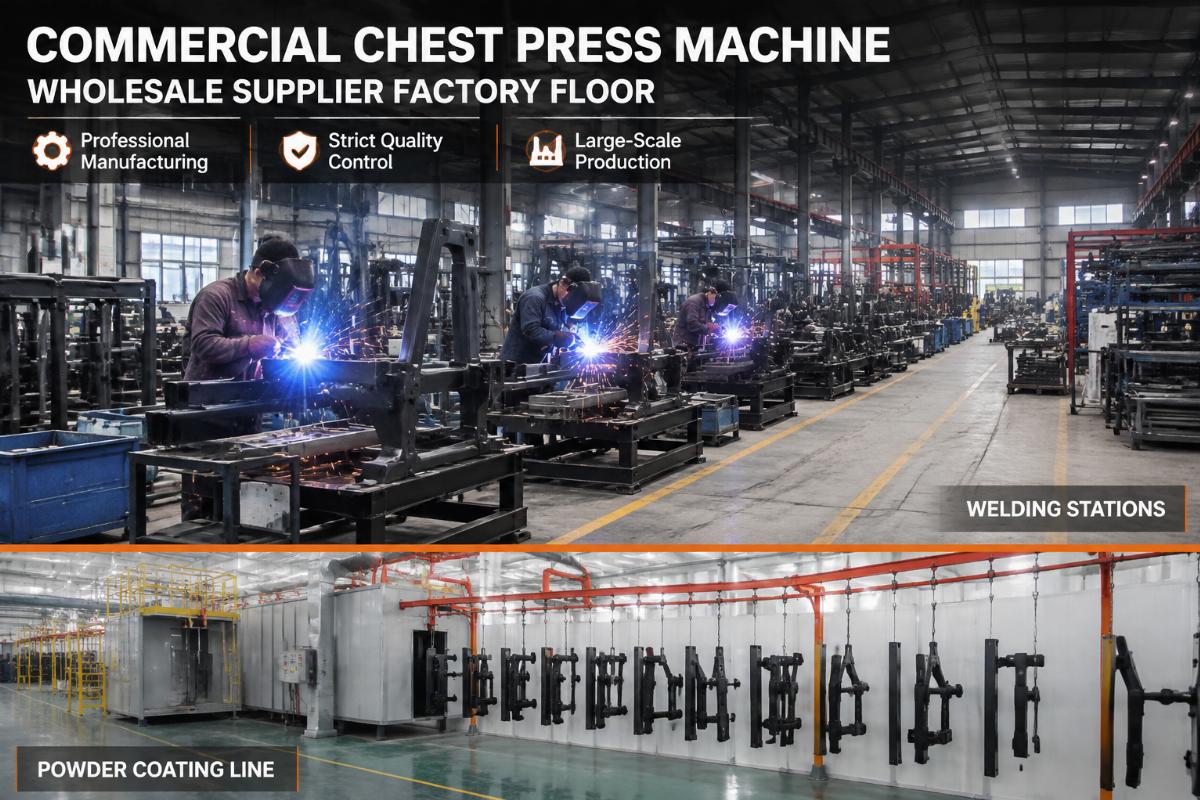
A reliable chest press machine wholesale supplier must hold CE certification aligned with EN957, operate a verifiable production line with in-house welding and powder-coating, and provide documented after-sales response within a defined window.
Every FIBO and IHRSA show I walk through, the same pattern repeats — buyers arrive with spec sheets from premium brands, collect quotes that come in at half the price, then discover months later that selectorized weight stack tolerances, linear guide rail smoothness, and stitch reinforcement on the seat pad are nowhere near what was promised. I have toured dozens of commercial equipment plants across Shandong Province over the years, and the older generation of factory hands drilled one habit into me: touch the machine before you discuss the price. At a Chicago expo, a distributor from the Gulf region told me his previous supplier shipped a batch of branded chest presses to Riyadh, and the selectorized pin holes were off by several millimeters — the entire batch had to be reworked on-site. That story stuck with me. OEM is not about slapping a decal on a frame; it is about every weld seam and every vinyl seam surviving an unannounced floor inspection. [NEED_CITE: EN957 stationary training equipment safety requirements and test methods]
If you are sourcing at scale, the questions below separate suppliers who can actually deliver from those who merely quote.
What Defines a Reliable Chest Press Machine Wholesale Supplier?
Three non-negotiable filters separate a production-capable partner from a trading-company middleman: recognized safety certification, verifiable in-house manufacturing steps, and a documented spare-parts pipeline.
Let me break each one down with what I have actually seen on factory visits.
First, certification. A legitimate chest press machine wholesale supplier will hold CE marking tested against EN957 standards for stationary training equipment. This is not a sticker you buy online — it requires third-party lab testing of load-bearing frames, pinch-point guards, and warning label compliance. [NEED_CITE: CE marking requirements for fitness equipment under EU Machinery Directive] I have walked into showrooms where the displayed machine carried a certificate, but the production batch shipped to the buyer used thinner gauge tubing that was never submitted to the lab. Always request the test report number and cross-check it against the notified body’s database.
Second, manufacturing depth. A real factory controls at least three critical processes in-house: laser cutting of frame components, MIG/TIG welding of the main structure, and electrostatic powder coating. When a supplier outsources welding to a nearby shop and only handles assembly, you lose traceability on weld penetration — the single biggest fatigue-risk factor on a chest press frame. [NEED_CITE: welding quality impact on structural fatigue in fitness equipment frames] During a visit to a Shandong facility, I watched their QC team pull random frames off the line for ultrasonic weld inspection — that level of process control is what separates a chest press machine wholesale supplier you can trust from one you cannot.
Third, after-sales infrastructure. Commercial gym operators cannot wait weeks for a replacement cam or cable pulley. A credible supplier maintains a spare-parts inventory mapped to every SKU they produce and commits to dispatch timelines written into the purchase contract.
| Verification Point | What to Request | What It Proves |
|---|---|---|
| Safety Certification | CE test report number + notified body ID | Compliance with EN957 |
| Welding Process | In-house MIG/TIG with documented WPS | Structural fatigue resistance |
| Coating Line | Electrostatic powder coating with film-thickness logs | Corrosion resistance |
| Spare Parts | Written SLA with dispatch timeline | Operational uptime guarantee |

Factory Direct vs Brand: Where Does the Price Gap Come From?
The price difference between a premium branded chest press and a factory-direct equivalent is driven by distribution layers, not by material or engineering compromises.
This is the single biggest misconception I encounter. Buyers see a quoted price that is substantially below a well-known brand and immediately assume something is wrong with the steel or the bearings. In reality, the cost structure tells a different story.
A branded machine sold through regional distributors typically carries markups at three stages: the brand’s own margin, the exclusive distributor’s margin, and the local dealer’s margin. Each layer adds logistics handling, warehousing cost, and profit. Strip those away and you are left with the actual manufacturing cost — frame steel, guide rails, upholstery, selectorized weight stack, assembly labor, and factory overhead. [NEED_CITE: commercial fitness equipment cost structure breakdown by distribution channel]
I sat down with a procurement manager from a gym chain operating across multiple regions. They compared their previous branded purchase against a factory-direct order from a Shandong-based chest press machine wholesale supplier. The per-unit hardware cost difference was dramatic, but what surprised them was the specification comparison:
| Specification | Premium Brand | Factory Direct Equivalent |
|---|---|---|
| Frame Tubing | Heavy-gauge steel | Same gauge, verifiable via caliper |
| Guide Rail System | Linear bearing | Same class linear bearing |
| Seat Upholstery | High-density foam + vinyl | Comparable density, stitched reinforcement |
| Weight Stack | Selectorized pin-lock | Same mechanism, tolerance verified |
| Warranty | Multi-year | Comparable terms via contract |
The key word is verifiable. A responsible chest press machine wholesale supplier will let you send a third-party inspector to measure tube wall thickness with an ultrasonic gauge, test guide rail smoothness under load, and inspect foam density before shipment. [NEED_CITE: material verification methods for commercial fitness equipment procurement]
One Middle East distributor I worked with initially hesitated at a factory-direct quote that was nearly half the branded alternative. After sending an inspection team to the Shandong plant, they confirmed the steel grade, weld quality, and coating thickness matched their requirements. They placed a full container order and redeployed the savings into additional SKU variety for their showroom.

How to Verify OEM Quality Before Placing Bulk Orders?
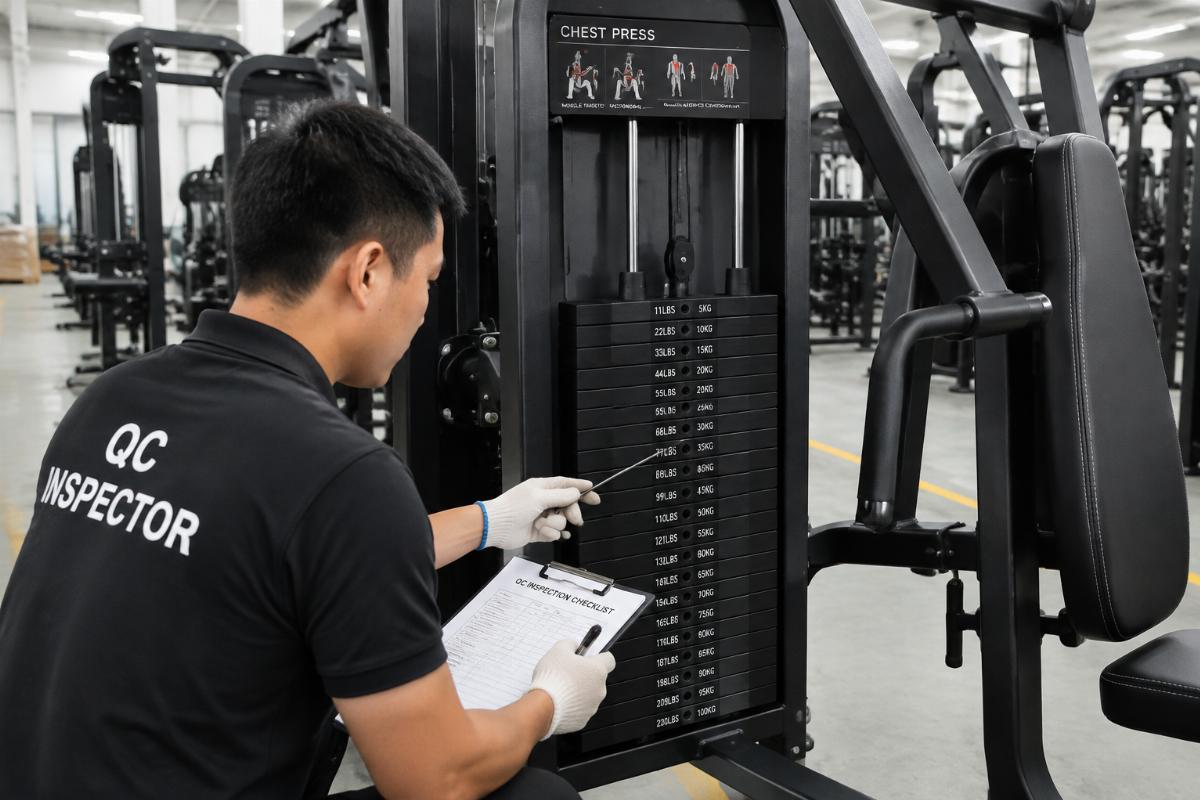
A structured four-point inspection checklist — covering weld integrity, guide rail function, weight stack tolerance, and upholstery durability — eliminates the majority of post-delivery quality disputes.
Here is the verification protocol I recommend to any buyer working with a chest press machine wholesale supplier for the first time.
Step 1: Weld Integrity Audit
Request cross-section photos of sample welds on the main frame joints. The weld should show full penetration with no visible porosity or undercut. On a production visit, ask the QC manager to perform a random pull from the line and demonstrate a dye-penetrant test. [NEED_CITE: weld inspection methods for fitness equipment structural frames] I once saw a batch where the supplier had switched from full MIG welds to intermittent tack welds mid-production to speed up throughput — the frames cracked under normal gym use within months.
Step 2: Guide Rail and Cable Path Test
Load the weight stack to maximum and cycle the press arm through its full range of motion. The movement must be smooth with no binding, grinding, or lateral play. Check that the cable routing does not contact any sharp frame edges. A well-built chest press machine wholesale supplier uses sealed linear bearings and routes cables through nylon-lined guides.
Step 3: Weight Stack Tolerance Check
Measure the selectorized pin holes across the entire stack. Hole-to-hole positional tolerance must be consistent — even a small deviation across multiple plates will cause the pin to jam or slip. [NEED_CITE: machining tolerance standards for selectorized weight stacks] I recall a Gulf distributor receiving a shipment where the pin holes drifted enough that the pin would not seat properly on several plates. The entire stack had to be re-drilled at the destination gym — a costly and reputation-damaging fix.
Step 4: Upholstery and Stitch Inspection
Press your thumb firmly into the seat and back pad. The foam should rebound immediately with no permanent deformation. Inspect the vinyl stitching — double-stitched seams with reinforced stress points are standard on commercial-grade equipment. Ask the supplier for a vinyl sample and perform a flex-crack test if possible.
| Inspection Point | Pass Criteria | Common Failure |
|---|---|---|
| Weld Joints | Full penetration, no porosity | Tack welds, visible cracks |
| Guide Rail | Smooth full-range travel | Binding, lateral play |
| Weight Stack Holes | Consistent positional tolerance | Drift causing pin jam |
| Upholstery | Immediate foam rebound, double-stitch | Single-stitch, foam compression |
What’s the Smartest Way to Structure a Container-Load Order?
Mixing strength machines, cardio units, and free-weight accessories in a single container dramatically reduces per-unit shipping cost and maximizes showroom readiness upon arrival.
This is where many first-time importers leave money on the table. They order a single machine type, fill a container with identical boxes, and pay the same ocean freight as someone who filled that container with a diversified gym package.
A seasoned chest press machine wholesale supplier will offer full gym outfitting packages that combine selectorized strength machines, plate-loaded equipment, cable crossovers, Smith machines, free-weight racks, dumbbells, benches, and cardio units — all engineered to nest efficiently inside a standard shipping container. [NEED_CITE: container loading optimization strategies for commercial fitness equipment]
Consider the loading geometry. A seated chest press is bulky but has usable void space inside its frame cavity. A set of dumbbells or weight plates can fill that void. Flat-foldable benches stack vertically. Cable crossover frames can be partially disassembled. When a supplier plans the load at the factory rather than leaving it to a generic freight forwarder, the container utilization rate jumps significantly.
I worked with a hotel project developer in Southeast Asia who needed to equip a mid-size fitness center. Their initial plan was to source cardio from one vendor and strength from another — two separate containers, double the port fees, double the inland transport cost. By consolidating through a single chest press machine wholesale supplier with a full product range, they fit the entire project into fewer containers. The per-unit freight cost dropped noticeably, and every piece arrived on the same timeline, simplifying installation scheduling.
| Order Strategy | Container Utilization | Freight Cost Per Unit | Installation Coordination |
|---|---|---|---|
| Single-Machine Full Container | Moderate | Higher | Simple but limited range |
| Multi-Vendor Split Orders | Low per container | Highest | Complex scheduling |
| Consolidated Gym Package | High | Substantially lower | Single delivery timeline |
The consolidation approach also simplifies customs clearance. One commercial invoice, one set of import documents, one inspection cycle at the destination port. For distributors building inventory across multiple product categories, this reduces administrative overhead and accelerates time-to-showroom.

Conclusion
Sourcing a chest press machine wholesale supplier that delivers on OEM promises requires verifying certification depth, inspecting manufacturing process control, and structuring orders to exploit container-loading efficiency. The price advantage of factory-direct procurement is real, but it only materializes when the buyer invests in pre-shipment verification and consolidates shipments strategically. Skip the verification step, and the savings evaporate in rework costs and reputation damage.


