Commercial Bench Press Bench Selection for Powerlifting Gyms OEM Supplier
A wider bench is not always more stable. In fact, if it exceeds the IPF-regulated width, your athletes will be disqualified mid-lift.
Powerlifting gyms must source bench press benches that meet IPF dimensional tolerances, use commercial-grade steel with verifiable load ratings, and feature upholstery of appropriate density and thickness. Non-compliant benches risk competition disqualification, premature structural fatigue, and costly post-delivery modifications.
I still remember a container that arrived in Jebel Ali a few years back. The client, a regional fitness chain, had ordered a batch of flat benches for a new powerlifting zone. Everything looked solid on paper—thick upholstery, heavy-gauge frame, clean welds. But when the crates were opened on-site, the bench tops measured wider than IPF competition limits. The gym was preparing to host a sanctioned meet within weeks. The fix? Cutting down every bench pad, re-wrapping the vinyl, and re-drilling mounting holes. The rework cost nearly matched the original freight. That kind of mistake doesn’t just burn cash—it burns credibility with the athletes who showed up expecting a regulation platform. Since then, I have made it a habit to cross-check every bench dimension against current IPF technical rules before a single piece goes into production. [NEED_CITE: IPF technical rules define exact bench width, length, and height ranges for competition approval]

Getting the spec right from the start is not optional—it is the foundation of a functional powerlifting zone. Let me walk you through what actually matters.
What Bench Dimensions Does IPF Require for Competition?
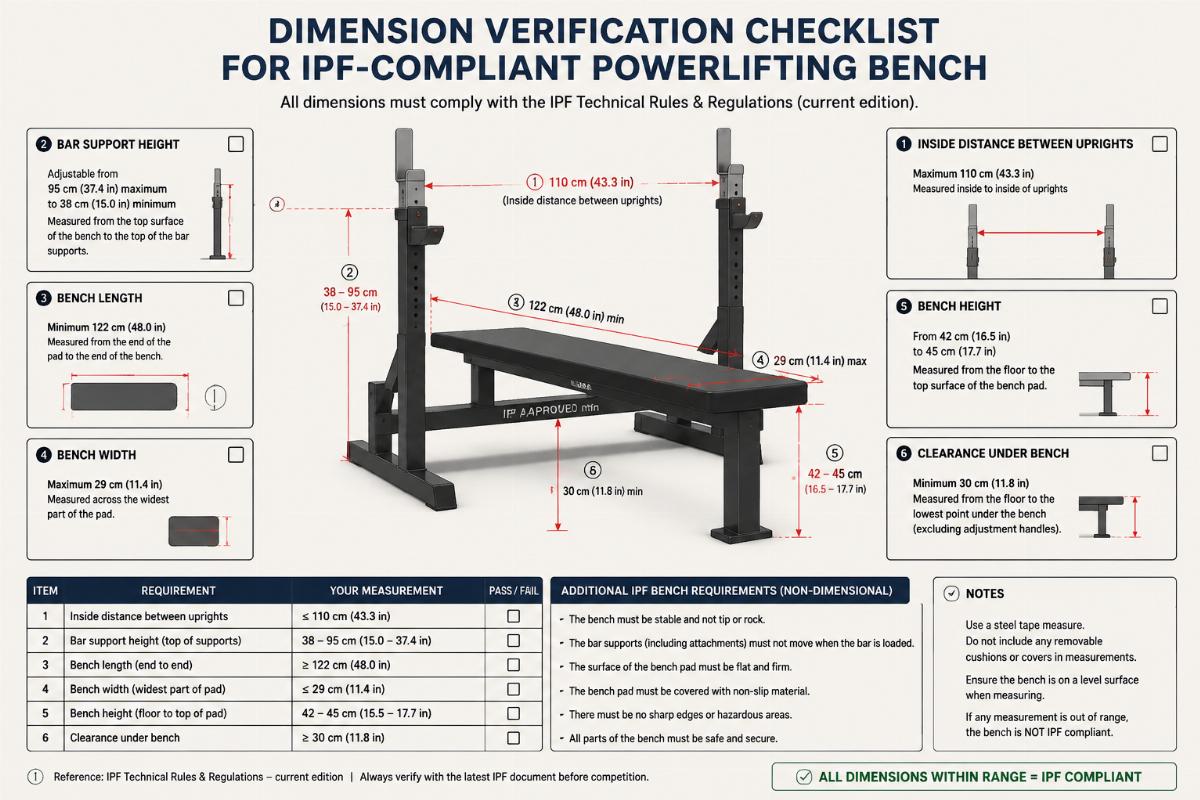
The IPF sets strict ranges for bench length, width, and height, and any bench used in sanctioned competition must fall within those tolerances.
The International Powerlifting Federation’s technical rules specify that a competition bench must have a flat, un-upholstered surface (meaning the pad itself must conform) with a length between a defined minimum and maximum, a width within a narrow band, and a height from the platform to the top of the pad within another set range. The exact figures are published in the IPF rulebook and are updated periodically, so sourcing teams should always verify against the latest edition rather than relying on memory or outdated supplier catalogs. [NEED_CITE: IPF equipment rules specify bench length, width, and height tolerance ranges]
Here is where most buyers trip: they assume "powerlifting bench" is a generic label. It is not. A bench built for a general commercial gym floor may be perfectly serviceable for recreational lifters but completely out of spec for sanctioned lifts. The width, in particular, is a common failure point. Some manufacturers produce benches that are noticeably wider to give a "more stable" feel—counterintuitively, that extra width pushes the bench outside legal limits and forces the lifter into a wider grip arc that compromises shoulder mechanics.
A distributor in the Middle East learned this the hard way. Their first order of flat benches arrived without any dimension verification documentation. When local officials measured the pads ahead of a regional championship, several units were flagged. The entire batch had to be pulled, reworked, and re-shipped to the venue—delaying the event and straining the distributor’s reputation with local federations. On the second order, they requested full dimension reports before loading, and every unit passed inspection on arrival.
| Dimension Parameter | IPF Competition Requirement | Typical Non-Compliant Gym Bench |
|---|---|---|
| Bench Width | Within IPF-defined narrow range | Often noticeably wider for perceived stability |
| Bench Length | Within IPF-defined range | May be shorter or longer without tolerance control |
| Bench Height (platform to pad top) | Within IPF-defined range | Frequently unregulated |
| Pad Surface | Flat, no contour or dip | Some feature contoured or curved surfaces |
| Compliance Documentation | Verifiable dimension report | Self-reported or not provided |
The takeaway is straightforward: if your gym plans to host any sanctioned powerlifting activity, every bench in that zone must carry verifiable dimension data. [NEED_CITE: competition-grade benches require documented dimensional compliance with IPF technical rules]
Flat vs Adjustable Bench: Which Suits Powerlifting Gyms?
Powerlifting is built around the flat bench press, so flat benches are the primary equipment need; adjustable benches serve a complementary role in general strength zones.
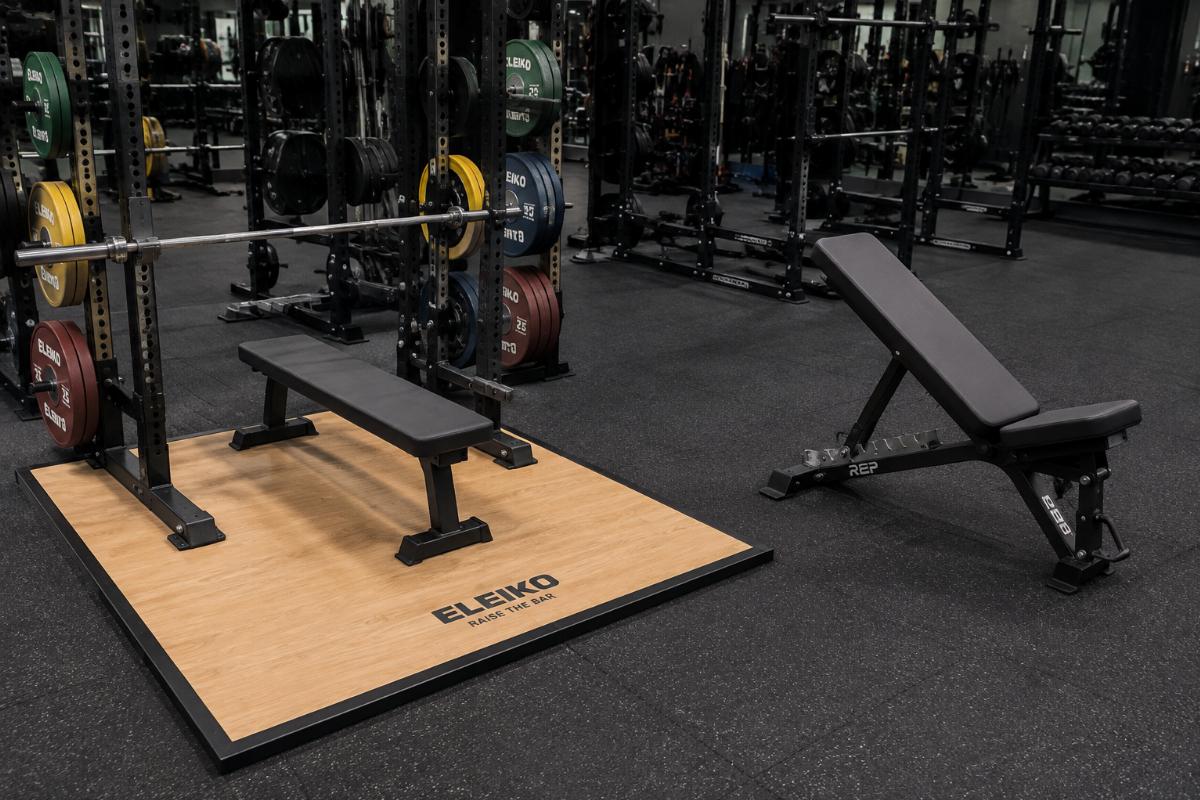
The competitive bench press is performed exclusively on a flat, horizontal surface. There is no incline or decline variation in IPF-sanctioned lifts. This means any gym designating a powerlifting zone must prioritize flat benches as the core offering. Adjustable benches—those with backrest angle mechanisms—have their place in commercial gyms, but they belong in functional training areas or bodybuilding zones, not on the competition platform.
The structural reason is worth understanding. A flat bench is a simpler construction: a rigid frame, a solid pad, and no moving joints. That simplicity translates directly into load-bearing reliability. An adjustable bench introduces pivot points, adjustment pins, and movable backrest supports—each of which represents a potential failure node under repeated heavy loading. In a high-traffic powerlifting gym where benches see continuous use from heavy lifters, the flat bench’s structural integrity holds up substantially better over extended service life. [NEED_CITE: flat bench structural simplicity offers superior load-bearing durability versus adjustable bench mechanisms under heavy repetitive use]
That said, a well-designed powerlifting gym is not a single-discipline facility. Most commercial operators we work with configure their floors with a dedicated powerlifting platform area—equipped with flat benches, competition-spec racks, and calibrated plates—alongside a broader free-weight zone where adjustable benches serve hypertrophy and accessory work. The key is not to mix the two. Putting an adjustable bench on a competition platform is a compliance failure; putting only flat benches in a general-purpose area limits programming flexibility.
A boutique strength gym in Southeast Asia initially ordered exclusively adjustable benches for their entire floor, citing versatility. Within a short period, the adjustment mechanisms on several units showed play and wobble under heavy loads. The owner then commissioned a separate batch of dedicated flat benches for the main platform area, keeping the adjustable units for accessory work. The flat benches showed no structural issues through extended heavy use, while the adjustable units required periodic mechanism tightening and, in some cases, pin replacement.
Steel Gauge and Load Capacity: What Specs Matter?
The steel tube wall thickness of the bench frame directly determines its load ceiling, and commercial powerlifting benches must use heavy-gauge steel with verifiable material certification.
This is the spec that separates a bench that lasts a decade in a busy gym from one that develops frame flex within a year. The main frame tubes—typically rectangular steel tubing—must have sufficient wall thickness to handle the combined load of the lifter plus the barbell without perceptible deflection. In a powerlifting context, where athletes regularly load well beyond recreational weights, the margin between adequate and inadequate is narrow.
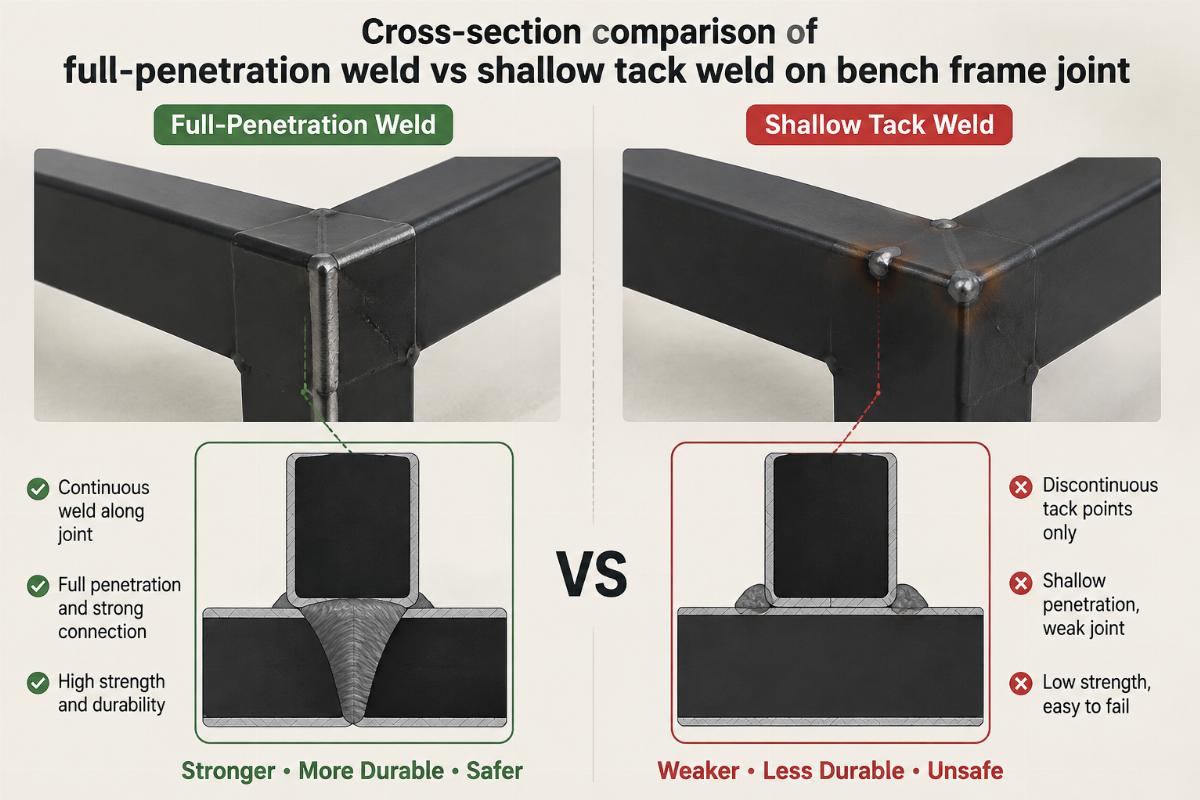
Commercial-grade benches intended for powerlifting use should be constructed from steel tubing with wall thickness in the heavy-gauge range. The frame must support not just the static load but the dynamic forces generated during lift-off, press, and re-rack. Weld quality at the joints is equally critical—a thick-walled tube with poor weld penetration will fail before a thinner tube with proper full-penetration welds. [NEED_CITE: bench frame load capacity depends on steel tube wall thickness and weld joint quality under dynamic loading]
There is a persistent misconception that more weld beads automatically mean a stronger bench. This is not accurate. What matters is weld penetration depth, joint design, and the consistency of the welding process across every unit in a production run. A bench with fewer but properly executed full-penetration welds will outperform one with numerous shallow tack welds. When sourcing, request the manufacturer’s welding procedure specification and, if possible, sample weld cross-section photos.
| Frame Quality Factor | Commercial Powerlifting Grade | Light-Duty Gym Grade |
|---|---|---|
| Steel Tube Wall Thickness | Heavy-gauge, verifiable | Thin-gauge, often unverified |
| Weld Type | Full penetration at structural joints | Shallow tack or spot welds |
| Material Certification | Available upon request | Not provided or self-reported |
| Load Testing | Batch-level or prototype-level verified | Not tested or sample-level only |
| Frame Deflection Under Load | Negligible | Noticeable flex at high loads |
A fitness equipment distributor in Africa was sourcing a full container of strength equipment for a chain of gyms. They specified heavy-gauge frames across all items, including the bench press benches. When the first sample arrived, the bench frame showed visible flex under a moderate load—well below the expected working capacity. Investigation traced the issue to the manufacturer substituting thinner tubing on the production run without notification. The batch was rejected, and the distributor subsequently added incoming material thickness checks to their receiving protocol. [NEED_CITE: incoming material thickness verification prevents unauthorized gauge substitution in production runs]
Upholstery Thickness: Thicker Is Not Always Better
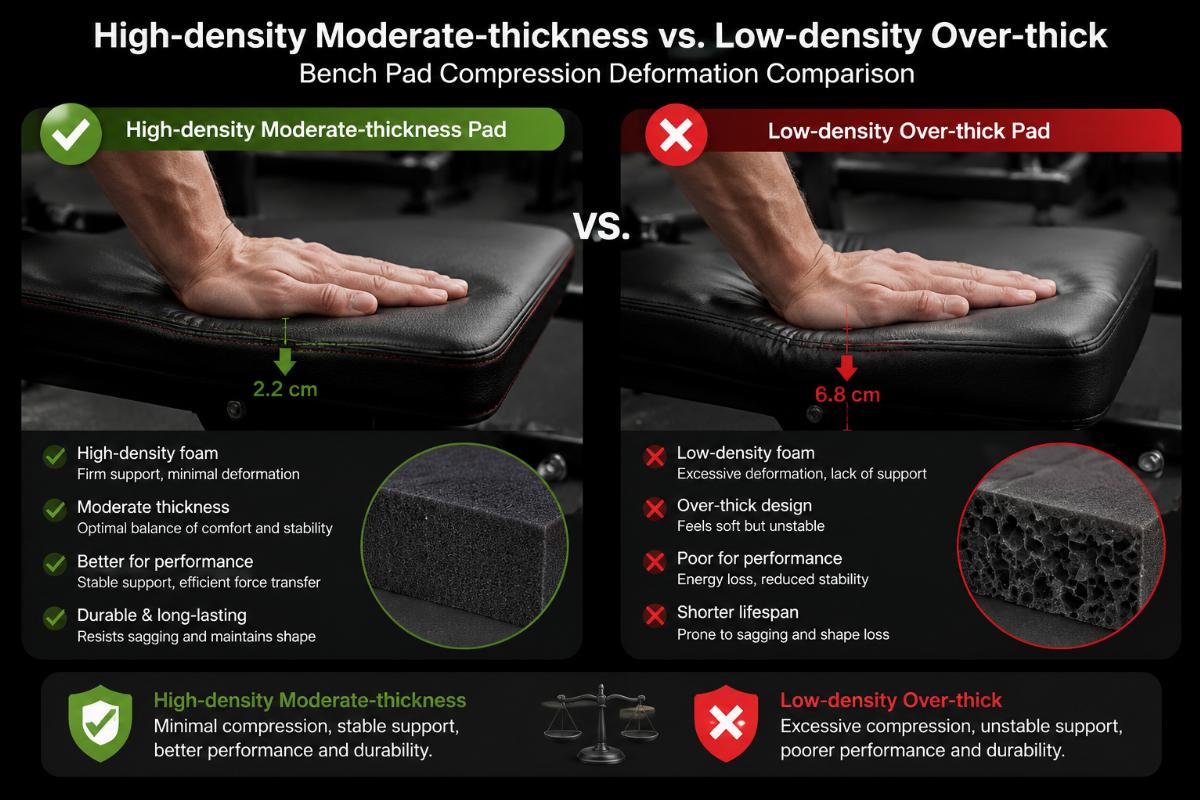
Competition bench press pads require a specific density and thickness range—excessively thick padding compromises scapular stability, while overly thin padding causes discomfort and pressure points.
This is one of the most counterintuitive specs in powerlifting equipment selection. The instinctive assumption is that thicker padding equals better quality. For a powerlifting bench, the opposite can be true.
During a competition bench press, the lifter drives their shoulder blades into the pad, creating a stable base and an arched back position. If the pad is too thick or too soft, the scapulae sink into the upholstery, destroying that stable platform. The lifter loses proprioceptive feedback from the bench surface, and their press path becomes inconsistent. IPF rules implicitly address this by requiring a firm, flat surface—pads that are excessively cushioned do not meet the spirit of that requirement even if the dimensions are technically legal.
The ideal competition bench pad balances firmness with minimal give. The foam density must be high enough to resist compression under a loaded athlete’s shoulder blades, while the surface vinyl must provide enough grip to prevent sliding during the arch setup without being so tacky that it impedes the lifter’s leg drive adjustment. The thickness typically falls in a moderate range—enough to prevent the athlete from feeling the hard board underneath, but not so much that it introduces unwanted compression.
| Pad Characteristic | Competition-Appropriate | Over-Padded (Problematic) | Too Thin (Problematic) |
|---|---|---|---|
| Foam Density | High density, firm compression resistance | Low density, excessive compression | Adequate density but insufficient thickness |
| Scapular Stability | Solid platform, minimal sink | Scapulae sink, unstable base | Hard surface discomfort |
| Surface Grip | Moderate vinyl grip | Often overly tacky or overly slick | Adequate |
| IPF Compliance Spirit | Meets firm flat surface requirement | May violate firm surface intent | May cause discomfort affecting performance |
For a commercial powerlifting gym, the recommendation is to specify pads that prioritize density over thickness. A moderately thick, high-density pad will outperform a thick, low-density pad in both competition utility and long-term durability—low-density foam compresses permanently over time, creating permanent dips that ruin the flat surface.
A gym owner in the Middle East initially specified extra-thick pads for their competition benches, believing it would attract more members with a "premium feel." Within a few months, the pads developed permanent compression marks where lifters’ shoulder blades rested. The surface was no longer flat, and experienced powerlifters complained about instability. The pads were replaced with high-density, moderate-thickness versions, and the complaints stopped.
Sourcing Tips: How to Verify Quality from Manufacturers
Request verifiable documentation—welding procedure records, steel material certificates, and dimension reports—before committing to any bulk bench order, and conduct incoming inspections on frame thickness and pad density.
Sourcing a bench press bench from an overseas manufacturer requires a structured verification process. Relying on product photos and marketing brochures is insufficient. The gap between what a catalog shows and what arrives in a container can be significant, particularly on specs that are not visually obvious: steel gauge, weld penetration, foam density, and vinyl grade.
Start with documentation. A reputable manufacturer should be able to provide steel material certificates showing the tube grade and wall thickness, welding procedure specifications, and pad foam density data. If a supplier cannot or will not provide these, treat it as a red flag. [NEED_CITE: reputable bench manufacturers provide steel material certificates and welding procedure documentation upon request]
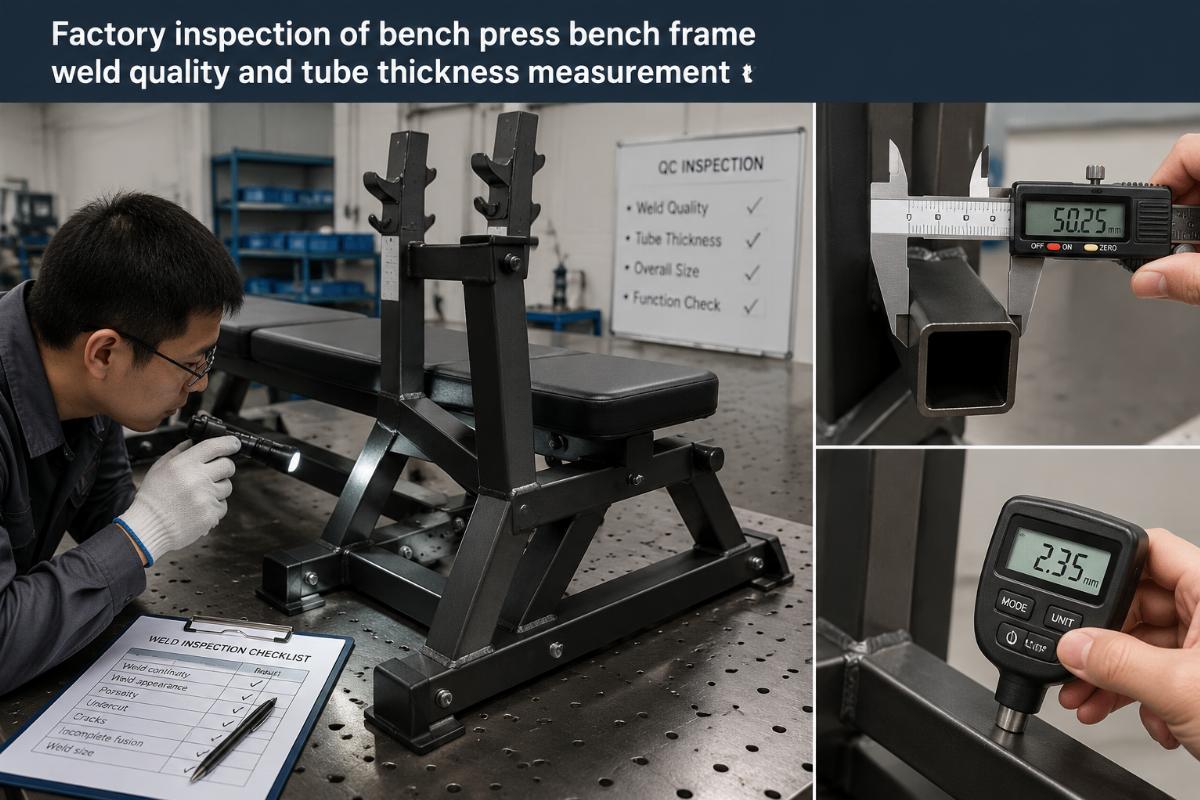
Next, request a pre-production sample or a first-article inspection. Measure the frame tube wall thickness with a caliper or ultrasonic gauge. Check the weld joints visually and, if possible, request a weld cross-section photo. Press into the pad firmly—high-density foam will resist compression and rebound quickly; low-density foam will compress easily and recover slowly.
When ordering in bulk, specify incoming inspection protocols. Check a statistically meaningful sample from each production batch for tube thickness, weld quality, pad firmness, and overall dimensions. This is especially critical for first-time orders or when switching manufacturers.
A powerlifting gym chain in the Middle East developed a structured sourcing protocol after their initial bench order dimension issues. For subsequent orders, they required the manufacturer to submit dimension reports for every bench before shipment, along with steel material certificates for the frame tubing. They also conducted random incoming thickness checks on received units. This protocol caught a second batch where pad foam density was below spec—the foam was noticeably softer than the approved sample. The batch was flagged before installation, and the manufacturer replaced the pads at their cost.
| Verification Step | What to Check | Tool or Method |
|---|---|---|
| Documentation Review | Steel material cert, weld procedure spec, pad density data | Request from manufacturer |
| Pre-Production Sample | Frame tube wall thickness, weld quality, pad firmness | Caliper, visual inspection, manual compression test |
| Incoming Batch Inspection | Tube thickness, weld integrity, pad compression, dimensions | Ultrasonic gauge, sample measurement |
| Ongoing Production | Consistency of weld quality, material substitution risk | Periodic factory audit or third-party inspection |
Working directly with a Shandong-based manufacturer that specializes in commercial strength equipment offers distinct advantages for gym operators and distributors sourcing bench press benches at scale. A factory with in-house production control can provide full documentation transparency, support OEM branding with flexible minimum order quantities, and consolidate bench orders with racks, platforms, and plates into a single container shipment—reducing per-unit freight costs and simplifying customs clearance. CE certification and material traceability should be standard, not optional add-ons. [NEED_CITE: direct manufacturer sourcing enables documentation transparency, OEM flexibility, and container consolidation for powerlifting gym equipment packages]
Conclusion
Selecting the right bench press bench for a powerlifting gym is a spec-driven exercise, not a marketing exercise. IPF dimensional compliance, heavy-gauge steel construction with verifiable weld quality, and appropriate pad density together determine whether a bench will serve a gym reliably for years or become a liability within months. Source with documentation, verify with inspection, and never assume that a label saying "powerlifting" guarantees compliance.