
Commercial Gym Equipment Manufacturer: Bulk OEM/ODM Factory-Direct Pricing for Fitness Centers & Hotels
The real price of gym equipment in Italy is not what you see on the showroom floor.
For commercial-grade cardio, strength, and free-weight equipment, factory-direct sourcing from China typically cuts landed costs substantially compared to buying through European retail channels or regional distributors. The gap comes from layered markups — import agent fees, local warehousing, dealer margins, and showroom overhead — all of which disappear when you buy directly from the manufacturer and manage the logistics chain yourself. However, the lowest unit price on a quotation sheet does not equal the lowest total cost. Customs compliance, CE documentation, and container loading strategy determine whether your shipment clears Italian ports smoothly or sits at the terminal bleeding demurrage fees.
I still remember a shipment bound for the Middle East a few years back — a full container of Smith machines and cable crossovers. The bill of lading listed a generic description that didn’t match the actual HS codes for those specific machine categories. The container sat at the port for weeks before the paperwork was corrected. The demurrage and storage charges ended up costing several times what the original freight savings had been. That kind of mistake doesn’t happen twice if you pay attention. [NEED_CITE: Italian customs HS code classification requirements for fitness machinery]
When buyers search for gym equipment price in Italy, what they’re really trying to figure out is whether importing directly makes financial sense for their project — and what the hidden costs look like along the way.

Let me walk you through the actual cost structure, category by category, and then break down how to calculate what you’ll really pay once the equipment reaches your warehouse in Italy.
What Is the Real Cost of Gym Equipment in Italy in 2026?
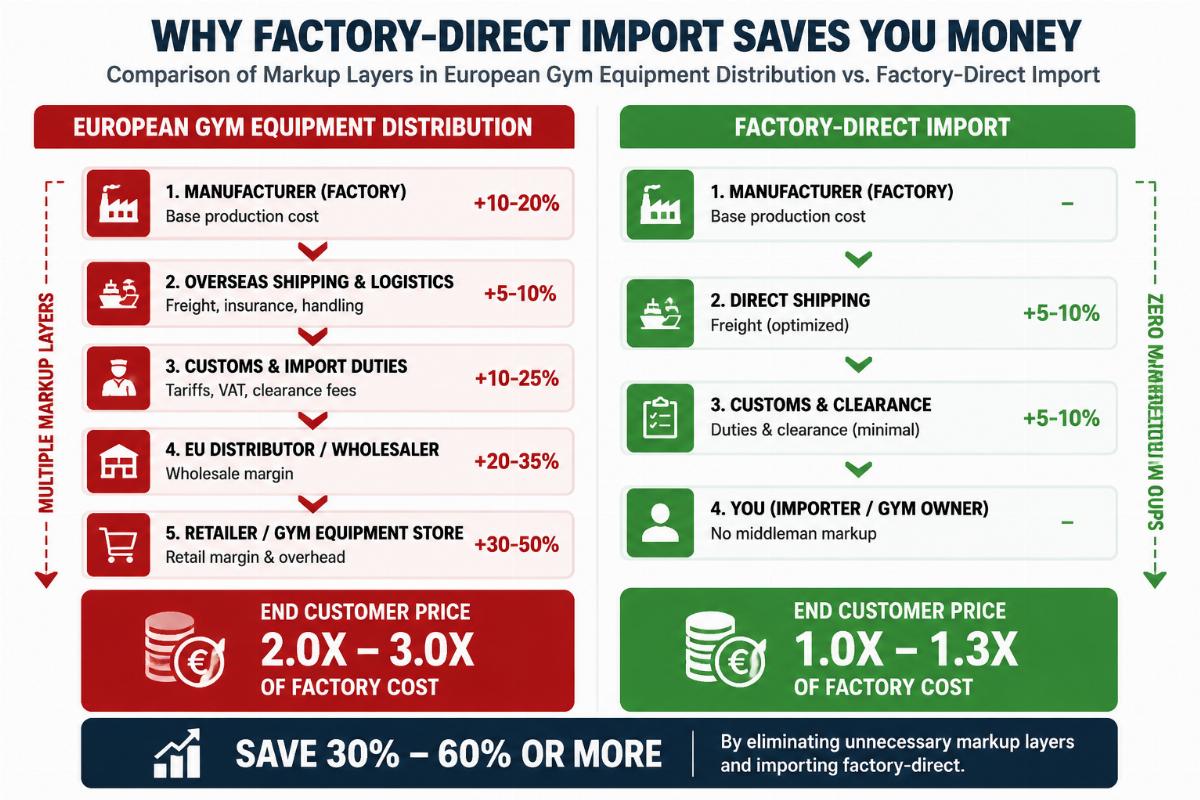
Terminal retail prices in Italy include multiple markup layers that most buyers don’t see until they compare them against factory quotations.
The typical supply chain for commercial gym equipment reaching an Italian fitness center looks like this: manufacturer → export agent or trading company → ocean freight → Italian customs broker → local warehouse → regional distributor → end buyer. Each step adds a margin, and by the time the equipment reaches the gym floor, the price can be substantially higher than the original factory price. [NEED_CITE: European fitness equipment distribution chain markup structure]
Here’s what those layers actually look like in practice:
- Factory price (FOB China): The baseline. This is what you pay the manufacturer for the equipment itself, packed and ready at the port.
- Export and documentation fees: Usually a small fixed amount per shipment, covering customs declaration in China, fumigation certificates if wooden packaging is used, and origin documentation.
- Ocean freight: Varies by container type and shipping route. A full forty-foot container from a major Chinese port to Genoa or Naples carries a base rate that fluctuates seasonally. [NEED_CITE: Container freight rate trends China to Mediterranean 2025-2026]
- EU import duty: Gym equipment falls under specific HS headings. The duty rate depends on the exact classification — some categories carry lower rates than others.
- Italian VAT: Applied on top of the CIF value plus duty. This is recoverable for registered businesses but affects cash flow at the point of entry.
- Local distribution margin: If you buy through an Italian dealer, their margin covers showroom costs, local warranty handling, and inventory risk.
The critical insight: when you buy gym equipment price in Italy from a local dealer, you’re paying for all of these layers. When you source factory-direct, you compress the chain — but you also take on responsibility for freight, customs, and compliance documentation.
A hotel developer in southern Italy recently compared quotes for a complete fitness center package. The local dealer’s quotation was roughly double the factory-direct price for equivalent specifications. But the developer’s initial assumption that "factory-direct is always cheaper" needed adjustment once we walked through the actual landed cost calculation including freight, duty, and CE compliance preparation. The savings were still substantial — but the gap was narrower than the raw factory price suggested.
How Do Prices Break Down Across Cardio, Strength, and Free-Weight Categories?
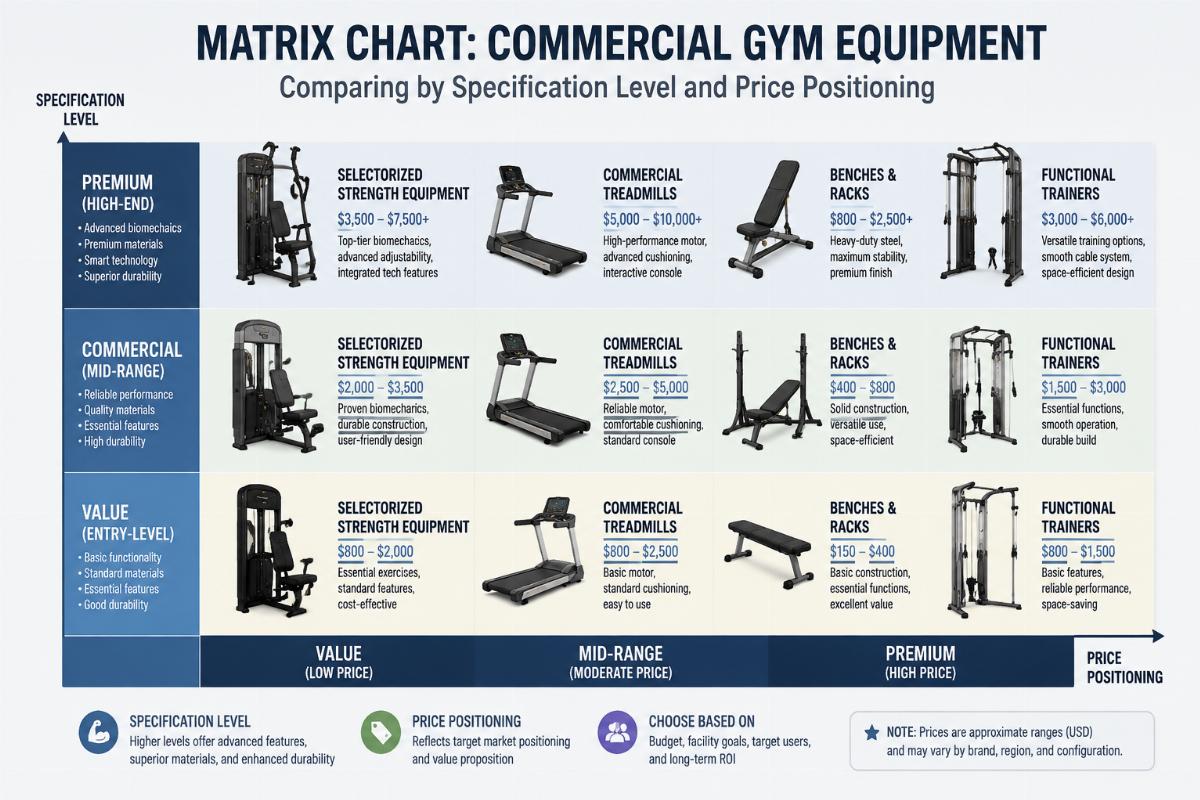
Equipment category is the single biggest variable in any gym equipment price in Italy comparison, because construction complexity, material weight, and certification requirements differ dramatically between a commercial treadmill and a set of dumbbells.
Let me lay out the typical price positioning for each major category when sourced factory-direct versus purchased through Italian retail channels. These are qualitative tiers based on commercial-grade specifications — not exact quotes, because pricing depends on order volume, customization, and current material costs.
| Category | Factory-Direct Tier | Italian Retail Tier | Key Cost Drivers |
|---|---|---|---|
| Commercial Treadmills (AC motor, heavy-duty frame) | Mid-range | Substantially higher | Motor rating, deck thickness, electronics integration |
| Ellipticals & Spin Bikes | Mid-range | Substantially higher | Flywheel weight, resistance system type, build quality |
| Smith Machines & Power Racks | Mid-range | Substantially higher | Steel gauge, load capacity, attachment ecosystem |
| Plate-Loaded & Selectorized Machines | Mid-range | Substantially higher | Weight stack type, pulley system, upholstery grade |
| Cable Crossovers & Functional Trainers | Mid-range | Substantially higher | Cable routing complexity, frame engineering |
| Free Weights (Dumbbells, Barbells, Plates) | Mid-range | Moderately higher | Material density, coating type, tolerance precision |
| Benches & Racks | Mid-range | Substantially higher | Frame welding quality, adjustment mechanism |
| Flooring & Accessories | Mid-range | Moderately higher | Rubber density, thickness, interlocking design |
[NEED_CITE: Commercial gym equipment material cost composition by category]
A few things worth noting from the table:
Cardio equipment carries the highest unit price and the most complex certification requirements. A commercial treadmill with an AC induction motor, welded steel frame, and integrated console is a fundamentally different product from a home-grade unit. The price gap between factory-direct and retail is widest here because retail margins on high-ticket cardio items are the largest.
Strength machines — Smith machines, plate-loaded machines, cable crossovers — represent the sweet spot for factory-direct sourcing. These are heavy, steel-intensive products where the raw material and welding labor cost dominates the price. European retail markups on these items are significant because local manufacturers have high labor costs. When you source from a Chinese factory with automated welding and powder-coating lines, the per-unit cost advantage is substantial.
Free weights are the simplest category to compare. A rubber-coated hex dumbbell or a competition-grade barbell has relatively straightforward manufacturing. The price difference between factory-direct and retail exists but is less dramatic than on complex machines — mainly because free weights are commodity-adjacent and retail competition is tighter.
I worked with a fitness chain operator in northern Italy who was outfitting multiple locations. They needed a mixed package: cardio for the front floor, a full strength line for the main training area, and free weights for the functional zone. By sourcing the entire package factory-direct and consolidating into multiple containers, their per-unit landed cost across all categories came in well below what any single Italian supplier could match — even after adding freight and duty.
How Do You Calculate the True Landed Cost from Factory to Italian Warehouse?
The factory quotation is just the starting point. The true gym equipment price in Italy depends on which trade terms you agree to, how you handle shipping, and how accurately your customs documentation is prepared.
There are three common trade terms buyers encounter, and each shifts cost and risk differently:
FOB (Free On Board): The manufacturer delivers the equipment to the Chinese port and handles export customs. You take over from there — ocean freight, insurance, Italian import customs, and final delivery. This gives you the most control and usually the lowest total cost, but requires you to manage or coordinate with a freight forwarder.
CIF (Cost, Insurance, and Freight): The manufacturer arranges and pays for ocean freight and basic insurance to the Italian port. You handle import customs and final delivery. This is simpler for the buyer but often means the manufacturer builds a margin into the freight cost. [NEED_CITE: FOB vs CIF cost comparison for heavy equipment imports to EU]
DDP (Delivered Duty Paid): The manufacturer handles everything including Italian customs clearance and duty payment, delivering to your door. This is the most convenient but also the most expensive option, because the manufacturer must build in risk buffers for customs variables and local delivery costs.
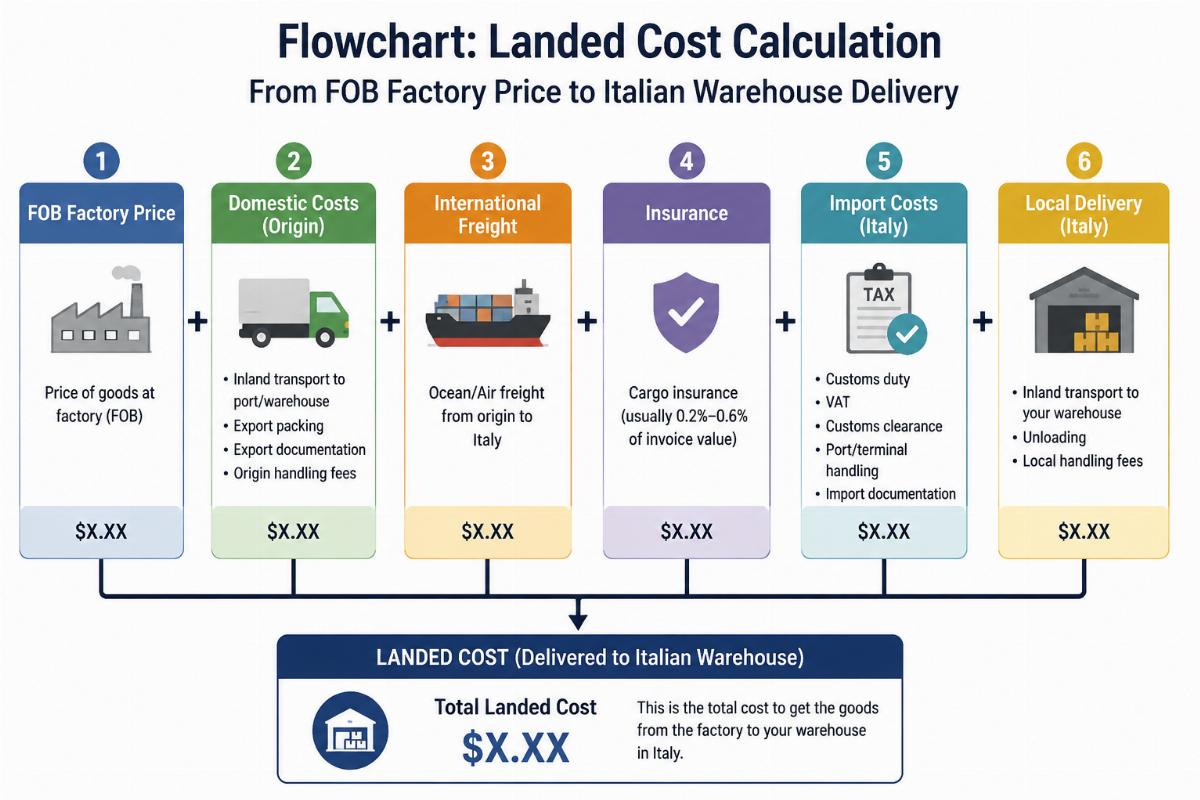
Here’s the step-by-step calculation method I use when helping buyers understand their real numbers:
- Start with the FOB price — the equipment cost plus packing, loaded at the Chinese port.
- Add ocean freight — get a current quote from your forwarder for the specific container type and destination port.
- Add insurance — typically a small percentage of the CIF value.
- Calculate the customs value — this is the CIF total, which forms the basis for duty calculation.
- Apply the EU import duty rate — determined by the HS code for each equipment category. [NEED_CITE: TARIC database HS code classification for gym and fitness equipment]
- Add Italian VAT — calculated on the customs value plus duty.
- Add local costs — customs broker fees, port handling charges, inland transport to your warehouse or site.
A common mistake I see: buyers focus entirely on the FOB price and assume the rest is small. For heavy gym equipment — especially plate-loaded machines, Smith machines, and commercial treadmills — the freight and duty components are meaningful portions of the total. A fully loaded forty-foot container of mixed strength equipment can carry significant weight, and ocean freight is partly weight-sensitive for certain routes.
Another mistake: not verifying the HS code before shipment. I once saw a buyer assume a generic "fitness equipment" code would cover everything in their container. In reality, cardio machines, strength machines, and free weights may fall under different HS headings with different duty rates. Misclassification can trigger customs inspection, delays, and re-assessment of duty — all of which add cost and time. [NEED_CITE: EU customs classification disputes for multi-category equipment shipments]
What Documents Do You Need to Clear Italian Customs Without Delays?
CE certification is not optional for gym equipment entering Italy, and having the certificate alone is not enough — you need the complete technical documentation package behind it.
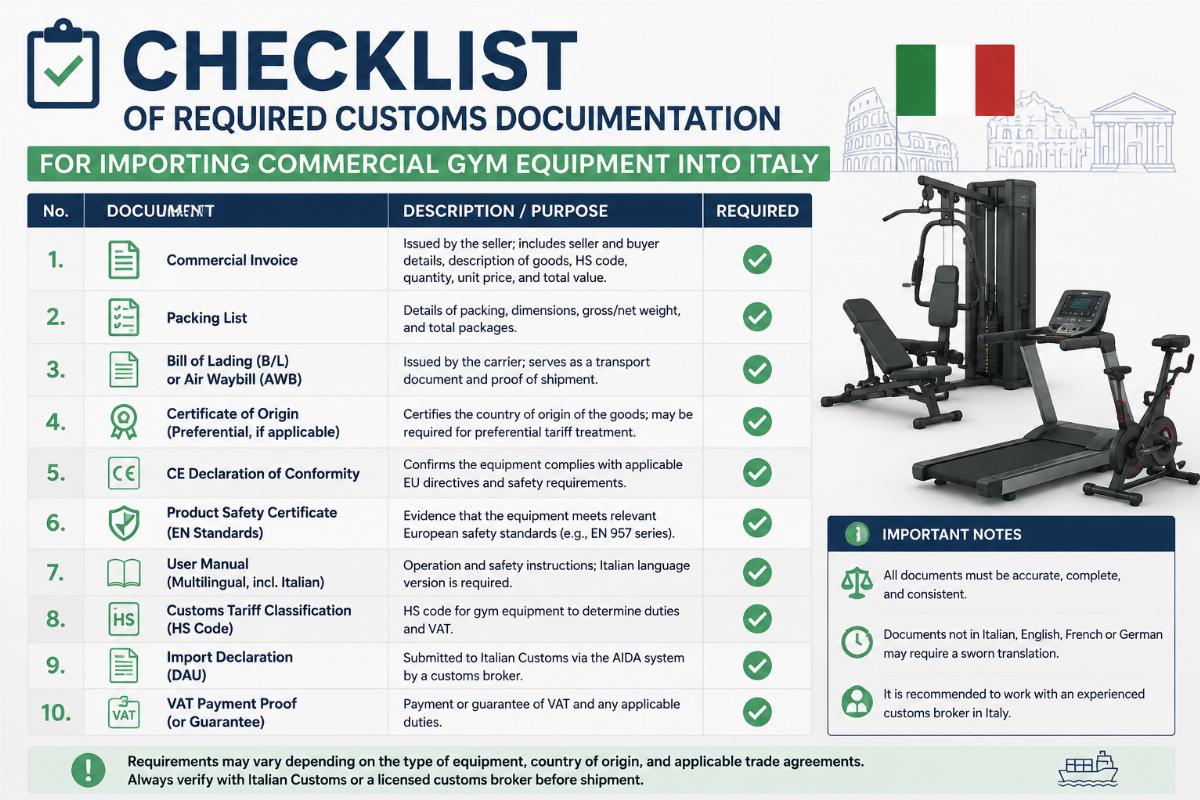
Italian customs authorities, like other EU member states, enforce the Machinery Directive for fitness equipment. This means every commercial-grade machine must carry CE marking and be accompanied by a Declaration of Conformity. But here’s what catches many first-time importers off guard: the CE mark on the machine is just the visible part. Customs can request the full technical file at any time, and if you can’t produce it, your shipment gets held. [NEED_CITE: EU Machinery Directive documentation requirements for fitness equipment imports]
The complete documentation package should include:
- CE Declaration of Conformity — signed by the manufacturer, referencing the specific Machinery Directive and applicable harmonized standards.
- Technical Construction File — including design drawings, risk assessment, bill of materials, test reports, and instructions for use.
- User manuals in Italian — or at minimum, multilingual manuals that include Italian. This is a frequently overlooked requirement.
- Commercial invoice and packing list — with descriptions that match the HS codes exactly.
- Bill of lading — with accurate commodity descriptions.
- Certificate of origin — if claiming any preferential treatment or required by your customs broker.
I mentioned the Middle East shipment problem at the beginning. Let me give you another example closer to the Italian market. A buyer in Europe ordered a mixed container of selectorized machines and functional trainers. The commercial invoice described everything as "gym machines" under a single line item. Italian customs flagged this because selectorized machines and functional trainers can fall under different tariff classifications. The container was held for inspection, the buyer had to engage a customs lawyer to reclassify the items, and the delay added weeks to the timeline plus storage charges at the port.
The lesson: every line item on your commercial invoice should have a clear, specific description that maps to a verified HS code. If you’re shipping a mixed container — cardio, strength machines, free weights, flooring — each category needs its own line with its own code.
One more point that matters for the gym equipment price in Italy calculation: if your documentation is incomplete or incorrect, the customs broker will charge additional fees for re-work, and the port will charge storage fees for every day the container sits. These are not large numbers per day, but they accumulate quickly — and they’re entirely avoidable with proper preparation.
Reputable manufacturers include the complete CE technical file package with every shipment as standard practice. When evaluating a factory, ask explicitly whether they provide the full technical construction file — not just a certificate — and whether their user manuals include Italian language versions. This is a basic compliance question that separates experienced exporters from those who haven’t dealt with EU customs enforcement.
How Do You Build a Full Gym Package Within Budget Using Container Consolidation?
The most effective way to control the gym equipment price in Italy for a complete facility is to plan your container loading around the equipment mix — not around individual product prices.
Here’s the counterintuitive part: buyers often assume that buying fewer items or choosing lighter equipment saves money. But when you’re outfitting a full commercial gym, hotel fitness center, or apartment complex gym, the per-unit cost is heavily influenced by how efficiently you fill each container.
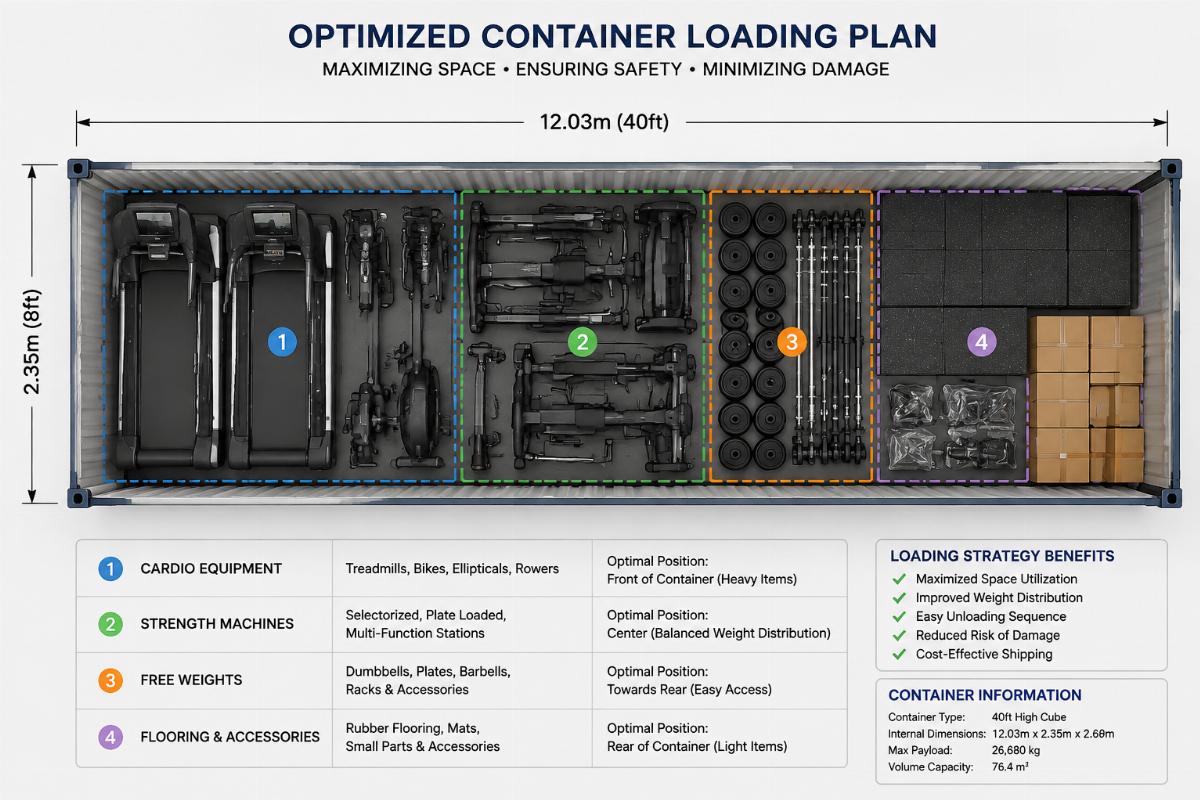
A forty-foot high-cube container has specific volume and weight limits. Heavy items like plate-loaded machines, Smith machines, and dumbbell sets consume weight capacity quickly. Lighter but bulky items like treadmills and cable crossovers consume volume. The optimal loading strategy mixes heavy and bulky items so that you reach both the weight limit and the volume limit simultaneously — maximizing what you get per container. [NEED_CITE: Container loading optimization for mixed heavy and bulky cargo]
Let me walk through a typical scenario. A hotel developer needs to equip a fitness center with a compact but complete setup: a few cardio units, a selection of strength machines, a free-weight area, and flooring. If they source each category separately from different suppliers, they end up with partial containers, higher per-unit freight costs, and multiple sets of customs documentation to manage.
The efficient approach: work with a single manufacturer who can supply the full range and plan the container load as a complete package. This way:
- Cardio units (treadmills, ellipticals, spin bikes) fill the upper volume space.
- Strength machines (Smith machines, plate-loaded units) are positioned as the heavy base layer.
- Free weights and accessories fill the gaps between larger machines.
- Flooring rolls and racks are loaded around the perimeter and on top where space allows.
The result is a fully loaded container where the freight cost per piece of equipment is minimized. When you spread the total freight across a larger number of items, the per-unit shipping cost drops noticeably.
I’ve seen hotel projects where the developer’s initial budget assumed buying locally in Italy. After we worked through the container consolidation approach — mapping out exactly which equipment goes where, calculating the weight distribution, and verifying that the full CE documentation package would be included — the factory-direct landed cost came in well below the local quotation. The developer got a higher specification level for the same budget.
Another advantage of the package approach: you get consistent design language across all equipment categories. When you buy cardio from one brand and strength from another, the visual and ergonomic experience in the gym can feel disjointed. A single-source package ensures matching upholstery colors, consistent frame finishes, and unified branding — which matters for hotel and commercial gym environments where aesthetics affect member perception.
For distributors buying multiple containers for stock, the same logic applies in reverse. You plan the product mix based on what sells fastest in your market, load each container to maximize both weight and volume, and ensure that every container carries the complete documentation set so that customs clearance is routine rather than problematic.
Conclusion
The gym equipment price in Italy is shaped far more by supply chain structure, customs compliance, and loading strategy than by the factory unit price alone. Factory-direct sourcing eliminates layered distributor markups and gives you control over specifications, but it requires accurate HS code classification, complete CE technical documentation, and intelligent container consolidation to realize the full cost advantage. Buyers who treat these logistics and compliance elements as afterthoughts end up paying for it in delays, re-work fees, and underutilized container space — while those who plan the entire chain from factory to warehouse consistently achieve substantially lower total project costs.


