
Commercial Gym Equipment Supplier Saudi Arabia: OEM Factory Direct Pricing
Most buyers think ordering from a top-tier international brand keeps them safe in Saudi Arabia. The real risk hides in the spec sheet — the operating environment assumptions behind those numbers are built for temperate climates, not 50°C summers and fine desert dust.
Sourcing commercial gym equipment in Saudi Arabia requires matching motor thermal tolerance, frame corrosion resistance, and SASO/IECEE certification readiness to local climate and customs realities — not just comparing brand names or unit prices. A qualified commercial gym equipment supplier must provide verifiable spec matrices, climate-adapted engineering, and turnkey container packages that align cardio, strength, and free-weight ratios to your floor plan.
I remember standing on the dock at a Middle Eastern port, watching a full container of treadmills get held up because the motor cooling fans were spec’d for a European warehouse climate. The buyer had ordered by a well-known brand’s published parameters, and our factory had built to those same numbers. What nobody checked was that those parameters assumed continuous operation at ambient temperatures well below what the Gulf summer delivers. The motors overheated within weeks of installation. We ended up air-shipping replacement parts at a cost that wiped out the entire order margin and then some. [NEED_CITE: motor thermal derating requirements for high-ambient gym equipment per ISO 20957] That was the moment I stopped trusting spec sheets at face value and started building side-by-side comparison tables for every single order.
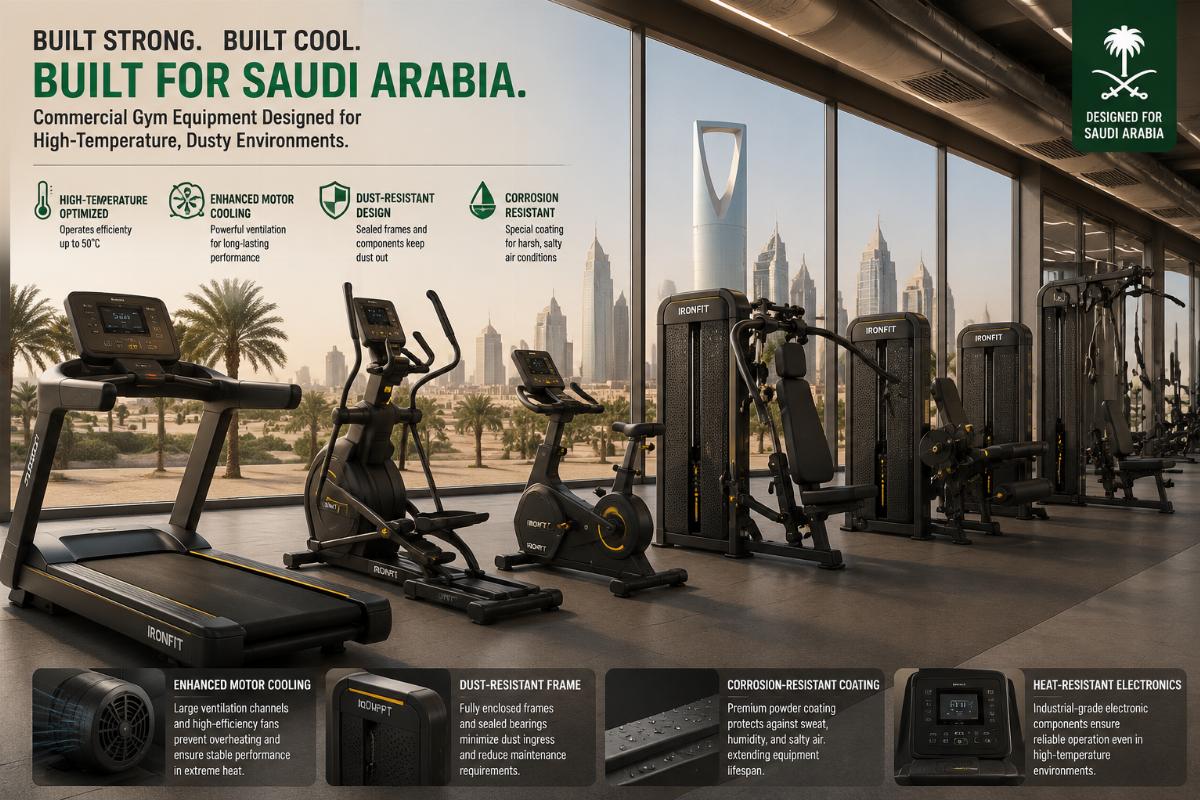
If you are evaluating a commercial gym equipment supplier for the Saudi market, here is what actually matters — and how to separate real readiness from marketing claims.
What Equipment Categories Should a Saudi Commercial Gym Prioritize?
The right mix of cardio, strength, and free-weight equipment depends entirely on your gym format — and getting the ratio wrong costs far more in wasted floor space than in unit price.
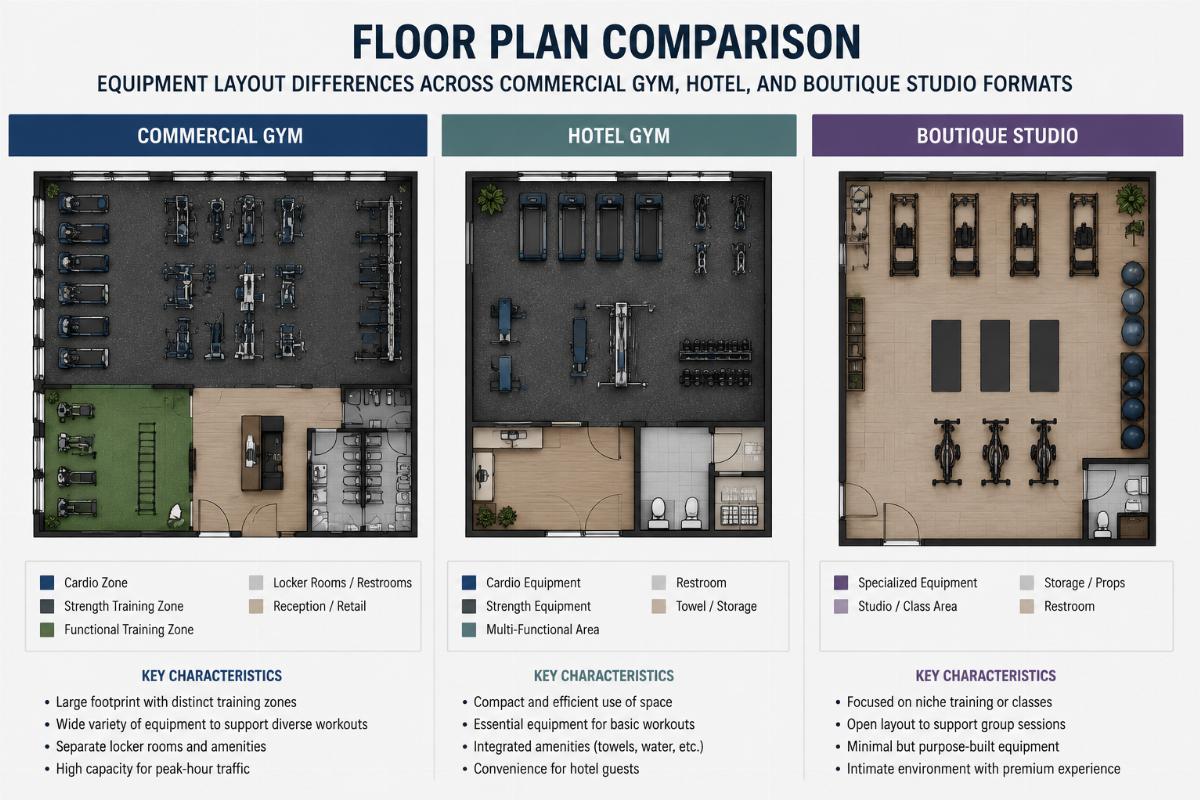
A full-scale commercial gym targeting membership growth needs a heavy cardio anchor, typically occupying roughly half the floor area, with plate-loaded and selectorized strength machines forming the second block, and a dedicated free-weight zone for dumbbells, barbells, and functional rigs. Hotel and apartment fitness rooms flip this logic: space is tight, so multi-stack cable crossovers and compact spin bikes replace full-size plate-loaded rows. Boutique studios and CrossFit boxes lean heavily on functional trainers, plyo boxes, battle ropes, and open-frame power racks, with minimal cardio.
| Category | Commercial Gym | Hotel / Apartment | Boutique Studio |
|---|---|---|---|
| Cardio Share | Substantial | Moderate | Minimal |
| Strength Machines | Full range | Compact multi-stack | Selective |
| Free Weights | Dedicated zone | Limited set | Core focus |
| Functional Gear | Supplementary | Rare | Primary |
A distributor in the Gulf region once ordered a container loaded almost entirely with selectorized machines, assuming higher unit value meant better ROI. The gym operator they were supplying had a floor plan that needed open rack space and turf zones. The machines sat in storage for months while the operator ordered functional gear elsewhere. [NEED_CITE: gym floor space allocation benchmarks per IHRSA facility design guidelines]
The lesson: a commercial gym equipment supplier who only quotes unit prices without asking about your floor plan and member profile is not solving your real problem. Turnkey packages that pre-balance cardio, strength, and free weight based on gym type prevent this mismatch before the container is sealed.
How Do Climate Conditions in Saudi Arabia Affect Equipment Specs?
The Saudi climate demands engineering tolerances that温带-spec equipment simply does not meet — and the gap only shows up after installation, not on the spec sheet.
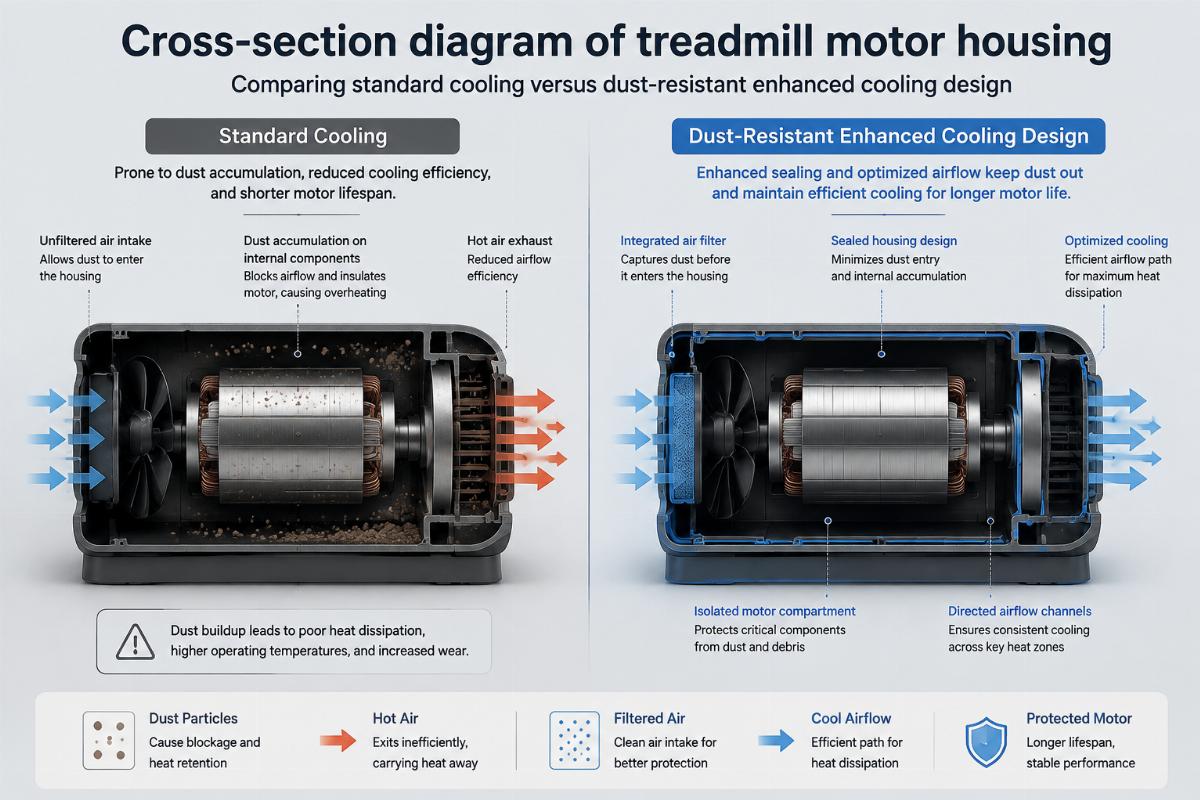
Summer ambient temperatures in central and eastern Saudi Arabia regularly exceed 45°C, and fine silica dust penetrates virtually any facility that is not hermetically sealed. For cardio equipment, this means treadmill and elliptical motors must handle continuous thermal loads far beyond what the same model would face in a European or North American gym. Motor power ratings that look adequate on paper can derate noticeably when cooling airflow is restricted by dust accumulation on intake filters. [NEED_CITE: motor thermal endurance testing under high-ambient high-dust conditions per IEC 60034]
For strength equipment, the main threats are corrosion and upholstery degradation. Standard electrostatic paint finishes that perform well in temperate warehouses can show early oxidation on welded joints when exposed to high humidity combined with sweat and saline air in coastal cities like Jeddah or Dammam. Upholstery vinyl that passes standard abrasion tests may crack prematurely under sustained UV exposure near floor-to-ceiling windows.
| Spec Element | Standard Temperate Spec | Saudi-Adapted Spec |
|---|---|---|
| Motor Cooling | Standard fan | Enhanced airflow with dust-filter intake |
| Frame Finish | Basic electrostatic | Anti-corrosion primer with reinforced topcoat |
| Weld Treatment | Standard grind | Full seam seal against moisture ingress |
| Upholstery | Standard vinyl | UV-stabilized high-temperature grade |
| Bearing Seals | Standard | Dust-resistant sealed bearings |
A gym operator in Riyadh reported that treadmills sourced through a generic supplier began showing console error codes within months. The root cause was not the motor itself but the dust clogging the control board ventilation slots — a detail that does not appear in most catalog spec sheets. [NEED_CITE: dust ingress protection requirements for fitness electronics per IP rating standards]
When you evaluate a commercial gym equipment supplier, ask specifically how their motor housings, frame welding, and electronics enclosures are adapted for high-heat high-dust environments. If the answer is "same as our standard export spec," that is a red flag.
Which Certifications Are Mandatory for Gym Equipment Import into Saudi Arabia?
SASO and IECEE certification is not optional paperwork — it is a hard customs gate, and missing a single document can hold an entire container at port.
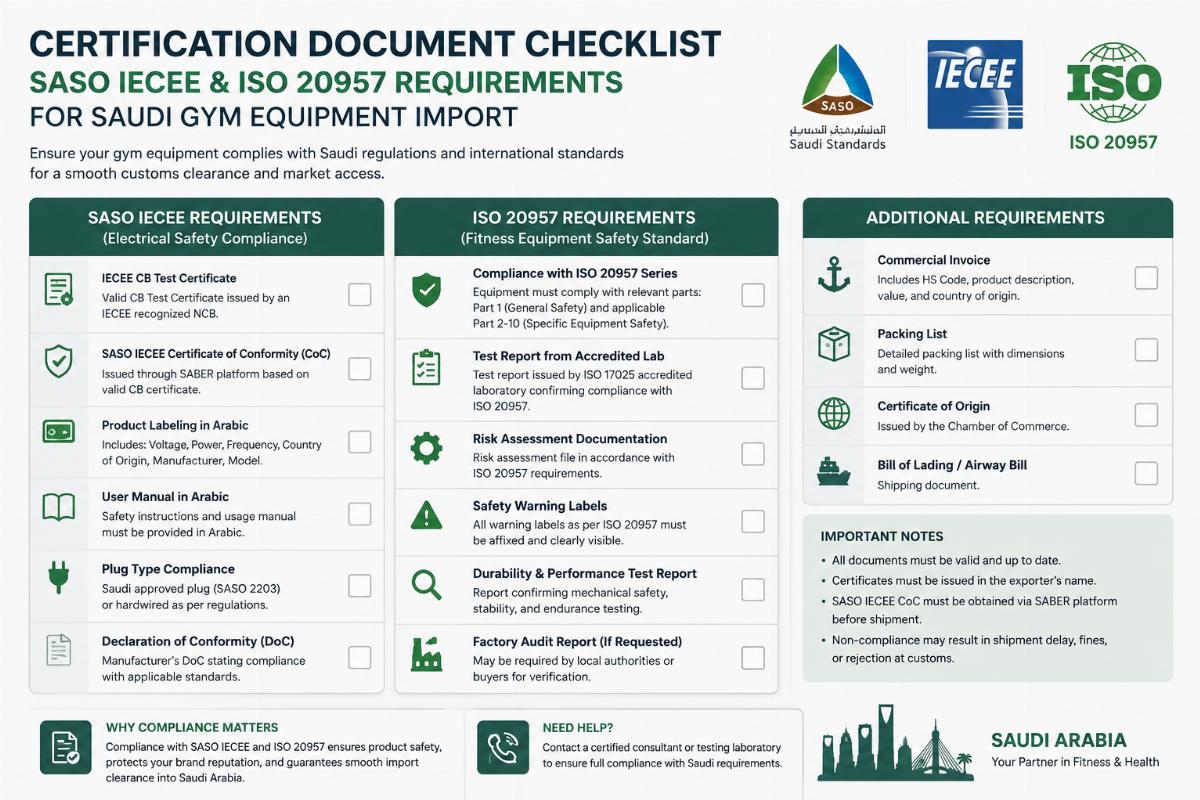
Saudi Arabia requires all imported electrical equipment, including motorized gym machines, to comply with SASO technical regulations and obtain IECEE recognition for electrical safety. [NEED_CITE: SASO IECEE certification requirements for imported electrical fitness equipment] Non-motorized strength and free-weight equipment must still meet ISO 20957 safety standards and carry corresponding test reports.
The certification process involves multiple layers: product testing by an accredited laboratory, factory audit documentation, a valid Certificate of Conformity, and correct labeling in both Arabic and English. Customs authorities verify these documents against the shipment manifest on a line-item basis. If the model number on the certificate does not match the model number on the commercial invoice exactly — even a minor revision suffix difference — the entire shipment can be flagged.
| Document | Applies To | Risk if Missing |
|---|---|---|
| SASO Certificate of Conformity | All gym equipment | Full container hold |
| IECEE Recognition | Motorized cardio and electrical strength | Customs rejection |
| ISO 20957 Test Report | All equipment categories | Delayed clearance |
| Arabic-English Labeling | All equipment | On-site relabeling cost or rejection |
A regional distributor once received a container where the free-weight benches lacked the required Arabic safety warnings on the frame labels. The equipment itself was fully compliant, but customs required the container to be moved to a bonded warehouse for relabeling before release. The demurrage and handling charges exceeded the original freight cost. [NEED_CITE: Saudi customs documentation verification procedures for fitness equipment imports]
The practical takeaway: confirm with your commercial gym equipment supplier that every SKU in your order — including non-electrical items like benches and weight trees — has current, verifiable certification with model numbers matching your purchase order exactly. Request scanned copies of certificates before shipment, not after.
How to Compare OEM Suppliers: A Spec-by-Spec Matrix Approach
The difference between a reliable commercial gym equipment supplier and a costly mistake often comes down to how you compare spec sheets — not which brand name is on the header.
Most buyers compare treadmills by motor horsepower, running surface length, and max user weight. Those are necessary data points, but they are not sufficient. Two treadmills both listed at a certain HP rating can behave completely differently in continuous commercial use if one uses a duty cycle rated for intermittent home use and the other is engineered for all-day gym operation. The same logic applies to frame steel gauge, welding method, cable routing on strength machines, and upholstery foam density.
| Comparison Point | What to Ask | What to Look For |
|---|---|---|
| Motor Duty Rating | Continuous vs. peak HP | Commercial continuous duty designation |
| Frame Steel | Gauge and grade | Heavy-gauge commercial specification |
| Welding Process | MIG/TIG and finish | Full-penetration welds with ground-smooth finish |
| Guide Rods (Strength) | Material and coating | Chrome-plated or self-lubricating solid rods |
| Cable System | Type and routing | Aircraft-grade cable with enclosed routing |
| Upholstery | Foam density and cover | High-density foam with commercial-grade vinyl |
| Warranty Terms | Frame, parts, labor | Multi-year frame with accessible spare parts |
A buyer in the Middle East compared two quotes for a full cable crossover machine. Both looked similar on paper. One supplier used solid chrome-plated guide rods; the other used hollow rods with a spray coating. The price difference was modest. Two years later, the hollow rods on the cheaper unit showed visible wear and cable friction issues, while the chrome rods on the other unit remained smooth. [NEED_CITE: guide rod material durability comparison in commercial strength equipment]
The right approach is to build a comparison matrix covering every contact point, wear component, and structural element — not just the headline specs. A serious commercial gym equipment supplier will provide this level of detail willingly, because their engineering can stand the comparison.

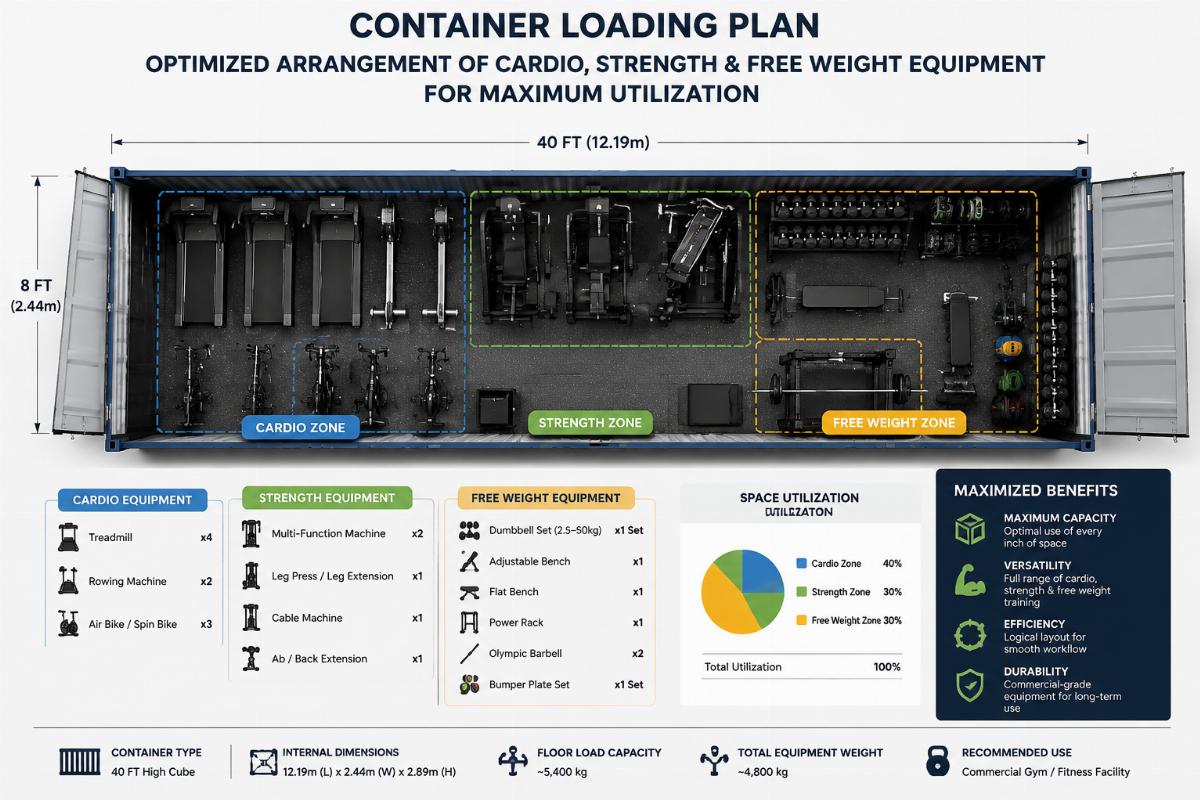
What Does a Turnkey Gym Package Include and How to Optimize Container Loading?
A turnkey package from a commercial gym equipment supplier covers more than machines — it includes flooring, accessories, and a loading plan that maximizes container utilization and minimizes landed cost per unit.
Ordering equipment piece by piece from different suppliers creates three problems: inconsistent lead times, mismatched aesthetics, and poor container fill rates. A turnkey approach bundles cardio, strength, free weights, functional gear, rubber flooring, and installation accessories into a single shipment plan. This is especially important for Saudi Arabia, where customs clearance is processed per container and per supplier documentation set.
Container loading optimization is not just about fitting more boxes. It is about sequencing heavy items like plate-loaded machines and dumbbell sets against lighter but bulky items like treadmill consoles and elliptical arms, so that weight distribution stays within safe limits and every cubic meter is used. A well-planned load can improve container utilization noticeably, reducing the effective landed cost per piece of equipment.
| Package Element | Typical Inclusion |
|---|---|
| Cardio Equipment | Treadmills, ellipticals, spin bikes, rowers |
| Strength Machines | Smith machines, cable crossovers, plate-loaded and selectorized |
| Free Weights | Dumbbells, barbells, plates, kettlebells, benches |
| Functional Gear | Rigs, battle ropes, plyo boxes, medicine balls |
| Flooring | Rubber mats, turf strips, anti-fatigue pads |
| Accessories | Mirror mounts, signage, maintenance kits |
A hotel developer in the western region of Saudi Arabia needed a complete fitness center for a new property. They initially planned to source cardio from one vendor and strength from another. When they switched to a single-source turnkey package, the supplier coordinated the flooring cut patterns to match the equipment footprint, pre-drilled anchor points on the rubber mats, and loaded the container so that the free-weight zone items were positioned for direct offload to the ground-floor gym space. [NEED_CITE: container loading optimization methods for mixed gym equipment shipments]
The result was a single customs clearance event, one set of certification documents, and a gym floor that was ready for equipment placement within days of arrival — not weeks.
Conclusion
Sourcing commercial gym equipment for Saudi Arabia is a climate, certification, and configuration challenge — not just a price comparison exercise. Match your equipment specs to the operating environment, verify every certification document before shipment, compare OEM suppliers on full spec matrices rather than headline numbers, and use turnkey container packages to control landed cost and simplify customs. The right commercial gym equipment supplier acts as a single point of accountability across all of these dimensions.


