Dip Station Import into Jordan
CE certificates do not clear Jordan customs. JSMO compliance does.
Importing a dip station into Jordan requires a commercial invoice, packing list, bill of lading, certificate of origin, and a JSMO conformity certificate (CoC). Without the CoC, the shipment will not clear Amman or Aqaba ports regardless of other documentation. Landed cost includes the HS-based import duty plus a flat 16% VAT, which together push the final cost well above the FOB quotation.
I remember a full container of commercial strength machines heading to a gym in Amman. The dip stations, cable crossovers, and Smith machines were loaded clean, paperwork looked complete from our side, and the buyer was expecting a smooth pickup at the dry port. What we did not anticipate was the Arabic labeling gap on the inner packaging. The shipment sat at the port for weeks. Daily demurrage charges piled up, and the buyer had to arrange re-labeling through a local agent before customs would release anything. That single oversight cost several times what proper pre-shipment label verification would have required. Since then, I treat every Jordan-bound fitness equipment order with the same rigor: invoice, packing list, bill of lading, certificate of origin, and JSMO CoC verified line by line before the container is sealed. [NEED_CITE: Jordan Customs mandatory document checklist for fitness equipment imports]
Customs clearance for a dip station import into Jordan is not complicated in theory, but it is unforgiving in execution. Every document must align, and the JSMO conformity certificate is non-negotiable. Let me walk through the specific requirements, duty structure, common hold-up reasons, and the certification process so you know exactly what to prepare before the cargo leaves the factory floor.
What Documents Are Required to Clear a Dip Station Through Jordan Customs?
The mandatory document set includes a commercial invoice, packing list, bill of lading, certificate of origin, and a JSMO-issued conformity certificate. Missing any one of these will result in the shipment being held at the port of entry.
The commercial invoice must reflect the actual transaction value, product descriptions matching the packing list, and the correct HS code for the fitness equipment. The packing list needs to itemize every carton with gross weight, net weight, and dimensions. The bill of lading serves as the title document and must be consistent with all other paperwork. The certificate of origin establishes where the goods were manufactured, which directly affects duty rate eligibility. And the JSMO CoC confirms that the product meets Jordan’s technical regulations for safety and quality. [NEED_CITE: Jordan Customs import documentation requirements for gym equipment]
A distributor in the Middle East once received a sample shipment of dip stations with all standard trade documents in place. What was missing was the CoC. The goods were held at the dry port, and the buyer was told that no amount of CE documentation or manufacturer test reports could substitute for the JSMO-issued certificate. The shipment had to be re-routed, re-tested, and re-certified before it could clear. The delay ran into multiple weeks, and the additional logistics costs were substantial.
The risk清单 for documentation is straightforward:
- Invoice value mismatch with the letter of credit or payment terms
- HS code inconsistency between invoice and bill of lading
- Certificate of origin issued by a non-accredited chamber
- JSMO CoC expired or issued for a different product category
- Packing list weights not matching the verified gross weight at the port
Every one of these errors can be caught before shipment if the buyer and the supplier review the full document set together during the production stage, not after the container is already on the water.
How Is Import Duty Calculated for Fitness Equipment Into Amman?
Import duty on fitness equipment entering Jordan is determined by the HS code classification, and when combined with the 16% VAT and port handling charges, the landed cost is significantly higher than the FOB price suggests.
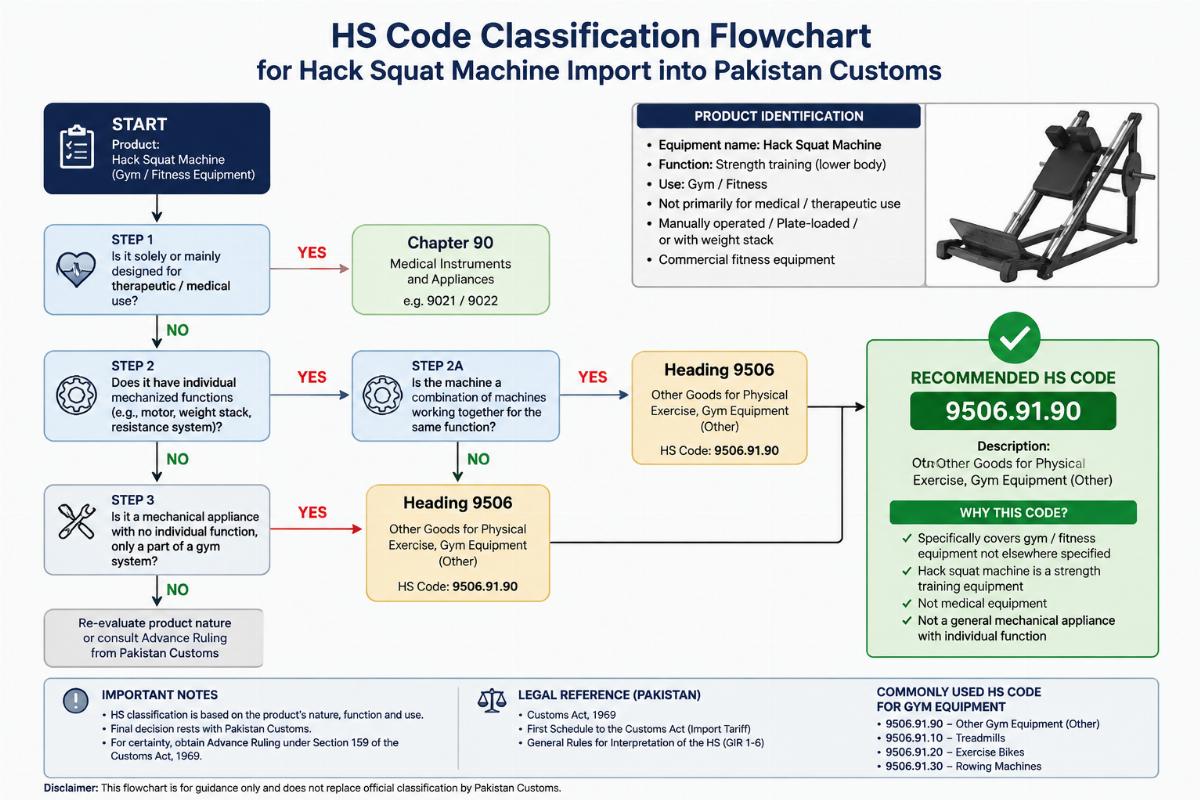
The HS code for a dip station typically falls under the category of other exercise or gymnastics equipment. The exact classification depends on whether the unit is categorized as a standalone strength machine or part of a broader gym equipment set. The duty rate varies based on this classification, and even a minor difference in how the product is described on the invoice can shift the rate. [NEED_CITE: Jordan Customs HS code tariff schedule for strength training equipment]
The landed cost formula works like this: start with the FOB value, add ocean freight and insurance to get the CIF value. Apply the HS-based import duty to the CIF value. Then apply the 16% VAT to the sum of CIF plus duty. On top of that, port handling fees, customs brokerage fees, and inland transportation to the final destination add further cost. The compounding effect of duty plus VAT on an already elevated CIF base means the final landed cost can be noticeably higher than what a buyer initially calculates from the FOB quotation alone.
A hotel fitness center project in the Levant region ordered a batch of selectorized machines and dip stations. The buyer had budgeted based on the FOB price plus a rough estimate for shipping. When the actual duty assessment and VAT calculation came through, the total landed cost exceeded the initial budget by a meaningful margin. The difference was not due to any hidden fee but simply the mathematical reality of duty plus VAT stacking on top of the CIF value.
The key takeaway for buyers is to request a duty estimate from a licensed Jordan customs broker before placing the order. The broker can confirm the HS classification and provide a realistic landed cost projection that includes all applicable charges. This step prevents budget surprises and allows the buyer to price the end product or membership package accordingly.
Why Do Dip Stations Get Held at Aqaba or Amman Dry Port?
The two most frequent reasons for dip station shipments being held at Jordan ports are missing Arabic-language product labels and disputes over HS code classification.
Jordan’s technical regulations require that consumer-facing products, including commercial fitness equipment, carry product information in Arabic. This includes safety warnings, material specifications, weight capacity, and manufacturer details. The requirement applies to the product itself and, in many cases, to the outer packaging as well. English-only labels are not accepted, and there is no grace period for compliance. [NEED_CITE: JSMO Arabic labeling requirements for imported fitness equipment]
I have seen shipments held because the carton markings were in English only. The buyer assumed the gym staff would understand English, but customs officers enforce the regulation uniformly. The cargo was released only after a local agent was hired to apply Arabic adhesive labels to every single carton. The labor cost and the demurrage charges combined to a sum that dwarfed the cost of having the labels printed and applied at the factory before shipment.
The second common hold-up is HS code classification. A dip station can be classified under different headings depending on whether it is viewed as a standalone piece of strength equipment or as part of a multi-gym system. The duty rate difference between these classifications may be a small percentage, but on a full container load, even a few percentage points translate to a significant amount. Buyers who do not confirm the HS code with their broker in advance risk an unfavorable classification at the port, and re-classification after the fact is a slow and costly process.
A commercial gym owner in Amman ordered a full container of functional training equipment including dip stations, plyo boxes, and cable machines. The invoice described the entire shipment under a single HS code for "gymnastics equipment." Customs assessed the entire container under a higher-rate classification because the description was too broad. The buyer ended up paying a higher duty than necessary and had to file a formal amendment request to correct the record for future shipments.
The solution is simple but requires discipline: confirm the Arabic label content with the buyer before production, and verify the HS code with a Jordan customs broker before the invoice is finalized. These two steps eliminate the majority of port delays for fitness equipment imports.
What Is the JSMO Certification Process for Strength Machines?
The JSMO certification process requires the exporter to submit product test reports, undergo a conformity assessment, and obtain a CoC before the goods are shipped. Attempting to complete this process after the cargo arrives at the port results in extended storage fees and potential return-to-origin costs.
The process begins with the manufacturer preparing test reports from an accredited laboratory. These reports must cover the safety and performance parameters specified in the relevant JSMO standards for fitness equipment. The test reports are then submitted to a JSMO-authorized conformity assessment body, which reviews the documentation and may request additional information or samples. Once the assessment is complete and the product is found to be compliant, the CoC is issued. [NEED_CITE: JSMO conformity assessment procedure for imported strength training machines]
The critical point here is timing. The CoC must be in hand before the shipment departs the origin port. If the cargo arrives in Jordan without a valid CoC, the goods cannot clear customs. The buyer then faces a choice: arrange for the certification process to be completed retroactively, which involves testing at a local or regional laboratory and can take multiple weeks, or return the shipment to the origin country. Both options are expensive. The demurrage charges at Aqaba or the Amman dry port accumulate daily, and the cost of re-testing and re-certification adds another layer of expense.
A fitness equipment distributor once shipped a batch of plate-loaded machines to Jordan without confirming the JSMO certification status in advance. The assumption was that the CE documentation from the European market would be sufficient. When the shipment arrived, customs rejected the CE certificates and demanded the JSMO CoC. The goods were held at the port for an extended period while the distributor arranged for the proper certification. The total cost of the delay, including storage, re-testing, and the eventual CoC issuance, was a mid-five-figure sum that completely erased the profit margin on the order.
The lesson is that JSMO certification is not a post-shipment formality. It is a pre-shipment requirement that must be planned into the production timeline. Buyers should confirm with their supplier that the JSMO CoC process is underway and on track to be completed before the cargo is loaded.
How Can Buyers Reduce Landed Cost and Avoid Delays?
The most effective way to reduce landed cost and avoid delays when importing a dip station into Jordan is to complete document pre-review, label compliance verification, and HS code pre-classification before the goods leave the factory.
Document pre-review means that the buyer, the supplier, and the customs broker examine the full set of shipping documents together before the container is sealed. This includes verifying that the commercial invoice matches the packing list, that the HS code is correct and consistently applied, and that the certificate of origin is issued by an accredited body. Any discrepancy caught at this stage costs nothing to fix. The same discrepancy caught at the port costs time, money, and frustration.
Label compliance verification means confirming that all product labels, carton markings, and any required safety information are printed in Arabic and meet JSMO formatting requirements. This should be done during the production run, not after the goods are packed. A factory that exports fitness equipment to multiple regions should have the capability to produce Arabic labels as a standard part of the packaging process. [NEED_CITE: Best practices for Arabic label compliance on exported fitness equipment]
HS code pre-classification involves working with a licensed Jordan customs broker to confirm the correct tariff classification for the specific product before the invoice is issued. The broker can provide a written confirmation of the HS code and the applicable duty rate, which gives the buyer certainty on the landed cost before the order is placed.
Our factory has shipped commercial and home fitness equipment to buyers across multiple regions for an extended period. Over that time, we have developed a standard pre-shipment verification process for Jordan-bound orders that covers all three areas. We prepare the Arabic labels during production, align the HS code with the buyer’s broker, and review the full document set before the container is loaded. This process has consistently allowed our buyers to clear customs without delay and to know their landed cost in advance.
The dip station import into Jordan does not have to be a source of stress. The regulations are clear, the requirements are documented, and the process is manageable when approached with proper preparation. The buyers who succeed are the ones who treat compliance as a production-stage activity, not a post-shipment afterthought.
Conclusion
Jordan customs clearance for fitness equipment is document-driven and unforgiving of gaps. The dip station import into Jordan requires complete documentation, JSMO conformity certification, Arabic labeling, and accurate HS classification. Buyers who verify these elements before shipment avoid port delays, control their landed cost, and receive their cargo on schedule. Preparation at the factory stage is the single most effective measure for a smooth import process.