Functional Rig for Multi-Site 24-Hour Gym Chains Rollout Wholesale Supplier
Most chain owners assume more modules mean more value; in reality, fewer attachment points mean fewer failure points under continuous unmanned operation.
A functional rig built for multi-site 24-hour gym chains must combine heavy-gauge welded frames, high-cycle cable systems, simplified modular architecture, and pre-verified shipping documentation — delivered in a single coordinated production batch to guarantee visual and functional consistency across every location.
I still remember standing on the dock at Qingdao Port watching a container of Smith machines get held up for over twenty days because the bill of lading and the packing list had mismatched product descriptions. The destination port agent had changed hands mid-transit, and nobody bothered to cross-check the paperwork before the vessel left. By the time the paperwork was sorted, the demurrage bill had climbed past the cost of the machines themselves. That single shipment taught every handler in our warehouse one rule: the product description, the HS code, and the packing list must match character by character, verified at least three times before the container doors are sealed. When we started rolling out identical functional rigs for multi-location gym chains, that same discipline became the backbone of every order we ship. [NEED_CITE: common causes of customs delays in fitness equipment shipments]

For anyone planning a chain-wide deployment, the conversation has to move past unit price and start with durability specs, layout logic, container consolidation, and documentation alignment. A functional rig is the structural spine of a 24-hour training zone, and getting it wrong at any of those four levels will cost far more than the equipment itself.
What Specs Should a Functional Rig Meet for 24-Hour Unmanned Gyms?
Continuous-use rigs in unmanned environments demand heavier steel gauge, higher pulley cycle ratings, and a deliberately simplified module count to keep downtime near zero.
When a gym operates around the clock with no staff on the floor, there is nobody to reset a stuck weight stack, re-thread a derailed cable, or tighten a loosened J-cup at two in the morning. The functional rig therefore has to survive the equivalent of commercial peak-hour traffic twenty-four hours a day, seven days a week. Industry testing benchmarks for cable and pulley systems in commercial environments typically require cycle-life ratings that far exceed what a staffed boutique studio would specify. [NEED_CITE: cable and pulley cycle-life testing benchmarks for commercial fitness equipment per ISO standards]
Frame construction is the first line of defense. A rig destined for a 24-hour chain location needs a main upright steel thickness that sits at the upper end of the commercial range, with full-depth welds at every junction rather than spot welds. The base plate footprint must also be wide enough to handle heavy barbell work without additional anchoring, because unmanned sites often skip floor bolting to preserve flooring flexibility.
The second critical spec is the pulley and cable system. In a staffed gym, a frayed cable is noticed and replaced within hours. In a 24-hour unmanned facility, that same cable might run for weeks before a member reports it. The cable routing must use sealed bearings and high-cycle-rated wire rope, and the pulley housings need to be fully enclosed to prevent chalk dust and sweat ingress — the two silent killers of pulley life.
The third spec is counter-intuitive: fewer modules. A common instinct is to load the rig with every possible attachment — landmines, band pegs, monolifts, storage horns, dip stations, pull-up bars at three heights. Each additional attachment is an extra weld point, an extra bolt, and an extra surface that can loosen under repetitive loading. In a 24-hour unmanned environment, the optimal functional rig strips the module list down to what members actually use during off-peak hours and reinforces those modules heavily rather than spreading stress across dozens of lightly built accessories.
A Middle East gym chain operator once ordered a highly customized rig with over a dozen attachment variants for each of their locations. Within the first year, three of their unmanned sites reported loose landmine joints and misaligned pulley tracks. The root cause was not poor steel — it was over-engineering. Too many attachment points created too many stress concentrations. Their second order, placed through our team, used a simplified six-module configuration with reinforced gussets at each junction. Maintenance tickets on the functional rig dropped noticeably across all sites within the first quarter.

How to Standardize Equipment Across Multiple Gym Locations?
Unified specifications, a single production batch, and container-load consolidation are the only reliable way to ensure every location in a chain receives identical color, weld quality, and component fit.
Multi-site gym chains face a consistency problem that single-location operators never encounter. If you order fifty rigs for five locations in five separate purchase orders, even the same factory will produce them in different batches. Steel from different mill heats can show subtle color variation after powder coating. Welders rotate between shifts, and weld bead appearance shifts. Pulley housings from different production weeks may use bearings from different sub-suppliers. Members who train at more than one location in the chain will notice these differences, and franchise brands cannot afford that perception gap.
The solution is straightforward but logistically demanding: consolidate the entire chain order into a single production run and ship in coordinated container loads. This means the chain buyer commits to a full specification freeze before production begins — upright height, bay width, attachment types, color code, pad stitching, and even the branding placement on every upright. Once the spec is locked, every rig rolls off the line in the same sequence, coated in the same batch of powder, and packed into the same container configuration.
Container consolidation also drives cost efficiency. A standard 40-foot high-cube container can hold a specific number of rig bays depending on the upright height and bay width configuration. By calculating the exact bay count per container across all locations, the chain can fill each container to maximum capacity, reducing the per-unit freight cost significantly compared to shipping partial containers for each site. [NEED_CITE: container load optimization ratios for commercial fitness equipment in 40HQ units]
A European fitness franchise developer came to us with a rollout plan for multiple locations across two countries. Their initial approach was to order in tranches — first location first, then second, then third — to preserve cash flow flexibility. We walked them through the consistency risk: different production batches meant different powder coat batches, which meant visible color mismatch between sites. They restructured the order into a single production run, split the rigs into destination-specific container loads, and staggered the container release dates at the port to match their site readiness schedule. The result was a visually identical functional rig in every location, with freight costs reduced per unit thanks to full container utilization.

What Are the Key Procurement and Shipping Checks for Multi-Site Rollouts?
Pre-shipment HS code verification, three-document alignment, and spare parts pre-positioning are non-negotiable steps that prevent port delays and unexpected costs.
The functional rig itself is only half the equation. The other half is getting it through customs at every destination port without delay. Multi-site rollouts multiply this risk because each location may ship to a different port, potentially in different countries with different tariff classifications. A single HS code mismatch between the commercial invoice, the packing list, and the bill of lading can trigger a customs hold that lasts weeks.
The three-document alignment process is rigorous. The product description on the commercial invoice must match the packing list line by line — same wording, same unit count, same HS code. The bill of lading must then mirror both documents exactly. Before any container leaves the factory floor, our documentation team runs a character-by-character comparison across all three documents and shares the comparison sheet with the buyer’s destination agent for sign-off. This is not optional. The demurrage and storage fees at many major ports accumulate daily and can quickly exceed the value of the equipment.
HS code classification for functional rigs requires particular attention. Depending on the destination country, a functional rig with cable pulley systems may be classified differently from a bare-frame rig without pulleys. Some countries treat the entire rig as a single unit under one HS code; others require separate classification for the frame and the cable附件. Getting this wrong means the buyer either overpays duty or faces a customs audit. [NEED_CITE: HS code classification guidelines for multi-station functional training rigs]
Spare parts pre-positioning is the third critical check. A multi-site chain cannot afford to wait for a replacement cable or pulley to ship from China when a rig goes down in an unmanned location. The standard practice is to include a spare parts package with the initial order — cables, pulleys, bolts, J-cup liners, and seat pads — sized to cover the entire chain for an extended period. The spare parts SKU coverage ratio should be calculated based on the total number of stations across all locations, not per location. This ensures that a single failure at any site can be resolved immediately from the central spare parts stock held at the chain’s maintenance hub.
A Southeast Asian distributor once received a full order of functional rigs at their Jakarta warehouse, only to discover that the HS code on the documents did not match the Indonesian tariff schedule for cable-based training equipment. The shipment was held at Tanjung Priok port for an extended period. The cost of storage and the penalty for document correction wiped out the margin on the entire order. Since that case, we have made it a standard procedure to request the buyer’s local agent confirm the HS code in writing before production begins.

How to Plan Functional Rig Layout for Maximum Member Throughput?
Footprint-to-capacity ratio and zone adjacency decisions determine whether a 24-hour gym’s functional rig area handles peak-hour traffic or becomes a bottleneck.
The functional rig zone in a 24-hour gym serves a fundamentally different traffic pattern than a staffed club. Peak hours in unmanned facilities tend to cluster around early morning and late evening, with a secondary surge during lunch hours. The rig layout must be designed to handle these concentrated peaks without creating member congestion that drives people away.
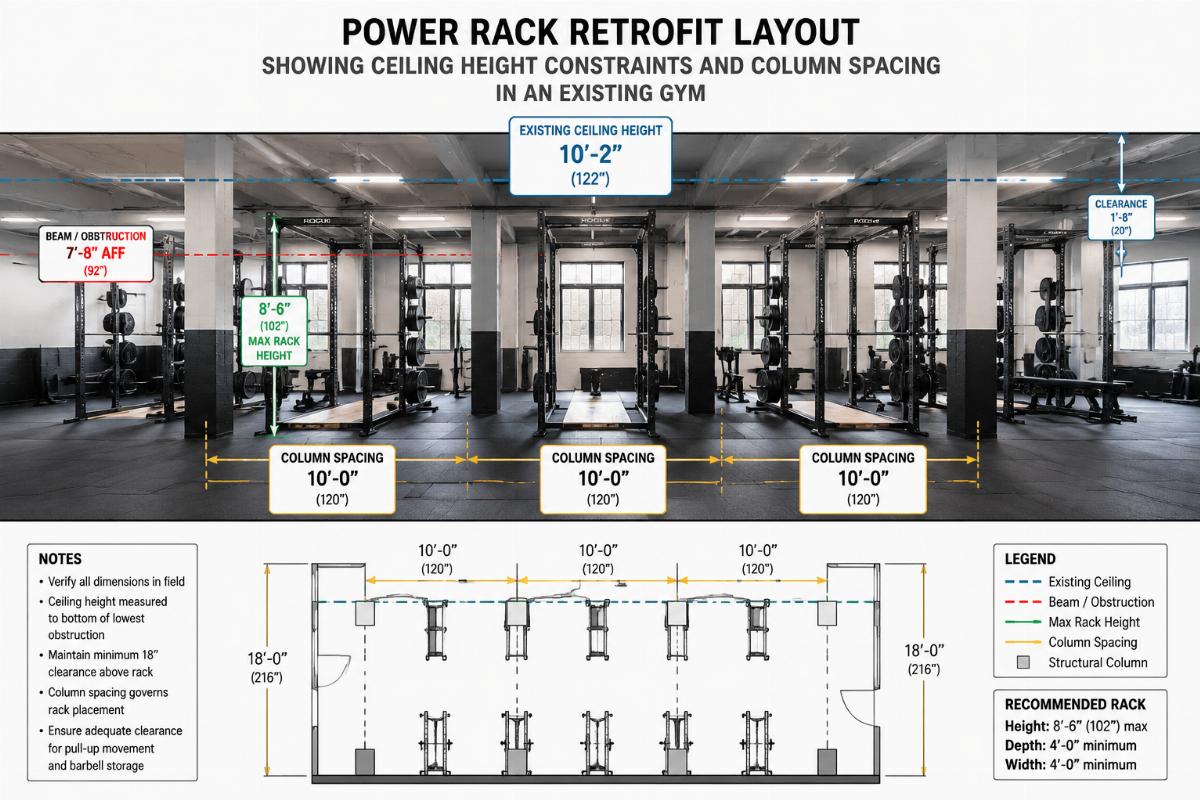
The footprint-to-capacity ratio is the starting metric. Each rig bay typically serves one to two members simultaneously, depending on the attachment configuration. A single-bay rig with a pull-up bar and a cable column can handle one member doing pull-ups while another uses the cable system. Adding a second member to the same bay requires a dual-cable configuration or a separate attachment zone. The chain planner must calculate the expected peak-hour member count at each location and divide it by the per-bay capacity to determine the minimum number of bays required.
Zone adjacency is the second layout principle. The functional rig should be positioned adjacent to the free weight zone, not isolated in a corner. Members doing barbell complexes, sled pushes, or kettlebell circuits need to move between the rig and the dumbbell rack or plate tree without crossing through cardio rows or machine lines. In a 24-hour unmanned gym, poor zone adjacency creates safety risks because fatigued members carrying heavy plates may have to navigate around equipment in low-light conditions.
A fitness chain operator in the Gulf region planned their rig layout based on aesthetic symmetry — rigs lined up along the back wall in a perfectly even row. The problem was that the free weight zone was on the opposite side of the gym. Members had to carry loaded barbells across the full width of the facility to reach the rig, creating a traffic hazard during peak hours. We worked with their design team to reconfigure the layout, splitting the rig count into two clusters flanking the free weight zone. Peak-hour throughput improved noticeably, and the safety incidents related to plate transport dropped to zero within the first month of operation.

Conclusion
A successful multi-site functional rig rollout depends on four pillars: heavy-duty specs for unmanned durability, single-batch production for chain-wide consistency, rigorous documentation alignment for customs clearance, and intelligent layout planning for peak-hour throughput.
Chain owners who treat the functional rig as a commodity purchase and ship it location by location will face consistency gaps, customs delays, and maintenance headaches. Those who approach it as a coordinated deployment — with unified specs, consolidated containers, pre-verified paperwork, and layout logic — will roll out identical member experiences across every site while keeping freight and maintenance costs under control.