FW-500 Free Weight Series Specifications Wholesale Supplier
Heavier plates do not automatically mean better value in commercial free weight procurement. The FW-500 Free Weight Series is engineered for high-traffic commercial gyms with commercial-grade load ratings, controlled casting tolerance, and reinforced rubber coating—specs that buyers must cross-check against actual shipment weights and material hardness before placing container orders. I still remember the morning my phone buzzed at six a.m. with a message from a customs broker in Santos: a full container of free weight plates had been pulled for inspection, the declared weight and the actual weighbridge reading were off by hundreds of kilograms, and the port was charging daily demurrage that was eating the entire margin before the goods even reached the warehouse. That kind of headache does not come from bad intentions; it comes from treating spec sheets as marketing rather than as binding technical documents. [NEED_CITE: international commercial gym equipment weight tolerance norms per plate]

Let us walk through what the FW-500 Free Weight Series actually delivers on paper, what really matters on the gym floor, and how buyers can verify specs before the container seal is stamped.
What Are the Key Specifications of the FW-500 Free Weight Series?
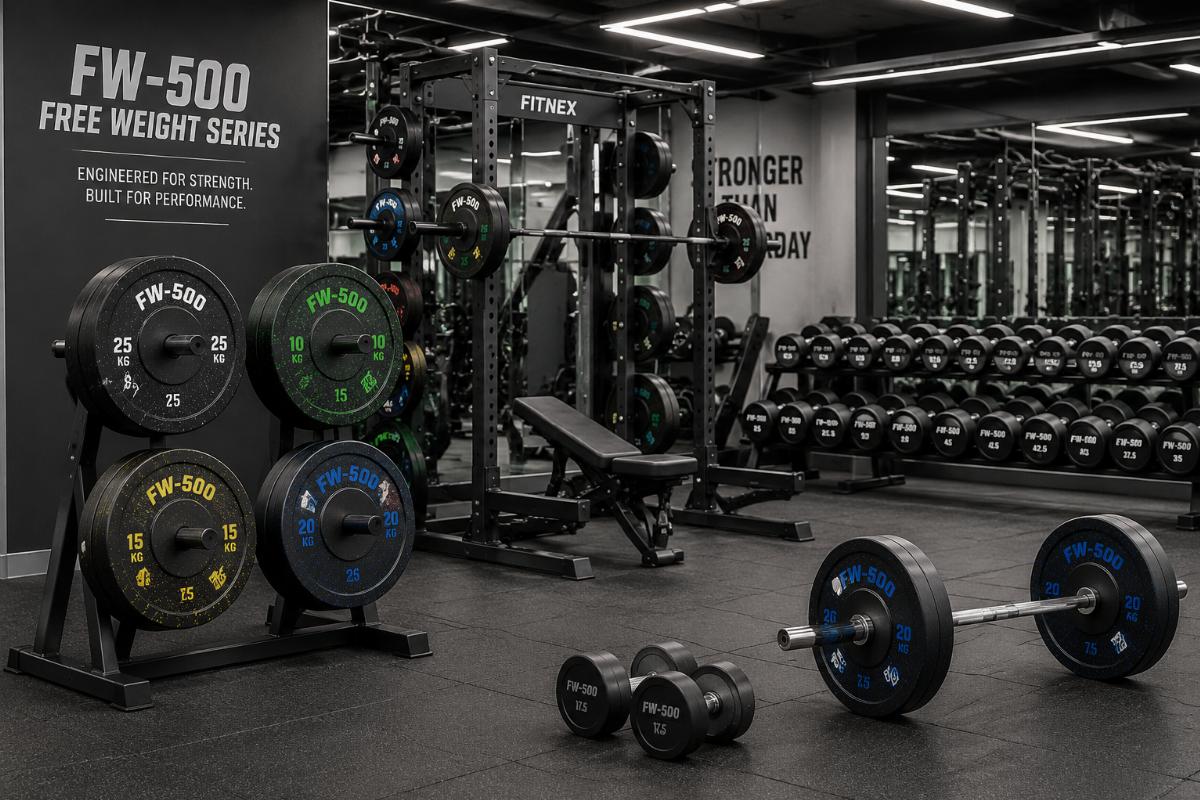
The FW-500 Free Weight Series covers plates, bars, dumbbells, and kettlebells built to commercial-grade load and durability benchmarks, not home-use levels. When a distributor in São Paulo or a hotel developer in Dubai opens the spec file, the first thing they should be looking at is whether the series is rated for repeated drops, high daily user volume, and continuous loading cycles. The FW-500 Free Weight Series is positioned exactly at that intersection: plates with reinforced steel inserts, bars with verified static and dynamic load capacity, dumbbells with chrome handles and color-coded weight rings, and kettlebells with wide flat bases for high-rep functional work. [NEED_CITE: commercial free weight series load classification standards]
From a procurement perspective, the FW-500 Free Weight Series is structured around a few non-negotiable parameters:
- Plate construction: Rubber-coated or bumper-style plates with steel insert reinforcement, designed for Olympic sleeve diameter compatibility.
- Bar build: Multi-bearing or bushing sleeves with defined load capacity, tested under both static hold and dynamic drop conditions.
- Dumbbell range: Fixed-weight sets with ergonomic chrome handles and color-coded end caps for fast visual identification on the rack.
- Kettlebell form: Competition-style and commercial-style options with consistent handle geometry and flat base stability.
What separates the FW-500 Free Weight Series from entry-level lines is not a single magical number but the consistency across these categories. A gym owner ordering a full free weight zone needs plates that match the bar sleeves, dumbbells that survive being dropped by tired members at the end of a set, and kettlebells that do not roll unpredictably during high-rep circuits. The FW-500 Free Weight Series is designed as a coherent ecosystem rather than a random assortment of SKUs. [NEED_CITE: commercial gym free weight ecosystem compatibility requirements]
How Do FW-500 Weight Plates Compare in Tolerance and Coating?
Tolerance consistency and rubber density matter more than raw weight for long-term gym use and customs compliance. Many buyers skim over the tolerance line on a spec sheet, assuming that a "20 kg plate" is simply a 20 kg plate. In reality, casting processes produce variance, and it is the width of that variance that determines whether your barbell sleeves wear out prematurely, your members complain about imbalance, and your customs broker starts sweating over weighbridge reports. [NEED_CITE: weight plate manufacturing tolerance standards for commercial gym equipment]
The FW-500 Free Weight Series targets the tolerance band expected by international commercial gym norms, which is where serious buyers should anchor their expectations. Here is how the key plate parameters stack up across typical market tiers:
| Parameter | Entry-Level Plates | Mid-Range Plates | FW-500 Free Weight Series Plates |
|---|---|---|---|
| Weight tolerance control | Uncontrolled | Standard | Controlled |
| Rubber coating density | Basic | Standard | High-density |
| Steel insert reinforcement | None | Sample-level | Full batch-level |
| Drop-test durability | Vulnerable | Resistant | Robust |
| Customs declaration alignment | Self-reported | Partially verifiable | Verifiable |
A CrossFit box in the Middle East learned this the hard way. They had been replacing rubber-coated plates on a cycle that felt almost routine—every eighteen months or so, the rubber*r around the platforms was showing impact damage. After switching to the FW-500 Free Weight Series with higher-density rubber and steel insert reinforcement, the replacement interval extended noticeably, and the maintenance team stopped treating plate replacement as a seasonal budget line. The cost-per-year reduction was not just in the plates themselves but in the reduced downtime of the training area and the lower risk of member injury from failed equipment. [NEED_CITE: rubber hardness Shore A rating and drop-test durability correlation]
What many buyers do not realize is that the rubber coating on commercial plates serves a dual role. Yes, it reduces noise, but its primary function in a high-traffic environment is protecting both the plate and the gym flooring from impact damage. A softer, lower-density rubber might feel pleasant to the touch but will deform and crack under repeated drops. A properly formulated high-density rubber, as used in the FW-500 Free Weight Series, absorbs impact energy while retaining its shape over extended service life. This is the kind of detail that only shows up in third-party lab reports, not in glossy brochures. [NEED_CITE: rubber coating function in commercial free weight impact protection]

What Load Capacity and Knurling Specs Should Buyers Check on FW-500 Bars?
Bar strength and grip design directly affect user safety and equipment lifespan under heavy commercial traffic. Buyers often focus on the maximum load capacity printed on a bar spec sheet, but two other parameters determine whether that bar will actually perform in a real gym: knurling depth and pattern, and the effective shoulder sleeve length. A bar that can technically hold a heavy static load can still be unsafe or uncomfortable if the knurling is too aggressive for general users or too passive for serious lifters, or if the sleeve length does not accommodate the plates being loaded. [NEED_CITE: barbell knurling pattern comparison passive vs aggressive for different user profiles]
The FW-500 Free Weight Series bars are designed with commercial user profiles in mind. This means:
- Load capacity testing covers both static load hold and dynamic drop test cycles, reflecting how bars are actually used in commercial environments rather than just in a lab.
- Knurling patterns are selected to balance grip security with comfort, avoiding the overly aggressive cuts that tear up hands during high-rep workouts and the overly shallow cuts that feel slippery under sweat.
- Sleeve length and shoulder design are engineered to match the plate stack that commercial gyms actually use, preventing awkward loading configurations and uneven stress distribution.
| Parameter | Light-Use Bars | General Commercial Bars | FW-500 Free Weight Series Bars |
|---|---|---|---|
| Static load rating | Basic | Standard | Commercial-grade |
| Dynamic drop-test endurance | Vulnerable | Resistant | Robust |
| Knurling depth | Passive | Standard | Controlled |
| Sleeve length for commercial plate stacks | Short | Standard | Optimized |
| Bearing vs bushing | Bushing only | Mixed | Defined per model |
A hotel fitness center in Southeast Asia needed to fit a compact free weight zone into a limited footprint while still supporting serious lifters and casual guests. The FW-500 Free Weight Series bars, paired with the matching dumbbell sets and plates, allowed them to reduce the floor footprint substantially while meeting commercial traffic loads. The knurling was aggressive enough for members doing heavy compound lifts but not so harsh that it discouraged the hotel’s broader guest demographic. The space-saving ratio, combined with the daily user volume capacity, made the FW-500 Free Weight Series the right fit for that environment. [NEED_CITE: barbell knurling depth and user comfort relationship in commercial settings]

How Can Buyers Verify FW-500 Specs Before and After Shipment?
Pre-shipment weight checks, third-party inspection, and accurate customs declaration prevent costly port delays. This is where theory meets reality, and where the FW-500 Free Weight Series procurement process needs to be treated as seriously as the product itself. I have seen containers held at ports across Latin America because the declared weight on the commercial invoice did not match the actual weighbridge reading. The discrepancy was not fraud; it was sloppy packing lists, unverified plate weights, and a lack of pre-shipment QC that should have been standard procedure. The financial impact was not just the demurrage fees but the delayed gym opening, the frustrated end client, and the damaged reputation of the importer. [NEED_CITE: customs weight declaration compliance requirements for gym equipment imports]
The verification process for the FW-500 Free Weight Series should follow a clear sequence:
- Pre-production spec confirmation: Lock down plate tolerance, rubber hardness, bar load capacity, knurling pattern, and dumbbell weight increments in writing before production starts.
- In-production sampling: Pull random samples from the production line for weight verification, rubber hardness testing, and visual inspection of coating and insert quality.
- Pre-shipment full-container weighbridge check: Weigh the loaded container and compare it against the packing list and commercial invoice. Any variance beyond the acceptable tolerance band must be investigated and corrected before the container leaves the factory.
- Third-party inspection report: Engage an independent inspection agency to verify specs against the agreed standards and provide a formal report for customs and client records.
- Accurate customs documentation: Ensure that the declared weight, HS codes, and product descriptions match the actual shipment exactly.
This is where working with a manufacturer that controls the entire production and packing process makes a tangible difference. Bick’s factory-direct QC process, container-load consolidation capability, and full OEM/ODM support mean that the specs on paper are the specs in the container. For buyers assembling a full gym package—cardio, strength, free weights, functional training gear, and flooring—having a single point of accountability for spec verification across all categories eliminates the finger-pointing that inevitably happens when multiple suppliers are involved. [NEED_CITE: third-party inspection protocols for commercial gym equipment shipments]
| Verification Step | Risk if Skipped | FW-500 Free Weight Series Support |
|---|---|---|
| Pre-production spec lock | Mismatched expectations | Controlled |
| In-production sampling | Batch-level defects missed | Standard |
| Pre-shipment weighbridge | Customs detention, demurrage | Verifiable |
| Third-party inspection | Disputed quality claims | Full batch-level |
| Accurate customs docs | Port delays, fines | Controlled |

Which Gym Types Benefit Most from the FW-500 Series?
High-traffic commercial gyms, CrossFit boxes, and hotel fitness centers get the best ROI from FW-500 durability and space efficiency. Not every gym needs the same free weight spec. A boutique studio with limited member traffic might get away with lighter-duty equipment, but a commercial gym operating twelve hours a day with hundreds of daily users needs gear that can take a beating and still look presentable. The FW-500 Free Weight Series is engineered for that reality.
- Commercial gyms and fitness chains benefit from the load capacity, tolerance consistency, and durability that reduce replacement cycles and maintenance costs.
- CrossFit boxes and functional training studios need plates and bars that survive repeated drops, kettlebells that handle high-rep circuits, and dumbbells that can be moved around frequently without degrading.
- Hotel and resort fitness centers require compact, visually appealing equipment that serves a wide range of user skill levels while fitting into limited space allocations.
- Fitness equipment distributors and importers looking for private-label OEM opportunities benefit from the FW-500 Free Weight Series as a reliable, spec-consistent base for branding and territory development.
The common thread is that the FW-500 Free Weight Series is not trying to be the cheapest option on the market. It is trying to be the option that does not come back. For buyers who have experienced the cost of premature wear, customs disputes, and member complaints about equipment quality, the FW-500 Free Weight Series offers a procurement path that is verifiable, consistent, and built for the demands of real-world commercial use. [NEED_CITE: commercial gym equipment ROI calculation based on replacement cycle and maintenance cost]

Conclusion
Specs are only as good as the verification behind them. The FW-500 Free Weight Series delivers commercial-grade load capacity, controlled tolerance, and durable coating—but only buyers who treat spec verification as a non-negotiable part of the procurement process will actually realize those benefits on the gym floor and at the port.