Monkey Bar Rig Duty Cycle for Strongman Training Facilities | OEM Wholesale Supplier
Thicker steel tubes do not guarantee longer rig life—weld nodes fail first under repeated dynamic impact.
Monkey bar rig duty cycle defines how many high-impact repetitions a rig can endure before fatigue cracks or beam deflection appear; selecting the wrong cycle rating is the single most common cause of premature structural failure in high-traffic functional training facilities, regardless of material grade or coating quality.
I still remember a video a client sent me from São Paulo—his CrossFit and strongman box had just opened, and the monkey bar rig he bought from a different supplier was already showing hairline cracks at the weld nodes by month four. The steel thickness looked fine on paper, the powder coating was intact, and the static load test certificate was printed and framed on his wall. What nobody had told him was that his daily usage pattern—dozens of athletes cycling through muscle-ups, rope climbs, and weighted pull-ups—fell squarely into the highest impact tier, and the rig he received was rated for a completely different duty cycle. That conversation changed how I approach every commercial rig inquiry, and it is the reason I now walk every buyer through duty cycle mapping before we even discuss pricing. [NEED_CITE: fatigue failure distribution in welded steel structures under cyclic loading per AWS D1.1 guidelines]

Let me break down what duty cycle actually means on a monkey bar rig, how different gym types map to different tiers, where rigs genuinely fail, and how you can verify a manufacturer’s claims before you commit to an order.
What Is Duty Cycle on a Monkey Bar Rig and Why Does It Matter?
Duty cycle on a monkey bar rig refers to the engineered endurance threshold of the entire structural system—tubes, weld joints, gussets, and attachment points—under a defined pattern of repeated loading and unloading over its intended service life.
It is not a measure of how much static weight the rig can hold. It is a measure of how many dynamic impact cycles the rig can absorb before micro-cracks initiate at stress concentration points. A rig that passes a one-time static load test of several hundred kilograms can still develop weld fatigue within months if the duty cycle rating does not match the facility’s actual usage intensity. [NEED_CITE: distinction between static load capacity and fatigue life in structural steel design per EN 1993-1-9]
The concept borrows from industrial welding and crane duty classifications, where equipment is rated not just by maximum load but by the number of load cycles per day and the severity of each cycle. In functional training rigs, the equivalent variables are daily athlete count, repetition frequency, impact type (controlled hang vs. explosive muscle-up vs. dynamic rope climb), and whether athletes add external load.
Most buyers conflate monkey bar rig duty cycle with tube wall thickness. Wall thickness matters for static rigidity and resistance to bending, but fatigue failure in welded structures overwhelmingly originates at the weld toe and heat-affected zone—not in the middle of a tube span. [NEED_CITE: weld toe fatigue crack initiation mechanisms in rectangular hollow section joints per IIW recommendations]
A boutique studio running two or three personal training sessions per day with moderate bodyweight work sits in a fundamentally different duty cycle tier than a CrossFit box running back-to-back classes with high-rep bar muscle-ups. Specifying the same rig for both is like specifying the same crane for a warehouse and a steel mill.
How Do Different Gym Types Map to Duty Cycle Tiers?
Functional training rigs are generally classified into light, moderate, heavy, and industrial duty cycles based on daily impact frequency, athlete profile, and exercise type—and mismatching the tier to the facility is the root cause of most premature rig replacements.
Here is how the tiers typically map to real-world facility types:
| Facility Type | Typical Daily Usage Pattern | Recommended Duty Cycle Tier | Key Stress Factors |
|---|---|---|---|
| Hotel / Apartment Fitness Center | Sporadic guest use, low peak-hour frequency, bodyweight exercises only | Light | Low cycle count, minimal dynamic impact |
| Boutique PT Studio / Small Group Training | Scheduled sessions, moderate rep volume, controlled movements | Moderate | Predictable load patterns, limited peak congestion |
| Commercial General Gym Functional Zone | Mixed member traffic, moderate-to-high daily rep count, varied exercises | Heavy | Higher cycle accumulation, occasional dynamic movements |
| CrossFit Box / Strongman Facility | Back-to-back classes, high-rep explosive movements, added external load, rope climbs | Industrial / Heavy-Duty | Extreme dynamic impact, high weld node stress, continuous cycling |
[NEED_CITE: fitness equipment structural durability classification frameworks per EN 957-1 and ASTM F3524]
The São Paulo case I mentioned earlier fell into the industrial tier. The athletes were doing high-rep muscle-ups with kipping, rope climbs that generate lateral swing loads on the bar, and weighted pull-ups—all of which produce dynamic impact forces substantially higher than the static weight of the athlete alone. The rig they originally purchased was rated for a moderate cycle, and the weld nodes showed fatigue cracking within a single quarter of heavy use.
For distributors and gym owners sourcing a monkey bar rig, the critical step is to document your facility’s usage profile before requesting a quote: daily athlete count, peak-hour class frequency, dominant exercise types, and whether external loading is typical. A reputable manufacturer will use this data to recommend the correct duty cycle tier and adjust weld joint design accordingly—not just quote you the thickest tube available.

Where Do Rigs Actually Fail—Tube or Weld Nodes?
The overwhelming majority of monkey bar rig structural failures originate at weld joints, not in the steel tube itself—and this is the single most misunderstood point in rig procurement.
Buyers naturally focus on tube diameter and wall thickness because those are the easiest specs to compare on a quotation sheet. But in any welded steel structure subjected to cyclic loading, the weld toe is the primary site of fatigue crack initiation. The heat-affected zone adjacent to the weld has a different microstructure from the base metal, and the geometric transition at the weld toe creates a stress concentration point. [NEED_CITE: fatigue crack initiation at weld toes in loaded rectangular hollow section connections per AWS D1.1 structural welding code]
This is why a rig built with heavy-wall tubing but inadequate weld penetration or poor joint preparation can fail faster than a rig with lighter tubing but properly engineered weld nodes. The tube may remain perfectly straight while the weld cracks progressively underneath the coating—often invisible until the crack propagates through the full joint depth and the bar shifts visibly under load.
In the São Paulo case, the first visible symptom was a subtle misalignment at the monkey bar connection point. By the time the client noticed, the micro-crack had propagated through the weld throat, and the horizontal beam had begun to deflect under load. The coating was still intact—the surface finish gave no indication of the structural damage underneath. This is exactly why coating quality and surface finish do not correlate with duty cycle endurance, and buyers who evaluate rigs primarily on appearance are exposing themselves to hidden failure risk.
The practical takeaway: when evaluating a monkey bar rig supplier, ask specifically about weld joint design, penetration depth standards, and whether the manufacturer performs dynamic cyclic load testing rather than static load testing alone. [NEED_CITE: dynamic fatigue testing versus static proof testing for welded fitness equipment structures]

How to Verify a Manufacturer’s Duty Cycle Claim Before Ordering?
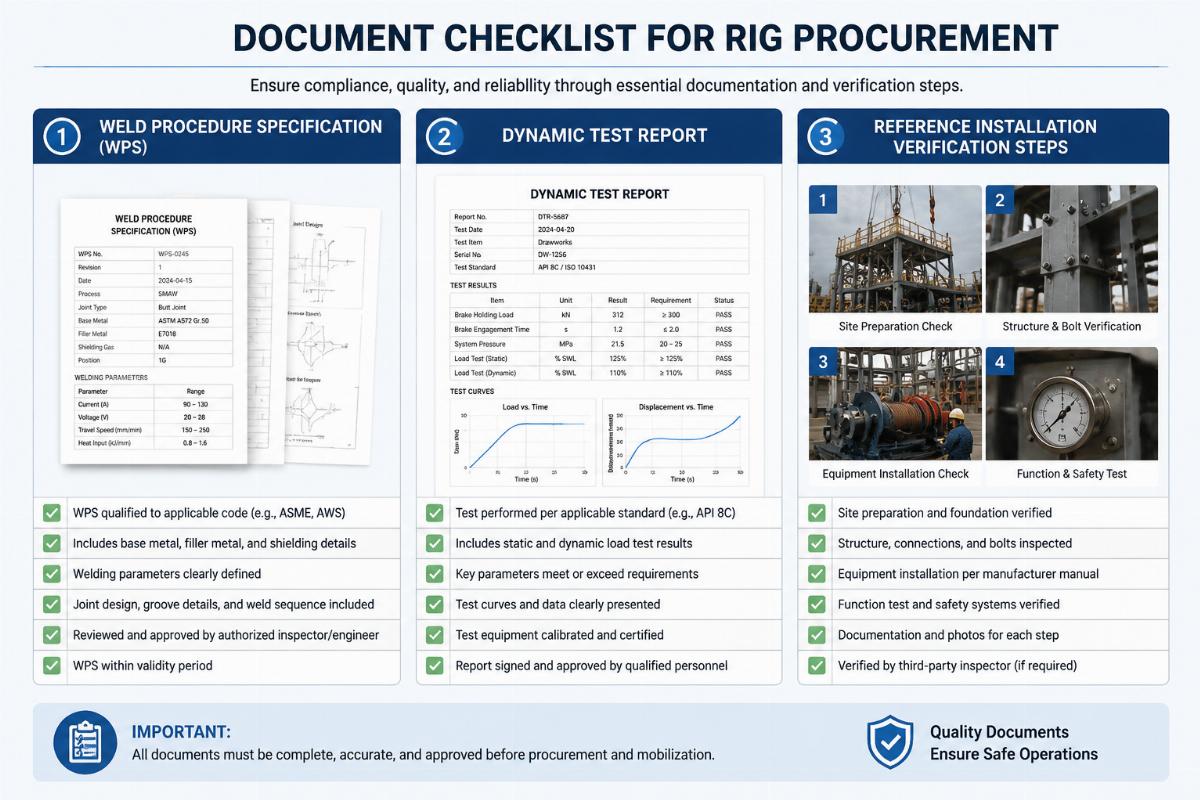
Verifying a manufacturer’s monkey bar rig duty cycle claim requires requesting weld procedure documentation, dynamic load test reports, and reference installations with comparable usage intensity—not just a static load certificate or a product brochure.
Here is the verification workflow I recommend to any commercial buyer or distributor evaluating a rig order:
- Request the weld procedure specification (WPS) and procedure qualification record (PQR). These documents define the welding parameters, joint geometry, and qualification tests the manufacturer follows. A supplier who cannot produce these is not engineering to a recognized welding standard. [NEED_CITE: weld procedure qualification requirements per AWS D1.1 or ISO 15614 for structural steel]
- Ask for dynamic cyclic load test reports, not just static load test certificates. Static testing proves the rig can hold a given weight once. Dynamic cyclic testing proves the rig can endure repeated impact loading over thousands of cycles without crack initiation. These are fundamentally different tests with fundamentally different implications for duty cycle.
- Request reference installations with similar usage intensity. If you operate a CrossFit box, ask the supplier for case references from other high-traffic functional training facilities that have been in operation for multiple years. A supplier who can only provide references from hotel gyms or light-use studios cannot validate an industrial duty cycle claim.
- Audit the joint design, not just the tube spec. Ask for cross-sectional drawings of the weld nodes. Look for full-penetration welds, gusset reinforcement at high-stress junctions, and evidence that the joint geometry was designed to reduce stress concentration at the weld toe.
- Confirm third-party testing or certification where applicable. Depending on your market, relevant standards may include EN 957 for fitness equipment structural safety or ASTM F3524 for functional training structures. Certification to these standards involves independent verification of structural endurance. [NEED_CITE: structural safety and durability testing requirements for commercial fitness equipment per EN 957-1]
When we prepare a commercial rig quotation at our facility in Shandong, we ask every buyer for their facility usage profile before we finalize the specification. For high-intensity functional training environments, we provide weld procedure documentation and dynamic load test data as standard deliverables with the order—not as optional extras. This is not a marketing gesture; it is the only rational way to ensure the monkey bar rig duty cycle matches the facility’s actual operating conditions.
What Happens When You Under-Spec the Duty Cycle?
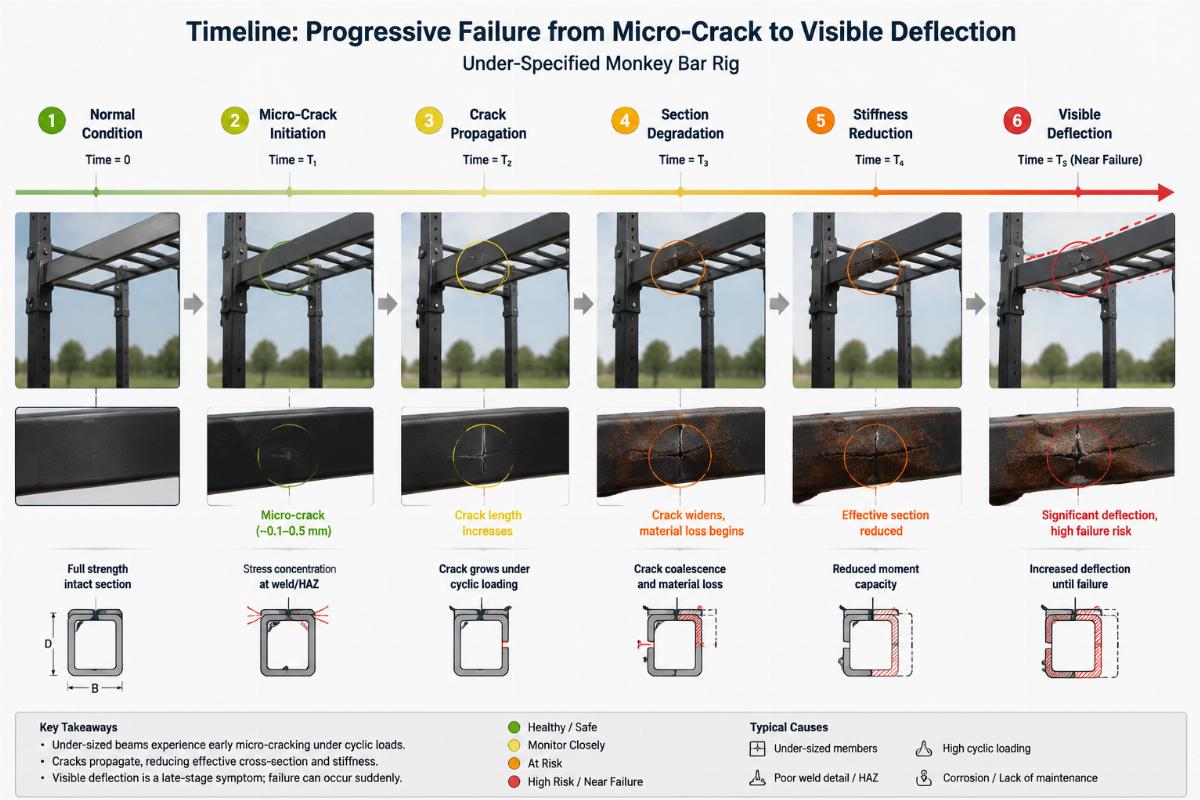
Under-specifying the monkey bar rig duty cycle leads to a predictable failure sequence: micro-cracks at weld nodes within the first months of heavy use, progressive beam deflection, visible structural deformation, and ultimately a full rig replacement at multiples of the original investment.
The failure sequence typically unfolds as follows. Micro-cracks initiate at the weld toe under repeated dynamic loading—often invisible from the surface because the powder coating bridges the crack. As cycling continues, the crack propagates through the weld throat, reducing the effective load-bearing cross-section of the joint. The bar begins to shift or deflect under loads it was originally rated to hold. Athletes notice instability. The facility manager notices visible misalignment. By the time the crack becomes visible on the surface, the joint has already lost a substantial portion of its structural capacity.
The cost consequence extends well beyond the replacement rig itself. Downtime in a commercial training facility means lost membership revenue and class cancellations. Shipping and installation costs for a replacement rig add substantially to the total expense. And if a structural failure occurs while an athlete is loading the bar, the liability exposure dwarfs the equipment cost entirely.
This is why the initial savings from specifying a lower duty cycle rig are illusory. A rig that costs marginally less upfront but fails within a single year of heavy use costs several times the original price difference when you factor in replacement, downtime, and reputational damage with members.
For distributors building inventory for the Latin American and Middle Eastern markets—where CrossFit and strongman training continue to grow rapidly—the risk is particularly acute. Facility operators in these regions often push for the lowest unit price, and without proper duty cycle guidance, they will default to the cheapest quote and discover the failure pattern the hard way. A knowledgeable supplier’s role is to educate the buyer on duty cycle mapping before the order is placed, not to ship a mismatched product and handle the complaint afterward.
Conclusion
Monkey bar rig duty cycle is the single most important specification for any high-traffic functional training facility, and it cannot be inferred from tube thickness or coating quality alone. Matching the duty cycle tier to your facility’s actual usage pattern, verifying the manufacturer’s weld joint design and dynamic testing capability, and demanding documentation before you order are the only reliable ways to avoid premature structural failure and the substantial hidden costs that follow.