Olympic Flat Bench for Commercial Gym Supplier, Heavy-Duty Factory Direct Price
There is no official "duty cycle" certification for Olympic flat benches — what matters is frame construction, welding integrity, and dynamic load tolerance under continuous professional use.
In professional sports facilities, Olympic flat bench duty cycle refers to the equipment’s capacity to endure extended daily operation — typically eight to twelve hours of continuous heavy lifting — without structural degradation. This is not a single-number rating printed on a spec sheet. It is determined by tube wall thickness, welding penetration depth, gusset reinforcement design, and whether the bench passes dynamic impact testing rather than static load testing alone.
I remember walking through a commercial gym in São Paulo that had purchased a full set of flat benches from a low-cost source. Within half a year, multiple units developed hairline cracks along the weld seams near the seat frame joints. The gym owner showed me repair invoices that added up to a significant portion of what a proper set would have cost upfront. [NEED_CITE: common failure modes in commercial gym bench equipment under high-frequency use] That gym was running twenty-plus benches with roughly ten hours of daily traffic — exactly the kind of environment where Olympic flat bench duty cycle becomes a make-or-break factor.

The lesson from that South American facility, and dozens of similar situations I have seen across Latin America, the Middle East, and Southeast Asia, is straightforward: buyers need to look past the advertised static weight capacity and understand what actually determines whether a bench survives professional-level abuse.
What Does "Duty Cycle" Actually Mean for Olympic Flat Benches?
Duty cycle for an Olympic flat bench is not a standardized industrial metric like it is for welding machines or compressors — it is a manufacturer-defined indication of how many hours per day the equipment can sustain under typical commercial loading conditions.
In industries such as power tools or industrial welding, duty cycle is expressed as a percentage of a ten-minute operating period. [NEED_CITE: standard duty cycle definitions in industrial equipment versus fitness equipment] For gym benches, no such universal standard exists. What you see on product listings is essentially the manufacturer’s own usage recommendation — and those recommendations vary wildly.
Some factories rate their benches for light commercial use at roughly four to six hours daily. Others claim heavy-duty status for eight-hour windows. The benches built for professional sports team facilities are engineered for continuous operation with minimal rest periods between users — and that is where the real differences in construction emerge.
I once inspected a shipment at our production floor where a buyer from a hotel chain in the Gulf region had selected benches purely based on the listed static weight capacity. The numbers looked impressive on paper. But when we ran a dynamic impact simulation — dropping weighted bars from a moderate height onto the bench repeatedly — the frame showed flex that a bench built for professional team use would never display. The actual load-bearing performance under dynamic conditions fell noticeably short of the static rating. [NEED_CITE: difference between static and dynamic load testing in fitness equipment standards]
That is the core misunderstanding: Olympic flat bench duty cycle in a professional setting is about surviving repeated dynamic loading — the bar being set down forcefully after a heavy set, the constant vibration from adjacent equipment, the lateral forces from uneven loading — not just holding a static number on a spec sheet.

How Do Professional Sports Facilities Define Bench Requirements?
Professional team facilities prioritize dynamic impact resistance and structural fatigue endurance over maximum static weight capacity — requiring reinforced frames, full-penetration welding at critical joints, and gusset plates at high-stress intersections.
When I work with facility managers from professional sports organizations, the conversation about Olympic flat bench duty cycle starts differently than it does with a commercial gym owner. A gym owner typically asks about the weight number. A team facility manager asks about the weld type, the steel grade, and whether we can provide third-party fatigue test documentation. [NEED_CITE: equipment procurement standards for professional sports team training facilities]
The reasoning is practical. In a team environment, athletes are lifting near-maximal loads and setting the barbell down with force — sometimes slightly off-center. This creates torsional stress on the frame that a purely static-rated bench was never designed to handle. Over hundreds of repetitions per day, this dynamic loading accelerates fatigue at welded joints far faster than a clean static load would.
A CrossFit-style training facility in Southeast Asia serves as a clear example. They initially ordered benches specified only by static weight capacity. The benches held up fine during the first few weeks of lighter programming. But once the athletes started incorporating heavy bench press variations with aggressive bar drops, weld failures began appearing at the seat-to-base connection points. The replacement cycle compressed to a fraction of what it should have been for properly specified equipment.
Professional team facilities typically require the following construction features:
- Frame tubing with controlled wall thickness and verified material grade — not just a larger outer dimension with thin walls
- Full-penetration welding at all structural joints, with post-weld grinding and inspection
- Gusset reinforcement at the seat-to-leg and leg-to-base intersections
- Rubber or urethane foot pads that prevent lateral sliding under dynamic loads
- Padding density and cover material rated for high-frequency use without compression breakdown

The key insight is that Olympic flat bench duty cycle in this context is less about a number and more about a construction philosophy — one that assumes the bench will be abused, not just used.
What Construction Features Determine Real Durability?
Frame tube wall thickness, welding工艺 quality, and structural reinforcement design matter far more than the advertised weight rating — and these features are verifiable through physical inspection and documentation review.
Let me break down what actually separates a bench that lasts years in a high-traffic facility from one that starts failing within months.
The frame tubing is the starting point. Many manufacturers use the same outer tube dimensions but vary the wall thickness to hit different price points. A bench with larger-diameter tubing but thinner walls may actually flex more under load than a bench with slightly smaller tubing but thicker walls. [NEED_CITE: structural engineering principles for steel tube load-bearing capacity in fitness equipment] The material grade matters too — standard mild steel versus higher-tensile grades makes a meaningful difference in fatigue resistance over time.
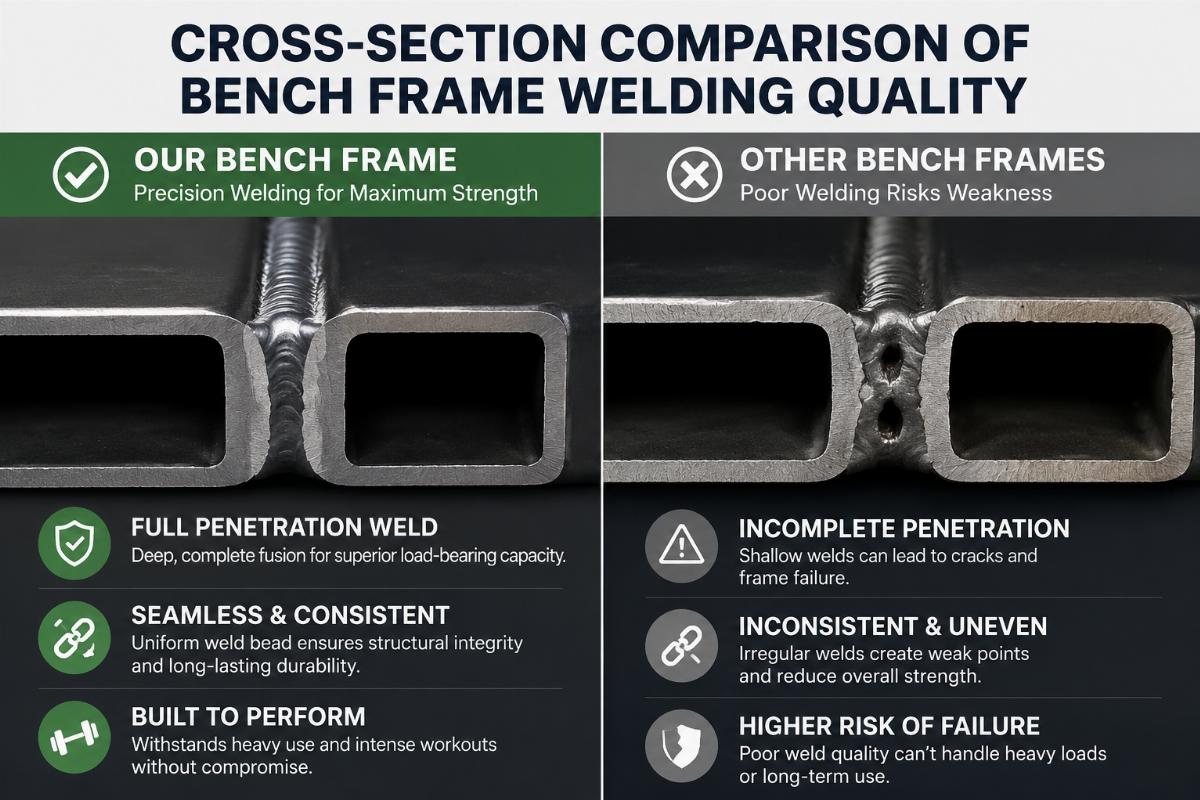
Welding is where the most critical differences hide. Spot welding or intermittent welding along a joint is significantly cheaper than full-length continuous welding, but it creates stress concentration points that become failure origins under cyclic loading. I have seen benches where the welds looked acceptable from a distance but, upon close inspection, had incomplete fusion at the root — a defect that would propagate into a crack under repeated dynamic loading. [NEED_CITE: welding defect types and their impact on structural fatigue life]
Post-weld treatment is another differentiator. Properly ground and smoothed welds reduce stress risers. Welds left as-deposited with spatter and undercut create microscopic crack initiation sites.
Reinforcement design rounds out the picture. Gusset plates at high-stress junctions distribute load across a broader area. Cross-bracing between legs reduces lateral flex. The bench’s overall geometry — the width of the base relative to the seat length, the angle of the leg supports — determines how forces transfer through the structure.
| Construction Factor | Light Commercial Grade | Heavy Commercial Grade | Professional Athletic Grade |
|---|---|---|---|
| Frame Tube Wall | Standard | Thickened | Controlled thickness with verified grade |
| Welding Method | Intermittent | Continuous | Full-penetration with post-weld treatment |
| Joint Reinforcement | Minimal | Standard gussets | Engineered gussets at all critical intersections |
| Load Testing | Static only | Static with safety margin | Dynamic impact and fatigue cycle testing |
| Padding Durability | Basic foam | High-density foam | High-density with reinforced cover material |
When evaluating Olympic flat bench duty cycle claims, these are the construction elements that need verification — not the marketing copy.
How to Verify Duty Cycle Claims Before Purchasing?
Request weld procedure specifications, third-party test reports, and warranty terms that explicitly cover continuous commercial use — then cross-reference these documents against physical samples or factory inspection.
This is where many purchasing processes break down. A supplier can print any weight number on a spec sheet. The question is whether that number reflects reality under the conditions your facility will impose.
Here is the verification approach I recommend when sourcing Olympic flat bench equipment for professional or heavy commercial environments:
First, request the weld procedure specification or at minimum a clear description of the welding method used at structural joints. If the supplier cannot distinguish between full-penetration welding and intermittent tack welding in their documentation, that is a significant red flag. [NEED_CITE: welding procedure qualification requirements for structural steel in fitness equipment]
Second, ask for test reports from recognized third-party laboratories. These should include static load testing results and, for professional-grade equipment, dynamic or fatigue cycle testing data. Self-reported test results from the factory’s own quality department carry less weight than independent lab certification. [NEED_CITE: third-party testing standards for commercial fitness equipment structural integrity]
Third, examine the warranty terms carefully. A warranty that covers "normal commercial use" but excludes failures from "repetitive heavy loading" is essentially excluding the exact conditions a professional facility creates. The warranty language should align with the stated duty cycle expectations.
Fourth, if the order volume justifies it, arrange a factory inspection or request physical weld samples. A cross-section photograph of a welded joint tells you far more than a product photo of the finished bench.
At our facility, we provide weld process documentation, load testing video records, and relevant CE certification files as standard parts of the procurement package for professional team facility orders. When we prepare a full container consolidation for a sports team complex, every bench specification is matched against the intended usage intensity — and the documentation travels with the shipment so the facility manager can verify what was delivered against what was promised.

What Happens When Duty Cycle Is Mismatched to Usage?
Benches specified below the actual usage intensity fail prematurely — creating safety hazards, unplanned downtime, and total replacement costs that substantially exceed the initial savings from choosing lower-grade equipment.
The consequences of mismatching Olympic flat bench duty cycle to actual facility demands are never subtle. They manifest as safety incidents, member complaints, and financial losses that dwarf the price difference between grade levels.
A hotel fitness center in the Middle East purchased benches based primarily on unit price, without evaluating dynamic load capacity. The facility served both hotel guests and local members, generating usage patterns closer to a commercial gym than a light-traffic hotel amenity. Within a short period, multiple benches exhibited frame flex and padding compression well beyond acceptable levels. The actual load-bearing performance under real conditions fell noticeably below the listed specifications. The hotel faced guest complaints, potential liability exposure, and the cost of replacing the entire bench inventory — a total expenditure far exceeding what properly specified equipment would have cost initially. [NEED_CITE: fitness equipment liability cases related to structural failure in commercial settings]
In the South American gym case I mentioned earlier, the repair costs accumulated over months of patching cracked welds and replacing failed units. The downtime for each repair meant reduced member capacity during peak hours. The total cost of ownership — purchase price plus repairs plus lost revenue from equipment outages — ended up being multiples of what a correct initial investment would have been.
The pattern is consistent across regions and facility types:
- Safety risk: A bench failing under load creates serious injury potential and corresponding liability
- Operational disruption: Removing equipment from the floor for repair or replacement reduces facility capacity
- Financial impact: Emergency replacement orders carry premium pricing and shipping costs, and the cumulative repair expenditure erodes any initial savings
- Reputation damage: Members and athletes notice equipment quality — and they talk

For facility managers, the calculation is straightforward. The incremental cost of specifying the correct Olympic flat bench duty cycle at the time of initial purchase is a fraction of the total cost of ownership when under-specification leads to premature failure.
Conclusion
Olympic flat bench duty cycle is not a certified number — it is a construction outcome determined by frame design, welding quality, and dynamic load testing. Professional facilities need benches built for repeated impact loading, not just static weight capacity. Verify construction through documentation, test reports, and physical inspection rather than spec sheet claims. The cost of getting it right upfront is always less than the cost of replacing equipment that was never built for the job.