01 / Scenario
STUDIO
P
High-End Pilates Studios
Premium aesthetics meet quiet operation for boutique studio environments.

ISO
9001
CE
Certified
OEM
Available
10YR
Warranty
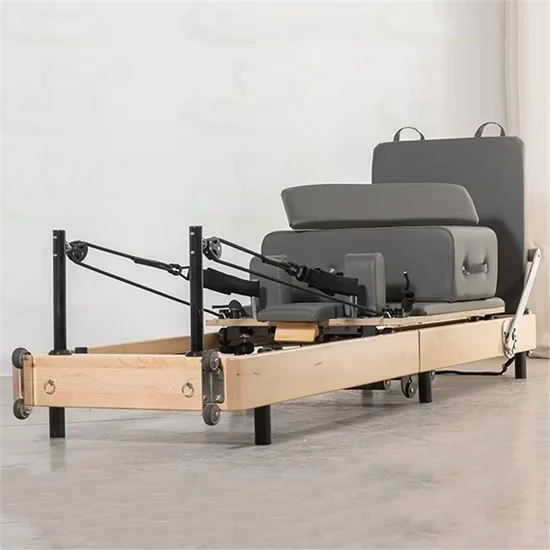
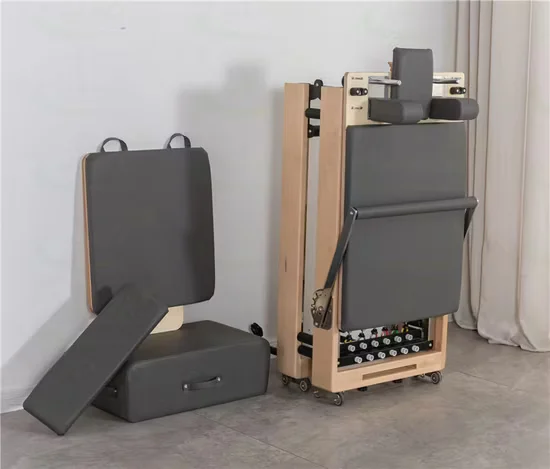
Pilates Cadillac Training Bed, Solid Wood Frame, 2520×760×2050mm Dimensions — engineered with mortise-and-tenon joinery and sealed spring housings to eliminate carriage wobble and rail play under repetitive commercial studio loads. Includes long box, jump board, and platform accessories with precision mounting interfaces for fast, secure swaps during high-frequency classes. Backed by 3-year warranty and per-unit rail straightness inspection before shipment.
// Spec Highlights
• Direct from Manufacturer · No Middlemen · Worldwide Shipping
01
// Material
Imported Solid Wood
Premium hardwood frames sourced for density and visual warmth.
02
// Hardware
Medical-Grade Silent
Whisper-quiet pulleys and springs for clinical environments.
03
// Customization
Appearance OEM
Color, upholstery, and branding tailored to your studio.
04
// Service
Layout Design
Free venue planning for studios and rehab institutions.
Every component is selected for longevity, performance, and aesthetic harmony - from imported hardwood frames to silent medical-grade accessories.
// Features
Solid Wood Joinery — mortise-and-tenon frame connections tested to hold spring tension without loosening across thousands of studio sessions.
| Parameter | Value |
|---|---|
| Product Type | Pilates Cadillac Equipment |
| Material | Solid Wood |
| Color | Solid Color |
| Product Dimensions | 2520 × 760 × 2050 mm |
| Net Weight | 150 kg |
| Accessories | Long Box / Jump Board / Platform |
| Customization | Available (color, accessory selection) |
| Logo | Customized Is Allowed |
| Warranty | 3 Years |
| Facility Type | Typical Use |
|---|---|
| Commercial Pilates studio | Daily group classes and private sessions on the reformer platform |
| Rehabilitation and physical therapy center | Controlled-range movement therapy and post-injury conditioning |
| Boutique fitness studio | Mixed-modality classes pairing Cadillac work with mat sequences |
| Hotel and resort wellness facility | Guest-accessible Pilates sessions and trainer-led programming |
| Private training studio | One-on-one instruction using full accessory range |
Mortise-and-tenon joints distribute spring-tension loads across the full cross-section of the frame, not just fastener shear points.
Many Cadillac units sold as studio-grade rely on bolted plate connections or dowel joints that hold during light mat work but develop visible play once jump board impacts and high-tension spring settings enter daily rotation. Instructive failures we have documented in Southeast Asian studios involve carriage rails that loosened within months — the root cause was unsealed bearing surfaces corroding in humid, salt-laden air, not the wood itself [NEED_CITE: wood joint fatigue behavior under cyclic tensile loading in humid environments]. When a frame joint shifts even fractionally under load, the carriage travel path deviates, and what feels like spring resistance becomes unpredictable rail friction. A commercial Pilates Cadillac reformer machine destined for daily class schedules needs joinery that treats every spring anchor point as a structural node, not a decorative attachment.
This Cadillac Training Bed addresses the vertical and overhead movement planes — spinal articulation, shoulder mobilization, and supine leg work — that mat stations and standard reformers cannot replicate alone. In a studio floor plan, it pairs with reformer units for class flow sequences and with tower or chair apparatus for intermediate bridging exercises. The 2520 × 760 mm footprint fits standard studio bay spacing while leaving adequate clearance on all sides for instructor access. For facilities running classes across diverse body types, the long box and platform accessories extend exercise range without requiring additional apparatus.
The frame endures three overlapping stress profiles: static tension from anchored springs during sustained holds, impact loading from jump board repetitions, and eccentric drag from controlled return phases. Over a full studio day, these cycles accumulate into the hundreds per unit. The critical stress zones are the spring anchor rail junctions and the upright post bases, where lateral forces concentrate during asymmetrical limb work. Wood species density and grain orientation at these junctions determine whether micro-cracks propagate or arrest [NEED_CITE: wood failure modes under combined static and impact loading in fitness equipment frames]. Upholstery contact surfaces — the platform pad and long box cover — face a separate wear path driven by body weight friction and cleaning chemical exposure rather than structural fatigue.
Solid wood as a frame material eliminates the delamination risk inherent in engineered composites, but species selection and grain alignment at joint intersections are what govern long-term rigidity under continuous spring pull. The carriage rail bearing surface — whether open bushing, sealed bearing, or polymer glide — sets the maintenance interval and the feel consistency from the first session to the thousandth. Spring housing design matters equally: exposed coil mounts invite dust accumulation and tension drift, while enclosed housings keep resistance profiles stable and cut replacement frequency. The accessory mounting interface for the long box, jump board, and platform must lock without lateral play; any wobble during dynamic work compounds into joint stress on both the user and the frame.
Downgrading from sealed bearings to open bushings on a Cadillac saves margin on the production side and creates a maintenance liability on the studio floor — bearing play introduces carriage drift that instructors feel before they diagnose. Bolted-plate joinery substituting for proper wood joinery accelerates fastener loosening under jump board impact, leading to mid-class equipment pull-downs and liability exposure. Thin upholstery foam on the platform and long box compresses past its recovery threshold within months of daily use, forcing re-padding jobs that cost more in downtime than denser stock would have upfront. Undersized spring coils lose tension consistency on a shorter cycle, meaning the resistance a client feels in week one is not what they feel in week twelve [NEED_CITE: spring fatigue and tension decay in cyclic-use fitness equipment].
Every frame joint on this Cadillac is executed with continuous connection methods rather than point-fastened shortcuts, mirroring the robotic MIG weld philosophy applied across our strength equipment lines. Each unit undergoes load testing before shipment — not sample-based batch testing, but per-unit verification under tension that exceeds rated spring capacity. The powder coating applied to all metal hardware meets 200μm industrial thickness, preventing the contact-point rust that compromises spring anchor integrity in humid studio environments. Customization in color, logo placement, and accessory selection allows studio operators to match existing equipment aesthetics without compromising structural specification. Floor layout support is available to confirm safe clearance spacing around the 2520 × 760 mm footprint for instructor circulation and emergency access.
Provide your studio floor dimensions and existing equipment list to receive a scaled 2D-3D layout showing this Cadillac positioned with safe clearance on all sides. Specify your average daily session count so we can confirm the structural grade matches your throughput. Note any customization requirements — frame color, logo application, accessory mix — to align the unit with your studio’s equipment standard.
Q: How do I tell a commercial-grade Pilates Cadillac from a light-commercial model?
A: Inspect the frame joinery method and spring housing design. Commercial units use mortise-and-tenon or equivalent full-section joints, not dowel or bolted-plate connections. Spring housings should be enclosed to prevent dust ingress and tension drift. Ask for per-unit load test records rather than batch sampling reports.
Q: What wood joinery methods keep a Cadillac frame stable under spring tension over time?
A: Mortise-and-tenon joints distribute tensile loads across the full wood cross-section at each connection point, preventing the localized stress fractures that dowel joints develop. Bolted plates can work if paired with continuous structural adhesive, but standalone bolted connections loosen under cyclic loading and require frequent re-torquing.
Q: How does spring gauge and housing type affect resistance consistency and maintenance?
A: Thicker spring coils resist tension decay across thousands of compression-extension cycles, maintaining the resistance profile clients experience in early sessions. Enclosed spring housings prevent dust and humidity from accelerating fatigue, extending the interval between replacements and keeping resistance feel predictable class after class.
Q: What should I check on accessory mounts to ensure safety during dynamic work?
A: The long box, jump board, and platform mounting interfaces must lock with zero lateral play before any dynamic exercise begins. Check that mounting pins or brackets engage fully and that repeated insertion-removal cycles have not worn the receiver holes past tolerance. Replace mounting hardware showing visible deformation immediately.
Q: How often should springs, carriage pads, and upholstery be replaced in a high-traffic studio?
A: Replacement intervals depend on daily session volume and spring tension settings used. Springs should be inspected for visible coil spacing changes and replaced when tension drift becomes perceptible to instructors. Carriage pads and upholstery require replacement once compression set eliminates recovery, typically flagged by visible surface deformation under load.
Premium aesthetics meet quiet operation for boutique studio environments.
Medical-grade silence and precision for sports & postpartum recovery.
Furniture-grade craftsmanship for premium residential installations.
Compact premium setups for one-on-one and small-group training.
Aesthetic Pilates integration for hybrid wellness studio programming.
Multi-unit deployment with instructor-grade reliability for certification programs.
Tell us about your project. Our team will respond within 24 hours with pricing, customization options, and shipping details.
// Sales Director
William
+86 132 2531 1800
// Export Manager
Bella
+86 198 5412 8032
william@bickfit.com