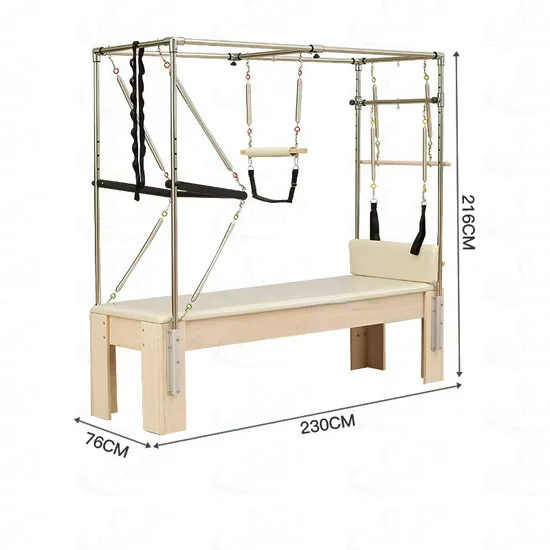
01 / Scenario
STUDIO
P
High-End Pilates Studios
Premium aesthetics meet quiet operation for boutique studio environments.

ISO
9001
CE
Certified
OEM
Available
10YR
Warranty
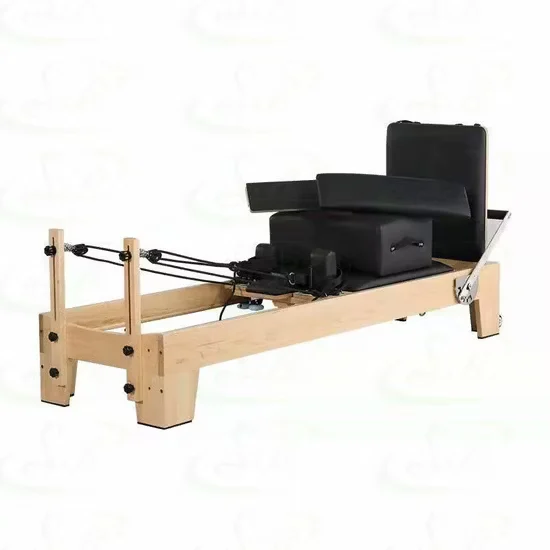
Pilates Reformer with Beech Ladder Barrel, 1100×770×980mm, 50kg Net Weight — solid beech wood frame paired with sealed pulley systems and reinforced carriage rails engineered for high-repetition studio use. High-density foam padding with commercial-grade vinyl resists compression and tearing across daily sessions. Every unit undergoes carriage glide load testing and spring tension calibration before shipment.
// Spec Highlights
• Direct from Manufacturer · No Middlemen · Worldwide Shipping
01
// Material
Imported Solid Wood
Premium hardwood frames sourced for density and visual warmth.
02
// Hardware
Medical-Grade Silent
Whisper-quiet pulleys and springs for clinical environments.
03
// Customization
Appearance OEM
Color, upholstery, and branding tailored to your studio.
04
// Service
Layout Design
Free venue planning for studios and rehab institutions.
Every component is selected for longevity, performance, and aesthetic harmony - from imported hardwood frames to silent medical-grade accessories.
// Features
Load-Tested Before Shipping — Every reformer unit undergoes repeated carriage cycling under load to verify rail alignment and spring tension consistency before leaving the factory.
| Parameter | Value |
|---|---|
| Product Type | Pilates Reformer / Ladder Barrel |
| Model NO. | SRY-03 |
| Frame Material | Solid Beech Wood |
| Specification | 1100×770×980mm |
| Net Weight | 50kgs |
| Accessory Options | Long Box / Jump Board / Platform |
| Color | Solid Color (customizable) |
| Logo | Customized Is Allowed |
| Upholstery | Commercial-grade vinyl, standard or high-density options available |
| Spring System | Progressive resistance calibration |
| Carriage Rail | Hardened steel rail with sealed bearing wheels |
| Warranty Time | 3 Years |
| Production Capacity | 800 Pieces/Month |
| Certification | ISO 9001:2015, CE, SGS |
| HS Code | 9506911900 |
| Facility Type | Typical Use |
|---|---|
| Boutique Pilates Studio | Daily group reformer classes with high-turnover carriage use |
| Commercial Gym Functional Zone | Strength and mobility complement to free weight and rig areas |
| Hotel Fitness Center | Low-volume premium wellness programming for guests |
| Rehabilitation & Physical Therapy Center | Controlled resistance exercises for post-injury recovery protocols |
| Private Training Facility | One-on-one instructor-led reformer sessions |
A reformer that rattles mid-footwork is not a tuning issue — it is a structural tolerance failure.
Studio operators invest in premium commercial pilates reformer beech ladder barrel setups only to hear complaints about shaky carriages by month three. The root cause is usually unverified rail-to-wheel fitment and carriage frame flex under eccentric loading. When a client performs a long stretch or a teaser, the carriage takes off-center force vectors that expose any gap in the rail channel or any play in the wheel axle. Laminated plywood frames compound this by warping as humidity cycles through the studio, pulling the rail mounting points out of parallel [NEED_CITE: wood dimensional stability under cyclic humidity in fitness environments]. What starts as a faint wobble becomes a visible lateral drift, and clients interpret it as the equipment failing beneath them.
The commercial pilates reformer beech ladder barrel occupies the core apparatus zone in a studio layout, anchoring the primary movement plane for supine, prone, and seated exercises. It pairs with the ladder barrel for spinal articulation sequences that the reformer alone cannot cover, creating a two-piece station that handles most classical repertoire. Studios running four or more classes per day benefit from placing these units with a minimum lateral clearance to allow instructor walk-through and client rotation. The 1100×770mm footprint fits standard studio grid spacing, accommodating users across a broad height range when paired with the long box and platform accessories.
A reformer in a studio running six classes daily endures thousands of carriage cycles per week, each carrying dynamic load through the rail, wheel bearings, and frame joints. The spring anchor points experience repeated tension-release fatigue, and any inconsistency in spring grading causes uneven resistance feel that instructors notice immediately [NEED_CITE: fatigue performance of spring steel under cyclic tension in studio equipment]. Sealed bearing wheels on hardened steel rails handle this repetition without developing the lateral play that unsealed bushings show within months. The beech wood frame resists the compressive and tensile forces transmitted through the spring attachments at the carriage and frame ends, where softer woods or laminated composites tend to develop fastener looseness over time. Upholstery contact points on the shoulder rests and headrest face sweat exposure and repeated compression, demanding vinyl rated for commercial turnover rather than residential use.
Solid beech wood is chosen for its tight grain structure and high density, which keeps fastener holes from enlarging under the repeated pull of spring tension — a failure mode common in plywood frames where the laminated layers separate at the glue line. The hardened steel carriage rail provides a consistent running surface that does not develop grooves or uneven wear tracks, maintaining glide quality through the full stroke length. Sealed bearing wheels prevent dust, hair, and studio humidity from entering the wheel axle, which is the primary cause of grinding noise and uneven carriage travel in high-use settings. Progressive spring resistance calibration means the springs are graded to deliver proportional load increase through the range of motion, so a client feels consistent effort whether they are at the top or bottom of a chest press. High-density upholstery foam options resist compression set — the permanent flattening that creates hard spots on shoulder rests after months of daily classes.
Studios that source reformers based on visual similarity alone often absorb the real cost later through maintenance and client attrition. Thin-walled frame tubes flex under loaded carriage travel, causing the rail to bow slightly and the wheels to bind at mid-stroke. Non-sealed wheel bearings require cleaning and re-lubrication at intervals that studio staff rarely maintain, leading to premature axle wear and carriage replacement. Low-density foam on the shoulder blocks compresses within weeks of heavy use, creating an uncomfortable hard spot that clients associate with the studio’s overall quality. Springs that are not individually tension-tested before assembly can vary in resistance from unit to unit, meaning two reformers side by side feel different during the same class. Hardware fasteners that are not stainless or corrosion-resistant develop surface rust from sweat exposure, seizing in place and making field repairs difficult [NEED_CITE: fastener corrosion in high-humidity fitness environments].
The 11-gauge steel frame principle applied to our strength line extends to the metal components in this reformer — any steel structural element is mill-certified and traceable, not generic commercial-grade tubing. Robotic MIG welding with continuous weld lines replaces the spot-weld joints that crack under repetitive spring tension cycling at the carriage end stops. Every unit is load-tested before shipment, meaning the carriage is cycled under weight to confirm rail alignment and spring response, not just sampled from a batch. The 200μm industrial powder coating on all metal hardware resists chipping at contact points where springs clip and unclip daily. Three-year warranty coverage on the frame and moving parts is backed by spare parts availability — springs, wheels, and upholstery pads can be reordered individually without replacing the entire unit. 2D-3D floor planning CAD support ensures this commercial pilates reformer beech ladder barrel is positioned with correct clearances for instructor access and client flow within your studio footprint. OEM private label options allow studio branding on the frame and upholstery for a unified visual identity.
Provide your studio floor dimensions and target class capacity to receive a 2D-3D layout showing optimal reformer placement with safe instructor clearances. Specify your expected daily class count so we can confirm the structural grade matches your usage intensity. Indicate your preferred upholstery density, frame color, and whether custom logo application is required for your branded studio environment.
Q: How do you distinguish a commercial-grade reformer from a home-use model?
A: Commercial units use solid hardwood frames with steel-reinforced carriage rails and sealed bearings rated for thousands of daily cycles. Home models typically rely on laminated wood and open bushings that develop play quickly under studio-level repetition. Spring tension is individually calibrated on commercial equipment, and upholstery foam density is specified to resist permanent compression through months of continuous class scheduling.
Q: Why does solid beech outperform plywood for reformer frames?
A: Solid beech has a tight, uniform grain structure that*n of spring-loaded carriage movement. Plywood frames are built from glued laminate layers that can separate at the bond line when exposed to studio humidity cycles and repetitive mechanical stress, leading to frame looseness and rail misalignment over time.
Q: What is the expected spring replacement cycle in a busy studio?
A: Spring lifespan depends on class frequency and load intensity, but commercial-grade springs in a high-use studio typically require inspection every six months for tension consistency and visible fatigue signs. Units running six or more classes daily may benefit from annual replacement to maintain uniform resistance feel across all stations. Individual spring tension test reports are available upon request.
Q: How should carriage wheels and rails be maintained under heavy use?
A: Sealed bearing wheels require minimal routine maintenance — a quarterly visual check for debris buildup and a glide test without load is generally sufficient. The hardened steel rail surface should be wiped clean of dust and residue periodically. Avoid lubricants on the rail, as they attract particulate matter that accelerates wear on the wheel contact surface.
Premium aesthetics meet quiet operation for boutique studio environments.
Medical-grade silence and precision for sports & postpartum recovery.
Furniture-grade craftsmanship for premium residential installations.
Compact premium setups for one-on-one and small-group training.
Aesthetic Pilates integration for hybrid wellness studio programming.
Multi-unit deployment with instructor-grade reliability for certification programs.
Tell us about your project. Our team will respond within 24 hours with pricing, customization options, and shipping details.
// Sales Director
William
+86 132 2531 1800
// Export Manager
Bella
+86 198 5412 8032
william@bickfit.com