01 / Scenario
STUDIO
P
High-End Pilates Studios
Premium aesthetics meet quiet operation for boutique studio environments.
ISO
9001
CE
Certified
OEM
Available
10YR
Warranty
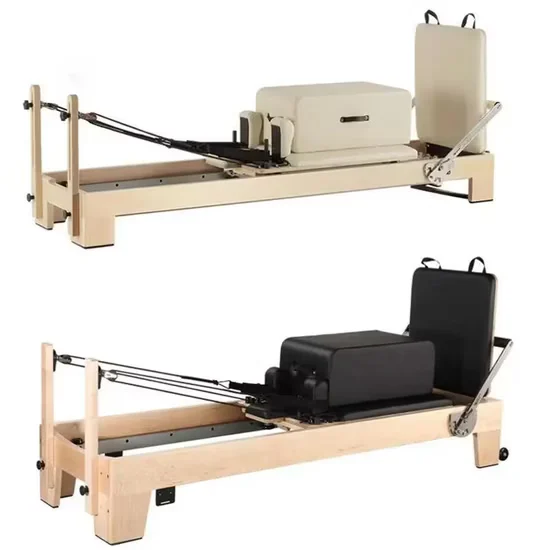
Pilates Reformer Equipment, Solid Wood Frame, 2460×730×680mm — engineered with a 100 kg net weight for stable carriage travel under spring tension across full-range movements. Includes long box, jump board, and platform with secure attachment interfaces for versatile studio programming. Backed by a 3-year warranty and customizable logo options for branding consistency.
// Spec Highlights
• Direct from Manufacturer · No Middlemen · Worldwide Shipping
01
// Material
Imported Solid Wood
Premium hardwood frames sourced for density and visual warmth.
02
// Hardware
Medical-Grade Silent
Whisper-quiet pulleys and springs for clinical environments.
03
// Customization
Appearance OEM
Color, upholstery, and branding tailored to your studio.
04
// Service
Layout Design
Free venue planning for studios and rehab institutions.
Every component is selected for longevity, performance, and aesthetic harmony - from imported hardwood frames to silent medical-grade accessories.
// Features
Structural Rigidity Under Repeated Spring Tension — Solid wood frame construction resists flex and rail deformation that compromises carriage alignment in daily studio use.
| Parameter | Value |
|---|---|
| Product Type | Pilates Reformer |
| Frame Material | Solid Wood |
| Product Dimensions | 2460 × 730 × 680 mm |
| Net Weight | 100 kg |
| Included Accessories | Long Box, Jump Board, Platform |
| Finish | Solid Color |
| Customization | Available |
| Logo | Customized Is Allowed |
| Warranty | 3 Years |
| Production Capacity | 80 Pieces/Month |
| Facility Type | Typical Use |
|---|---|
| Commercial Pilates Studio | Group reformer classes with high daily turnover and multiple instructor rotations |
| Yoga Studio | Integrated reformer sessions complementing mat-based flexibility and mobility work |
| Rehabilitation and Physical Therapy Center | Controlled spring-loaded movement for post-injury strengthening and neuromuscular re-education |
| Boutique Fitness Studio | Small-group reformer training within a mixed-format class schedule |
| Premium Home Gym | Full-footprint reformer for dedicated personal practice without space compromise |
Most commercial pilates reformer equipment for yoga studio use is marketed on spring count and accessory bundles, but the frame material dictates whether the carriage still tracks true after thousands of cycles.
Solid wood maintains dimensional stability where composite and laminated cores compress, warp, or delaminate under sustained spring tension.
I have seen reformers with hollow-core wood composite frames start showing carriage drift within the first year of studio-grade use. The rails, bonded to a substrate that flexes under repetitive eccentric loading, gradually pull out of parallel alignment. Instructors notice the carriage binding at specific points in the travel range, and the fix is never simple — it means re-shimming rails on a frame that continues to move. Solid wood, when properly selected for grain orientation and density, holds its geometry under the same cyclical loads without that substrate compression. The mass matters too: at 100 kg net weight, this reformer does not shift or creep during jump board work or loaded standing exercises. [NEED_CITE: EN 957 structural requirements for stationary training equipment]
A full-size reformer at 2460 mm length covers the complete movement spectrum — from short-range rehabilitation exercises to full extension work for tall users. In a commercial studio floor plan, it anchors the reformer zone and pairs with cadillac and chair units for comprehensive apparatus-based programming. The included long box, jump board, and platform mean the unit supports the full class curriculum without requiring accessory purchases after delivery. The solid color finish and customizable logo allow visual consistency across a multi-unit studio installation. This commercial pilates reformer equipment for yoga studio environments fits facilities running four or more group classes daily.
Every reformer rep transmits force through the carriage wheels into the rails, and from the rails into the frame. Spring-loaded footwork generates repetitive impact at the end stops. Jump board work introduces dynamic eccentric loading that tests frame rigidity at the base joints. Over thousands of daily cycles in a busy studio, these forces accumulate at the rail mounting points and the frame corners. Solid wood construction, when the grain runs along the length of the frame, distributes this stress along continuous fiber rather than across adhesive bonds. The 100 kg net weight provides the inertial mass to resist micro-movement during high-force exercises. [NEED_CITE: fatigue performance in structural materials under cyclical loading]
The 2460 × 730 mm footprint defines the usable carriage travel and the user height range the reformer can accommodate. A shorter frame forces tall users to compromise their range on supine exercises, while a narrower platform limits standing and kneeling work. The solid wood frame specification matters because density and grain structure determine whether the rail mounting surface stays flat over years of spring tension — softer woods or composite boards compress unevenly, pulling the carriage off its intended path. The 100 kg net weight indicates a frame with enough mass to stay planted during dynamic exercises, eliminating the need to bolt the unit to the floor for normal studio use. The included long box, jump board, and platform form a complete accessory set that covers the standard reformer repertoire without modular gaps. A 3-year warranty signals the manufacturer’s confidence in the frame and rail interface holding up under commercial conditions.
A reformer that costs less upfront often carries its expense forward in maintenance and replacement. Composite or laminated frames compress at the rail mounting points, requiring periodic re-shimming that takes the unit out of class rotation. Non-solid wood substrates absorb moisture from studio humidity and cleaning products, swelling at the joints and accelerating hardware loosening. Thin or low-density wood species split at fastener points under the repetitive vibration of jump board work. When the frame itself becomes the failure point rather than a wear component, the entire unit reaches end of life prematurely. In a studio running multiple classes daily, even one reformer pulled from rotation for frame repair means lost revenue and rescheduled clients. [NEED_CITE: material degradation in fitness equipment under commercial use conditions]
The solid wood frame is traceable to material grade, not just described as wood construction. Every unit undergoes load testing before shipment rather than relying on sample-based inspection batches. The carriage rail and wheel interface is checked for parallel alignment and smooth travel under loaded conditions. The 200μm industrial coating standard applied across the commercial equipment line extends to hardware and contact surfaces on this reformer. The 3-year warranty covers frame structural integrity, carriage mechanism, and spring components under documented commercial use. Facility planning support includes 2D-3D CAD layout showing safe clearance distances between reformer units and adjacent apparatus in a studio configuration.
Provide your studio floor dimensions and total reformer count to receive a 2D-3D layout showing unit placement, instructor circulation paths, and safe clearance zones between stations. Specify your average class size and daily session count so we can confirm the structural grade matches your usage intensity. Confirm the user height range in your client population to verify the 2460 mm footprint accommodates your tallest participants through full-range exercises. State any finish color, logo placement, or accessory configuration requirements for your studio branding and programming needs.
Q: How do I distinguish a commercial-grade Pilates reformer from a light-duty home model?
A: Check the frame material specification for solid wood versus composite or laminated construction. Verify the net weight — commercial units carry enough mass to resist shifting during dynamic exercises. Confirm the warranty explicitly covers commercial use conditions. Review the accessory set for completeness, as home models often exclude the long box, jump board, or platform. Ask for load testing documentation on individual units rather than sample-based inspection.
Q: What wood species and construction methods indicate long-term frame stability?
A: Dense hardwoods with straight grain orientation along the frame length resist compression at rail mounting points better than softwoods or cross-grain configurations. Solid wood, not laminated layers bonded over a composite core, maintains dimensional stability under sustained spring tension. Look for material traceability documentation and avoid units where the wood type is unspecified. The frame should show continuous grain patterns without visible adhesive seams at stress points.
Q: How does carriage rail and wheel material affect maintenance in a studio?
A: Hard polymer wheels on precision-machined rails maintain smooth travel with minimal residue buildup, reducing cleaning frequency between classes. Metal-on-metal interfaces generate particulate that migrates into the rail channel and requires more frequent disassembly. Sealed wheel bearings prevent dust and moisture ingress that accelerates wear in humid studio environments. Ask the manufacturer for the specific wheel and rail material pairing and the recommended inspection interval for your class volume.
Q: What accessory configurations are essential for a complete reformer class?
A: The long box enables seated and supine exercises that extend the reformer’s programming range beyond the standard carriage work. The jump board provides dynamic plyometric loading for athletic conditioning and cardiovascular intervals within a reformer class. The platform adds standing and kneeling exercise options. A reformer lacking any of these three accessories limits the class curriculum and forces instructors to work around gaps rather than program comprehensively.
Q: How should I evaluate warranty coverage for high-traffic studio use?
A: Confirm the warranty explicitly states commercial or studio use rather than limiting coverage to home environments. Check whether springs, straps, and carriage wheels are included as wear components or excluded entirely. Verify that replacement parts are available through the manufacturer rather than only through third-party suppliers. Ask about the warranty claim process and expected turnaround time for parts delivery, since a reformer out of rotation means lost class capacity.
Premium aesthetics meet quiet operation for boutique studio environments.
Medical-grade silence and precision for sports & postpartum recovery.
Furniture-grade craftsmanship for premium residential installations.
Compact premium setups for one-on-one and small-group training.
Aesthetic Pilates integration for hybrid wellness studio programming.
Multi-unit deployment with instructor-grade reliability for certification programs.
Tell us about your project. Our team will respond within 24 hours with pricing, customization options, and shipping details.
// Sales Director
William
+86 132 2531 1800
// Export Manager
Bella
+86 198 5412 8032
william@bickfit.com