01 / Scenario
STUDIO
P
High-End Pilates Studios
Premium aesthetics meet quiet operation for boutique studio environments.

ISO
9001
CE
Certified
OEM
Available
10YR
Warranty
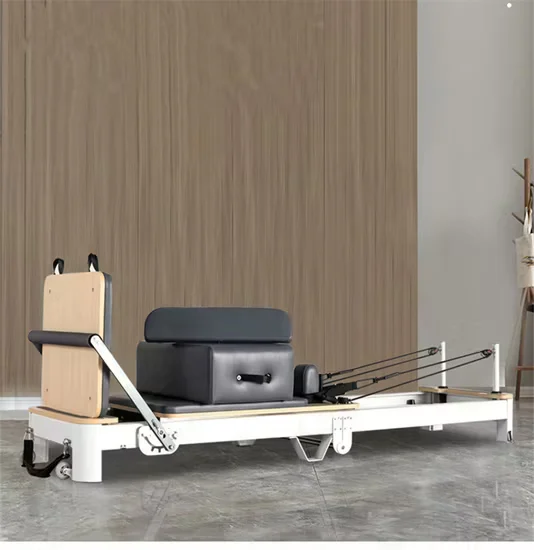
Commercial Pilates Reformer, Solid Wood Frame, 2460×730×680mm — engineered with mortise-and-tenon joinery and integrated long box, jump board, and platform for vibration-free carriage travel across full studio-class scheduling cycles. Customizable color and logo options available with 3-year warranty coverage. Each unit undergoes 32-point inspection and 100% load testing before shipment to ensure rail straightness and wheel alignment integrity.
// Spec Highlights
• Direct from Manufacturer · No Middlemen · Worldwide Shipping
01
// Material
Imported Solid Wood
Premium hardwood frames sourced for density and visual warmth.
02
// Hardware
Medical-Grade Silent
Whisper-quiet pulleys and springs for clinical environments.
03
// Customization
Appearance OEM
Color, upholstery, and branding tailored to your studio.
04
// Service
Layout Design
Free venue planning for studios and rehab institutions.
Every component is selected for longevity, performance, and aesthetic harmony - from imported hardwood frames to silent medical-grade accessories.
// Features
Solid Wood Rigidity — Mortise-and-tenon joinery in the solid wood frame resists carriage rail misalignment under thousands of spring-loaded cycles.
| Parameter | Value |
|---|---|
| Product Type | Pilates Reformer |
| Frame Material | Solid Wood |
| Finish Color | Solid Color (White) |
| Included Accessories | Long Box, Jump Board, Platform |
| Product Dimensions | 2460 × 730 × 680 mm |
| Net Weight | 100 kg |
| Upholstery | Standard commercial vinyl, color customizable |
| Customization | Frame color and logo available on request |
| Warranty | 3 Years |
| User Profile | Adult, Unisex |
| Facility Type | Typical Use |
|---|---|
| Commercial Pilates studio | Group reformer classes and private sessions |
| Hotel fitness center | Guest wellness programming and personal training |
| Rehabilitation and physical therapy clinic | Post-injury mobility and core stabilization work |
| Boutique fitness studio | Mixed-format Pilates and functional movement classes |
Mortise-and-tenon frames outlast dowel-only assemblies when spring tension cycles repeat hourly across a full studio schedule.
Many reformers marketed as commercial grade use laminated plywood with unspecified veneer thickness. Under repetitive spring loading, the adhesive layers in engineered wood begin to separate at the rail mounting points, and carriage alignment drifts within the first year of daily classes. A solid wood frame with proper joinery keeps the rail geometry locked regardless of how many jump board sets or long box sequences run through the carriage each day. [NEED_CITE: wood joinery fatigue performance under cyclic loading]
This reformer addresses the full sagittal and frontal plane repertoire — footwork, long stretch, rowing, and side-lying series — within a single footprint. In a commercial Pilates studio layout, it pairs with mat zones and Cadillac units to rotate clients through apparatus-based circuits. The 2460 mm rail length accommodates users across a broad height range without requiring carriage extension kits. For boutique studios running back-to-back group classes, the commercial pilates reformer wood frame configuration holds alignment through high-throughput scheduling.
Every reformer class generates hundreds of carriage transitions — the load shifts from slow eccentric control during leg circles to impact spikes during jump board plyometrics. The carriage wheels and rail interface absorb the most abuse: sealed bearings resist sweat and dust infiltration that degrade bushing-style wheels over time. At the spring attachment points, repeated tension-and-release cycles concentrate stress on the hardware mounting plates. [NEED_CITE: cyclic fatigue in spring-loaded fitness equipment hardware] Vinyl upholstery at the shoulder block and headrest contact zones compresses and recovers thousands of times per week, making foam density the primary determinant of replacement intervals.
Solid wood species selection directly governs long-term dimensional stability — hardwoods with tight grain structure resist the humidity swings common in studio environments with heavy HVAC cycling. The joinery method matters as much as the material: mortise-and-tenon connections distribute spring tension loads across a larger glue surface area compared to dowel-only or bolt-only assemblies, which concentrate stress at single fastener points. Carriage wheel durometer and rail surface finish together determine the noise floor during class — harder wheels on polished rails produce less rolling resistance but transmit more vibration, while softer compounds dampen sound at the cost of slightly higher drag. Spring configuration, including resistance progression across the set, shapes how instructors scale exercises for different client levels without swapping hardware mid-class.
Switching from solid wood to engineered plywood saves weight and material cost upfront, but the rail mounting zone becomes the failure point once adhesive bonds fatigue under daily spring cycling. Thin vinyl upholstery with low-density foam compresses permanently within months of group class use, forcing studios to schedule re-upholstery downtime. Non-sealed carriage wheels accumulate chalk dust and sweat residue, developing play that instructors notice as wobble during precision movements. [NEED_CITE: maintenance cost comparison sealed vs unsealed bearings in studio equipment] When accessory mounting points use undersized hardware, the long box and jump board develop rattle that grows progressively worse until the mounting plates need replacement.
The solid wood frame is sourced with species documentation, so buyers know exactly what they are receiving rather than a generic "hardwood" claim. Every unit undergoes carriage rail straightness verification and wheel alignment checks before packing, not sample-based inspection. The 200μm industrial powder coating process — adapted here for hardware components — prevents corrosion at spring anchors and pulley mounts where sweat contact is constant. A 3-year warranty covers structural and hardware defects. OEM customization for frame color and logo is available for studios building a branded environment, and 2D layout CAD support helps operators plan reformer spacing with safe clearance for carriage travel and instructor circulation paths.
Provide your studio floor dimensions and intended class capacity to receive a 2D layout showing reformer spacing with safe instructor circulation paths. Specify expected daily class volume so we can confirm the spring and carriage configuration matches your throughput. Share your target client demographic so we verify the rail length accommodates your user height range. Let us know any branding requirements — custom frame color or logo placement — to confirm lead time alongside your accessory package selection.
Q: How do I distinguish solid wood from engineered wood reformer frames for commercial durability?
A: Check the frame cross-section at the rail mounting area. Solid wood shows continuous grain running the full depth, while engineered wood reveals layered laminations with alternating grain direction. Solid wood frames accept fastener re-torque without stripping, whereas laminated boards lose grip strength once the outer veneer layers delaminate under repeated spring tension cycles. Request species documentation from the supplier.
Q: What spring configuration suits group class versus private session use?
A: Group classes benefit from a progressive spring set with clearly differentiated resistance levels, letting instructors scale exercises without hardware swaps. Private sessions often use a finer-granularity spring set for incremental client progression. Both benefit from color-coded springs for quick identification during fast-paced class transitions.
Q: How does carriage rail length affect exercise range and user accommodation?
A: A longer rail permits full leg extension for taller users during footwork and long stretch series without the carriage bottoming out. It also provides more travel distance for advanced exercises requiring extended range. Studios serving diverse client populations should match rail length to the tallest expected user height.
Q: What is the replacement cycle for carriage wheels, springs, and upholstery in daily-use studios?
A: Under daily class scheduling, sealed bearing carriage wheels typically require inspection every six months with replacement when lateral play becomes detectable. Springs should be checked annually for permanent elongation. Upholstery foam and vinyl lifespan depends on density and gauge — commercial-grade materials in high-throughput studios generally warrant scheduled assessment every twelve to eighteen months.
Q: What are the lead times for custom color, logo, and accessory configuration?
A: Standard configurations ship on the shortest timeline. Custom frame color and logo printing add production steps for finishing and curing. Accessory packages including the long box, jump board, and platform are configured per order. Request a confirmed timeline when submitting your customization requirements alongside your floor plan.
Premium aesthetics meet quiet operation for boutique studio environments.
Medical-grade silence and precision for sports & postpartum recovery.
Furniture-grade craftsmanship for premium residential installations.
Compact premium setups for one-on-one and small-group training.
Aesthetic Pilates integration for hybrid wellness studio programming.
Multi-unit deployment with instructor-grade reliability for certification programs.
Tell us about your project. Our team will respond within 24 hours with pricing, customization options, and shipping details.
// Sales Director
William
+86 132 2531 1800
// Export Manager
Bella
+86 198 5412 8032
william@bickfit.com