01 / Scenario
STUDIO
P
High-End Pilates Studios
Premium aesthetics meet quiet operation for boutique studio environments.
ISO
9001
CE
Certified
OEM
Available
10YR
Warranty
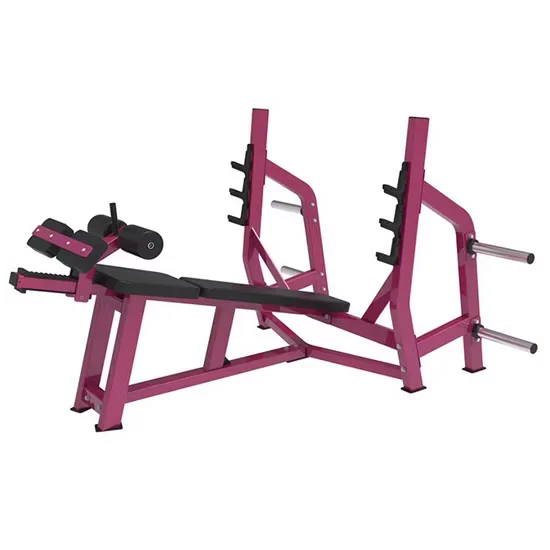
Commercial Plate Loaded Decline Bench Press, 11-Gauge 3×3 Inch Frame, 500kg+ Load Capacity — robotic MIG continuous welds eliminate spot-weld fatigue, while sealed industrial bearings maintain smooth pivot action without play under heavy cyclic use. Every unit undergoes per-unit load testing before shipment, backed by a 10-year frame warranty.
// Spec Highlights
• Direct from Manufacturer · No Middlemen · Worldwide Shipping
01
// Material
Imported Solid Wood
Premium hardwood frames sourced for density and visual warmth.
02
// Hardware
Medical-Grade Silent
Whisper-quiet pulleys and springs for clinical environments.
03
// Customization
Appearance OEM
Color, upholstery, and branding tailored to your studio.
04
// Service
Layout Design
Free venue planning for studios and rehab institutions.
Every component is selected for longevity, performance, and aesthetic harmony - from imported hardwood frames to silent medical-grade accessories.
// Features
Traceable Mill Steel — Every tube in this plate loaded decline bench traces back to a certified Q235/Q345 coil, not an unmarked commercial-grade claim.
| Parameter | Value |
|---|---|
| Product Type | Plate Loaded Chest Press |
| Frame Steel Gauge | 11-gauge |
| Frame Tube Size | 3×3 inch |
| Steel Grade | Q235 / Q345 |
| Welding Type | Robotic MIG continuous weld |
| Load Capacity | 500 kg+ |
| Loading Type | Plate loaded |
| Bearing Type | Sealed industrial bearings |
| Pulley System | Aircraft cable |
| Powder Coating | 200 μm scratch-resistant |
| Product Dimensions | 1500 × 1150 × 1280 mm |
| Net Weight | 65 kg |
| Certification | ISO 9001:2015, CE, SGS |
| Warranty | 10-year frame warranty |
| Color Options | Main frame and cushion available according to customer requirements |
| OEM/ODM | Acceptable |
| Facility Type | Typical Use |
|---|---|
| Commercial gym and health club | Dedicated decline pressing station on the strength floor |
| CrossFit box functional zone | Heavy pressing accessory work alongside rig-based training |
| Hotel and resort fitness center | Low-maintenance pressing option for unsupervised guest use |
| University strength and conditioning room | Athlete chest development in periodized strength programs |
| Rehabilitation and performance center | Controlled decline pressing for return-to-play protocols |
A wobbly decline bench is a liability, not a training tool.
When a member loads three plates per side on a decline press and the frame flexes, the entire movement path shifts. Spot-welded joints on lighter frames fatigue quickly under cyclic heavy use, and once a weld cracks, the bench becomes a safety incident waiting to happen. I’ve seen facility operators pull decline benches off the floor within the first year because the frame tubes were spec’d vaguely as "commercial grade" with no verifiable gauge — the steel simply could not hold its shape under repeated off-axis loading [NEED_CITE: structural steel fatigue behavior under cyclic loading in fitness equipment].
The commercial plate loaded decline bench press targets the lower sternal fibers of the pectoralis major with a movement path that complements flat and incline pressing stations. In a well-configured strength zone, it sits adjacent to a plate loaded flat bench and an incline press, giving members a complete pressing triad without redundant footprints. It suits medium-to-high traffic facilities where members expect dedicated stations rather than adjustable multi-bench setups. The fixed decline angle accommodates a broad range of torso lengths, and the plate-loaded horns allow incremental loading without the constraint of a selectorized stack.
Every repetition on a decline bench generates a combination of static compression and eccentric shear at the seat-to-frame junction. Members dropping into the seat create impact loads that travel through the rear stabilizer tube, and the pivot points on the loading arms experience repeated rotational stress hundreds of times per day. The welds at the seat post base and the horn bracket attachment points concentrate the highest stress, making continuous weld penetration critical rather than cosmetic. Sealed bearings at the arm pivot resist sweat and chalk infiltration that would otherwise accelerate wear on open bushings [NEED_CITE: bearing contamination and service life in high-traffic commercial environments]. The powder coating at the footplate contact zone and loading horn collars faces constant abrasion from shoes and plate edges.
The 11-gauge, 3×3 inch frame tube determines how much the bench resists lateral deflection when a member loads unevenly or shifts during a set — thicker walls and a wider cross-section raise the deformation threshold substantially compared to 12- or 14-gauge alternatives. Robotic MIG continuous welding ensures full-penetration weld lines along every joint, eliminating the cold-joint failures that plague spot-welded frames under cyclic loading. Sealed industrial bearings at the arm pivots maintain consistent rotational resistance over thousands of cycles, whereas open bushings develop play as dust and moisture work into the contact surface. The 200 μm powder coating, applied over a sandblast pre-treatment, provides a scratch-resistant barrier that prevents bare steel exposure at high-wear contact points like the loading horns and footplate edges.
A decline bench built on thinner-gauge tubing will show visible frame flex within months of heavy use, and members notice the instability immediately — they stop using the station, and it becomes dead floor space. Spot-welded joints that pass a visual factory inspection develop hairline cracks under repeated heavy loading, creating a safety liability that no amount of routine maintenance can catch in time. Non-sealed bearings on the loading arms develop rotational play, making the movement feel rough and inconsistent, which drives member complaints and increases maintenance callouts. Low-density upholstery compresses and splits within months of daily commercial use, forcing operators to source replacement pads or retire the unit entirely [NEED_CITE: upholstery compression and replacement frequency in commercial strength equipment].
The 11-gauge steel frame with mill certification ensures every tube is traceable to its source coil, removing the guesswork that comes with vague "commercial grade" claims. Robotic MIG continuous welds deliver consistent penetration along every joint — no cold spots, no weak links at the high-stress seat post base. Every unit undergoes a three-stage QC inspection including per-unit load testing before it leaves the factory, so the bench you receive has been verified under actual stress, not just sampled. The 200 μm industrial powder coating protects against the corrosion that gym humidity and daily cleaning accelerate on thinly coated alternatives. The 10-year frame warranty reflects the structural confidence built into the design, and OEM customization options allow frame and cushion color matching to your facility’s branding. Floor planning CAD support helps position this commercial plate loaded decline bench press with correct safety clearances around adjacent pressing stations.
Share your strength floor square footage and existing equipment list to receive a 2D or 3D layout showing optimal placement and safety clearances for this commercial plate loaded decline bench press. Specify your expected daily user volume so the structural grade matches your traffic demands. Confirm the body-size range of your member population to verify that the fixed geometry suits your users. Outline any customization requirements including frame color, cushion color, or logo placement for OEM production runs.
Q: How do I verify a decline bench is truly commercial grade rather than light commercial?
A: Request the steel mill certificate showing the exact gauge and grade of the frame tubing — true commercial frames use 11-gauge or thicker steel with documented traceability. Check whether the welding is robotic MIG continuous or spot-welded, and confirm that load testing is performed on every unit rather than on a sample basis. A verifiable multi-year frame warranty is also a strong indicator of structural confidence.
Q: Why does frame tube size matter alongside steel gauge on a plate loaded press?
A: Steel gauge determines wall thickness, but the tube’s cross-sectional dimensions dictate how the frame resists bending and torsional forces. A 3×3 inch tube distributes load across a wider structural profile than a 2×3 inch tube, reducing lateral deflection when a member shifts or loads unevenly. Both gauge and tube size must be specified together to assess true structural rigidity.
Q: What maintenance do sealed bearings require compared to open bushings on a decline press?
A: Sealed industrial bearings are enclosed against sweat, chalk dust, and moisture, so they maintain smooth pivot action with minimal scheduled maintenance. Open bushings allow contaminants to infiltrate the contact surface, developing rotational play and requiring more frequent inspection, lubrication, and eventual replacement. In high-traffic commercial environments, sealed bearings meaningfully reduce maintenance callouts.
Q: How should I plan spacing between a decline press and adjacent pressing stations?
A: Allow enough lateral clearance for members to load and unload plates without interfering with neighboring equipment users. Consider the full range of plate diameter on the loading horns and the swing path of the arms. Request a floor planning CAD layout that maps safety clearances specific to your bench model and adjacent station dimensions.
Premium aesthetics meet quiet operation for boutique studio environments.
Medical-grade silence and precision for sports & postpartum recovery.
Furniture-grade craftsmanship for premium residential installations.
Compact premium setups for one-on-one and small-group training.
Aesthetic Pilates integration for hybrid wellness studio programming.
Multi-unit deployment with instructor-grade reliability for certification programs.
Tell us about your project. Our team will respond within 24 hours with pricing, customization options, and shipping details.
// Sales Director
William
+86 132 2531 1800
// Export Manager
Bella
+86 198 5412 8032
william@bickfit.com