01 / Scenario
STUDIO
P
High-End Pilates Studios
Premium aesthetics meet quiet operation for boutique studio environments.
ISO
9001
CE
Certified
OEM
Available
10YR
Warranty
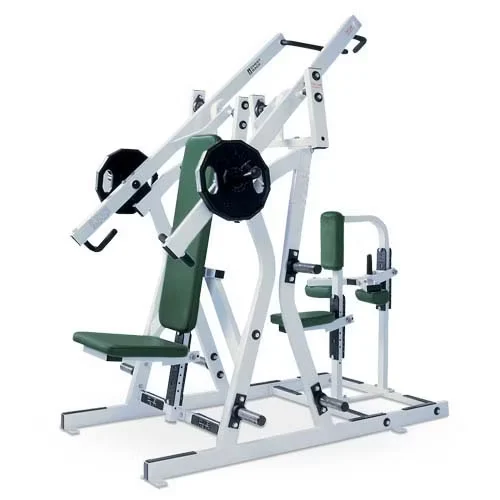
Plate Loaded ISO Lateral Chest Back Machine, 50×100×3mm Frame, 170kg Weight — robotic MIG continuous welding eliminates spot-weld fatigue, while sealed industrial bearings on iso-lateral arms maintain zero-play rotation under repeated eccentric loading. Each unit undergoes full load testing before shipment, backed by a 10-year frame warranty and mill-certified steel traceability.
// Spec Highlights
• Direct from Manufacturer · No Middlemen · Worldwide Shipping
01
// Material
Imported Solid Wood
Premium hardwood frames sourced for density and visual warmth.
02
// Hardware
Medical-Grade Silent
Whisper-quiet pulleys and springs for clinical environments.
03
// Customization
Appearance OEM
Color, upholstery, and branding tailored to your studio.
04
// Service
Layout Design
Free venue planning for studios and rehab institutions.
Every component is selected for longevity, performance, and aesthetic harmony - from imported hardwood frames to silent medical-grade accessories.
// Features
Traceable Frame Steel — Every 50×100×3mm rectangular tube used in this plate loaded iso lateral chest back machine is sourced from mill-certified Q235 industrial steel with full coil traceability.
| Parameter | Value |
|---|---|
| Product Type | Plate Loaded ISO Lateral Chest Back Machine |
| Frame Tube Size | 50×100×3mm rectangular steel |
| Steel Grade | Q235 industrial steel, mill-certified |
| Welding Type | Robotic MIG, continuous weld lines |
| Loading Type | Plate loaded |
| Bearing Type | Sealed industrial bearings on pivot arms |
| Pulley System | Aircraft-cable rated for repeated load cycles |
| Upholstery | Standard or high-density options available |
| Powder Coating | 200μm scratch-resistant finish |
| Product Dimensions | 1830×1680×2010mm |
| Net Weight | 170kgs |
| Certification | RoHS, ISO 9001, CE |
| Warranty | 10-year frame warranty |
| Facility Type | Typical Use |
|---|---|
| Commercial gym strength floor | High-traffic chest and back compound training station for diverse membership |
| Hotel and resort fitness center | Durable structural appearance for moderate daily traffic with aesthetic demands |
| University strength and conditioning room | Heavy loading sessions for varsity athletes across multiple body types |
| Functional training facility | Complementary plate loaded station alongside rigs and free weight zones |
Spot welds fracture at the joint perimeter; continuous MIG welds distribute stress across the full seam length.
When a commercial plate loaded iso lateral chest back machine endures hundreds of daily load cycles, the connection points between the main frame and the iso-lateral pivot arms face the highest stress concentration. Facilities that accept equipment with spot-welded joints often report hairline cracks appearing within the first year of heavy rotation. The problem is not the steel itself — it is the discontinuous weld pattern that creates localized stress risers at each spot weld boundary. [NEED_CITE: weld classification and fatigue performance in structural steel]. Robotic MIG welding eliminates this failure mode by producing a uniform, continuous bead along every joint intersection, removing the weak points that visual inspection alone cannot detect.
This machine targets the horizontal push and horizontal pull planes through independent iso-lateral arm movement, engaging the pectoral, latissimus, and rhomboid muscle groups without forcing bilateral symmetry on the user. On a commercial strength floor, it complements selectorized chest press and lat pulldown stations by serving athletes and experienced members who prefer plate loaded feedback and independent arm loading. The 1830×1680mm footprint fits standard commercial spacing grids, and the converging movement path accommodates users across a wide range of torso lengths and shoulder widths. A commercial plate loaded iso lateral chest back machine earns its floor space by covering both push and pull patterns in a single station, reducing the total unit count needed for complete upper body programming.
Each loading cycle on this plate loaded iso lateral chest back machine introduces an eccentric moment at the pivot arm axis, where the combined weight of plates and user force creates off-center loading on the frame-to-arm junction. In a busy commercial gym with eight or more hours of daily operation, these junctions accumulate thousands of fatigue cycles per month. The sealed industrial bearings at each pivot point must resist ingress from airborne dust, chalk residue, and cleaning chemicals that accelerate wear in unsealed alternatives. Upholstery contact surfaces endure repeated compression and shear from users sliding into position, while the powder-coated frame faces abrasion from plate loading and unloading at the horn sleeves. [NEED_CITE: EN 957 structural requirements for stationary training equipment].
The 50×100×3mm rectangular tube specification determines the section modulus of the main frame members, which directly governs how much the frame deflects when a fully loaded arm reaches peak torque mid-repetition. A thinner wall — even in a tube of the same external dimension — reduces the moment of inertia and allows perceptible flex that accelerates fatigue at every downstream connection. The continuous robotic MIG weld pattern ensures that each joint carries load across its full length rather than concentrating stress at discrete spot-weld nodes. Sealed bearings at the pivot axis prevent the gradual development of play that causes iso-lateral arms to drift from their intended path, a common complaint in facilities that selected equipment with unsealed bushings or sleeve bearings. The 200μm powder coating, applied over a sandblasted substrate, provides a coating thickness that resists chipping at the plate horn contact zones where bare steel exposure would otherwise lead to corrosion within months.
A frame built with undersized tube wall thickness may pass initial inspection but begins to show visible deflection under heavy plate loads, leading to member complaints about instability and eventual structural retirement far earlier than expected. Spot-welded joints that survive the factory floor often develop cracks at the weld perimeter once subjected to the dynamic loading patterns of daily commercial use, creating liability exposure for facility operators. Non-sealed bearings require scheduled maintenance intervals that many gyms cannot staff consistently, resulting in pivot arm play that degrades movement quality and triggers premature replacement. Thin powder coatings chip at high-contact zones within the first year, exposing bare steel to sweat and humidity that accelerate corrosion and force costly refinishing or full unit replacement. [NEED_CITE: corrosion progression on powder coated gym equipment frames].
The 11-gauge frame steel used in this machine carries mill certification traceable to the source coil, giving facility operators verifiable material provenance rather than a generic commercial-grade label. Robotic MIG welding produces continuous weld lines at every structural joint, eliminating the spot-weld weak points that cause field failures. Each plate loaded iso lateral chest back machine undergoes individual load testing before shipment, with documentation provided per unit rather than per batch sample. The 200μm industrial powder coating is applied over sandblasted surfaces to ensure adhesion at high-wear contact zones. A 10-year frame warranty backs the structural components, and 2D-3D CAD layout support helps operators plan safe clearance distances around the 1830×1680mm footprint, ensuring adequate passage space between this station and adjacent equipment.
Provide your strength zone dimensions and current equipment list to receive a 2D-3D floor plan that accounts for safe passage spacing around each plate loaded iso lateral chest back machine. Specify your expected daily user volume so the structural grade can be matched to your traffic pattern. Share the body type range of your primary user population to confirm the adjustment and clearance envelope covers all intended members.
Q: How do I verify that a plate loaded machine is genuinely built for commercial use?
A: Request the frame tube dimensions and wall thickness from the manufacturer, along with the steel grade and mill certificate. Confirm that welding is continuous MIG rather than spot welds, and ask whether each unit is individually load tested before shipment. Machines described only as commercial grade without verifiable structural data often use thinner tubing and discontinuous welds that fail under sustained high-frequency use.
Q: What is the relationship between frame tube size and load capacity?
A: The external dimensions and wall thickness of the frame tube determine its section modulus, which governs how much the frame deflects under load. A 50×100×3mm rectangular tube provides a higher moment of inertia than a thinner-walled tube of identical external size, meaning the frame resists bending under heavy plate loads and maintains alignment at the pivot arm connections over thousands of loading cycles.
Q: How do sealed bearings differ from bushings in an iso-lateral machine?
A: Sealed industrial bearings use enclosed race and ball assemblies that prevent dust, chalk, and moisture from entering the contact surfaces, maintaining smooth pivot arm rotation over extended periods. Bushings rely on surface-to-surface contact that wears progressively, developing play that causes the iso-lateral arms to drift from their intended movement path. In high-traffic commercial environments, sealed bearings meaningfully extend maintenance intervals.
Q: How should I plan spacing between plate loaded stations on a gym floor?
A: Account for the full footprint of each machine plus the swing radius of plates being loaded and unloaded. Users need clearance on the plate horn side and adequate passage width between adjacent stations. A 2D-3D CAD layout helps identify dead zones and unsafe pinch points before equipment is delivered, ensuring every square meter of the strength floor is both usable and compliant with safety clearance standards.
Premium aesthetics meet quiet operation for boutique studio environments.
Medical-grade silence and precision for sports & postpartum recovery.
Furniture-grade craftsmanship for premium residential installations.
Compact premium setups for one-on-one and small-group training.
Aesthetic Pilates integration for hybrid wellness studio programming.
Multi-unit deployment with instructor-grade reliability for certification programs.
Tell us about your project. Our team will respond within 24 hours with pricing, customization options, and shipping details.
// Sales Director
William
+86 132 2531 1800
// Export Manager
Bella
+86 198 5412 8032
william@bickfit.com