01 / Scenario
STUDIO
P
High-End Pilates Studios
Premium aesthetics meet quiet operation for boutique studio environments.

ISO
9001
CE
Certified
OEM
Available
10YR
Warranty
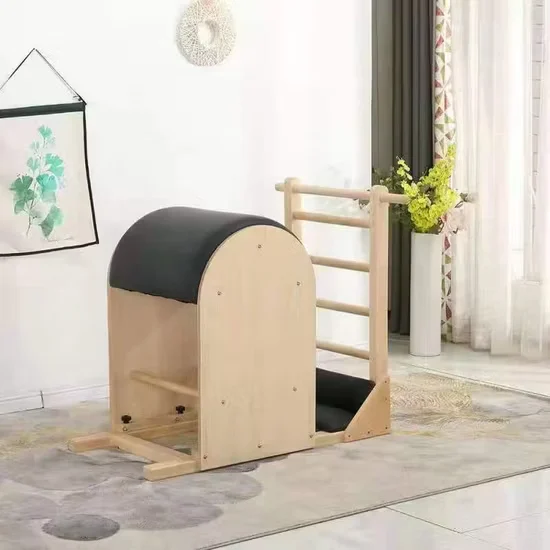
Wood Pilates Chair, 380×360×480mm, 5kg Net Weight — solid wood frame eliminates flex under repetitive pedal loading, maintaining consistent spring tension across daily studio sessions. Compact footprint supports high-density floor layouts with safe clearance between stations. Custom logo and solid color finishes available for brand-aligned studio environments. Every unit undergoes full load testing and 32-point inspection before shipment to ensure structural integrity.
// Spec Highlights
• Direct from Manufacturer · No Middlemen · Worldwide Shipping
01
// Material
Imported Solid Wood
Premium hardwood frames sourced for density and visual warmth.
02
// Hardware
Medical-Grade Silent
Whisper-quiet pulleys and springs for clinical environments.
03
// Customization
Appearance OEM
Color, upholstery, and branding tailored to your studio.
04
// Service
Layout Design
Free venue planning for studios and rehab institutions.
Every component is selected for longevity, performance, and aesthetic harmony - from imported hardwood frames to silent medical-grade accessories.
// Features
Solid Wood Integrity — kiln-dried hardwood resists cyclic pedal loading without flex or joint separation.
| Parameter | Value |
|---|---|
| Product Type | Pilates Chair |
| Product Dimensions | 380 × 360 × 480 mm |
| Net Weight | 5 kg |
| Frame Material | Solid Wood |
| Finish | Solid Color |
| Logo | Customized Is Allowed |
| Warranty | 3 Years |
| Target User | Adult, Unisex |
| Load Type | Spring Resistance |
| Facility Type | Typical Use |
|---|---|
| Commercial Pilates Studio | Group reformer-style classes with multiple chairs per session |
| Boutique Fitness Facility | Small-footprint strength stations complementing reformers and cadillacs |
| Home Gym / Private Practice | Compact daily-use unit for residential or private studio floors |
| Rehabilitation Center | Low-impact resistance work for movement correction and recovery protocols |
Solid hardwood eliminates the flex that hollow-core boards develop within months of daily studio use.
Walk into any commercial Pilates studio running chairs with laminated or MDF-core frames and you will eventually spot the telltale signs: pedal mounts loosening where the screw threads have stripped out of compressed fiber, side panels bowing outward under repeated spring tension, and pivot joints developing lateral play that changes the resistance feel mid-repetition. These failures are not manufacturing defects in the traditional sense — they are material limitations showing up exactly where cyclic loading concentrates [NEED_CITE: structural fatigue behavior in wood-based panels under cyclic mechanical loading]. A solid wood frame distributes pedal-mount stress across continuous grain rather than through glued particle layers, maintaining dimensional stability across thousands of compression cycles.
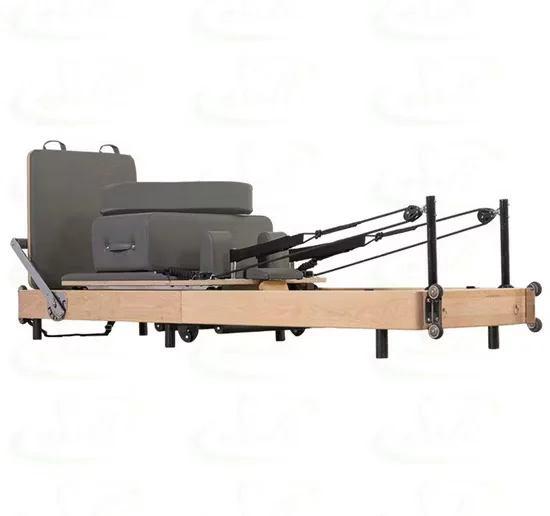
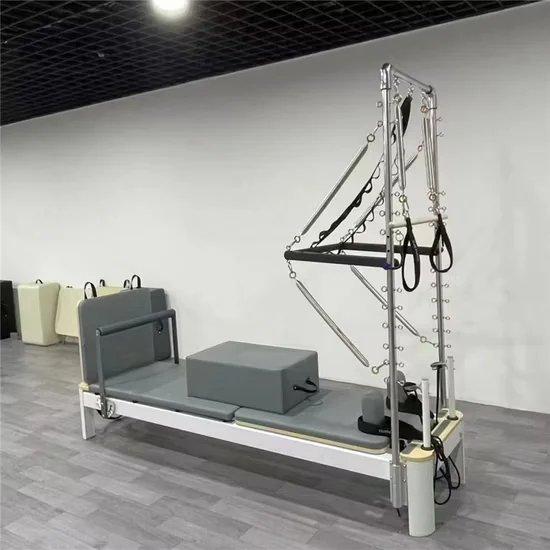
The compact 380 × 360 mm footprint positions this commercial wood pilates chair as a high-density add-on for studios that already run reformers and trapeze tables. It covers sagittal-plane resistance movements targeting lower-body stabilizers, hip flexors, and deep core musculature — work that supplements rather than duplicates the reformer’s horizontal-plane repertoire. Facilities running group classes benefit from the small clearance envelope, which allows six to eight stations in a footprint that would hold two reformers. The unisex load rating and spring-based resistance scale across body types without requiring pin-loaded adjustment mechanisms.
The pedal hinge is the single highest-stress node on any Pilates chair. Each depression drives spring compression through a pivot that must resist both axial load and lateral torque as the user’s foot shifts position mid-rep. On chairs built with engineered board, this joint gradually loosens as screw threads chew through compressed fiber, introducing wobble that propagates through the entire resistance pathway. Spring anchors mounted into solid hardwood maintain pull-direction consistency because the wood grain resists pull-out forces along its longitudinal axis [NEED_CITE: fastener withdrawal strength in solid hardwood versus MDF substrates]. The spring mechanism itself requires periodic inspection for coil fatigue and anchor-point wear, but the frame around it should not be the failure point.
Spring resistance systems live or die by coil consistency — a batch with uneven wire diameter produces chairs that feel different from one another across the studio floor, complicating group class instruction. The 480 mm overall height sets the seat-to-pedal travel distance, which directly determines the range of motion available for standing and seated exercises. The 5 kg net weight reflects the solid-wood mass; chairs significantly lighter at this footprint typically achieve that reduction through hollow-core construction. The three-year warranty signals expected structural service life under commercial conditions, though spring units and surface finish will require maintenance attention before the frame does. Finish adhesion on solid wood depends on surface prep quality — poor sanding or sealing leads to finish lifting at high-contact zones like pedal edges and grip points.
Studios that procure chairs at the lowest unit cost often discover the true price eighteen months later. Hollow-core frames that warp under humidity fluctuation require replacement rather than repair, because structural board cannot be re-torqued or reinforced once the fiber matrix compresses. Non-standard spring units sourced without traceable specifications mean that when a coil fails, no replacement parts exist in the supply chain — the entire chair becomes scrap. Finish that chips at pedal contact points exposes bare wood to sweat and cleaning chemicals, accelerating surface degradation in ways that affect client perception long before structural failure occurs [NEED_CITE: wood surface degradation pathways under repeated chemical exposure in fitness environments]. These are not edge cases; they are the predictable outcomes of material substitutions made invisible by finished-product photography.
Solid wood sourcing requires species and grade documentation traceable to the mill — we confirm hardwood classification and reject veneered composites that mimic solid-wood appearance in product images. The 380 × 360 mm footprint integrates into floor-plan CAD layouts that calculate safe clearance between stations for group-class traffic flow, preventing the unusable gaps that appear when equipment is sized without spatial planning. Custom logo placement undergoes finish adhesion testing to confirm that branded surfaces resist peeling under repeated hand and foot contact. Every unit receives spring-resistance consistency checks to confirm that batch-to-batch coil variation stays within tolerance, so chairs within the same studio feel identical during class rotation.
Share your studio floor dimensions and current equipment roster to receive a 2D-3D layout that positions each commercial wood pilates chair with correct clearance and traffic flow. Specify your expected daily user volume so we can confirm spring-duty rating alignment with your class schedule. Provide your branding requirements — logo placement, finish color, and any custom dimensions — early in the specification process to integrate customization into the production cycle rather than treating it as an afterthought.
Q: How do I tell solid wood Pilates chairs apart from laminated or hollow-core versions?
A: Check the frame cross-section at any exposed edge or mounting point. Solid wood shows continuous grain running through the full thickness, while laminated boards reveal layered construction and MDF shows uniform fiber with no grain pattern. Weight is another indicator — solid hardwood at this footprint typically weighs more than hollow-core alternatives due to material density.
Q: What spring resistance levels are available and how do they affect training?
A: Spring resistance varies by coil wire diameter and length, with heavier springs producing higher peak tension at full pedal depression. Studios typically stock multiple spring weights to accommodate different user strength levels and exercise types. Consistent spring feel across all chairs in a studio is more important than the specific resistance value, because it allows instructors to cue uniformly during group sessions.
Q: What spacing do you recommend between Pilates chairs in a commercial studio?
A: Allow a minimum of 600 mm between chair edges to permit safe mounting, dismounting, and standing exercises beside the unit. In group-class layouts, wider spacing improves instructor sightlines and reduces collision risk during choreographed sequences. Submit your room dimensions for a CAD layout that optimizes station count without compressing clearance below safe thresholds.
Q: What maintenance does the wood frame need under daily studio use?
A: Wipe the frame after each session with a pH-neutral cleaner to prevent sweat and oils from degrading the finish. Inspect pedal pivot hardware for looseness every six months and re-torque as needed. Check spring anchors for wear signs quarterly. Avoid abrasive cleaning pads that score the surface finish, as scratches expose wood to moisture absorption.
Premium aesthetics meet quiet operation for boutique studio environments.
Medical-grade silence and precision for sports & postpartum recovery.
Furniture-grade craftsmanship for premium residential installations.
Compact premium setups for one-on-one and small-group training.
Aesthetic Pilates integration for hybrid wellness studio programming.
Multi-unit deployment with instructor-grade reliability for certification programs.
Tell us about your project. Our team will respond within 24 hours with pricing, customization options, and shipping details.
// Sales Director
William
+86 132 2531 1800
// Export Manager
Bella
+86 198 5412 8032
william@bickfit.com