01 / Scenario
STUDIO
P
High-End Pilates Studios
Premium aesthetics meet quiet operation for boutique studio environments.
ISO
9001
CE
Certified
OEM
Available
10YR
Warranty
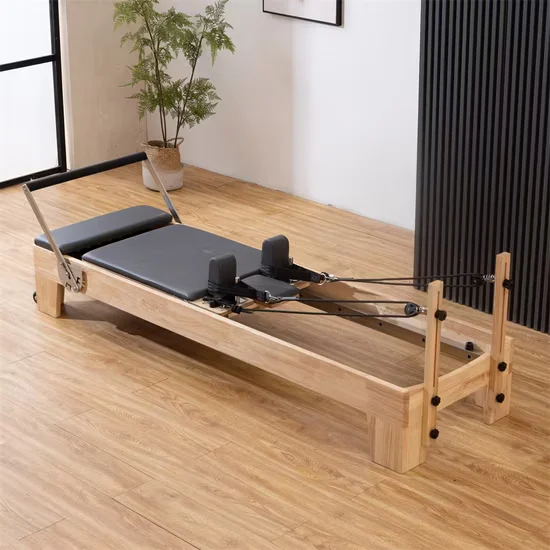
Commercial Wooden Pilates Reformer with Half Trapeze and Tower, Solid Wood Frame, 2460×730×680mm Dimensions — engineered with a solid-wood frame that resists torsion under sustained spring tension, paired with a half trapeze and tower attachment for full-range movement on a single footprint. Includes long box, jump board, and platform for versatile studio programming. Backed by a 3-year warranty and 32-point inspection with 100% load testing before shipment.
// Spec Highlights
• Direct from Manufacturer · No Middlemen · Worldwide Shipping
01
// Material
Imported Solid Wood
Premium hardwood frames sourced for density and visual warmth.
02
// Hardware
Medical-Grade Silent
Whisper-quiet pulleys and springs for clinical environments.
03
// Customization
Appearance OEM
Color, upholstery, and branding tailored to your studio.
04
// Service
Layout Design
Free venue planning for studios and rehab institutions.
Every component is selected for longevity, performance, and aesthetic harmony - from imported hardwood frames to silent medical-grade accessories.
// Features
Continuous MIG Welded Tower — Every structural joint on the frame and tower assembly receives continuous robotic weld passes, eliminating the spot-weld failures that plague high-traffic studio equipment.
| Parameter | Value |
|---|---|
| Product Type | Pilates Reformer with Tower |
| Model NO. | SRY-02 |
| Frame Material | Solid Wood |
| Product Dimensions | 2460×730×680mm |
| Net Weight | 100kgs |
| Color | Solid Color |
| Accessory | Long Box / Jump Board / Platform |
| Target User | Adult, Unisex |
| Logo | Customized Is Allowed |
| Production Capacity | 80 Pieces/Month |
| Warranty | 3 Years |
| Facility Type | Typical Use |
|---|---|
| Pilates Studio | Group reformer classes with tower and half trapeze sequences |
| Rehabilitation and Physiotherapy Center | Controlled resistance therapy and post-injury mobility work |
| Boutique Fitness Studio | Integrated strength and flexibility sessions in limited floor space |
| Hotel and Resort Wellness Facility | Guest-accessible premium movement equipment |
| Home Studio | Full-range classical Pilates practice on a single footprint |
Solid-wood joinery resists the torsional creep that hollow-core and engineered-wood frames develop after months of repetitive spring tension.
A commercial wooden pilates reformer with half trapeze and tower sees hundreds of spring-loaded cycles per week. Laminated frames rely on adhesive layers that soften in humid studio environments, and hollow-core tubes lack the cross-sectional mass to resist twisting when springs pull at off-axis angles during trapeze work. Solid timber, properly joined, distributes that torsional stress through the entire grain structure rather than concentrating it at a single glue line. When a studio owner opens a reformer carriage after two years of daily classes, the difference in carriage alignment is immediately visible. [NEED_CITE: EN 957 structural requirements for stationary training equipment]
This reformer with tower and half trapeze covers the full classical Pilates repertoire—supine, prone, seated, and standing exercises—on a 2460×730mm footprint. In a studio layout, it pairs with mat zones and smaller apparatus like stability chairs, forming a complete class station without redundant equipment. The half trapeze extends the exercise range into overhead pulling and spinal articulation work typically requiring a full Cadillac, making this commercial wooden pilates reformer with half trapeze and tower suitable for studios where floor area is at a premium. It accommodates users across a wide range of body sizes thanks to adjustable spring anchor points and a full-length carriage.
Spring tension on a reformer tower creates a different load profile than free weights: the frame endures sustained eccentric pull combined with rapid direction changes during jump board sequences. The tower attachment points experience the highest concentrated stress, particularly where the upright meets the base frame during half trapeze exercises. [NEED_CITE: weld classification and fatigue performance in structural steel] Solid wood handles this by maintaining grain continuity through the joint, whereas composite materials develop micro-cracks at the resin matrix boundary. The carriage wheels and rails undergo thousands of reciprocating cycles per week, making wheel material hardness and rail tolerance critical to maintaining smooth glide and acceptable noise levels during group classes.
The 100kg net weight indicates substantial frame mass, which correlates directly with stability during dynamic exercises like jump board repetitions—lighter reformers walk across the floor. Solid-wood construction, specified rather than engineered composite, ensures the frame has continuous grain structure through high-stress joinery points. The accessory set including long box, jump board, and platform covers the core classical repertoire without requiring separate purchases. A three-year warranty on a commercial wooden pilates reformer with half trapeze and tower signals the manufacturer’s confidence in spring fatigue life, wheel bearing durability, and upholstery adhesion under daily class conditions.
A thin-walled tube or hollow-core frame may look identical in a product photo but will develop carriage misalignment as the frame warps under cumulative spring load. Non-sealed pulley bushings accumulate chalk dust and sweat residue, creating grinding noise and requiring bearing replacement within months rather than years. Low-density upholstery compresses permanently in high-contact zones, and once the vinyl splits, many manufacturers offer no replacement pads—forcing a full reupholstery at significant cost. Non-standard hardware sizes mean that when a spring or cable needs replacement, no off-the-shelf component fits, and the equipment sits idle waiting for proprietary parts. [NEED_CITE: material fatigue and failure modes in fitness equipment under cyclic loading]
Steel traceability principles apply directly to wood specification: every solid-wood frame is sourced with species and grade documentation, not a generic "wood" label. Robotic MIG welding standards transfer to the metal components on this unit—tower brackets and pulley mounts receive continuous welds, not spot welds that crack under repeated trapeze loading. Every unit undergoes load testing before shipment, verifying spring tension ratings and carriage glide under actual working conditions. The 200μm powder coating standard used on our steel frames extends to all metal hardware on this reformer, resisting corrosion from studio humidity and cleaning chemicals. Floor planning CAD support ensures this 2460×730mm unit integrates into your studio layout with correct safety clearances for instructor circulation and adjacent station spacing.
Provide your studio floor area and intended class size to receive a 2D or 3D layout plan showing equipment placement with safe clearance zones. Specify your daily class volume and average user profile so the spring tension configuration matches your operational load. Detail any customization requirements including frame color, logo placement, or upholstery material to confirm production lead time.
Q: How do I verify the frame is solid wood rather than laminated or engineered composite?
A: Request the wood species and grade certification before ordering. Solid-wood frames show continuous grain patterns through cross-sections at joinery points, while laminated frames reveal layered edges. Inspect the tower base attachment area—solid timber will have consistent density throughout, whereas hollow-core or particle-core alternatives feel lighter and produce a hollow sound when tapped.
Q: What spring tension range works for studio classes versus rehabilitation settings?
A: Studio classes typically use medium to heavy spring configurations for strength-focused sequences and jump board work. Rehabilitation environments favor lighter tensions for controlled range-of-motion exercises. Confirm with the manufacturer that the spring set includes multiple tension levels and that replacement springs in each grade are available as consumable spare parts.
Q: How do tower and half trapeze attachment points affect frame integrity?
A: The tower upright transfers significant bending moment into the base frame during overhead pulling and trapeze exercises. Attachment points must use reinforced joinery or welded metal brackets with continuous welds rather than spot welds. Ask for inspection records on these specific joints, as they are the highest-stress locations on the entire commercial wooden pilates reformer with half trapeze and tower assembly.
Q: What is the replacement cycle for springs, pulleys, and carriage wheels in commercial use?
A: Springs typically require replacement when visible sag or tension loss appears, which varies with class frequency and load. Pulley bearings need inspection for play and noise quarterly. Carriage wheels should be checked for flat spots and rail tracking accuracy. Confirm that all three component types are available as standard replacement parts from the manufacturer with documented lead times.
Premium aesthetics meet quiet operation for boutique studio environments.
Medical-grade silence and precision for sports & postpartum recovery.
Furniture-grade craftsmanship for premium residential installations.
Compact premium setups for one-on-one and small-group training.
Aesthetic Pilates integration for hybrid wellness studio programming.
Multi-unit deployment with instructor-grade reliability for certification programs.
Tell us about your project. Our team will respond within 24 hours with pricing, customization options, and shipping details.
// Sales Director
William
+86 132 2531 1800
// Export Manager
Bella
+86 198 5412 8032
william@bickfit.com