01 / Scenario
STUDIO
P
High-End Pilates Studios
Premium aesthetics meet quiet operation for boutique studio environments.
ISO
9001
CE
Certified
OEM
Available
10YR
Warranty
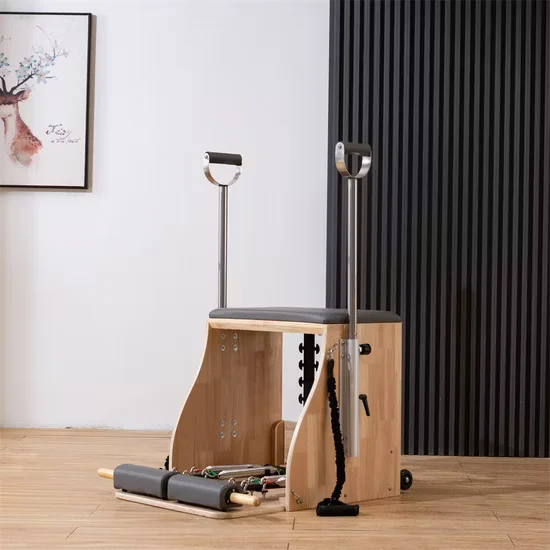
Pilates Combo Chair, Solid Wood Frame, 800×620×1100mm — engineered with integrated mounting points for long box, jump board, and platform to eliminate play during repetitive studio-class loading. 45kg net weight and 3-year structural warranty validate joint integrity under dynamic push-offs and high-frequency scheduling. Each unit undergoes 32-point inspection and 100% load testing before shipment to ensure spring tension consistency and surface finish durability.
// Spec Highlights
• Direct from Manufacturer · No Middlemen · Worldwide Shipping
01
// Material
Imported Solid Wood
Premium hardwood frames sourced for density and visual warmth.
02
// Hardware
Medical-Grade Silent
Whisper-quiet pulleys and springs for clinical environments.
03
// Customization
Appearance OEM
Color, upholstery, and branding tailored to your studio.
04
// Service
Layout Design
Free venue planning for studios and rehab institutions.
Every component is selected for longevity, performance, and aesthetic harmony - from imported hardwood frames to silent medical-grade accessories.
// Features
Solid Wood Joinery — Every Pilates combo chair frame is cut from kiln-dried hardwood and assembled with reinforced joinery to prevent racking under repeated jump board and pedal loading.
| Parameter | Value |
|---|---|
| Product Type | Pilates Combo Chair |
| Frame Material | Solid Wood |
| Specification | 800 × 620 × 1100 mm |
| Net Weight | 45 kg |
| Accessory Compatibility | Long Box / Jump Board / Platform |
| Color Options | Solid color, customizable |
| Logo | Customized logo available |
| Warranty | 3 Years |
| Facility Type | Typical Use |
|---|---|
| Boutique Pilates Studio | Group reformer and chair classes with back-to-back scheduling |
| Rehabilitation and Wellness Center | Low-impact progressive resistance training for post-injury clients |
| Hotel Fitness Facility | Compact footprint equipment for multipurpose wellness rooms |
| Functional Training Studio | Integrated accessory work combining chair, long box, and jump board sequences |
The frame joint is where a Pilates chair either lasts a decade or fails before the warranty expires.
Many manufacturers label their equipment as studio-grade without disclosing the wood species, moisture content at assembly, or the joinery method holding the frame together. In high-frequency class environments where a single commercial Pilates combo chair for gym studio use sees dozens of pedal depressions and jump board push-offs daily, vague specifications translate directly into wobble at the pedal mount, surface cracking along grain lines, and joint separation at the uprights. [NEED_CITE: wood joinery fatigue performance under cyclic dynamic loading] I once saw a row of chairs in a busy studio where three out of six had visible hairline cracks at the dowel joints within eight months — the owner had no way to verify what wood was actually inside the frame when it arrived.
This unit supports sagittal and frontal plane resistance work through its dual-pedal system and accommodates seated, standing, and prone positions across the accessory ecosystem. In a group class layout, it pairs naturally with reformers for circuit-style programming where clients rotate between apparatus every few minutes. The 800 × 620 mm footprint allows tight studio rows while maintaining the lateral clearance needed for side-lying series and long box slides. It suits facilities running six or more group classes daily where the commercial Pilates combo chair for gym studio scheduling demands rapid setup changes between sessions.
The highest stress concentrations on a combo chair occur at the pedal pivot housing and the upright-to-base junction, where repeated eccentric loading from controlled pedal returns generates sustained shear forces. In a studio running eight classes a day, each pedal endures thousands of compression cycles per week, and any moisture ingress from sweat or cleaning solutions accelerates grain splitting near fastener holes. [NEED_CITE: EN 957 structural requirements for stationary training equipment] The accessory mounting points — where the long box slots in and the jump board pins engage — face impact loading every time a client lands or pushes off, making the precision of those machined slots critical to preventing play that worsens with use. Upholstery contact zones on the seat and backrest compress and release hundreds of times daily, demanding foam density that resists permanent deformation.
The 800 × 620 × 1100 mm envelope defines not just the physical footprint but the pedal travel arc and the clearance radius required when the jump board is attached — undersizing the station spacing by even 100 mm can cause a client’s foot to contact an adjacent unit mid-repetition. Solid wood as a frame material means the long-term rigidity depends entirely on the species selected and the joinery method; mortise-and-tenon or doweled joints distribute stress across a larger glue surface compared to mechanical fasteners alone, which concentrate load at discrete screw points. The 45 kg net weight provides a stable base that resists tipping during standing pedal work without requiring floor anchoring, though the weight also means repositioning for layout changes demands two people. The three-year warranty on structural components signals the manufacturer’s confidence in joint integrity under commercial cycles, but buyers should verify what specifically the warranty covers — frame cracks, pedal mechanism failure, and spring fatigue are very different claim categories. Accessory compatibility with the long box, jump board, and platform means the mounting interfaces must be machined to tight tolerances; even a millimeter of play at the pin slot will produce audible knocking and accelerate wear at the connection point.
A frame built from underspecified softwood or composite board will show surface denting within months where clients grip the uprights during standing exercises, and those dents become moisture entry points that swell the grain and compromise joint adhesion. Non-precision pedal pivots using basic bushings instead of sealed bearings develop lateral play that instructors notice as wobble during single-leg press work — and that play only worsens as sweat and chalk dust infiltrate the pivot housing. [NEED_CITE: bearing seal degradation in high-humidity fitness environments] Thin vinyl upholstery bonded to low-density foam compresses permanently at the seat’s center within a single season of heavy use, leaving a visible depression that clients feel as inadequate support during supine series. When spring tension ratings are not matched to the pedal’s mechanical advantage, instructors find themselves constantly swapping springs between beginner and advanced classes, and mismatched springs fatigue unevenly across the fleet.
The solid wood frame provides a repairable structure — unlike molded composites, a dented or scratched wood surface can be sanded and refinished on-site without returning the unit to the factory. The integrated accessory ecosystem with long box, jump board, and platform compatibility means a single station supports the full range of combo chair programming without requiring separate apparatus purchases. The 800 × 620 mm footprint was validated against standard studio grid layouts to confirm safe clearance between stations during lateral movement series. The customizable color and logo options allow the commercial Pilates combo chair for gym studio branding alignment without compromising the structural specification underneath. The three-year warranty on frame and mechanism covers the period where manufacturing defects typically surface in daily-use environments, and replacement spring and pad availability should be confirmed at the time of order to prevent downtime later.
Provide your studio floor plan dimensions and target class capacity to receive a 2D layout showing optimal chair spacing and accessory storage zones. Specify your expected daily class count and average participant weight range so the spring tension configuration matches your actual usage profile. Confirm your branding requirements including frame color, upholstery selection, and logo placement before production begins to ensure color matching across your entire apparatus order.
Q: How do I tell a commercial Pilates combo chair from a home-use model?
A: Commercial units specify wood species, joinery method, and spring fatigue ratings, while home models often list only generic material descriptions. Check whether the manufacturer provides replacement spring and upholstery availability under warranty, and whether the pedal pivot uses sealed bearings rather than open bushings. Weight and footprint also differ — commercial frames are heavier to resist tipping during dynamic standing exercises in class environments.
Q: What wood characteristics indicate long-term durability in a studio chair?
A: Kiln-dried hardwood with documented moisture content at assembly resists warping and joint separation under seasonal humidity changes. Joinery method matters equally — mortise-and-tenon or multi-dowel connections distribute cyclic loads across broader glue surfaces compared to single-point mechanical fasteners. Ask the manufacturer for the specific species and whether frame components are solid stock or laminated layers, as this affects repairability.
Q: How does accessory compatibility influence my class programming options?
A: A combo chair accepting long box, jump board, and platform attachments lets instructors progress clients from seated pedal work through supine box slides and standing plyometric sequences without moving to different apparatus. Verify that mounting pins and slots are machined to tight tolerances, because any play at the connection point produces noise and accelerates wear during repeated attachment and removal across back-to-back class sessions.
Q: When should I plan to replace springs under daily studio use?
A: Spring fatigue depends on class volume and the tension range instructors select most frequently. Studios running six or more chair classes daily should inspect springs quarterly for loss of tension consistency and visible coil deformation. Confirm with the manufacturer that replacement springs matching your original tension ratings remain available throughout the warranty period, and keep a small inventory of common tensions to avoid class cancellations.
Premium aesthetics meet quiet operation for boutique studio environments.
Medical-grade silence and precision for sports & postpartum recovery.
Furniture-grade craftsmanship for premium residential installations.
Compact premium setups for one-on-one and small-group training.
Aesthetic Pilates integration for hybrid wellness studio programming.
Multi-unit deployment with instructor-grade reliability for certification programs.
Tell us about your project. Our team will respond within 24 hours with pricing, customization options, and shipping details.
// Sales Director
William
+86 132 2531 1800
// Export Manager
Bella
+86 198 5412 8032
william@bickfit.com