01 / Scenario
STUDIO
P
High-End Pilates Studios
Premium aesthetics meet quiet operation for boutique studio environments.

ISO
9001
CE
Certified
OEM
Available
10YR
Warranty
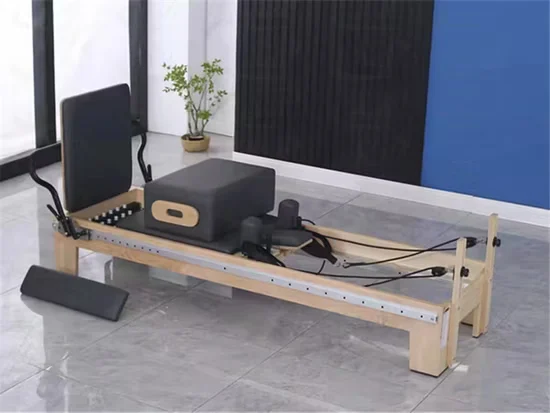
Portable Wood Pilates Reformer, Solid Wood Frame, 2460×730×680mm, 100kg — engineered with a solid-wood carriage bed for warp resistance and smooth sliding cycles, paired with sealed pulley assembly to maintain consistent spring tension over repeated use. Includes long box, jump board, and platform for full-spectrum training progression. Backed by 3-year warranty and factory-direct manufacturing with 17 years of commercial equipment heritage.
// Spec Highlights
• Direct from Manufacturer · No Middlemen · Worldwide Shipping
01
// Material
Imported Solid Wood
Premium hardwood frames sourced for density and visual warmth.
02
// Hardware
Medical-Grade Silent
Whisper-quiet pulleys and springs for clinical environments.
03
// Customization
Appearance OEM
Color, upholstery, and branding tailored to your studio.
04
// Service
Layout Design
Free venue planning for studios and rehab institutions.
Every component is selected for longevity, performance, and aesthetic harmony - from imported hardwood frames to silent medical-grade accessories.
// Features
Factory-Direct Structural Integrity — Every Portable Home Pilates Reformer with Bed unit ships with solid-core wood carriage construction and a three-year structural warranty, backed by mill-certified material traceability.
| Parameter | Value |
|---|---|
| Product Type | Pilates Reformer |
| Model NO. | SRY-02 |
| Frame Material | Solid Wood |
| Product Dimensions | 2460 × 730 × 680 mm |
| Net Weight | 100 kg |
| Included Accessories | Long Box, Jump Board, Platform |
| Color Options | Solid color finishes available |
| Logo | Customized branding available |
| Target User | Adult, Unisex |
| Production Capacity | 80 Pieces / Month |
| Warranty | 3 Years |
| Facility Type | Typical Use |
|---|---|
| Home Pilates Studio | Daily reformer practice with full accessory range for progressive resistance work |
| Boutique Reformer Class Room | Small-group sessions where portability allows reconfiguration between classes |
| Rehabilitation & Physiotherapy Center | Controlled movement therapy with low-impact spring resistance and stable carriage travel |
| Small Fitness Studio | Space-constrained facilities requiring equipment that can be repositioned for multi-use floors |
| Athletic Conditioning Room | Jump-board plyometrics and sport-specific movement prep in functional training zones |
Solid-core wood beds resist the deflection cycles that hollow boards fail at within months of daily use.
Many portable reformers on the market cut weight by using honeycomb-core or particle-board carriage beds. These panels hold flat on day one, but under the repetitive eccentric loading of reformer springs — thousands of return cycles per month — the internal structure compresses unevenly. The carriage begins to rock on its rails. Pulley alignment drifts. What feels like minor play today becomes a binding, noisy carriage track by month six. This portable wood pilates reformer for home use addresses the problem at the material level: solid wood with consistent grain orientation across the carriage bed maintains flatness through the loading cycles that hollow boards cannot survive. [NEED_CITE: wood panel deflection thresholds under cyclic loading for fitness equipment]
This unit occupies the intersection of rehabilitation-grade control and athletic conditioning capacity. The included long box enables seated and supine pulling movements targeting the posterior chain, while the jump board converts the reformer into a low-impact plyometric platform for lower-body power development. In a home studio layout, the 2460 × 730 mm footprint allows placement against a wall with adequate clearance for full carriage travel and accessory swaps. The 100 kg net weight provides enough mass to resist lateral shift during explosive jump-board repetitions, yet the unit remains repositionable by a single operator when the floor plan needs reconfiguration.
Every reformer session generates hundreds of carriage return cycles under varying spring tensions. The rails absorb both the static load of the user’s body weight and the dynamic impact of directional reversals at end range. Pulley assemblies face continuous rope friction and lateral forces as the carriage moves through its full travel path. On units with unsealed bearing assemblies, dust and moisture migrate into the contact surfaces, accelerating wear and introducing play that manifests as carriage drift. The spring anchors endure repeated tension loading, and fatigue at the attachment points can alter resistance consistency over time. Sweat exposure in high-use environments compounds corrosion risk at every metal-to-metal interface. [NEED_CITE: bearing degradation patterns in cyclic linear motion fitness assemblies]
The frame material specification — solid wood versus composite or hollow-core construction — directly governs how the carriage bed responds to asymmetric loading. When a user applies force off-center during single-leg or single-arm movements, the bed must resist torsional deflection to keep the carriage tracking true on its rails. Wood grain orientation matters here: boards cut with consistent longitudinal grain along the travel axis distribute cyclic stress more evenly than cross-grain or laminated panels with mixed orientation. The net weight of 100 kg reflects the mass required for in-use stability; a lighter unit would shift during jump-board exercises, while the solid construction provides a planted base without sacrificing repositioning capability. Accessory interchangeability — the fitment tolerance between the long box, jump board, platform, and the carriage frame — determines whether components seat securely or develop rattle and movement over repeated attachment cycles.
Thin-bed construction reduces shipping weight and unit cost at the factory gate, but the downstream expenses accumulate quickly in a working studio. A carriage bed that warps under cyclic loading requires track realignment or full rail replacement. Open bearing assemblies that lack seals demand regular disassembly, cleaning, and lubrication — downtime that takes the unit out of rotation. Non-standard spring anchors and proprietary pulley diameters mean replacement parts are sourced only from the original manufacturer, if they remain available at all. Low-mass frames that shift during use create floor-marking and safety-clearance issues that force layout compromises. These costs do not appear on the purchase invoice but surface reliably within the first year of commercial-frequency use. [NEED_CITE: total cost of ownership for commercial fitness equipment bearing and rail systems]
The solid wood carriage bed on this reformer is built from material with traceable sourcing, not generic composite panels selected solely for cost-per-sheet optimization. The frame joints are assembled to withstand the directional forces generated during full-range reformer movements, not simply the static weight of a user at rest. Each unit undergoes a three-stage inspection process before shipment, verifying carriage travel smoothness, accessory fitment tolerance, and spring tension consistency across the resistance range. The 200μm industrial-grade finish on all metal hardware provides corrosion protection against sweat exposure and cleaning chemicals common in studio environments. The three-year warranty covers structural components, reflecting confidence in the assembly’s fatigue life. Floor layout support is available to plan clearance zones around the 2460 × 730 mm footprint, ensuring safe passage and accessory-swap space in multi-unit studio configurations. Custom logo application is available for branded studio environments.
Provide your studio floor dimensions and intended unit count to receive a 2D layout plan with clearance zones calculated around each reformer’s footprint. Specify your anticipated daily session volume so the structural specification level can be confirmed against your usage intensity. Identify your user population — rehabilitation patients, general fitness clients, or athletic performers — to verify that the accessory configuration matches your programming needs. Communicate any branding requirements, including custom logo placement and color preferences, early in the procurement process to align production scheduling.
Q: How can I verify whether a reformer carriage bed is solid wood or hollow-core construction?
A: Examine the cross-section edges of the carriage bed where it meets the frame. Solid wood shows continuous grain structure throughout the thickness, while hollow-core boards reveal an internal honeycomb or void structure beneath thin veneer surfaces. You can also assess the unit’s overall mass relative to its dimensions — a 100 kg net weight for this footprint indicates solid construction, whereas hollow-core units weigh significantly less. Knock the bed surface; solid wood produces a dense, low-pitch response versus the hollow echo of composite panels.
Q: What pulley and spring specifications affect long-term carriage smoothness?
A: Sealed bearing pulley assemblies resist dust and moisture intrusion far better than open bushing designs, maintaining smooth rope travel over thousands of cycles without requiring disassembly for cleaning. Spring steel grade and coil consistency determine whether resistance remains linear across the full tension range or develops dead spots as the metal fatigues. Verify that the manufacturer specifies replacement spring availability and recommended swap intervals based on session volume, since springs are consumable components in any reformer system.
Q: How do I evaluate accessory compatibility if I need to source replacements later?
A: Check the attachment interface dimensions — the slot width, pin diameter, and mounting point spacing — against the manufacturer’s published specifications rather than assuming cross-brand interchangeability. Even minor tolerance differences in how the long box seats into the carriage channel or how the jump board locks into the foot-bar position can create play and noise. Request fitment drawings from the supplier before purchasing third-party accessories to confirm dimensional alignment with your reformer model.
Q: What floor clearance does a home studio need around this reformer for safe operation?
A: The 2460 × 730 mm footprint must be surrounded by clearance on all sides to accommodate full carriage travel, accessory insertion and removal, and user movement during standing or kneeling exercises. Plan for minimum lateral space on the long sides for long-box sliding and on the short ends for jump-board approach. Ceiling height should accommodate overhead pulling movements with the user fully extended on the carriage plus arm reach above the unit’s 680 mm base height.
Premium aesthetics meet quiet operation for boutique studio environments.
Medical-grade silence and precision for sports & postpartum recovery.
Furniture-grade craftsmanship for premium residential installations.
Compact premium setups for one-on-one and small-group training.
Aesthetic Pilates integration for hybrid wellness studio programming.
Multi-unit deployment with instructor-grade reliability for certification programs.
Tell us about your project. Our team will respond within 24 hours with pricing, customization options, and shipping details.
// Sales Director
William
+86 132 2531 1800
// Export Manager
Bella
+86 198 5412 8032
william@bickfit.com