01 / Scenario
STUDIO
P
High-End Pilates Studios
Premium aesthetics meet quiet operation for boutique studio environments.

ISO
9001
CE
Certified
OEM
Available
10YR
Warranty
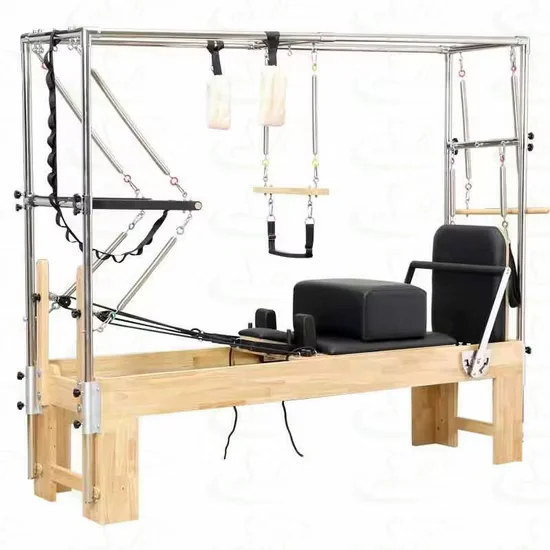
Solid Maple Wood Pilates Reformer with Tower, 2460×730×1900mm, 150kg Net Weight — solid maple frame delivers dimensional stability and consistent rail glide, resisting warping under daily humidity shifts. Tower attachment expands standing and hanging exercise options without increasing floor footprint. Includes long box, jump board, and platform for full-range training. 3-year warranty with custom logo options available. Every unit undergoes 32-point inspection and 100% carriage load testing before shipment.
// Spec Highlights
• Direct from Manufacturer · No Middlemen · Worldwide Shipping
01
// Material
Imported Solid Wood
Premium hardwood frames sourced for density and visual warmth.
02
// Hardware
Medical-Grade Silent
Whisper-quiet pulleys and springs for clinical environments.
03
// Customization
Appearance OEM
Color, upholstery, and branding tailored to your studio.
04
// Service
Layout Design
Free venue planning for studios and rehab institutions.
Every component is selected for longevity, performance, and aesthetic harmony - from imported hardwood frames to silent medical-grade accessories.
// Features
Mill-Certified Maple Frame — Solid maple timber sourced with moisture content documentation ensures dimensional stability under cyclic carriage loading.
| Parameter | Value |
|---|---|
| Product Type | Pilates Reformer with Tower |
| Frame Material | Solid Maple Wood |
| Product Dimensions | 2460 × 730 × 1900 mm |
| Net Weight | 150 kg |
| Color Options | Solid color finish, custom tones available |
| Accessories Included | Long Box, Jump Board, Platform |
| Logo | Customized logo allowed |
| Warranty | 3 Years |
| Production Capacity | 80 Pieces / Month |
| Transport Package | Standard Wood Case |
| Facility Type | Typical Use |
|---|---|
| Boutique Pilates Studio | Group reformer classes with tower-assisted standing and hanging sequences |
| Home Yoga and Movement Space | Daily personal practice combining mat work with reformer and tower exercises |
| Rehabilitation and Physiotherapy Clinic | Controlled spring-resistance rehabilitation for joint recovery and neuromuscular re-education |
| Personal Training Studio | One-on-one sessions requiring versatile resistance progressions and exercise variety |
| Wellness Resort Fitness Center | Guest-accessible reformer stations for guided Pilates programming |
Solid maple resists the rail warping that forces plywood reformers out of alignment within two seasons of humidity cycling.
Most reformer frames in commercial Pilates studios are built from laminated plywood or composite wood panels. These materials hold their shape in controlled environments but begin to twist when ambient humidity fluctuates across seasons. Once the carriage rails drift out of parallel, the wheel-to-rail interface develops play, and the smooth glide that defines reformer work degrades into a rattling, uneven ride. Operators then face repeated realignment service calls or full frame replacement [NEED_CITE: wood dimensional stability and moisture cycling effects on structural lumber]. A solid maple wood Pilates reformer with tower avoids this failure mode because solid timber of adequate density maintains consistent grain geometry, keeping the rail plane true through years of daily carriage loading and environmental variation.
The reformer with tower covers the full spectrum of Pilates movement planes — supine, prone, seated, kneeling, and standing — within a single footprint. In a studio configuration, it pairs with mat zones and smaller apparatus such as stability chairs and barrels to create a complete class circuit without redundant equipment. For boutique studios running group classes, the tower attachment eliminates the need for separate wall-mounted spring boards, consolidating standing and hanging exercises into the same station. The solid maple wood Pilates reformer with tower accommodates users across a wide height and strength range, as the carriage and spring system supports both gentle rehabilitation loads and athletic resistance demands.
A reformer in a studio running four to six classes daily endures thousands of carriage cycles per week, each one transferring load through the wheels, rails, and frame joints. The static load is predictable — user weight plus spring tension — but the eccentric forces during controlled deceleration and directional reversals create stress concentrations at the rail mounting points and the tower base connection. Over time, any looseness in fasteners or wear in wheel bearings manifests as lateral carriage drift [NEED_CITE: cyclic loading fatigue in timber frame joints]. The tower introduces additional lateral forces during standing cable work and hanging exercises, meaning the tower-to-frame joint must resist not just vertical pull but rotational torque. In a humid environment, sweat and cleaning solutions also attack the finish and any exposed metal hardware, accelerating corrosion at contact points.
The frame material — solid maple — is specified by wood species rather than a generic "hardwood" label, which gives buyers a verifiable density and grain structure to evaluate against load requirements. Maple’s tight grain pattern and high Janka hardness rating make it one of the more dimensionally stable choices for a carriage-bearing frame, meaning the rails are less likely to develop the micro-warping that causes wheel chatter. At 2460 × 730 × 1900 mm, the overall footprint including the tower is compact enough for high-density studio floors where spacing between reformers determines how many stations fit per room. The 150 kg net weight reflects the mass of solid timber construction combined with the steel tower frame, providing a stable base that does not shift during aggressive spring-loaded movements. The included accessories — long box, jump board, and platform — extend the exercise repertoire without requiring separate purchases or additional floor space.
Reformers built from underspecified plywood or fast-growth plantation timber may look identical in product photos but reveal their limitations within the first year of commercial use. Thin frame walls flex under loaded carriage travel, causing the rail gauge to widen and the wheels to bind. Non-sealed wheel bearings ingest dust and chalk residue from studio floors, developing play that transfers vibration into the frame and amplifies noise across a class of twelve or more machines running simultaneously [NEED_CITE: bearing contamination and wear in fitness equipment]. Tower attachment points secured with wood screws rather than through-bolted steel brackets loosen under repeated lateral spring tension, creating a visible wobble that alarms users and exposes the studio to liability. Thin surface finishes that chip at contact points expose raw wood to moisture absorption, accelerating localized swelling and further rail misalignment.
The solid maple frame provides a verifiable material specification that purchasing teams can audit against supplier documentation, rather than accepting a vague "commercial-grade wood" claim. The tower mounting structure is engineered to handle multi-directional spring loads, not just vertical hanging weight. The three-year warranty covers frame and structural components, providing a defined accountability window for commercial buyers. Custom logo and finish options allow studios to maintain brand consistency across a fleet of reformers without resorting to third-party refinishing. For facility planners, CAD-supported layout guidance ensures the 2460 × 730 mm footprint integrates with safe clearance corridors between stations, preventing the cramped configurations that compromise user safety during jump board and standing tower exercises.
Provide your studio floor dimensions and target station count to receive a 2D-3D layout plan that accounts for carriage clearance and tower swing radius. Specify your daily class volume and average user profile so the spring configuration and accessory package can be matched to your programming needs. Communicate finish color and logo requirements early to align with your brand identity and delivery timeline.
Q: What is the structural difference between solid maple and plywood reformer frames?
A: Solid maple maintains consistent grain density throughout the frame, resisting the layer separation and warping that plywood develops under repeated humidity cycling and carriage loading. Plywood frames rely on adhesive bonds between veneer layers, which degrade over time and allow rail mounting points to shift out of alignment, causing carriage drag and uneven wheel wear.
Q: How should I evaluate carriage glide quality before purchasing?
A: Test the carriage under loaded conditions with springs attached at multiple tension levels. The carriage should travel the full rail length without lateral drift, audible grinding, or dead spots. Ask the manufacturer for documentation on wheel bearing type and rail tolerance specifications, as these determine long-term smoothness under daily commercial cycling.
Q: What are the load limits for the tower attachment?
A: The tower is engineered to handle the spring tension forces generated during standing, kneeling, and hanging exercises within the reformer’s designed resistance range. Request the manufacturer’s rated load specification for the tower mounting points, and verify that the connection uses through-bolted hardware rather than wood screws alone [NEED_CITE: structural fastener load ratings for timber connections].
Q: How often should springs be replaced on a commercially used reformer?
A: Springs in daily commercial use gradually lose their rated tension over thousands of extension cycles. Inspect springs quarterly for visible deformation or loss of return force, and request the manufacturer’s recommended replacement interval based on their fatigue testing data. Keeping a spring inventory on site minimizes studio downtime when replacements are needed.
Premium aesthetics meet quiet operation for boutique studio environments.
Medical-grade silence and precision for sports & postpartum recovery.
Furniture-grade craftsmanship for premium residential installations.
Compact premium setups for one-on-one and small-group training.
Aesthetic Pilates integration for hybrid wellness studio programming.
Multi-unit deployment with instructor-grade reliability for certification programs.
Tell us about your project. Our team will respond within 24 hours with pricing, customization options, and shipping details.
// Sales Director
William
+86 132 2531 1800
// Export Manager
Bella
+86 198 5412 8032
william@bickfit.com