01 / Scenario
STUDIO
P
High-End Pilates Studios
Premium aesthetics meet quiet operation for boutique studio environments.

ISO
9001
CE
Certified
OEM
Available
10YR
Warranty
// Spec Highlights
• Direct from Manufacturer · No Middlemen · Worldwide Shipping
01
// Material
Imported Solid Wood
Premium hardwood frames sourced for density and visual warmth.
02
// Hardware
Medical-Grade Silent
Whisper-quiet pulleys and springs for clinical environments.
03
// Customization
Appearance OEM
Color, upholstery, and branding tailored to your studio.
04
// Service
Layout Design
Free venue planning for studios and rehab institutions.
Every component is selected for longevity, performance, and aesthetic harmony - from imported hardwood frames to silent medical-grade accessories.
// Features
Solid Wood Integrity — kiln-dried hardwood resists the warping that hollow-core and laminated plywood frames develop under constant spring tension.
| Parameter | Value |
|---|---|
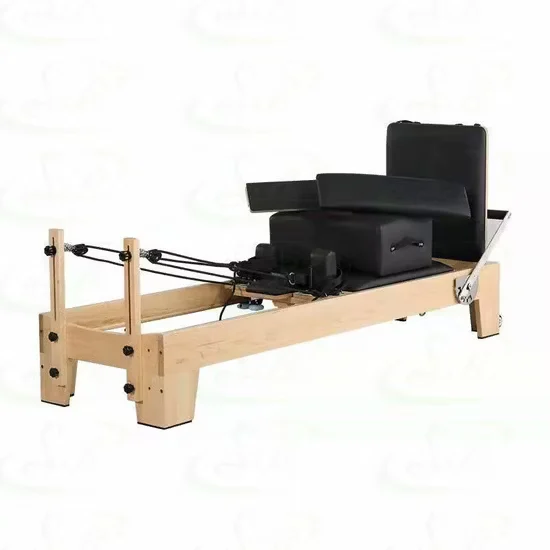
| Product Type | Pilates Reformer |
| Model NO. | SRY-20 |
| Product Dimensions | 2400×600×350mm |
| Net Weight | 100kgs |
| Frame Material | Solid Wood |
| Folding Design | Yes |
| Included Accessories | Long Box, Jump Board, Platform |
| Color | Solid Color, custom options available |
| Logo | Customized Is Allowed |
| Warranty | 3 Years |
| Certification | CE |
| Production Capacity | 80 Pieces/Month |
| Facility Type | Typical Use |
|---|---|
| Boutique pilates studio | Group reformer classes with folding storage between sessions |
| Home studio pilates training | Space-efficient daily practice with full accessory range |
| Rehabilitation and physiotherapy center | Controlled resistance work for patient recovery protocols |
| Hotel and resort wellness facility | Guest-accessible pilates equipment with premium aesthetic |
A commercial wood folding pilates reformer machine built from engineered wood or laminated plywood absorbs moisture unevenly, and the frame rails begin to twist under repeated spring tension cycles. The carriage no longer tracks straight, the springs bind, and the entire unit requires re-alignment within months of daily studio use.
Solid hardwood stays dimensionally stable where composite materials fail.
I learned this the hard way on an early folding reformer project. To cut cost, the original spec used a thinner-walled tube at the folding hinge. Six months of open-close cycles later, the hinge seat cracked clean through. That failure drove every decision on this SRY-20 build: solid timber at every stress junction, reinforced hinge plates, and a carriage rail mated directly to the hardwood rail bed rather than sitting on a subframe that can drift out of square [NEED_CITE: dimensional stability of hardwood vs engineered wood under cyclic moisture exposure]. The result is a reformer that tracks true whether it sits unfolded in a studio corner or gets folded and stored daily.
The reformer covers the full sagittal plane with spring-loaded resistance for lower body, spinal articulation, and upper body pressing and pulling patterns. In a boutique studio layout, it pairs with a cadillac or wall unit for a complete apparatus-based class format. The folding capability means a room configured for mat work in the morning can convert to a reformer studio by afternoon — a practical advantage for operators managing limited square footage. It accommodates users across a broad height and strength range through adjustable spring tension and the included long box, jump board, and platform.
The folding hinge is the highest-stress point on any collapsible reformer. Every open-close cycle concentrates shear force at the pivot pin and the surrounding wood fibers. Hardwood holds fastener threads far better than particleboard or plywood, which strip after repeated loading. The carriage rail endures continuous friction under spring tension — the rail surface must resist grooving from the carriage wheels over thousands of repetitions. Sweat and cleaning solutions also attack the finish at contact points, so the coating must withstand both chemical exposure and mechanical abrasion [NEED_CITE: fatigue classification for wood joints under cyclic loading]. The spring anchor points see eccentric pull forces when users work unilateral patterns, demanding solid cross-sections at each attachment.
The 2400×600mm footprint provides a full-length carriage travel suitable for tall users without consuming excess floor width — critical when four or six units line a studio wall. At 100kgs net weight, the frame mass is enough to stay planted during jump board work without requiring floor anchoring. Solid wood construction eliminates the delamination risk inherent in plywood: there is no glue line between veneers that can separate under sustained spring tension or moisture intrusion. The folding mechanism depends on the wood’s compressive strength at the hinge bolt seats — hardwood crushes far less than softwood or MDF, keeping the pivot tight through years of use. The included long box, jump board, and platform attach to reinforced anchor points rather than screwing into end-grain, which strips under lateral load.
A cheaper reformer with a laminated plywood frame may look identical on day one. Within a year of studio traffic, the plywood layers separate at the rail mounting points, the carriage develops lateral play, and spring tension becomes inconsistent. Folding hinges on composite frames strip their bolt holes — once the threads go, the frame cannot be repaired, only replaced. Thin surface finishes chip at the carriage contact zone and expose raw wood to sweat and humidity, accelerating the decay cycle [NEED_CITE: maintenance cost comparison of solid wood vs composite fitness equipment frames]. Operators end up buying twice.
The solid wood frame is sourced by grade, not by whatever sheet stock is cheapest at the mill — grain orientation and knot-free sections are specified at procurement. The folding hinge uses through-bolts with steel reinforcement plates rather than wood screws that pull free under cyclic load. Every unit is assembled and cycled through its full folding range before packing, verifying that the carriage tracks straight and the hinge operates without binding. The finish is applied at a thickness that withstands daily cleaning chemicals and sweat exposure without checking or peeling. A three-year warranty backs the structural components, and custom logo application is available for studios that brand their equipment. The 80-unit monthly production capacity supports multi-studio rollout without extended lead times.
Provide your studio floor dimensions and target class size to receive a 2D layout showing reformer placement with proper clearance zones. Specify your expected daily session count so we can confirm the structural grade matches your traffic volume. Share your client demographic — height range and strength levels — to verify the spring tension configuration and accessory package fits your programming. Indicate any custom color or logo requirements early to align with the production schedule.
Q: How can I verify the frame is solid wood and not plywood or MDF with a veneer?
A: Check the end grain at any exposed cross-section — solid wood shows continuous grain running through the full thickness, while plywood reveals alternating laminated layers and MDF shows uniform fiber with no grain structure. Request a material certification from the manufacturer specifying wood species and grade. Solid wood also produces a distinct acoustic resonance when tapped, unlike the dull thud of composite panels.
Q: What determines how smoothly the carriage rides over time?
A: Carriage smoothness depends on rail surface hardness, wheel material, and the precision of the rail-to-wheel fit. Solid hardwood rails resist grooving far better than softwood or coated particleboard. Wheels made from low-friction polymer maintain their profile longer than hard plastic that develops flat spots. Consistent spring tension also matters — if springs fatigue unevenly, the carriage pulls to one side and accelerates asymmetric rail wear.
Q: Will the folding hinge hold up with daily open-close cycles in a busy studio?
A: Hinge longevity depends on the fastener type and the wood’s compressive strength at the bolt seats. Through-bolts with steel reinforcement plates distribute load across a wider area than wood screws, which pull free from end grain under repeated shear stress. Hardwood species maintain thread engagement far longer than softwood or composite materials. Request the manufacturer’s hinge cycle test data before committing to a high-traffic deployment.
Q: What spring tension range is available and does it suit different user levels?
A: The reformer ships with a set of springs covering light to heavy resistance, accommodating rehabilitation clients through advanced practitioners. Each spring is color-coded or marked by tension rating so instructors can match resistance to user capability quickly. Springs are replaceable individually as they fatigue, so you maintain consistent resistance feel without replacing the entire set.
Premium aesthetics meet quiet operation for boutique studio environments.
Medical-grade silence and precision for sports & postpartum recovery.
Furniture-grade craftsmanship for premium residential installations.
Compact premium setups for one-on-one and small-group training.
Aesthetic Pilates integration for hybrid wellness studio programming.
Multi-unit deployment with instructor-grade reliability for certification programs.
Tell us about your project. Our team will respond within 24 hours with pricing, customization options, and shipping details.
// Sales Director
William
+86 132 2531 1800
// Export Manager
Bella
+86 198 5412 8032
william@bickfit.com