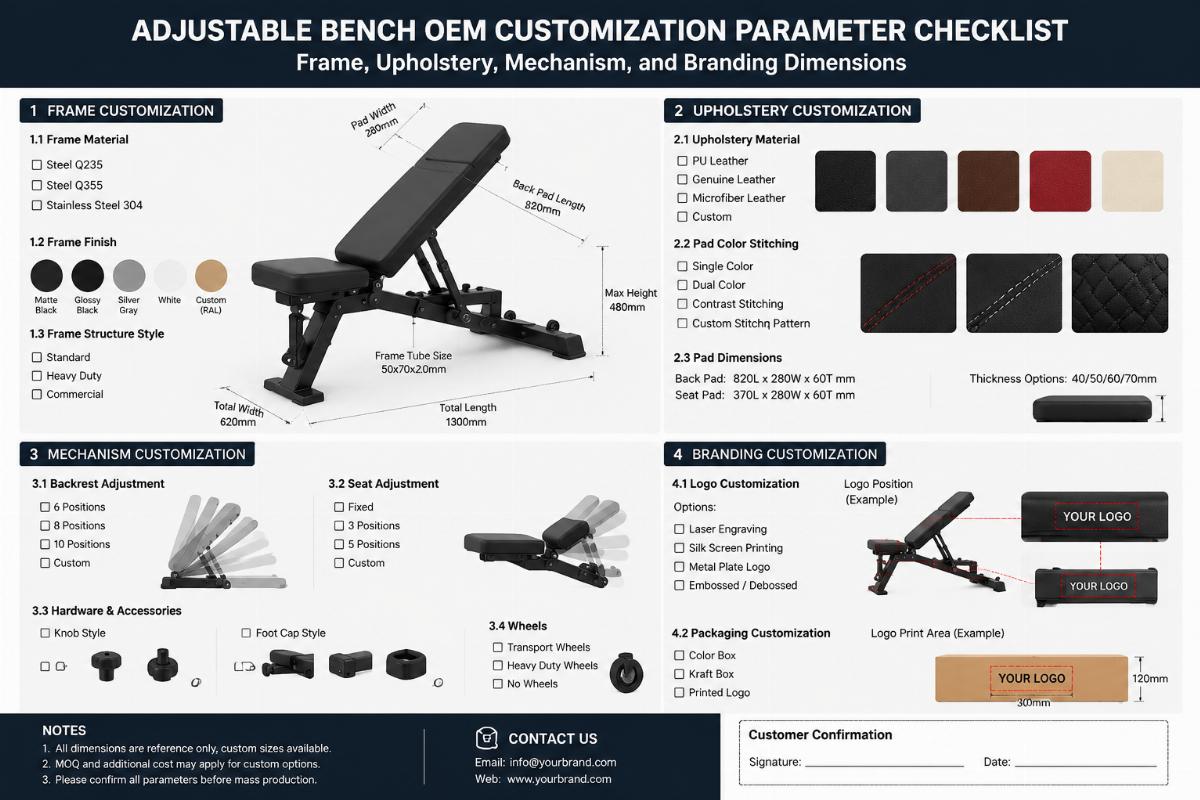
AB-Adjustable Bench Sub-Series for Italy Market: Wholesale Supplier Guide
Most importers assume a CE certificate alone clears Italian customs. In reality, missing a single annex page in the technical file can strand an entire container at the port for weeks.
The AB-Adjustable Bench sub-series is readily available for the Italian market, with flexible MOQ from single units to full container loads. However, successful delivery depends not on production capacity but on CE documentation completeness, label compliance, and advance planning for container consolidation from the Shandong factory.
I still remember a shipment of adjustable benches that arrived at the Port of Genoa only to be held up because the CE technical file lacked the Machinery Directive annex pages. The container sat in customs for an extended period, and the accumulated storage fees ended up costing several times more than what the buyer had saved on the order itself. That kind of loss doesn’t come from bad product quality—it comes from paperwork gaps that nobody bothered to double-check before loading. Since then, I have treated every document for the Italian market as if a customs inspector were reading it over my shoulder. [NEED_CITE: EU Machinery Directive 2006/42/EC documentation requirements for fitness equipment]

Getting the product to Italy is only half the equation. The other half is making sure it actually clears customs and reaches the gym floor without surprise costs or delays. Let me walk you through the specific checkpoints that determine whether an AB-Adjustable Bench order runs smoothly or turns into a logistics nightmare.
Can the AB-Adjustable Bench Series Reliably Supply the Italian Market?
Yes, the AB-Adjustable Bench sub-series is in regular production and can cover Italy’s typical procurement cycles, supporting flexible order quantities from individual units up to full container loads.
The Shandong manufacturing base produces these benches continuously, and the production rhythm aligns well with how Italian buyers tend to order—sometimes a handful of units for a boutique studio, sometimes enough to fill a container for a commercial gym chain. The key advantage here is that the manufacturer does not force you into rigid batch sizes. A small fitness chain in Milan might need a mixed pallet of flat and incline benches, while a distributor in Rome might want a full container combining benches with plate-loaded machines and dumbbells. Both scenarios are handled within the same production workflow. [NEED_CITE: EN ISO 20957 safety requirements for adjustable bench equipment]
A European distributor I worked with initially ordered a small batch to test market response. Once the benches passed their quality inspection and end-user feedback came back positive, they scaled up to container-level orders within a single quarter. The transition was seamless because the production line was already calibrated for that product family.
What matters here is not just whether the benches exist in the catalog, but whether the supplier can maintain consistent build quality across small and large orders alike. The AB-Adjustable Bench series uses commercial-grade steel framing and heavy-duty adjustment mechanisms designed for high-usage environments. Whether you receive ten units or five hundred, the structural integrity and finish quality remain at the same level.

Which CE Documents Cause Customs Delays in Italy?
The CE technical file must include the Machinery Directive annex pages, a Declaration of Conformity, and an Italian-language user manual—missing any one of these triggers inspection holds.
Here is the mistake I see repeatedly: importers receive a CE certificate from the factory, assume it is sufficient, and ship the goods. Then the container arrives at Genoa or Naples, and customs asks for the full technical construction file. The certificate alone is just a summary document. What customs actually wants to see is the complete package that proves compliance with Directive 2006/42/EC and the relevant harmonized standards. [NEED_CITE: Italian customs procedures for CE-marked fitness equipment imports]
The technical file must contain the following elements:
- Full risk assessment covering mechanical hazards specific to adjustable bench designs
- Test reports demonstrating compliance with EN ISO 20957 for stationary training equipment
- List of applied standards with edition years
- Technical drawings showing load-bearing structures and adjustment mechanisms
- Declaration of Conformity signed by the manufacturer or authorized representative
- Italian-language operating and maintenance instructions
I have seen shipments delayed because the Declaration of Conformity referenced an outdated version of the standard. I have seen other shipments held because the user manual was only in English, with no Italian translation provided. Each of these gaps requires the importer to request corrected documents from the factory, coordinate with customs brokers, and pay daily storage fees while waiting.
A practical approach is to request a complete document preview before production begins. A reliable AB-Adjustable Bench supplier should be able to provide sample copies of every document in the technical file for your review. This allows you to verify that the Italian-language manual exists, that the Declaration of Conformity references current standards, and that the risk assessment covers the specific adjustment mechanisms used in the bench design.

What Are Italy’s Specific Label and Manual Requirements?
Labels must be in Italian, include load capacity markings, and display the manufacturer’s EU authorized representative information—commercial gym equipment faces particularly strict scrutiny on these details.
Italian customs does not treat adjustable benches the same way they treat consumer electronics. For commercial fitness equipment, the expectation is that every unit carries permanent identification markings that remain legible throughout the product’s service life. This means the label material itself matters—vinyl stickers that peel off after a few months of gym use will not satisfy an inspector.
The label must include:
- Manufacturer name and full address
- EU authorized representative name and address within the European Union
- Model identification and serial number
- Maximum user weight capacity in kilograms
- Maximum load capacity for adjustment positions
- CE marking with correct proportions
Beyond the physical label, the user manual must be provided in Italian. This is not optional. Italian law requires that safety-critical instructions be available in the national language of the destination country. The manual must cover assembly procedures, adjustment operations, maintenance schedules, and safety warnings—all in Italian. [NEED_CITE: Italian consumer product labeling regulations for fitness equipment]
An OEM client of ours once received a shipment where the factory had applied labels in English only, assuming the Italian manual would compensate. Customs flagged the entire batch because the permanent markings on the equipment did not match the language requirement. The solution involved sending a technician to apply new Italian labels to every single unit before release—a costly and time-consuming fix that could have been avoided with proper pre-shipment verification.
When ordering from an AB-Adjustable Bench supplier, confirm in writing that labels and manuals will be produced in Italian to your specifications. Request pre-production samples of both the label artwork and manual translation for approval before mass production begins.

How Does Container Consolidation Reduce Per-Unit Shipping Costs to Italy?
Combining adjustable benches with strength machines and free weights in shared containers increases load utilization and spreads fixed logistics costs across multiple product categories.
Shipping a container filled exclusively with adjustable benches rarely makes economic sense. Benches are relatively compact but do not fully utilize a container’s volumetric capacity when shipped alone. The real cost advantage comes from consolidation—mixing benches with other equipment types that complement their dimensions and weight distribution.
A typical consolidation scenario might look like this:
- Adjustable benches occupy the lower tier, providing a stable base
- Plate-loaded machines are positioned against container walls
- Dumbbell sets and weight plates fill gaps between larger equipment
- Functional training accessories and flooring materials occupy remaining space
This approach requires careful load planning. Weight distribution must be balanced to prevent shifting during ocean transit. Heavier items like plate-loaded machines need to be secured against the container walls, while lighter but bulkier items like benches can fill the center space. The goal is to maximize the number of SKUs per container without exceeding weight limits or creating unstable load configurations. [NEED_CITE: Container loading optimization for mixed fitness equipment shipments]
A gym owner in Turin needed to outfit a new facility with a complete equipment package. Rather than placing separate orders with multiple suppliers and paying for multiple partial containers, they consolidated everything through a single source—cardio equipment, strength machines, free weights, benches, and flooring. The result was a noticeable reduction in per-unit shipping costs because the container was fully utilized, and all products arrived together on the same vessel, simplifying customs clearance and on-site delivery scheduling.
The AB-Adjustable Bench series is specifically designed to integrate into these mixed-container shipments. The benches can be nested or stacked efficiently, and their packaging dimensions are compatible with standard pallet configurations used for other equipment types. This compatibility makes them an ideal component in consolidation strategies.

How Do You Verify a Supplier’s Italy Market Delivery Experience?
Request sample clearance documents from previous Italian shipments and verify that the supplier understands specific port requirements and documentation standards.
Not every factory that exports fitness equipment has specific experience with Italian customs procedures. The Italian market has particular requirements around language, labeling, and documentation that differ from other European destinations. A supplier who has successfully delivered to Germany or France may not automatically understand what Italian customs expects.
When evaluating an AB-Adjustable Bench supplier, ask for the following evidence of Italy-specific experience:
- Sample CE technical files from previous Italian shipments (with client information redacted)
- Copies of Italian-language manuals and labels they have produced
- References from Italian importers or gym operators who have received their equipment
- Knowledge of specific Italian port procedures and documentation requirements
- Understanding of EN ISO 20957 testing standards as applied to adjustable benches
A supplier with genuine Italy market experience will be able to show you documentation samples that demonstrate compliance with all the requirements discussed above. They will know that the Declaration of Conformity must reference current standard versions, that labels must be in Italian with specific information fields, and that the technical file must include complete risk assessments.
I have worked with importers who switched suppliers after their first shipment faced delays. The new supplier provided complete documentation packages upfront, including Italian-language materials and properly formatted CE files. The second shipment cleared customs without issues, and the importer realized that the initial delays were not due to bad luck but to the original supplier’s lack of familiarity with Italian requirements.
Before placing a significant order, request a documentation review meeting where the supplier walks you through their CE file structure, shows you sample labels and manuals, and explains their process for ensuring compliance. This conversation will quickly reveal whether they have genuine Italy market experience or are simply hoping the documents will be sufficient.

Conclusion
Successful AB-Adjustable Bench delivery to Italy requires complete CE documentation, Italian-language compliance, and strategic container consolidation planning. The product itself is readily available from Shandong manufacturers with flexible order quantities, but the real challenge lies in navigating customs requirements and logistics optimization. Importers who verify supplier experience, request complete documentation previews, and plan mixed-container shipments will avoid the delays and costs that catch unprepared buyers off guard.