Back Extension Bench OEM Manufacturer – Commercial Gym Equipment for Sale
Most buyers assume every export shipment needs an MSDS. For a back extension bench, that assumption is wrong—and it has cost importers thousands in port demurrage.
Back extension benches are primarily steel-frame, foam-padded strength equipment. They do not contain hazardous chemicals, so a full Material Safety Data Sheet is almost never required. What customs authorities actually demand are CE certificates, material test reports for foam and leather components, and standard shipping documents. Confusing MSDS with these compliance certificates is the single most common reason gym equipment gets held at destination ports.
I remember a container of mixed benches we shipped to a Middle East gym buyer a few years back. The goods arrived at Jebel Ali, and the local clearing agent flagged the shipment for missing "chemical safety documentation." The buyer had been told by his agent that an MSDS was needed. We scrambled to explain that benches don’t require MSDS, but what the agent actually wanted was a CE certificate and a material declaration for the foam padding. The cargo sat in the port for an extended period. The demurrage charges ended up eating a significant portion of the order value. That whole mess started from a single miscommunication about what "compliance documents" meant. [NEED_CITE: Jebel Ali port customs documentation requirements for fitness equipment imports]
Let me walk you through exactly what documents you need, why port agents sometimes ask for an MSDS anyway, and how to prevent your shipment from becoming a expensive lesson.
Does a Back Extension Bench Actually Need an MSDS?
No. A standard back extension bench does not require an MSDS for export.
An MSDS—or SDS, Safety Data Sheet under the Globally Harmonized System—is a document that describes the hazards of chemical products and how to work safely with them. It applies to substances and mixtures classified as dangerous under transport regulations like the IMDG Code for sea freight. [NEED_CITE: IMDG Code classification criteria for hazardous materials requiring SDS]
A commercial back extension bench consists of welded steel tubing, a foam-padded pad covered with PU leather or vinyl, adjustment pins, and bolt hardware. None of these components are classified as hazardous chemicals. The steel frame is inert. The high-density foam padding is a solid polymer. The leather cover is a finished synthetic material. There are no solvents, no flammable liquids, no corrosive agents, and no pressurized containers involved.
So why does the question keep coming up? Because freight forwarders and customs brokers sometimes use "MSDS" as a blanket term for any safety-related document. When they see a product with foam or rubber components, their checklist reflexively flags it for chemical safety review. The reality is they don’t need a full MSDS—they need a material composition statement or a test report confirming the foam and leather comply with destination-country chemical restrictions.
Here is the distinction that matters:
| Document Type | What It Covers | When It Applies to Benches |
|---|---|---|
| MSDS / SDS | Hazardous chemical substances and mixtures | Almost never—benches contain no regulated chemicals |
| Material Test Report | Chemical composition of specific components like foam, leather, paint | Required when destination regulations restrict certain substances |
| CE Certificate | Compliance with EU safety directives for mechanical equipment | Required for European Union and many Middle East markets |
| REACH SVHC Screening | Presence of Substances of Very High Concern above threshold | Required for EU market entry |
A gym equipment distributor in Southeast Asia once received a customs query asking for a "chemical safety sheet" for a container of mixed benches including hyperextension benches, Roman chairs, and adjustable flat-incline benches. The foam padding triggered the request. We provided a material test report from an accredited lab showing the foam met standard safety limits for restricted substances. The clearance process took a few extra days, but it resolved without demurrage because we had the report ready. [NEED_CITE: REACH SVHC threshold requirements for foam and synthetic leather in fitness equipment]
The takeaway is simple: do not waste time asking your supplier for an MSDS for a back extension bench. Instead, ask for the material test reports and CE documentation that actually matter.
What Compliance Docs Do You Really Need for Export?
The core export document package for a back extension bench includes CE certification, material test reports, a certificate of origin, commercial invoice, packing list, and bill of lading.
Let me break down each document and explain why it matters, because I have seen shipments delayed by missing just one of these.
CE Certificate. For the European Union and countries that recognize CE marking, a back extension bench falls under the EN 20957 standard for stationary training equipment. [NEED_CITE: EN 20957 standard scope and requirements for stationary strength training equipment] This standard covers structural integrity, stability, pinch points, and labeling requirements. The CE certificate confirms the bench has been tested and meets these safety requirements. Many Middle Eastern and African importers also require CE documentation even though they are not in the EU, because their local customs authorities use it as a baseline safety benchmark.
Material Test Report. This document covers the chemical composition of the foam padding and leather or vinyl cover. It typically screens for restricted substances like heavy metals, phthalates, and certain azo dyes. For the EU market, this report should confirm compliance with REACH regulations. For other markets, a general material safety test report from an accredited third-party lab is sufficient. Preparing this report takes a moderate amount of time if you do not have it on file, so request it from your supplier well before the shipment date.
Certificate of Origin. This document certifies where the goods were manufactured. Many countries require it for customs clearance, and it may affect import duty rates depending on trade agreements between the origin country and the destination country.
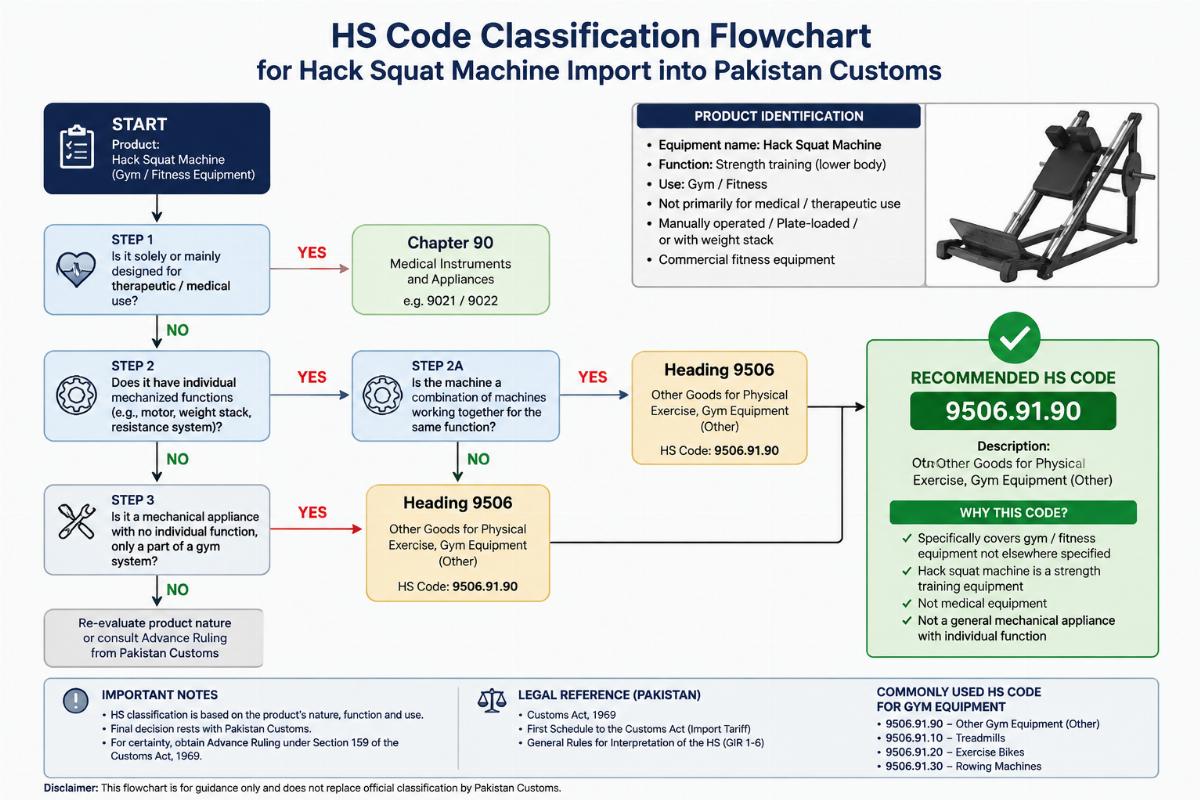
Commercial Invoice and Packing List. These are standard shipping documents. The commercial invoice declares the transaction value, and the packing list details the contents, dimensions, and weight of each package. For gym equipment shipped in mixed containers, the packing list must clearly itemize each piece of equipment with its HS code. [NEED_CITE: HS code classification for stationary strength training equipment under heading 9506]
Bill of Lading. Issued by the shipping line, this is the title document for the goods. Your freight forwarder handles this, but you need to verify that the product descriptions on the B/L match your commercial invoice and packing list exactly. Mismatches here are a common cause of customs delays.
A hotel project buyer in Africa needed a REACH-compliant leather cover statement for a batch of back extension benches destined for a hospitality fitness center. The requirement came up late in the process, and sourcing the documentation took a couple of weeks. Fortunately, the shipment timeline had enough buffer. But I have seen other cases where last-minute document requests pushed shipments past the vessel cutoff, forcing buyers to wait for the next sailing. [NEED_CITE: Documentation lead time requirements for REACH compliance testing on synthetic leather]
The lesson is to confirm the full document checklist with your supplier and your clearing agent at least a few weeks before the cargo is ready to ship. Do not assume the supplier knows what your destination port requires.
Why Do Port Customs Sometimes Request "MSDS"?
Port customs agents sometimes request an "MSDS" because their screening systems flag any product containing foam, rubber, or coated materials for chemical safety review—and the term MSDS has become a catch-all shorthand in their workflows.
This is one of those industry quirks that causes confusion on every first-time shipment. The customs agent is not actually looking for a full 16-section Safety Data Sheet. What they want is proof that the materials in your product do not contain restricted or hazardous substances. But because their checklist says "MSDS" or "chemical safety document," that is what they ask for.
I have dealt with this situation multiple times. The foam padding on a back extension bench is made of polyurethane or EVA foam. The cover is PU leather or vinyl. The frame is powder-coated steel. The powder coating is a cured polymer finish. None of these are hazardous chemicals in their finished form. But the customs agent’s system does not distinguish between raw chemical powders and finished coated products. It just sees "coated metal" and "foam" and triggers a documentation request.
The solution is to prepare a material composition declaration in advance. This is a simple document from your supplier that lists the materials used in the bench, confirms they are finished non-hazardous products, and references any applicable test reports. It is not an MSDS, but it serves the same purpose for customs clearance.
Here is a practical risk list for this scenario:
- Your clearing agent asks for "MSDS" but actually means material test report or composition declaration. Clarify the exact document name and format required.
- The agent may reject a generic supplier declaration and insist on a third-party lab test report. Confirm whether an in-house declaration is acceptable.
- Foam density and fire retardancy ratings may be requested separately, especially for hotel and public facility projects. Check whether your destination market has specific fire safety requirements for gym equipment upholstery.
- Some ports require documents to be notarized or legalized by a chamber of commerce. Verify this requirement before the shipment departs.
How to Avoid Delays and Extra Port Charges?
Confirm the complete document requirements with your buyer’s clearing agent well before the shipment date, and prepare every document in parallel with production rather than as an afterthought.
Port demurrage and detention charges accumulate quickly. When a container sits at the terminal because of missing paperwork, the daily storage fees add up to a significant unexpected cost. I have seen cases where the demurrage charges represented a substantial portion of the original goods value. That is money that comes directly out of the buyer’s margin, and it is entirely avoidable.
The process that works reliably is straightforward:
-
At the order confirmation stage, ask the buyer to check with their local clearing agent about the exact document requirements for importing strength training equipment. Get the specific document names, format requirements, and whether any legalization or notarization is needed.
-
During production, have your supplier prepare the CE certificate, material test reports, and certificate of origin in parallel. Do not wait until the goods are packed and ready to ship. If a material test report needs to be commissioned from a third-party lab, that process takes time. Start it early.
-
Before the container is loaded, send draft copies of all documents to the buyer’s clearing agent for pre-review. This catches any formatting errors, missing information, or additional requirements before the cargo is on the water.
-
At the shipping stage, verify that the product descriptions, HS codes, weights, and dimensions on the bill of lading, commercial invoice, and packing list are perfectly consistent. Even minor discrepancies like a weight rounding difference can trigger a customs query.
-
After departure, provide the buyer with complete electronic copies of all documents immediately. Do not wait for the originals to arrive by courier. Many ports now accept electronic document submissions for initial clearance processing.
A commercial gym chain in the Middle East once had a full container of back extension benches and other strength equipment held at the port because the CE certificate did not specifically list the back extension bench model by name. The certificate covered the product category but not the exact SKU. The customs agent rejected it. The buyer had to request an amended certificate from the supplier, which took over a week to process. Meanwhile, the container accumulated daily port storage charges. [NEED_CITE: CE certificate product model specificity requirements for gym equipment customs clearance]
The fix is to ensure your CE certificate explicitly covers the specific models being shipped. If you are ordering a back extension bench from an OEM manufacturer, confirm that the CE documentation lists the exact product name and model number on your commercial invoice.
What Should Buyers Ask Suppliers Before Ordering?
Request a complete export document package list at the quotation stage, and confirm that the supplier can provide CE certification, material test reports, and all standard shipping documents for the specific models you are ordering.
This is the single most effective step you can take to prevent port delays. Most experienced gym equipment manufacturers maintain a standard export document package. But you need to ask for it explicitly, because if you do not ask, some suppliers will assume you only need the basic commercial invoice and packing list.
Here is what you should request from your supplier before placing the order:
- CE certificate that specifically covers the back extension bench model you are ordering, issued under EN 20957. Confirm the certificate is current and has not expired.
- Material test reports for the foam padding and leather or vinyl cover. If you are shipping to the EU, confirm the report covers REACH SVHC screening.
- Certificate of origin and confirmation of whether it needs to be issued by a local chamber of commerce or can be a supplier self-declaration.
- Product specification sheet with accurate dimensions, weight, HS code, and packaging details. This ensures your commercial invoice and packing list match the physical cargo.
- Spare parts list and assembly instructions if your market requires them for import clearance or end-user compliance.
When you work with an established OEM manufacturer that regularly ships commercial gym equipment to international markets, most of these documents are already prepared and maintained on file. The supplier can typically provide them quickly because they go through this process for every export order. At our facility, every commercial bench order ships with a complete document package including CE certification, OEM branding files for custom labeling, and a spare parts list—because we have learned through years of shipping to markets across multiple regions that having these documents ready prevents problems at the destination.
The key is to treat export documentation as a non-negotiable part of the product specification. Just as you would confirm the steel frame thickness or the foam density, confirm the document package before you commit to the order.
Conclusion
A back extension bench does not need an MSDS, but it does need CE certification, material test reports, and standard shipping documents to clear customs smoothly. Confusing these requirements is the most common cause of port delays for gym equipment imports. Confirm your document checklist with your clearing agent before production starts, prepare everything in parallel with manufacturing, and verify all document details match your shipping paperwork exactly. These steps cost nothing extra but save you from expensive port demurrage and delayed gym openings.