
Buy Gym Equipment Bulk Order Wholesale Manufacturer Direct Pricing
Bulk gym equipment procurement is not about stacking individual units — it is an integrated engineering project spanning floor planning, container consolidation, pricing structure, and after-sales infrastructure.
To execute a successful buy gym equipment bulk order, gym owners and distributors must align four variables: equipment category ratios (cardio, strength, free weights, functional), container load efficiency (CBM versus 40HQ capacity), total landed cost breakdown (FOB plus ocean freight plus customs plus last-mile plus installation), and quality verification checkpoints at production, pre-shipment, and on-arrival stages. Skipping any one of these turns a volume discount into a hidden loss.
I still remember a hotel project in Riyadh where the client’s freight forwarder loaded treadmill motors and elliptical flywheels into the same container without weight distribution planning. When the boxes opened at the destination port, three control panels had been crushed by misplaced counterweight stacks. The replacement air freight cost several times what the original ocean shipment saved. That kind of mistake does not show up on a quotation spreadsheet — it shows up on an opening-day delay. [NEED_CITE: IHRSA global fitness equipment procurement trend report on commercial gym outfitting costs]

Getting a buy gym equipment bulk order right means treating the entire facility as one system. Let me walk through how that system actually works on the ground.
What Equipment Should You Include in a Bulk Gym Order?
A well-balanced bulk order follows a four-module structure: cardio, selectorized and plate-loaded strength, free weights, and functional training — with ratios determined by member demographics and floor area, not by catalog appeal.
Most first-time buyers over-order the equipment that looks impressive in a showroom and under-order the items members actually queue for. A hotel fitness center in West Africa once received a full order where nearly half the units were single-station machines targeting small muscle groups. Within months, the squat racks and cable crossovers were running double shifts while the leg extension machines collected dust. The mismatch was not a quality problem — it was a planning problem. [NEED_CITE: IHRSA equipment utilization data by commercial gym category]
Here is how the four modules typically break down for a mid-size commercial gym:
| Module | Typical Equipment | Space Priority | Usage Intensity |
|---|---|---|---|
| Cardio | Commercial treadmills, ellipticals, spin bikes, rowing machines | High — requires power outlets and ventilation | Noticeably high during peak hours |
| Selectorized & Plate-Loaded Strength | Smith machines, cable crossovers, leg press, chest press | Medium — stack depth and clearance | Robust daily cycle |
| Free Weights | Dumbbells, barbells, weight plates, kettlebells, adjustable benches | Low footprint, high density | Extremely high turnover |
| Functional Training | Functional trainers, battle ropes, plyo boxes, medicine balls, gym flooring | Open floor area | Noticeably high in group and PT sessions |
The critical insight is that free weights and functional gear deliver the highest usage-per-square-meter ratio, yet they are often the last items added to a buy gym equipment bulk order because they lack the visual impact of a chrome-plated cable tower. Smart operators reverse that instinct. [NEED_CITE: commercial gym equipment ROI analysis by equipment category]
When I help clients build a full gym equipment package, the first step is always a space plan overlay — not a product list. You map the floor, assign zones by traffic flow, then fill each zone with the right density of equipment. Only then do you count units and match them to container dimensions.
How to Calculate the Right Container Load Plan?
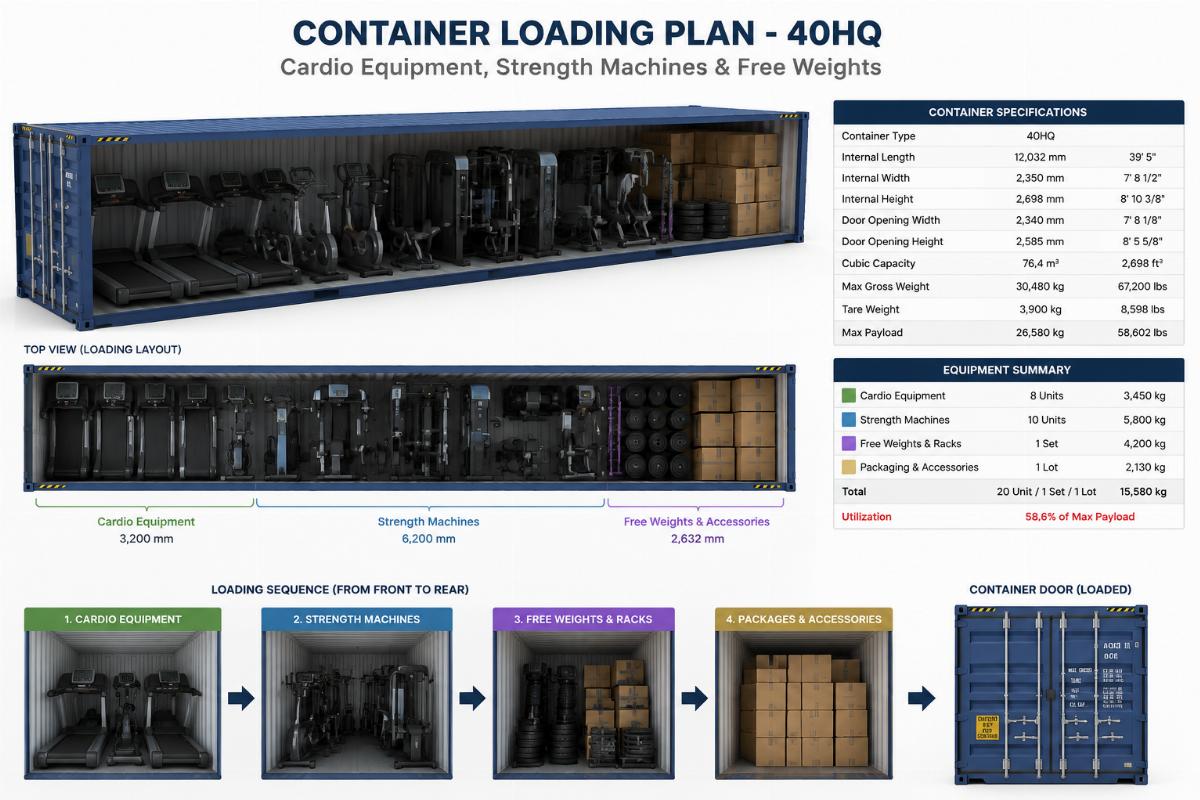
Container load planning determines whether your buy gym equipment bulk order arrives intact and on budget — poor loading causes damage, wasted volume, and surprise re-shipment costs that dwarf the unit price savings.
A standard 40HQ container offers a fixed internal volume. Every piece of equipment has a known CBM footprint and a weight profile. The loading sequence matters as much as the total count: heavy steel frames go on the bottom, padded components stack above, and delicate electronics like console displays must never sit beneath anything with shifting mass. [NEED_CITE: international shipping container loading best practices for heavy fitness equipment]
Here is the step-by-step approach I use for every container consolidation:
- Calculate total CBM — sum the packed dimensions of every unit in the order, then compare against the 40HQ usable volume. Leave a margin for bracing materials and pallets.
- Classify by weight tier — separate plate-loaded machines and power racks (heavy base) from cable crossover frames (medium) from console-equipped cardio units (fragile top layer).
- Assign loading layers — bottom layer takes the heaviest steel structures, bolted and strapped to floor anchors. Middle layer holds medium-weight frames with foam separators. Top layer reserves space for cardio consoles, dumbbell sets in cartons, and accessories.
- Cross-check weight distribution — an unevenly loaded container triggers port inspection holds and increases the risk of frame bending during ocean transit.
- Photograph every loaded tier — this creates a loading record that protects both buyer and manufacturer in case of transit damage claims.
A distributor in East Africa started with a single-container trial order to test market response. The first container carried a mix of strength machines and free weights. By the third container, they had added cardio units and optimized the ratio based on member feedback from the first location. The key was that the container load plan evolved with real data — not with guesswork. [NEED_CITE: fitness equipment import container loading optimization guide]
The difference between a well-planned container and a poorly planned one is not just about damage rates. It is about how many units you can actually fit. A buy gym equipment bulk order with tight CBM planning can compress a two-container shipment into one, saving an entire ocean freight invoice.
What Are the Real Costs Behind Bulk Gym Equipment Pricing?
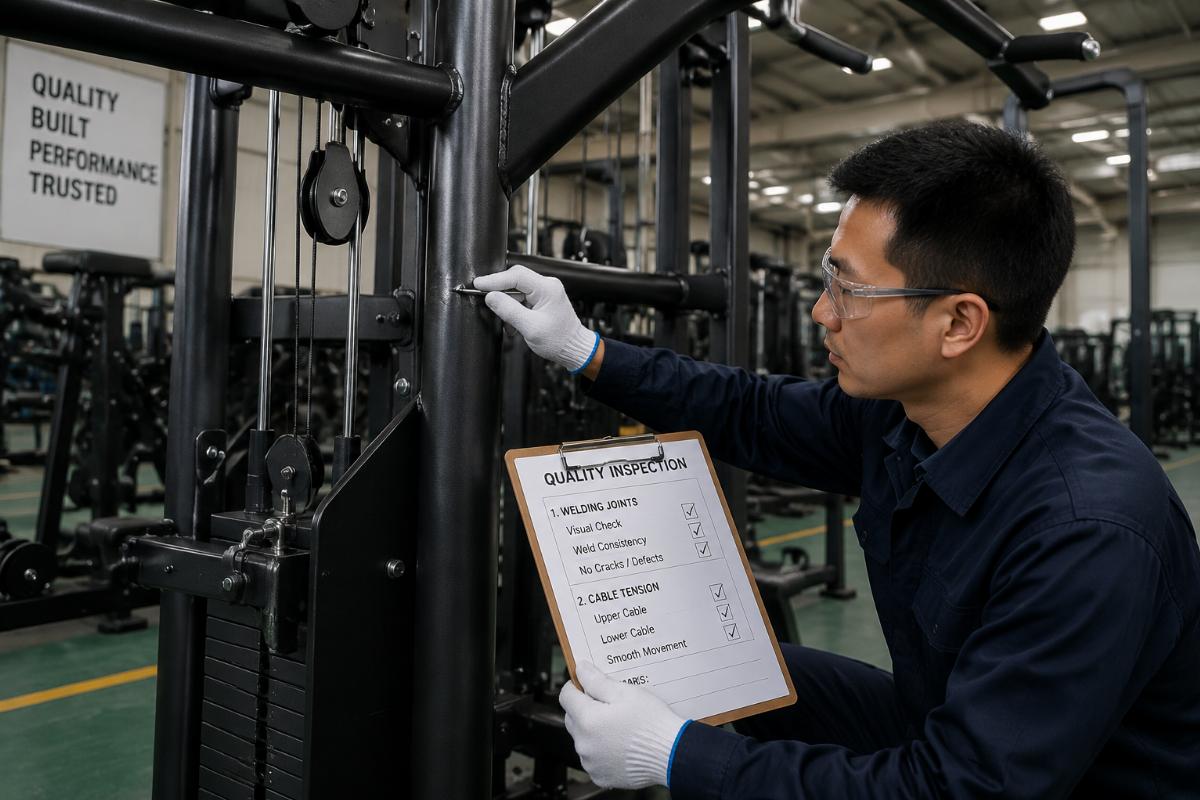
The FOB price on a quotation is only the starting line — the true cost of a buy gym equipment bulk order includes ocean freight, import duties, port handling, inland transport, assembly labor, and the long-tail expense of spare parts availability.
Many buyers fixate on unit price comparison across manufacturers and overlook the cost structure that actually determines profitability. A slightly higher FOB price from a manufacturer with reliable spare parts supply and clear warranty terms often results in a lower total cost of ownership than the cheapest quote from a supplier who disappears after the container leaves the port. [NEED_CITE: total cost of ownership model for commercial fitness equipment procurement]
Here is the cost anatomy of a typical bulk order:
| Cost Component | What It Covers | Risk if Ignored |
|---|---|---|
| FOB Unit Price | Equipment manufacturing, packaging, factory loading | Overemphasis leads to quality shortcuts |
| Ocean Freight | Container shipping, insurance, port fees | Volume miscalculation causes re-shipment |
| Import Duties & Customs | HS code classification, tariff rates, inspection fees | Wrong HS code triggers penalties |
| Inland Transport | Port to warehouse or gym site, crane unloading | Unplanned crane rental costs |
| Assembly & Installation | On-site setup, calibration, floor anchoring | Improper assembly voids warranty |
| Spare Parts & Warranty | Replacement cables, pulleys, console boards, upholstery | No parts supply means idle equipment |
A chain gym operator expanding to a second location discovered that the spare parts cost for non-standard components from their original supplier had grown to a mid-five-figure sum over two years — because the supplier used proprietary fasteners and discontinued console boards. Switching to a manufacturer with standardized components and a documented spare parts catalog cut that expense noticeably. [NEED_CITE: commercial gym equipment maintenance cost benchmark study]
This is where the manufacturer relationship matters most. A factory-direct buy gym equipment bulk order with OEM flexibility means you control the component specifications from day one — choosing standardized bearings, universal cable gauges, and replaceable upholstery covers that any local technician can source. That decision does not affect the quotation price. It affects the next several years of operating cost.
How to Verify Quality and Avoid Bulk Order Pitfalls?
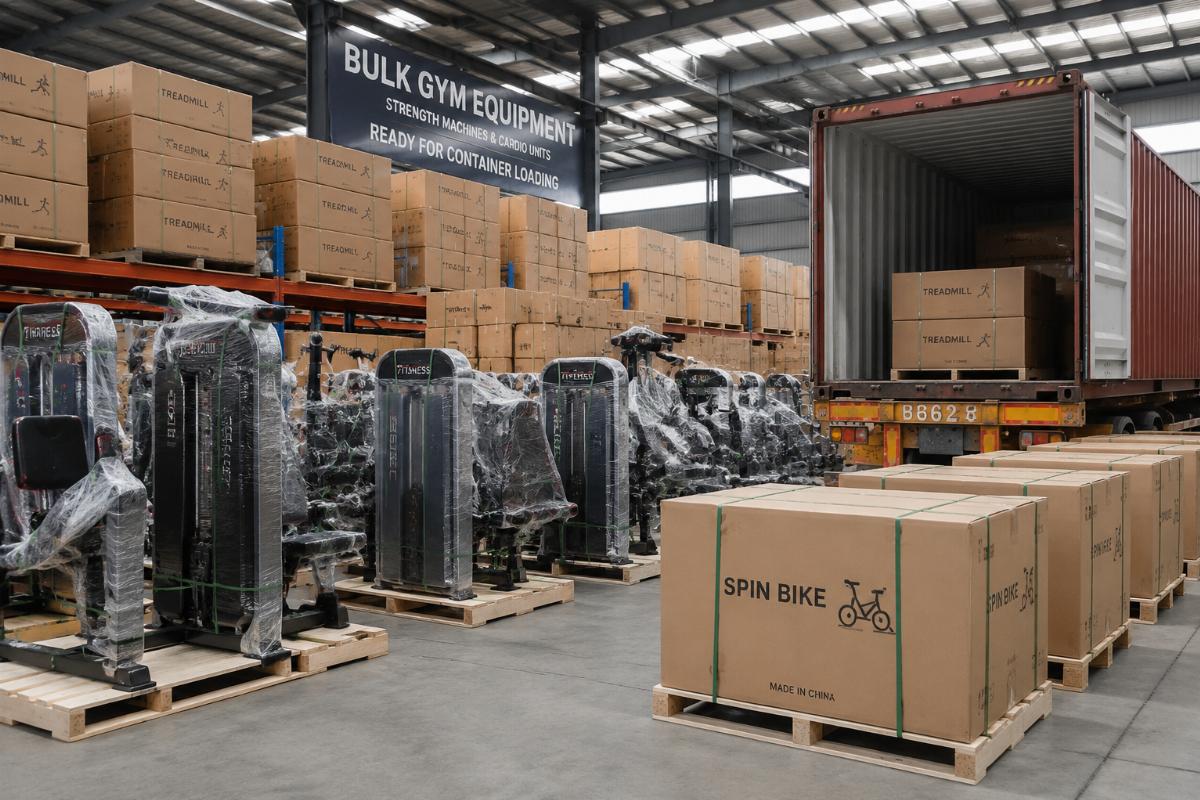
Quality verification in a buy gym equipment bulk order must happen at three gates: pre-production sample approval, in-process production inspection, and pre-shipment loading audit — skipping any gate multiplies the risk of receiving a container full of problems.
The most expensive mistake in bulk procurement is not discovering a defect after the goods arrive. It is discovering it after members have already used the equipment, after warranty claims have started piling up, and after your reputation in the local market has taken a hit. [NEED_CITE: fitness equipment quality control checklist per ISO and EN certification standards]
Here is the three-gate verification framework:
- Pre-Production Sample Gate — Before the full buy gym equipment bulk order enters production, request a pre-production sample of every major SKU. Test the welding joints, cable routing, upholstery stitching, and console responsiveness. Confirm that the CE certification documentation matches the actual product configuration — not a different model from the manufacturer’s catalog. [NEED_CITE: CE EN certification verification process for imported fitness equipment]
- In-Process Production Gate — During manufacturing, conduct at least one mid-production inspection. Check frame steel thickness, powder coating adhesion, pulley alignment, and weld penetration on load-bearing joints. This is the stage where corrections cost the least.
- Pre-Shipment Loading Gate — Before the container doors close, verify unit count, packaging integrity, accessory inclusion, and loading sequence. Photograph every pallet position. Cross-reference the packing list against the original order specification.
A boutique studio owner in Southeast Asia ordered a full functional training package. At the pre-shipment gate, the inspection revealed that the battle rope anchors had been welded to a thinner gauge of steel than specified. The correction was made before loading — a two-day delay that prevented what would have been a structural failure under repeated high-intensity use. [NEED_CITE: fitness equipment pre-shipment inspection failure case analysis]
The pattern across every successful buy gym equipment bulk order I have been involved with is the same: the buyers who invest time in verification at each gate receive equipment that performs consistently for years. The buyers who skip verification to save a few hundred dollars in inspection fees end up paying many times that amount in replacements, member complaints, and downtime.
Conclusion
A buy gym equipment bulk order succeeds or fails on system-level planning — not on unit price alone. Equipment ratios must match member behavior, container loading must protect every piece during transit, total cost must account for the full supply chain, and quality verification must occur before the container seals. Treat the order as one integrated project, and the volume advantage works in your favor for years.


