
Commercial Fitness Equipment Manufacturer & Wholesale Supplier | Bick
Most buyers fixate on unit price, yet the real cost of a gym build-out hides in freight, duty, and packaging damage — not the invoice.
The fitness equipment price in Thailand typically runs 40-60% lower when sourcing commercial-grade units directly from Chinese factories versus premium international brands, but the final landed cost depends on container consolidation strategy, import duty classification, and packaging standards — not just the quoted FOB number.
I still remember a full-container shipment bound for a Dubai gym chain a few years back. The client had ordered a complete free-weight zone — plates, bars, benches — and the factory shipped everything in standard woven bags to save a few dollars per pallet. When the container was stripped at Jebel Ali, nearly every plate had chipped edges and scuffed coating. The client deducted a chunk of the balance right there on the dock. That single lesson reshaped how I approach every quote: heavy iron demands wooden pallets with corner guards, period. Now when I walk a buyer through the fitness equipment price in Thailand, I start by unpacking what sits behind the unit number. [NEED_CITE: Thailand Customs tariff classification by HS code for fitness equipment]

Let me walk you through what actually drives the fitness equipment price in Thailand, how landed cost is built, and where buyers quietly lose money.
What Is the Average Fitness Equipment Price Range in Thailand (2026)?
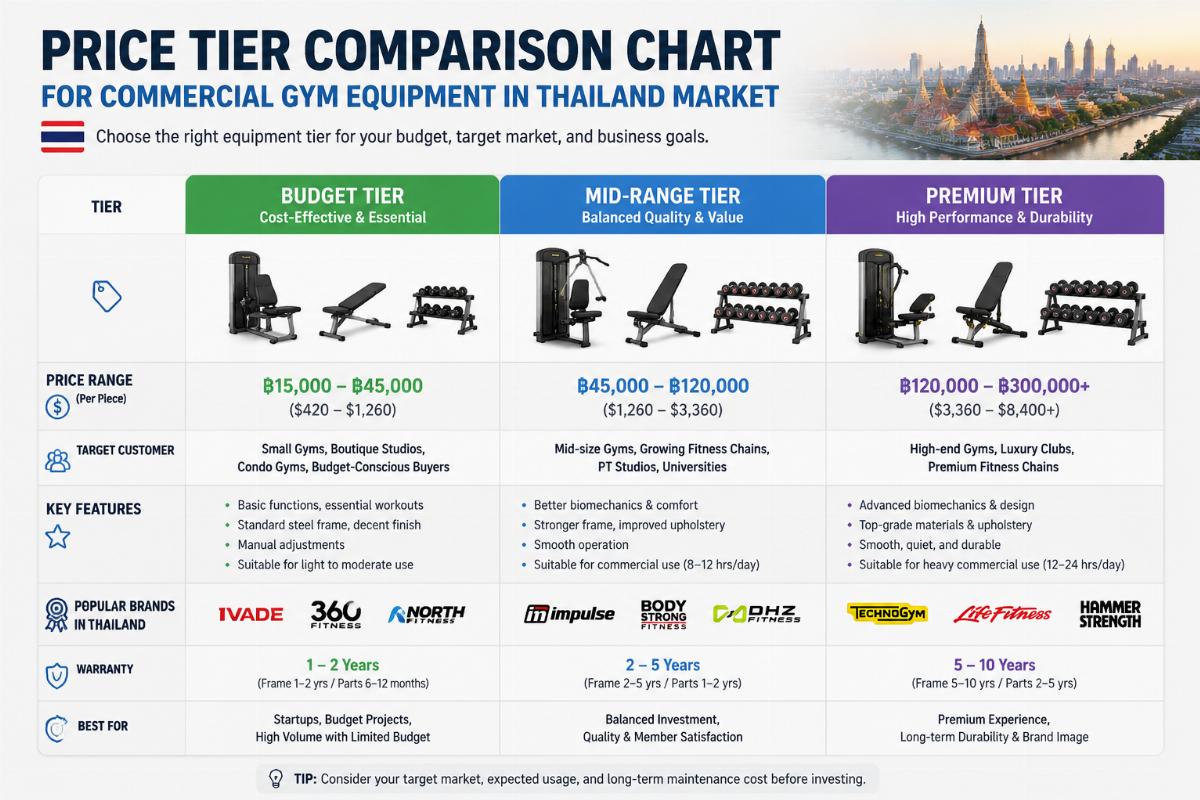
Commercial-grade equipment sourced from Chinese factories sits noticeably below premium international brands, with cardio, strength, and free-weight categories each occupying distinct price tiers.
When gym owners in Bangkok or Phuket ask me about the fitness equipment price in Thailand, I break the market into three clear bands:
- Premium international brands: These carry the highest per-unit cost, driven by brand positioning, localized service networks, and import markups through regional distributors.
- Mid-tier regional options: Typically assembled locally or sourced through Southeast Asian intermediaries, with moderate pricing and variable build quality.
- Factory-direct commercial grade from China: The most cost-efficient tier for buyers purchasing in container-load quantities, offering comparable heavy-duty construction at a fraction of premium pricing. [NEED_CITE: Southeast Asia fitness equipment market pricing structure by sourcing channel]
Here is a qualitative comparison of what buyers actually encounter:
| Sourcing Channel | Build Quality | Warranty Support | Price Position | Spare Parts Availability |
|---|---|---|---|---|
| Premium International Brands | Certified commercial-grade | Full local service team | Highest tier | Verifiable, stocked locally |
| Mid-Tier Regional | Standard to good | Variable response time | Mid-range | Self-reported |
| Factory-Direct China | Certified commercial-grade | Factory-backed with spare parts supply | Noticeably lower | Verifiable from manufacturer |
A hotel developer in Phuket once asked me to quote a complete fitness center for a new resort. They had received a local dealer quote that looked reasonable on paper. When I ran the same equipment list through our factory-direct pricing, the per-unit fitness equipment price in Thailand dropped substantially — enough to fund an extra functional training zone within the same overall budget. The catch? The local dealer had bundled installation and a service contract into their number, while our quote was pure equipment cost. That is exactly why buyers need to compare apples to apples.
How to Break Down Total Landed Cost for Imported Gym Equipment?
Unit price accounts for roughly half to sixty percent of what you actually spend — freight, import duty, last-mile delivery, and packaging protection make up the rest.
This is where most first-time importers get blindsided. They see a competitive fitness equipment price in Thailand on a proforma invoice and assume that is the final number. It is not. Let me lay out the components that build the real landed cost:
- FOB unit cost: The factory price for the equipment itself.
- Ocean freight: Varies by container type, origin port, and destination. Thailand-bound shipments from Chinese ports typically run through Laem Chabang or Bangkok Port. [NEED_CITE: China-Thailand shipping freight rate structure for fitness equipment]
- Import duty: Thailand classifies fitness equipment under specific HS codes, and duty rates vary by category — cardio machines, strength stations, and free weights do not always carry the same rate.
- VAT and customs processing fees: Applied on top of the CIF value.
- Last-mile delivery and offloading: Heavy strength machines and plate-loaded units require forklift access and sometimes crane assistance at the gym site.
- Packaging loss protection: The upfront cost of wooden pallets and corner guards versus the downstream risk of damage claims.
I once worked with a distributor in Chonburi who kept ordering free-weight sets in woven bag packaging to minimize upfront cost. Every shipment, without exception, produced damage claims on a noticeable percentage of the plates. The claim deductions and replacement shipments ended up costing several times what proper packaging would have added. Once we switched the entire free-weight line to wooden pallets with corner guards, the damage rate dropped to near zero. [NEED_CITE: Import duty rate structure by HS code category for fitness equipment entering Thailand]

Which Equipment Categories Cost More to Ship and Why?
Heavy free weights and plate-loaded machines dominate container weight limits, while bulky cardio equipment dominates cubic meter capacity — smart consolidation between the two cuts per-unit shipping cost significantly.
Understanding this dynamic is essential when calculating the fitness equipment price in Thailand on a per-unit-landed basis. Here is the core tension:
- Free weights and plate-loaded strength machines: Extremely dense, heavy relative to their footprint. A container can hit its weight ceiling long before it fills the available space.
- Cardio equipment: Treadmills, ellipticals, and rowing machines are voluminous but relatively light. A container can fill to its cubic meter limit before approaching the weight cap.
The consolidation strategy is straightforward: mix heavy iron with bulky cardio in the same container. This balances weight and volume, maximizing what you fit per shipment and driving down the per-unit freight cost.
| Equipment Category | Weight Impact | Volume Impact | Consolidation Role |
|---|---|---|---|
| Free Weights (plates, dumbbells) | High | Low | Fills weight capacity |
| Plate-Loaded Strength | High | Moderate | Fills weight capacity |
| Selectorized Machines | Moderate | Moderate | Balanced |
| Cardio (treadmills, ellipticals) | Low | High | Fills volume capacity |
| Functional Gear (benches, racks) | Moderate | Moderate | Balanced |
A gym chain owner in Bangkok was initially shipping cardio and strength in separate less-than-container-load consignments. The per-unit freight cost was eating into margins on both sides. Once we restructured the order into full container loads with mixed product — treadmills up top, weight plates and plate-loaded machines anchored below — the per-unit shipping cost dropped noticeably. The fitness equipment price in Thailand on a landed basis improved without changing a single unit price. [NEED_CITE: Container consolidation strategy for mixed fitness equipment shipments]

How to Avoid Hidden Costs from Packaging Damage and Warranty Gaps?
Proper wooden pallet packaging for iron items adds marginal upfront cost but prevents double-digit percentage damage claims; factory-direct warranty with spare parts supply eliminates local repair markup.
This is the section I wish every buyer would read before signing a purchase order. The fitness equipment price in Thailand looks attractive on paper, but two hidden cost traps routinely erase the savings:
Packaging damage on heavy iron items. Cast iron plates, loaded pin stacks, and frame components are vulnerable during ocean transit. Standard woven bag packaging offers minimal protection against shifting, stacking pressure, and port handling impacts. I have seen chipped plate edges, cracked welds on rack frames, and scratched selectorized machine housings — all traceable to inadequate packaging. The fix is non-negotiable: wooden pallets with corner guards and stretch wrap for any item exceeding a basic weight threshold. Yes, it adds to the upfront unit cost. No, it is not optional if you want the gear to arrive saleable.
Warranty and spare parts gaps. When buyers source through local dealers, warranty claims often involve weeks of back-and-forth, service visit surcharges, and markup on replacement parts. Factory-direct sourcing shifts this dynamic: the manufacturer supplies spare parts directly, provides technical support remotely, and ships replacement components with the next container consolidation. A hotel fitness center operator in Phuket learned this the hard way — a cable crossover pulley failed within months, and the local dealer quoted a replacement timeline measured in weeks plus a premium service fee. Sourcing direct would have resolved the same issue with a spare part dispatched alongside routine restocking. [NEED_CITE: Packaging standard comparison for heavy fitness equipment ocean transit]

How to Build a Complete Gym Budget by Equipment Zone?
Allocating budget across cardio, strength, free weight, and functional zones using a percentage-based framework ensures balanced setup without overspending on any single category.
When I help buyers plan a full commercial gym, I never start with a product catalog. I start with a zone-based budget framework. This approach keeps the overall fitness equipment price in Thailand aligned with revenue projections and member capacity targets.
Here is the typical allocation structure I use:
- Cardio zone: Occupies a significant share of the budget, driven by the higher per-unit cost of commercial treadmills, ellipticals, and bikes. This zone also tends to consume the most floor space per machine.
- Strength zone: Plate-loaded and selectorized machines form the core. Budget allocation here depends on the gym concept — a bodybuilding-focused facility will skew heavier than a general fitness club.
- Free weight zone: Dumbbells, barbells, plates, benches, and racks. Individually lower cost per item, but the total adds up quickly when outfitting a full dumbbell rack and multiple power stations.
- Functional training zone: Functional trainers, battle ropes, plyo boxes, kettlebells, medicine balls. Relatively modest budget share but high member engagement value.
- Flooring and accessories: Often underestimated. Commercial rubber flooring, mirror walls, and storage racks carry real cost.
| Gym Zone | Budget Weight | Space Demand | Priority for First-Time Buyers |
|---|---|---|---|
| Cardio | High | High | Critical — member retention driver |
| Strength Machines | High | Moderate | Critical — core offering |
| Free Weights | Moderate | Moderate | Essential — versatility |
| Functional Zone | Low to Moderate | Low | High ROI, low investment |
| Flooring & Accessories | Moderate | Full facility | Often underestimated |
A boutique studio operator in Chiang Mai came to me with a fixed build-out budget and a tight floor plan. By applying this zone framework, we allocated more to the cardio and functional zones — where member experience is most visible — and optimized the strength zone with a compact rack setup rather than multiple standalone machines. The result was a balanced facility that hit the target fitness equipment price in Thailand without cutting corners on any single zone. [NEED_CITE: Gym budget allocation methodology by equipment zone]

Conclusion
The fitness equipment price in Thailand is never just a unit number — it is a composite of sourcing channel, freight strategy, duty classification, and packaging discipline. Buyers who evaluate only the invoice price leave money on the table through hidden freight inefficiencies, avoidable damage claims, and warranty gaps. Those who plan by zone, consolidate containers intelligently, and insist on proper packaging standards build gyms that perform — and budgets that hold.


