
Commercial Gym Equipment Manufacturer: Bulk OEM Packages for Sale
Most buyers think the lowest unit price wins the deal, but unreasonable container consolidation can let freight costs swallow the entire price gap.
In 2026, gym equipment price in UK for a full commercial setup typically ranges from mid-five-figure to low-six-figure GBP depending on category, volume, and OEM depth. Direct sourcing from a Shandong-based factory can cut landed costs substantially versus premium international brands, provided buyers master container consolidation, MOQ tiers, and hidden import charges.
I still remember my first full-gym OEM order for a Middle East client—fifty-plus machines, cardio plus strength, all under his own brand. I spent weeks squeezing FOB prices down on each treadmill and Smith machine, only to discover on loading day that the power rack packaging dimensions simply would not stack with the cable crossover cartons in one container. The consolidation plan collapsed, and we had to rush a less-than-truckload shipment of knock-down frames from a neighboring city, burning a mid-five-figure sum in extra freight. That was the moment I realized per-unit quotation sheets tell only a fraction of the story. Packaging modularity, container loading rates, and OEM sampling lead times are where real margin hides or disappears [NEED_CITE: UK import freight cost composition for fitness equipment shipments].
Let me walk you through how UK buyers actually budget, source, and land equipment in today’s market.
What Does Commercial Gym Equipment Cost in the UK in 2026?
Pricing breaks down sharply by category, and the gap between premium imported brands and direct factory sourcing has widened noticeably over the past few years.
When a UK gym owner or hotel developer asks about gym equipment price in UK, the honest answer requires splitting the floor into zones. Cardio machines—commercial treadmills, ellipticals, spin bikes—carry the highest per-unit sticker because of electronics, motors, and console integration. Strength machines—Smith machines, functional trainers, plate-loaded stacks—sit in the middle, with price driven largely by steel gauge, cable routing complexity, and weight stack tonnage. Free weights and functional accessories—dumbbells, barbells, kettlebells, plyo boxes, rubber flooring—form the lowest per-unit tier but the highest volume tier by piece count.
| Category | Typical UK Retail Tier | Direct OEM Factory Tier | Price Gap Direction |
|---|---|---|---|
| Commercial Cardio (treadmill, elliptical, bike) | Premium | Noticeably reduced | Substantial |
| Strength Machines (Smith, cable crossover, plate-loaded) | Premium | Noticeably reduced | Substantial |
| Free Weights (dumbbells, barbells, plates) | Standard | Noticeably reduced | Moderate |
| Functional Training & Flooring | Standard | Noticeably reduced | Moderate |
A 300-square-meter commercial gym typically allocates budget roughly in a four-to-six cardio-to-strength ratio by machine count, with free weights and flooring absorbing a smaller but meaningful share. Lead time for a full container order from a Shandong factory to a UK port usually runs in the range of two to three months from deposit to warehouse delivery, depending on OEM customization depth [NEED_CITE: UK commercial gym equipment market pricing structure 2026].
The key takeaway: gym equipment price in UK at retail level includes distributor margins, local warehousing, and compliance markups that do not exist in a direct factory relationship.

How Much Can You Save Buying Direct from a China OEM Factory?
The real comparison is not factory price versus factory price—it is landed cost versus landed cost.
A UK distributor importing container-load OEM equipment once told me his per-unit retail markup needed to cover three layers: the local agent commission, the UK warehouse rent, and the after-sales buffer. When I ran the same SKU through our FOB plus ocean freight plus UK VAT plus duty plus inland delivery model, his landed cost was barely lower than ours, yet his shelf price carried a hefty premium. That is the structural advantage of going direct.
Three sourcing tiers dominate the UK market:
- Premium international brands: Highest unit price, strong brand recognition, extensive local service networks. Suitable for flagship hotel gyms where brand signaling matters more than equipment cost.
- UK-based distributors reselling imported goods: Mid-range pricing, faster local delivery, but margins built on top of factory price plus import overhead.
- Direct factory OEM from Shandong: Lowest base price, full branding control, MOQ flexibility from single-unit samples to full-gym container packages. Requires the buyer to manage or partner on import logistics.
For a hotel chain developer outfitting multiple boutique fitness rooms, the package deal route versus single-unit purchasing can produce savings in a clearly noticeable range. The reason is simple: a full-gym package lets the factory optimize container loading around a single shipping plan, eliminating the per-SKU sampling and small-batch surcharges that inflate one-off orders [NEED_CITE: cost structure comparison UK gym equipment sourcing channels].
However, direct sourcing only wins if the buyer understands the landed cost formula: FOB price plus ocean freight plus UK import VAT plus customs duty plus clearance fees plus inland haulage. Miss any line item and the savings illusion collapses.

How to Build a Full-Gym Package Within Budget?
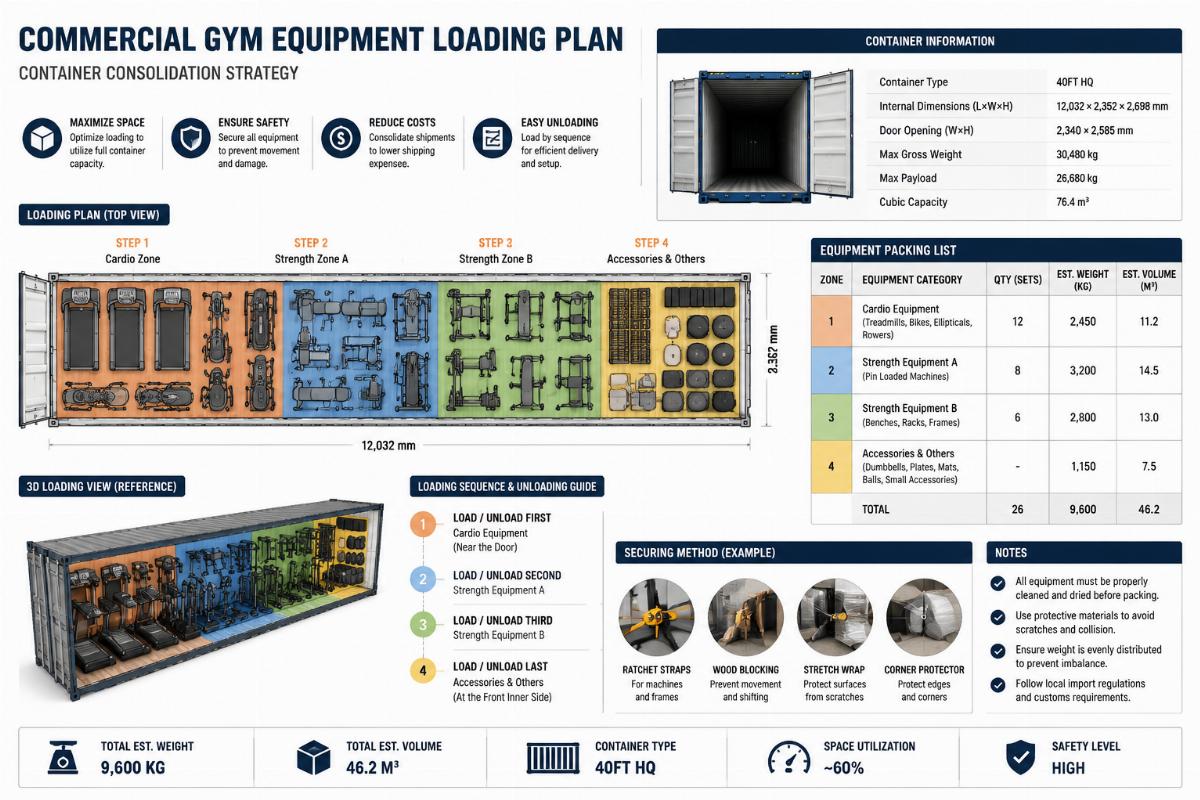
Container consolidation is not a logistics afterthought—it is the single biggest lever for compressing per-unit landed cost.
The principle is straightforward: a forty-foot high-cube container has fixed internal dimensions. Every piece of equipment you load must fit within those dimensions without wasting cubic space. If your cardio machines and strength machines pack in incompatible carton sizes, you end up shipping air, and freight cost per usable machine spikes [NEED_CITE: container loading optimization methods for fitness equipment export].
Here is the step-by-step approach I use with UK clients:
- Map the floor plan by zone: Cardio zone, selectorized strength zone, free-weight zone, functional training zone. Assign target machine counts per zone based on member capacity and square footage.
- Request packaging dimension sheets from the factory: Every treadmill, Smith machine, dumbbell set, and rubber floor roll has a specific carton or pallet footprint. The factory’s packing department can provide a loading simulation before production starts.
- Balance the mix to match container modularity: Heavy compact items like weight plates and dumbbells fill the bottom layer; tall but light items like battle ropes and medicine balls fill gaps; mid-size boxed machines stack on top. The goal is to reach a container weight and volume utilization that leaves minimal dead space.
- Choose knock-down versus assembled based on the SKU: Some strength frames ship flat-pack to save volume; some cardio consoles ship assembled to avoid on-site wiring errors. The factory should advise per SKU which option optimizes container fill without adding installation complexity.
- Consolidate multiple orders into one shipment window: If you are outfitting two hotel sites or a gym plus a CrossFit box, merging orders into a single container or a tightly scheduled series reduces per-container freight cost noticeably.
A UK distributor once saved a substantial amount on a full container of OEM-branded strength and free-weight equipment simply by switching three SKUs from assembled to knock-down packaging. The on-site assembly labor cost was marginal compared to the freight savings on a volumetric basis.

What Hidden Costs Do UK Buyers Often Overlook?
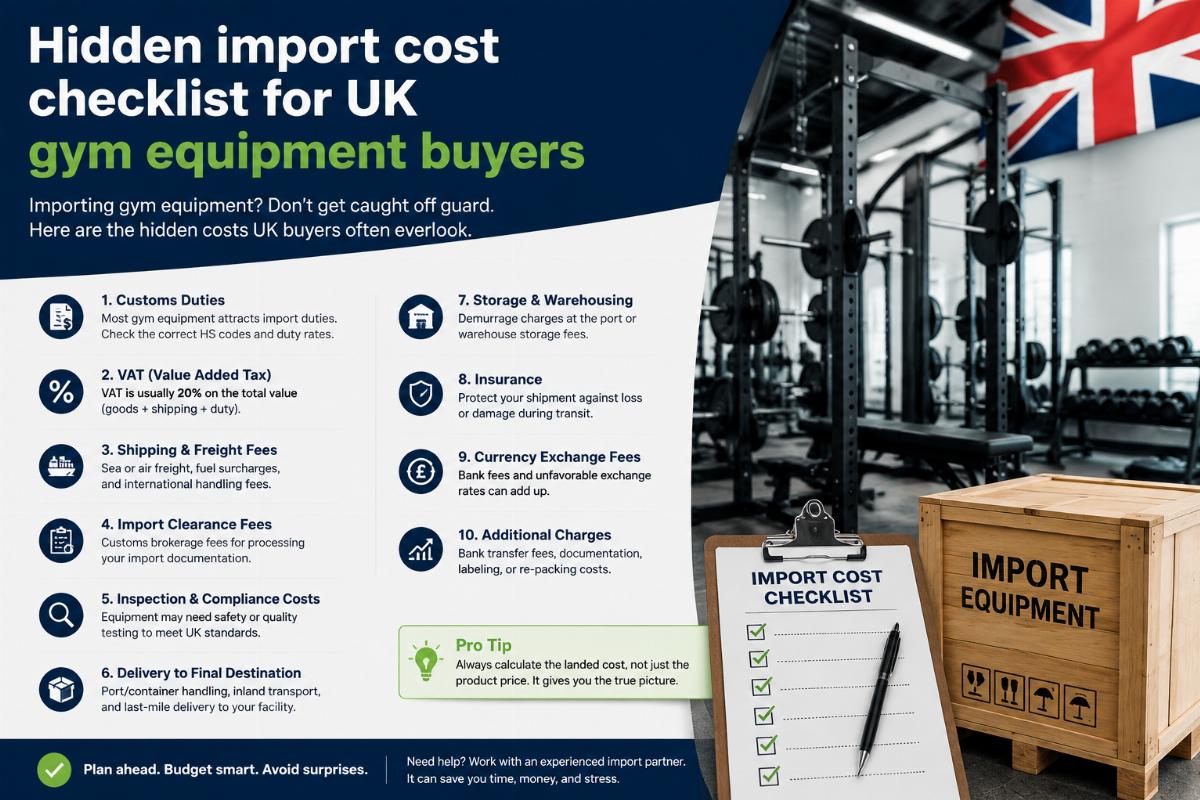
VAT, duty classification, and consolidation mistakes are the silent budget killers in UK gym equipment imports.
The UK charges import VAT on the total landed value—goods plus freight plus insurance. This is not a small line item; it applies to the full CIF value and must be cash-flowed before the goods clear customs [NEED_CITE: UK import VAT and customs duty rules for fitness equipment]. Misclassifying the HS code can push duty rates higher than necessary, so verifying the correct tariff heading with a customs broker before shipment is essential.
Other commonly overlooked costs include:
- OEM sampling and mold fees: Custom console designs, branded upholstery colors, or proprietary weight stack shrouds require tooling or sampling runs. These costs amortize over the order quantity—small MOQs absorb them painfully, while full-container orders spread them thin.
- Consolidation errors: Ordering cardio from one supplier and strength from another without coordinating container space leads to less-than-container-load shipments, which carry dramatically higher per-cubic-meter freight rates.
- Spare parts buffer: Commercial gym equipment needs wear-item replacements—cable sets, pulley bearings, running belts, upholstery patches. Ordering a spare parts kit alongside the main shipment costs almost nothing in incremental freight but saves significant downtime and emergency air-shipping costs later.
- Certification compliance: UK market access requires CE marking and conformity documentation. Factories that cannot provide verifiable CE test reports create a risk of customs holds or market withdrawal [NEED_CITE: CE certification requirements for gym equipment sold in UK market].
The pattern I see repeatedly: buyers focus intensely on the per-machine quotation and then discover that VAT, duty, and freight inefficiencies add a layer that erases the factory-price advantage.
How to Verify Quality and After-Sales from an Overseas Supplier?
CE certification is the entry ticket, but real confidence comes from verifiable spare parts supply and structured warranty terms.
When UK buyers evaluate a gym equipment price in UK from an overseas OEM factory, the quality question usually surfaces fast. The practical verification path has three layers:
First, confirm CE certification with traceable test reports—not just a self-declared certificate, but reports from recognized testing bodies covering the specific machine models in the order [NEED_CITE: how to verify CE certification authenticity for imported gym equipment]. A reputable factory will provide these without hesitation.
Second, evaluate the spare parts mechanism. Commercial equipment will need maintenance. The critical question is not whether the machine will break, but how fast replacement parts reach the floor. A factory that ships a spare parts kit with every container—and maintains a standing inventory of wear components for re-order—eliminates the downtime risk that plagues buyers who depend on emergency international courier shipments.
Third, review warranty structure. Standard commercial gym equipment warranties cover frames for extended periods and wear parts for defined terms. The value lies in the factory’s willingness to honor claims with direct part shipments rather than requiring the buyer to return defective components overseas.
A European hotel group operator once told me his previous supplier’s warranty process required him to ship broken console boards back to Asia for inspection before receiving replacements. The downtime cost him far more than the board itself. Switching to a factory that ships replacement parts immediately against photo evidence changed his operational economics completely.

Conclusion
Gym equipment price in UK is ultimately a function of category mix, order volume, OEM depth, and how well the buyer manages the landed cost chain. Direct factory sourcing from a Shandong OEM manufacturer offers a clear structural cost advantage for UK gym owners, hotel developers, and distributors who invest time in container consolidation planning, spare parts provisioning, and certification verification. The savings are real, but only for buyers who look beyond the unit quotation and optimize the full shipment.


