
Commercial Gym Equipment Supplier for Jordan: China Factory Direct OEM
Most buyers assume a CE certificate opens every door in the Middle East. It does not.
Sourcing from a reliable gym equipment supplier for Jordan means securing factory-direct pricing roughly half that of European brands, while simultaneously verifying that your CE notified body number is accepted by Jordanian customs, your voltage matches 220V/50Hz, and your labels carry Arabic text — before the container reaches Aqaba port.
I spent years walking the welding lines and spray-paint booths of a fitness equipment plant in Guangdong before moving into export coordination. A few years back, a gym owner in Amman ordered a full container of plate-loaded strength machines and commercial treadmills. We quoted FOB Shenzhen the way we always did. When the shipment reached Aqaba, customs held it because the notified body number on our CE certificate was not on Jordan’s accepted list. The container sat for weeks. The storage fees alone nearly wiped out the margin the buyer had saved by choosing a Chinese factory over a European brand. That single shipment reshaped how I handle every order bound for the Hashemite Kingdom. [NEED_CITE: Jordan customs accepted notified body list for CE conformity assessment]

Let me walk you through what actually matters when you are choosing a gym equipment supplier for Jordan, based on hard lessons and the patterns I have seen across dozens of Middle East shipments.
What Certifications and Standards Must Your Gym Equipment Meet for Jordan?
CE marking is necessary but not sufficient — the notified body number printed beneath the CE logo must appear on Jordan’s recognized list, and electrical equipment must comply with 220V/50Hz with compatible plug types.
Many gym equipment supplier catalogs display a generic CE certificate and assume that covers global markets. Jordan operates its own conformity verification process at the border. Customs officers cross-check the four-digit notified body number against an internal registry. If your factory’s certificate was issued by a body outside that registry, the entire shipment gets flagged for additional inspection or outright rejection. [NEED_CITE: Jordan Standards and Metrology Institute conformity requirements for imported fitness equipment]
Beyond the certificate itself, Jordanian regulations require:
- Voltage and frequency: All motorized cardio equipment must operate at 220V/50Hz. Equipment wired for 60Hz markets will overheat motors and void warranties within months.
- Plug type: Type G (British-style three-pin) or Type C (European two-pin) are commonly accepted, but confirm with your clearing agent before production.
- Label language: User manuals and safety warning labels must include Arabic text. English-only labels trigger delays at the document-checking stage.
- Material safety: Steel frames and upholstery must meet basic fire-retardant and heavy-metal limits aligned with EU REACH benchmarks, which Jordanian inspectors often reference.
| Certification Element | Accepted Standard | Risk if Non-Compliant |
|---|---|---|
| CE Notified Body Number | Must match Jordan’s recognized registry | Container held, storage fees accumulate daily |
| Voltage Rating | 220V / 50Hz mandatory | Motor burnout, warranty void |
| Safety Labels | Arabic + English bilingual | Document rejection at port |
| Fire Retardancy | Aligned with EU REACH benchmarks | Additional testing ordered at buyer’s cost |
A distributor in the Levant once received a batch of selectorized machines with CE certificates from a notified body that Jordan did not recognize. The re-testing and re-labeling process at the destination warehouse cost several times what proper pre-shipment verification would have required. When you evaluate a gym equipment supplier for Jordan, ask them to show you the exact notified body number and confirm it against Jordan’s current list before you sign the proforma invoice. [NEED_CITE: list of notified bodies recognized by Jordanian customs for CE imports]

How Do You Avoid Costly Clearance Delays at Aqaba Port?
Complete document preparation before departure — not after arrival — is the single biggest factor in whether your container clears Aqaba in days or weeks.
Aqaba is Jordan’s only seaport, and its customs procedures differ noticeably from Dubai’s Jebel Ali or Saudi’s Jeddah. The port handles a lower volume of container traffic, which means fewer daily sailings and less flexibility when paperwork errors surface. [NEED_CITE: Aqaba Port Authority customs clearance documentation requirements]
The document checklist I now enforce on every Jordan-bound order includes:
- Commercial invoice — must state HS codes for each equipment category, unit prices, and total CIF or CFR value. Vague descriptions like "gym machines" invite customs to assign a higher-tariff HS code at their discretion.
- Packing list — itemized by carton number, gross weight, net weight, and dimensions. Mismatches between the packing list and physical cargo trigger physical inspection, which adds days.
- Certificate of Origin — issued by the relevant Chinese chamber of commerce. Some Jordanian importers prefer legalization through the Jordanian embassy in Beijing; confirm this requirement with your clearing agent.
- CE certificate and test reports — including the notified body number, product model list, and applicable directive references (Machinery Directive 2006/42/EC, Low Voltage Directive 2014/35/EU).
- Bill of Lading — original or telex release, matching all consignee details exactly as registered with Jordanian customs.
- Arabic-language user manuals and safety labels — physically attached or packed in clearly marked cartons, not buried inside machine housings.
| Document | Common Error | Consequence at Aqaba |
|---|---|---|
| Commercial Invoice | Missing HS codes or vague descriptions | Customs assigns higher tariff, duty overpayment |
| Packing List | Weight or carton count mismatch | Physical inspection ordered, multi-day delay |
| Certificate of Origin | Not legalized when required | Rejected outright, re-issuance from China needed |
| CE Certificate | Notified body not on Jordan’s list | Additional testing or rejection |
One Middle East fitness importer learned this the expensive way. Their gym equipment supplier for Jordan had prepared all documents correctly except the Certificate of Origin, which lacked the embassy legalization stamp that the Jordanian side required. The container sat at Aqaba for an extended period while the document was re-issued and couriered. The storage and demurrage fees were substantial — a cost entirely avoidable with upfront verification.

How Should You Plan a Complete Gym Equipment Package for Jordan’s Market?
Match your equipment mix to local demand patterns — Jordan’s commercial gym market favors heavy-duty plate-loaded strength equipment and functional training zones, with cardio selected for durability over feature density.
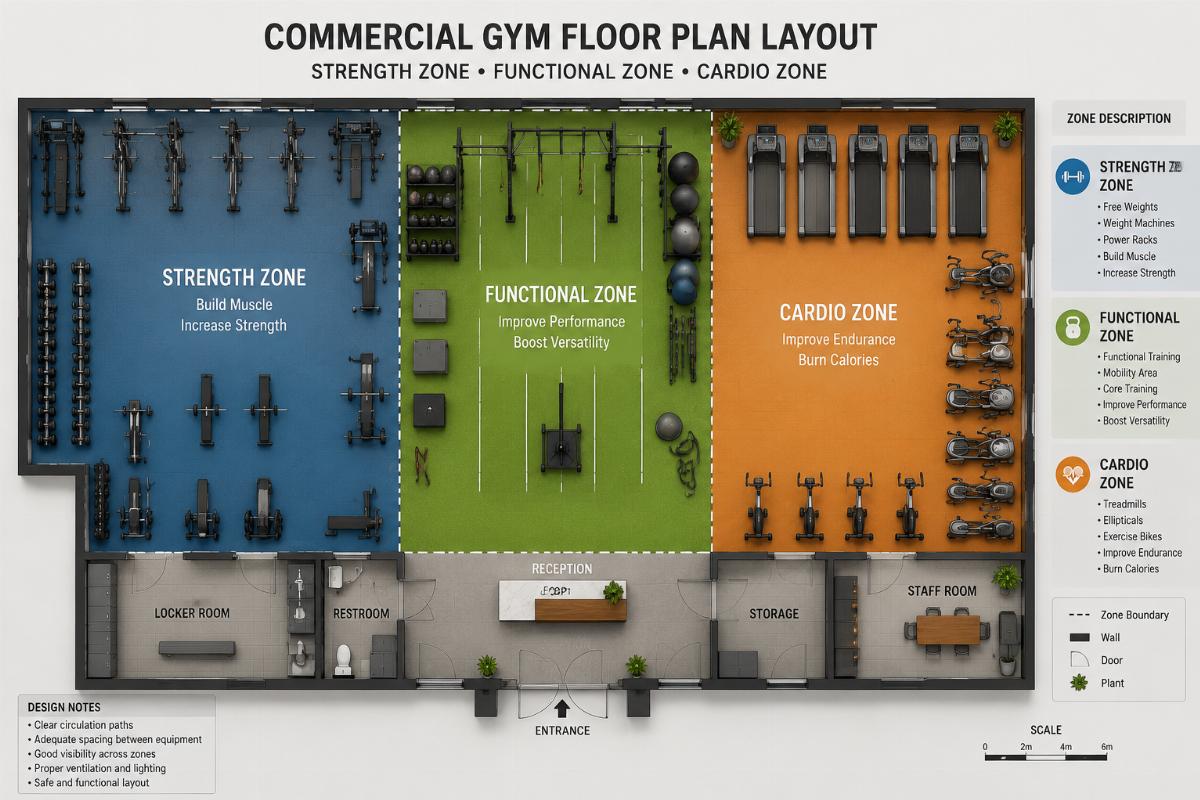
When I help buyers configure a full gym package, the conversation always starts with floor space, target membership profile, and budget ceiling. Jordan’s fitness market skews toward serious lifters and younger demographics who prioritize free-weight and functional areas over flashy cardio theaters. A typical commercial gym package for an Amman fitness center might include:
- Strength zone: Smith machines, power racks, cable crossovers, and a full range of plate-loaded machines covering chest, back, legs, and arms. These see the heaviest daily use and must feature thick-gauge steel frames and high-weight-capacity guide rods.
- Functional zone: Functional trainers with adjustable pulleys, battle ropes, plyometric boxes, medicine balls, and kettlebell sets. These items have lower individual cost but high member engagement.
- Cardio zone: Commercial treadmills, ellipticals, and spin bikes. Jordan’s heat and dust environment means treadmill motors need robust cooling and sealed bearings. Specifying 220V/50Hz is non-negotiable.
- Free weights: Dumbbell sets, Olympic barbells, bumper plates, and adjustable benches. Rubber-coated plates resist chipping better than virgin vinyl in high-traffic floors.
| Zone | Equipment Type | Priority Spec for Jordan |
|---|---|---|
| Strength | Plate-loaded, cable machines | Heavy-gauge steel frame, high weight stack capacity |
| Functional | Functional trainers, free-weight accessories | Modular design, easy replacement parts |
| Cardio | Treadmills, ellipticals, spin bikes | 220V/50Hz motor, sealed bearings, dust-resistant electronics |
| Free Weights | Dumbbells, barbells, plates | Rubber coating durability, knurling quality |
A hotel developer in the Dead Sea region recently needed a compact yet durable fitness center package for a mid-scale property. The gym equipment supplier for Jordan worked with them to consolidate cardio, strength, and free weights into a single mixed container, optimizing space utilization while meeting the hotel’s budget ceiling. The factory handled container-load planning to ensure every cubic meter was used efficiently — a service that matters when shipping costs per unit are significant.
What After-Sales Support Should a Reliable Gym Equipment Supplier for Jordan Provide?
Warranty terms, spare parts availability, and remote technical guidance determine whether your equipment runs for years or becomes a maintenance nightmare within months.
The distance between a Chinese factory and Jordan means on-site technician visits are impractical for routine issues. A competent gym equipment supplier for Jordan must therefore offer:
- Spare parts supply: Wear items like treadmill belts, deck boards, cable pulleys, and seat upholstery should be available for individual order, not only bundled with new machine purchases. Confirm lead times for parts shipment to Aqaba.
- Remote technical support: Video-call guided troubleshooting for electronics boards, motor controllers, and assembly adjustments. The supplier’s engineering team should be available during overlapping business hours.
- Warranty structure: Frame warranties of multiple years, wear-parts warranties of at least one year, and clear terms on what is covered versus excluded.
- Documentation: Arabic-language maintenance manuals, exploded-part diagrams, and wiring schematics packed with each shipment — not available only upon request after a breakdown.
A gym chain operator in the Levant once faced a situation where treadmill display boards failed across multiple units within months of installation. The original supplier could not provide replacement boards quickly, and the wiring schematics were unavailable in a format the local technician could follow. The downtime cost the chain significant membership revenue. By contrast, working with a gym equipment supplier for Jordan that stocks common spare parts and provides multilingual technical documentation prevents these cascading failures.

Conclusion
Choosing a gym equipment supplier for Jordan requires looking past the unit price and verifying certification acceptance, port documentation, and after-sales infrastructure before any money changes hands. Factory-direct sourcing from China offers substantial cost advantages, but those savings evaporate instantly if your container sits at Aqaba due to a mismatched notified body number or missing Arabic labels. Confirm every detail — from voltage specs to spare parts availability — before the container is stuffed, and your equipment will serve Jordan’s growing fitness market reliably for years.


