Commercial Seated Leg Curl Machine for Sale | Bick OEM Manufacturer
Most strength machines shipped to Kazakhstan enjoy a lower duty rate than buyers expect, but misclassification and missing certifications routinely erase that advantage.
Seated leg curls classified under HS 9506.99 typically face an EAEU Common Customs Tariff duty in the low single-digit range, with Kazakhstan VAT applied on top of the combined CIF value plus duty — not on the invoice price alone.
I still remember a container of seated leg curls that sat at the Dostyk border crossing for well over a week because the broker declared them under a generic metal furniture heading instead of the proper gym equipment code. The duty differential alone was noticeable, but the storage fees and re-classification penalty cost the importer several times what a correct declaration would have required. That shipment was headed to a commercial gym outfit in Almaty, and the delay pushed their grand opening back by a full month. Since then, I have watched the same pattern repeat across Central Asia: buyers focus on unit price and overlook the customs mechanics that actually determine landed cost. [NEED_CITE: EAEU Common Customs Tariff classification methodology for strength training equipment]
Getting the import duty rate right is not about guessing — it is about understanding how the EAEU tariff schedule treats fitness equipment, how Kazakhstan layers VAT on top, and which documents prevent your cargo from becoming a border warehouse resident. Let me walk you through the exact framework I use when a distributor or gym owner asks me what a seated leg curl will actually cost once it clears customs.
What Is the Import Duty Rate for Seated Leg Curls into Kazakhstan?
The import duty rate for seated leg curls into Kazakhstan generally falls within the low end of the EAEU Common Customs Tariff range for sports and gym equipment, with an additional standard VAT applied at the national level.
Kazakhstan, as a member of the Eurasian Economic Union, applies the EAEU Common Customs Tariff rather than setting its own independent duty schedule. Strength training machines — including seated leg curls, leg extensions, chest presses, and cable crossover stations — are classified under heading 9506, specifically subheadings related to gymnasium and athletic articles. [NEED_CITE: EAEU Common Customs Tariff rates for HS 9506 subheadings covering gymnasium equipment]
Here is what catches most first-time importers off guard: the duty percentage is only part of the equation. Kazakhstan VAT is calculated on the cumulative value — the CIF price plus the duty amount — not on the commercial invoice alone. This means even a modest duty rate compounds into a meaningful addition to your total landed cost. A distributor I worked with in the Almaty region initially budgeted based on invoice value times the VAT percentage, only to discover the actual VAT liability was noticeably higher once freight, insurance, and duty were rolled in.
There is also a persistent myth that fitness equipment always carries a heavy duty burden. In practice, many strength machines under the 9506.99 subheading benefit from relatively moderate MFN rates within the EAEU framework. The real cost driver is rarely the duty percentage itself — it is the valuation method and the certification requirements that follow.
How Do You Determine the Correct HS Code for Strength Machines?
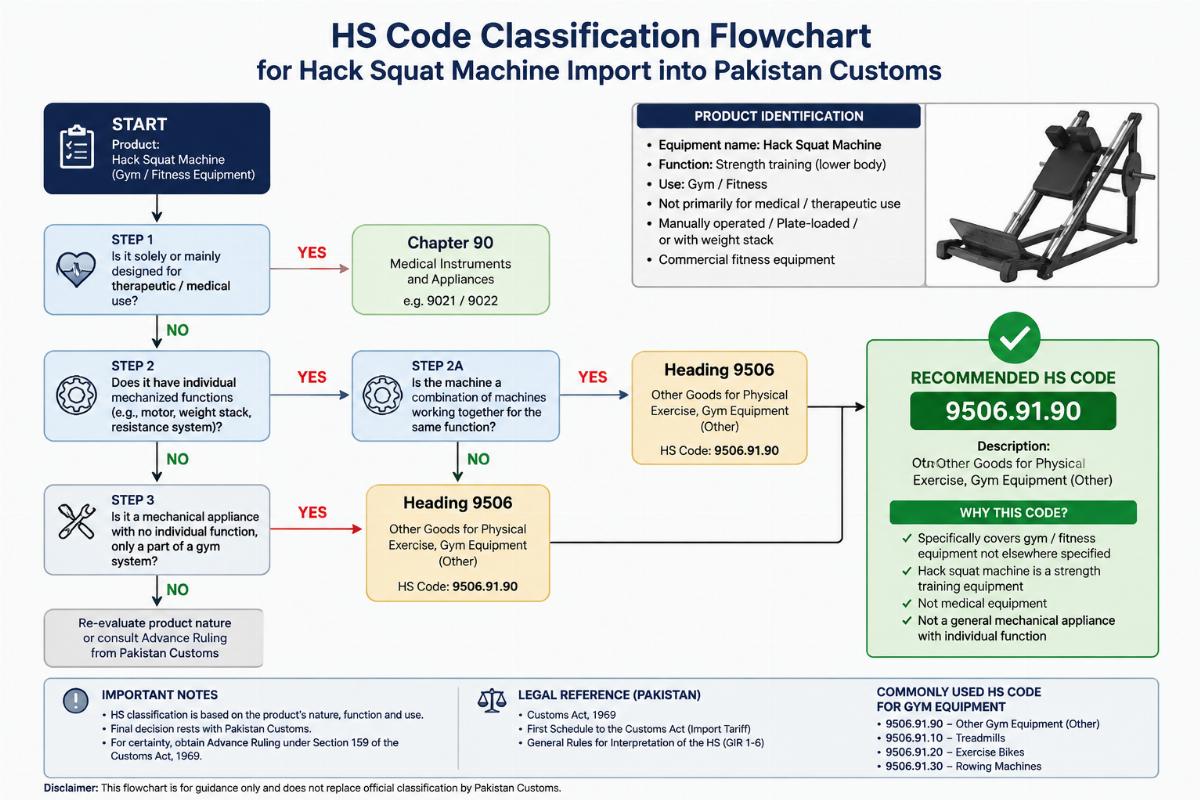
Accurate HS code classification under heading 9506 is the single most important step in controlling your import duty rate for seated leg curls and other strength machines entering Kazakhstan.
The process starts with the World Customs Organization nomenclature and flows through the EAEU’s own tariff database. Strength training machines that are mechanically operated — meaning no electric motor drives the movement — typically fall under 9506.91 or 9506.99, depending on the specific article description. [NEED_CITE: WCO HS nomenclature guidelines for classification of gymnasium and strength training equipment under heading 9506]
I once reviewed a customs declaration where a plate-loaded leg curl had been declared under a heading for general-purpose metal furniture. The broker argued it was "a metal structure with padding." The customs authority at the Altynkol crossing disagreed, reclassified the goods, and applied a higher duty rate. The importer faced both the duty differential and a re-classification penalty, plus a clearance delay that stretched into double-digit days.
The methodology I follow is straightforward:
- Identify the machine’s primary function — in this case, seated leg curl for quadriceps and hamstring training.
- Confirm whether the machine is manually loaded (plate-loaded) or selectorized (pin-loaded with a weight stack).
- Cross-reference the EAEU tariff database under heading 9506 to locate the precise subheading.
- Verify whether any EAEU-specific explanatory notes or classification decisions apply to that subheading.
- Document the classification rationale in your customs declaration file for audit readiness.
This is not optional paperwork. Post-clearance audits by the Kazakhstan State Revenue Committee do happen, and a defensible classification file is your protection against retroactive duty adjustments. [NEED_CITE: Kazakhstan State Revenue Committee post-clearance audit procedures for customs valuation disputes]
What Certifications Are Required Beyond CE for Kazakhstan Customs?
CE marking alone is not accepted for customs clearance in Kazakhstan — EAC (Eurasian Conformity) certification is the legally required standard for fitness equipment entering the EAEU market.
This is perhaps the most costly misconception among overseas gym equipment suppliers. I have seen entire containers of commercial-grade machines — including seated leg curls, Smith machines, and functional trainers — held at the Kazakhstan border because the importer assumed a CE certificate from a European notified body would satisfy Kazakh customs. It does not. The EAEU operates its own technical regulation framework, and customs officers at crossings like Dostyk and Altynkol will reject CE documentation as insufficient.
The relevant technical regulations depend on the equipment type:
- For electrically powered machines — such as motorized treadmills, ellipticals, and spin bikes — compliance with TR CU 004/2011 (low voltage safety) and TR CU 020/2011 (electromagnetic compatibility) is required, and the EAC mark must be affixed.
- For non-electric strength machines — including plate-loaded leg curls, cable crossovers, and free weight stations — a declaration of conformity under the applicable EAEU technical regulation is typically required, though the specific regulation depends on the product category and intended use. [NEED_CITE: EAEU technical regulation requirements for non-electric gymnasium strength training equipment]
The practical impact of missing EAC certification is severe. A gym owner in Nur-Sultan once told me his seated leg curl shipment was detained for over a week at the border. The machine was physically perfect, the invoice was clean, but without the EAC certificate, customs would not release it. The accumulated storage fees alone ran into a sum that made the original certification cost look trivial by comparison.
When I prepare shipments for Central Asian clients, I ensure the EAC documentation is finalized before the container leaves the Shandong port. This is not something you can sort out after the cargo arrives. The certification process involves testing, technical file review, and registration with an EAEU-accredited body — all of which take time.
How Is Customs Value Calculated (CIF, VAT, and Hidden Costs)?
Customs duty and Kazakhstan VAT are both calculated on the full CIF value — including freight and insurance — not merely on the commercial invoice price of the machines.
This is where many importers miscalculate their total landed cost and end up facing unpleasant surprises at the point of clearance. The transaction value method used by Kazakhstan customs means the dutiable base is the cost of the goods plus insurance plus freight to the point of entry — typically the Dostyk/Altynkol border crossing for rail shipments from China, or the designated customs post for road freight. [NEED_CITE: Kazakhstan customs valuation methodology based on transaction value under EAEU rules]
I have reviewed declarations where the importer listed freight as a nominal figure well below the actual shipping cost, apparently hoping to reduce the duty base. Post-clearance audits catch this routinely. When customs recalculates the duty and VAT on the corrected CIF value, the adjustment — plus any applicable penalties — can add a significant percentage to the original declared amount.
Beyond the base duty and VAT, consider these cost components that often go unbudgeted:
- Customs broker fees at the border post
- Warehouse storage charges if clearance is delayed
- Certification verification fees if the EAC document requires validation
- Potential re-classification penalties if the HS code is disputed
- Currency conversion margins if the declaration currency differs from the invoice currency
A distributor in Central Asia once shared that his first import of commercial gym equipment — a full container including seated leg curls, power racks, and plate-loaded machines — came in noticeably over budget because he had calculated VAT on the FOB price alone. The freight component, once added to the CIF base, pushed the VAT liability substantially higher than expected. He now builds his landed cost model on the full CIF value from the start.
What Documents Prevent Clearance Delays at Kazakhstan Borders?
A complete, aligned document package — commercial invoice, packing list, certificate of origin, EAC certificate, and bill of lading — is the most reliable safeguard against multi-day clearance holds at Kazakhstan border crossings.
Every missing or mismatched document is a potential delay. I have seen shipments of seated leg curls and other strength machines held at Dostyk because the packing list weight did not match the bill of lading, or because the EAC certificate number on the declaration did not correspond to the actual certificate on file. Customs officers are thorough, and inconsistencies trigger physical inspections, which add days to the clearance timeline.
The document checklist I use for Kazakhstan-bound gym equipment shipments includes:
- Commercial invoice with full product description, HS code, unit price, and total CIF value
- Detailed packing list with net weight, gross weight, dimensions, and package count — all matching the invoice and bill of lading
- Certificate of origin, preferably in the format recognized under EAEU rules
- EAC certificate or declaration of conformity, with the certificate number accurately reflected in the customs declaration
- Bill of lading or rail waybill, consistent with the declared shipment details
- Any additional permits or licenses required for specific product categories
One case I recall involved a gym equipment distributor who had ordered a mixed container — cardio machines, a Smith machine, several seated leg curls, and a set of adjustable benches. The EAC certificates were in order, but the packing list had been prepared using an older template that listed incorrect package counts for two of the machines. The customs broker at the border flagged the discrepancy, and the container was pulled for a physical inspection. The delay stretched well over a week, and the storage fees accumulated to a sum that ate meaningfully into the order margin.
Since then, I have made it a standard practice to cross-check every document against every other document before the container is sealed. A few hours of verification at the origin port saves days of uncertainty at the destination border.
Conclusion
The import duty rate for seated leg curls into Kazakhstan is manageable when classification, certification, and valuation are handled correctly from the start.
Getting the HS code right under heading 9506, securing EAC certification before shipment, and calculating VAT on the full CIF value are the three controls that determine whether your landed cost stays within budget or spirals into unexpected expense. Documents must align perfectly — even minor inconsistencies between the packing list and the bill of lading can trigger border delays that cost far more than the machines themselves.