
Commercial Treadmill Price in Australia: 2026 Wholesale Buyer Guide
The FOB price on your invoice is never the real commercial treadmill price Australia lands at.
Commercial treadmill price Australia in 2026 is determined by FOB factory cost plus ocean freight, Australian customs duty, GST calculated on the CIF value, clearance fees, and inland haulage — not by the supplier’s quoted unit price alone. Buyers must match specification tiers to usage intensity, and control total landed cost through compliant HS classification and full-container consolidation rather than scattered LCL shipments.
I spent years handling shipping documents at Yantian Port in Shenzhen — bills of lading, customs declarations, container loading plans — before moving into sales. One line typed wrong on an HS code kept a client’s cargo stuck in Melbourne for weeks. After switching to the Australian fitness equipment market, the most painful lesson came early: I quoted a commercial treadmill FOB price, and the buyer’s GST was calculated on the CIF value, not the FOB value. The extra tax hit ran into the mid-four-figure AUD range per container. Emails flew back and forth for rounds before we sorted out the difference between CIF and FOB as tax bases. Since then, I never finalize a quote without first mapping Australian duty brackets, GST treatment, and certification requirements, then working backward to factory cost. I have supplied full-gym fitouts for连锁 chains in Sydney and Melbourne, and the mistakes I have watched buyers make cost far more than the equipment itself.

Let me walk through what actually drives the commercial treadmill price Australia buyers pay, and where the hidden costs hide.
What Costs Actually Make Up the Commercial Treadmill Price Australia Buyers Pay?
The terminal commercial treadmill price Australia is never the factory price — it is the sum of FOB cost, ocean freight, customs duty, GST on CIF, clearance charges, and domestic delivery.
Most first-time importers fixate on the FOB number the supplier quotes. That number is only the starting block. The Australian Border Force levies customs duty on the CIF value — cost, insurance, and freight combined — and the Australian Taxation Office then applies GST on that same CIF-plus-duty base [NEED_CITE: Australian customs duty and GST calculation base per ABF and ATO guidelines]. This is the single biggest misunderstanding I see: buyers compare FOB quotes from two factories and assume the cheaper one saves money, when in reality the ocean freight differential and the GST base can flip the ranking entirely.
A Sydney-based gym chain once ordered a full fitout through scattered LCL shipments to "test" different suppliers. The per-unit freight on those partial containers ran substantially higher than a consolidated full container load would have, and the repeated customs entries multiplied clearance fees. When we recalculated the true commercial treadmill price Australia on a per-unit landed basis, the LCL route cost noticeably more per treadmill than a single FCL shipment — even though the FOB price per unit looked cheaper on paper.
The cost stack breaks down as follows:
| Cost Component | Basis | Typical Treatment |
|---|---|---|
| FOB Factory Price | Per unit, negotiated | Base cost |
| Ocean Freight | FCL or LCL, origin to destination port | Varies by volume |
| Insurance | CIF component | Minor percentage |
| Customs Duty | Applied on CIF value | Standard rate per HS code [NEED_CITE: Australian tariff schedule for fitness equipment HS classification] |
| GST | Applied on CIF plus duty | Fixed statutory rate |
| Customs Clearance | Per entry, per shipment | Fixed fee plus brokerage |
| Inland Haulage | Port to warehouse | Distance-dependent |
The takeaway is simple: any supplier quoting you the commercial treadmill price Australia without addressing CIF, duty, and GST is giving you an incomplete number.

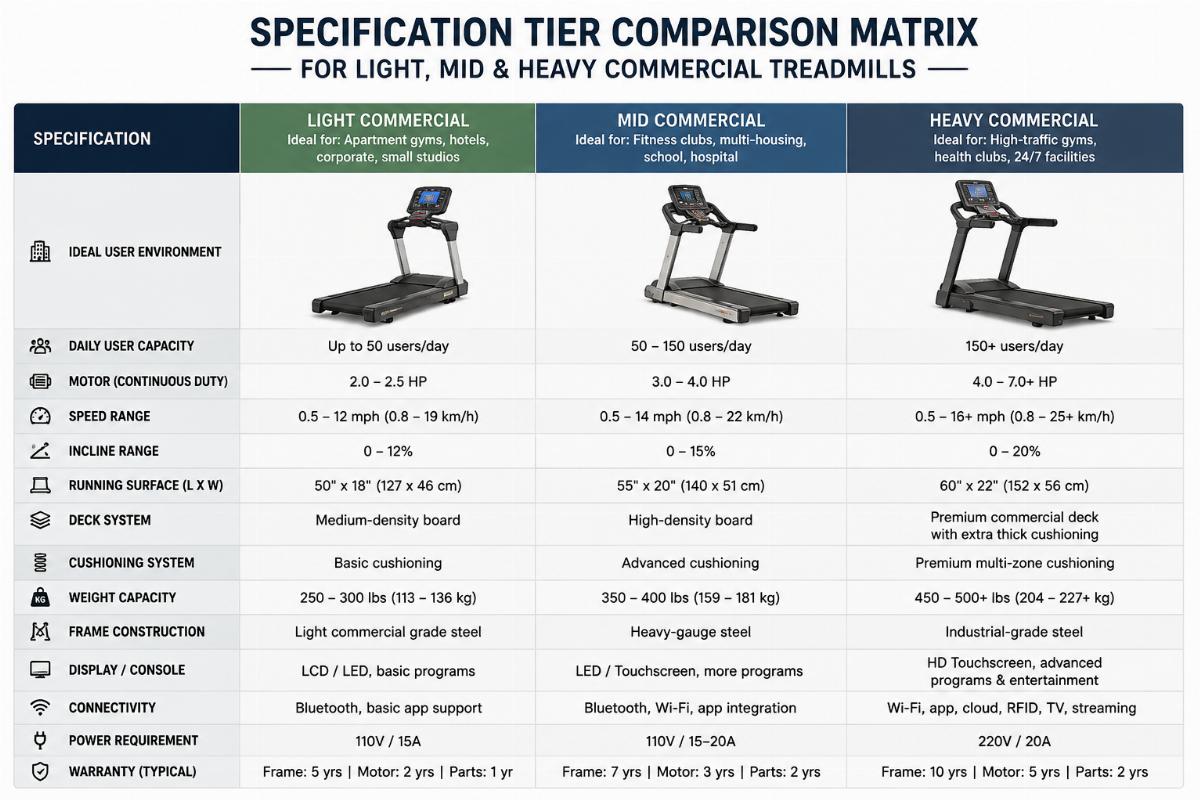
Which Specification Tier Matches Your Usage Scenario?
Light commercial, mid commercial, and heavy commercial treadmills serve fundamentally different intensity levels — and the commercial treadmill price Australia scales with motor type, deck construction, and frame rating, not with marketing labels.
The mistake I see most often is buyers selecting a treadmill based on peak horsepower. Peak HP is a marketing number — it tells you what the motor can hit for a few seconds. What matters in a real gym environment is continuous horsepower, the rating the motor can sustain hour after hour without thermal degradation [NEED_CITE: continuous horsepower versus peak horsepower standards per fitness equipment industry specifications]. A hotel lobby treadmill running six hours a day has completely different CHP requirements than a 24-hour commercial gym floor running sixteen.
I watched a Melbourne hotel project specify a light commercial treadmill for their fitness room — the wrong tier for their actual foot traffic. Within months, the drive motor began overheating during peak check-in hours. Replacement parts had to be shipped from overseas, and the downtime stretched across multiple weeks. The commercial treadmill price Australia they originally saved by going lighter was wiped out many times over by the replacement cost and guest complaints.
Here is how the three tiers compare on key parameters:
| Parameter | Light Commercial (Hotel) | Mid Commercial (Studio) | Heavy Commercial (Gym Chain) |
|---|---|---|---|
| Continuous Horsepower | Entry-level CHP range | Mid CHP range | High CHP range |
| Running Deck Thickness | Standard | Reinforced | Heavy-duty multi-layer |
| Frame Weight Capacity | Moderate | Substantial | Maximum |
| Intended Daily Use Hours | Low to moderate | Moderate to high | Extended continuous |
| Commercial Treadmill Price Australia Tier | Lowest | Mid | Highest |
Our factory in Shandong produces the full range across all three tiers — light commercial through heavy commercial — with CE certification across the line and OEM branding available. The MOQ structure is flexible enough for a single unit trial or a full gym package, which matters when you are testing a new market before committing to a container load.
Full Container Load versus Less than Container Load — Which Lowers the Commercial Treadmill Price Australia?
For orders above a small handful of units, FCL consolidation drops the per-unit commercial treadmill price Australia noticeably compared to LCL, and reduces cargo damage risk at the same time.
Treadmills are bulky, heavy, and boxed in rigid packaging that does not stack well with unrelated goods. LCL shipments mean your treadmill shares a container with who-knows-what — steel pipes, chemical drums, furniture — and gets handled multiple times during consolidation and deconsolidation at both ends. Each handling is a damage opportunity.
A Brisbane distributor placed an initial trial order of a small number of units via LCL. The per-unit freight was steep, and two units arrived with cosmetic damage to the console housing — damage that only became visible after customs inspection required the boxes to be opened. The replacement shipping and the delayed delivery to their end customer ate into the margin on the entire batch.
The break-even logic is straightforward: once your order volume crosses a certain threshold, the fixed costs of a full container — the base ocean freight rate, the single customs entry, the single inland haul — spread across more units. The per-unit commercial treadmill price Australia drops. Meanwhile, FCL means your goods stay in one sealed container from the manufacturer’s production facilities to your warehouse, with no intermediate handling.
| Factor | FCL Consolidation | LCL Shipment |
|---|---|---|
| Per-Unit Freight | Noticeably lower at volume | Substantially higher |
| Customs Entries | Single entry | Multiple possible |
| Cargo Handling Risk | Minimal, sealed container | Multiple touchpoints |
| Damage Probability | Low | Noticeably elevated |
| Best Suited For | Full gym fitouts, distributor restocks | Small trial orders, single units |
We handle container-load consolidation directly from our Shandong facilities, loading cardio, strength, and free-weight equipment into a single container for gym fitout projects. That capability matters when the commercial treadmill price Australia needs to sit inside a total project budget, not just a line-item quote.

How Do You Avoid Customs Traps That Inflate the Commercial Treadmill Price Australia?
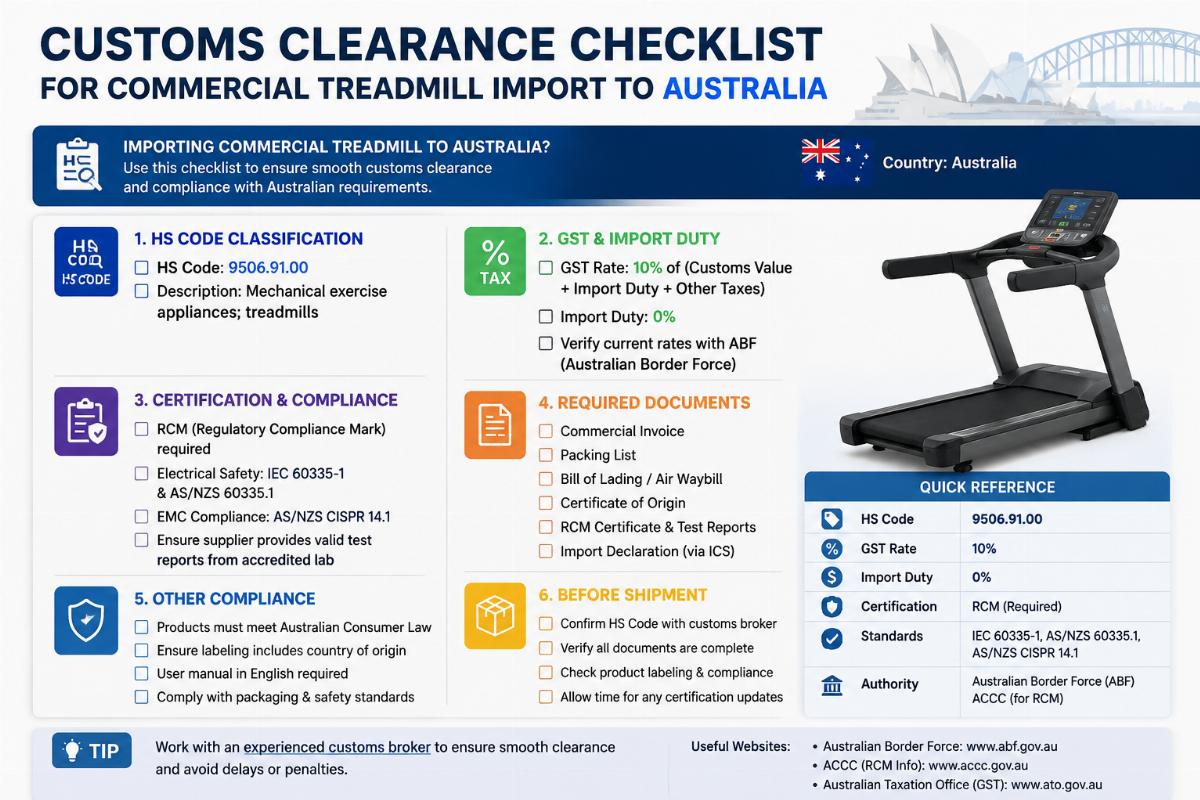
HS code classification accuracy, correct GST tax base calculation, and certification compliance are the three control points that prevent unexpected cost additions to the commercial treadmill price Australia.
The HS code determines your duty rate. Get it wrong, and you either overpay duty voluntarily or — worse — get flagged during a post-clearance audit and hit with back duties plus penalties. Fitness equipment HS classifications have specific subheadings, and the distinction between "general physical exercise" equipment and other categories can shift the rate [NEED_CITE: Australian tariff classification rules for gym and fitness equipment].
I once worked with a Brisbane distributor whose first trial shipment was cleared under an HS code that did not match the product description on the commercial invoice. The GST base was calculated incorrectly as a result, and the effective tax burden ran noticeably higher than it should have. It took correspondence with the broker and a voluntary disclosure to correct the record. The lesson was expensive.
Three control points to lock down before your first shipment:
- HS Code Verification: Confirm the exact 10-digit Australian tariff item with your customs broker before the goods leave the origin port. Match it against the product specification sheet, not just the general description.
- CIF Value Accuracy: Ensure the commercial invoice reflects the true CIF value — FOB plus actual freight plus actual insurance. Under-declaring to "save" duty is a compliance violation that triggers audits.
- Certification Readiness: Australia requires specific electrical safety compliance for powered fitness equipment [NEED_CITE: Australian electrical safety certification requirements for commercial gym equipment]. Having CE documentation from the manufacturer is a strong foundation, but Australian-specific compliance must be confirmed separately.
Our treadmills ship with CE certification as standard, and we support OEM documentation packages that help importers prepare accurate customs filings. The goal is to make the commercial treadmill price Australia you budgeted match the commercial treadmill price Australia you actually clear — no surprises at the port.
Conclusion
The real commercial treadmill price Australia is a landed cost equation, not a factory quote — and controlling it requires matching specification tiers to actual usage intensity, consolidating shipments into full containers wherever volume allows, and locking down HS classification and GST treatment before the cargo sails.
Buyers who optimize only the FOB number leave money on the table at every subsequent step. Buyers who plan the full stack — spec tier, shipping mode, customs compliance — land equipment on time, on budget, and without the phone calls that nobody wants at six in the morning.


