Functional Trainer for Spain Export | Bick OEM Manufacturer
Most buyers think a CE mark on the machine is enough for Spanish customs. It is not.
To clear a functional trainer through Barcelona or Valencia ports without delays, you need two distinct documents: a valid Certificate of Origin for Spain in the correct format (usually EUR.1 for tariff preference) and a complete Technical Construction File (TCF) that proves compliance with EU Machinery Directive 2006/42/EC. The physical CE sticker is merely a declaration; the TCF is the proof. Without the TCF, customs officers can detain the cargo regardless of the Certificate of Origin for Spain status.
Getting these documents right requires more than just filling out forms. It demands an understanding of how Spanish customs officers verify mechanical safety and origin claims simultaneously. I have seen shipments held for weeks because the description on the Certificate of Origin for Spain did not perfectly match the commercial invoice, or because the EN ISO test reports were missing from the digital file sent to the broker. This guide breaks down the exact requirements to ensure your functional trainer export documents are bulletproof.
Which Certificate of Origin Format Does Spain Require?
The format depends entirely on whether you claim preferential tariff treatment under the EU-China trade framework.
Many exporters default to Form A, but this is often the wrong choice for Spain. Form A is used for Generalized System of Preferences (GSP) countries. China has graduated from many GSP schemes, meaning Form A may no longer grant duty reductions. For Spain, as an EU member state, the critical document is often the EUR.1 movement certificate if specific bilateral or regional agreements apply, or a standard non-preferential Certificate of Origin for Spain issued by the Chamber of Commerce if no preference is claimed.
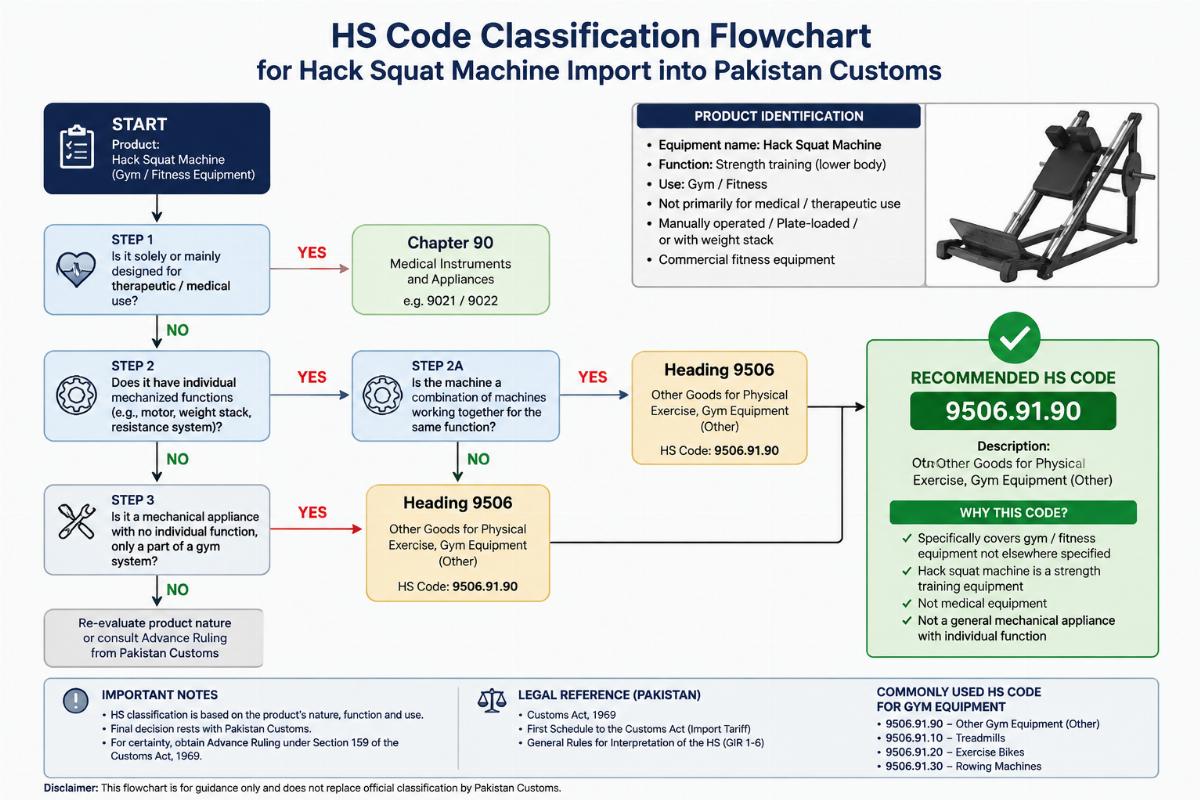
The confusion usually stems from a lack of clarity on the Harmonized System (HS) code classification. Functional trainers typically fall under HS 9506.91 or 9506.99 depending on their specific mechanical features. [NEED_CITE: HS code classification guidelines for strength training equipment] If you use the wrong CO format, your buyer in Madrid or Barcelona cannot claim the reduced duty rate, which can range significantly. This financial loss often leads to disputes and delayed payments.
Consider a recent case involving a distributor in Valencia. They ordered a container of mixed gym equipment. The supplier issued a Form A certificate, assuming it was the standard global document. However, Spanish customs required a non-preferential Certificate of Origin for Spain because the specific product category did not qualify for GSP treatment at that time. The mismatch forced the broker to apply for a retroactive correction, delaying clearance by several days. The distributor had to pay storage fees at the port, eating into their margin.
To avoid this, always confirm with your freight forwarder or the buyer’s customs broker which format is currently accepted for your specific HS code. Do not assume. The Certificate of Origin for Spain must be issued by a recognized authority, such as the China Council for the Promotion of International Trade (CCPIT), and must bear the original stamp and signature. Digital copies are often accepted for pre-clearance, but the original hard copy must follow the cargo or be couriered ahead of arrival.
Why Is CE Documentation More Critical Than the CO Itself?
Customs officers care more about the Technical Construction File than the paper certificate of origin.
While the Certificate of Origin for Spain proves where the goods were made, the CE documentation proves they are safe to use. Under the EU Machinery Directive 2006/42/EC, manufacturers must compile a Technical Construction File (TCF). This file includes design drawings, risk assessments, and most importantly, test reports from accredited laboratories proving compliance with relevant EN standards. For functional trainers, the key standard is EN ISO 20957, which covers stationary training equipment. [NEED_CITE: EN ISO 20957 standard requirements for strength equipment]
A common misconception is that affixing the CE logo to the machine is sufficient. It is not. The CE mark is a self-declaration by the manufacturer that the product meets all applicable EU directives. If customs suspects non-compliance, they will request the TCF. If you cannot provide it immediately, the goods are detained.
I recall a shipment bound for Barcelona that was held for inspection. The Certificate of Origin for Spain was perfect. The packing list was accurate. But when customs asked for the EN ISO 20957 test report for the cable crossover unit, the exporter only had a generic "CE Certificate" from a third-party agency that did not include the actual test data. This is a red flag. Spanish authorities require the specific test reports that validate the structural integrity of the frame and the safety of the pulley systems. Without these detailed reports, the CE declaration is considered invalid.
The risk here is not just delay. If the TCF is missing or inadequate, customs may order the destruction of the goods or require them to be re-exported at the seller’s expense. This is a catastrophic loss. Therefore, before shipping, ensure your functional trainer export documents include the full TCF, signed by the responsible person within the manufacturing company. This file should be ready to email to your broker the moment the vessel departs.
How to Avoid Common Description Errors in Shipping Documents?
Inconsistency between the Bill of Lading, Invoice, and Certificate of Origin for Spain is the fastest way to trigger a manual inspection.
Spanish customs brokers are meticulous. They cross-check every word. If your Commercial Invoice says "Commercial Functional Trainer Model X," but the Certificate of Origin for Spain says "Gym Equipment," you have a problem. Even minor discrepancies, such as abbreviations or model number variations, can cause flags in the automated clearance system.
The description on the Certificate of Origin for Spain must mirror the Commercial Invoice exactly. It should also align with the Bill of Lading, although the BL often uses broader terms for space reasons. The safest approach is to use the full, precise product name on the CO and Invoice, and ensure the BL references the same HS code and general description.
A hotel project in Marbella faced this issue. They imported a mixed container of treadmills, racks, and functional trainers. The supplier listed "Fitness Machines" on the Certificate of Origin for Spain to save space. However, the Invoice listed each item separately with specific model numbers. Customs could not reconcile the generic CO description with the detailed Invoice. They paused the clearance to verify if the goods matched the origin claim. This delay meant the hotel could not open its fitness center on schedule, leading to penalty clauses being triggered against the supplier.
To prevent this, draft your Certificate of Origin for Spain with the same level of detail as your Invoice. If you have multiple items, list them clearly or use a reference number that links back to the Invoice. Do not use vague terms like "parts" or "accessories" unless they are genuinely spare parts shipped separately. For a complete functional trainer, describe it as such. Consistency is key. Your freight forwarder can help review these documents before issuance, but the ultimate responsibility lies with the exporter to ensure accuracy.
What Are the Risks of Incorrect HS Code Classification?
Wrong HS codes lead to incorrect duty payments and higher inspection probabilities.
Classifying functional trainers correctly is crucial for the Certificate of Origin for Spain and duty calculation. As mentioned, these machines often fall under HS 9506. However, the specific subheading matters. Some components might be classified differently if shipped separately. For instance, weight plates might fall under a different code than the frame itself. If you ship a complete functional trainer, it should generally be classified as a single unit. [NEED_CITE: EU customs classification rules for composite gym equipment]
Using an incorrect HS code can have two negative outcomes. First, you might pay the wrong duty rate. If you underpay, you face fines and back taxes later. If you overpay, you lose margin. Second, certain HS codes are flagged for higher inspection rates due to safety concerns or anti-dumping measures. While fitness equipment is not typically subject to anti-dumping duties like some steel products, misclassification can still draw unwanted attention.
For example, if a functional trainer is incorrectly classified as a general metal structure rather than sports equipment, it might attract a different VAT treatment or regulatory check. In one case, a buyer in Seville received a shipment where the supplier used a generic HS code for "metal furniture." Spanish customs reclassified it as sports equipment, which required additional CE documentation that the supplier had not prepared because they thought it was furniture. The resulting delay cost the buyer significant storage fees.
Always verify the HS code with your buyer’s broker before issuing the Certificate of Origin for Spain. They know the local interpretation best. Do not rely solely on online lookup tools, as they may not reflect current Spanish customs practices. Accurate classification ensures smooth clearance and correct duty application, protecting both you and your customer from unexpected costs.
Conclusion
Exporting to Spain requires precision in both origin and safety documentation.
A successful shipment hinges on the seamless integration of the Certificate of Origin for Spain and the CE Technical Construction File. Do not treat these as mere formalities. They are critical legal documents that determine whether your goods clear customs quickly or sit in a bonded warehouse accruing fees. Ensure your HS codes are accurate, your descriptions are consistent across all papers, and your CE test reports are complete and accessible. By mastering these details, you protect your reputation and your buyer’s timeline, turning a complex regulatory process into a routine transaction.