
Hotel Gym Equipment Complete Setup: China Factory Direct OEM Supplier
Hotel gyms are not mini commercial gyms. The single biggest mistake developers make is copying a fitness chain layout into a 150-square-meter hotel space and wondering why guests never use it.
A complete hotel gym equipment setup requires matching cardio, strength, and free-weight zones to room count and guest dwell time, not to square footage alone. Sourcing hotel gym equipment from a China factory direct supplier cuts procurement cost substantially while maintaining commercial-grade durability, provided you verify steel gauge, welding standards, and spare-parts availability before placing the order.
I still remember the first hotel fitness center I spec’d end-to-end — a boutique property in the Gulf region with roughly 200 square meters of usable floor. The developer wanted everything: treadmills, ellipticals, a full Smith machine stack, cable crossovers, dumbbells up to heavy sets, and rubber flooring. We loaded the gear into mixed containers at the Shandong production base and shipped it out. When the shipment reached the port, the on-site installer discovered that the selectorized weight stacks carried metric-only labeling, while the local maintenance crew expected imperial-pound markings. That single oversight pushed the commissioning timeline back by weeks and nearly derailed the soft opening. [NEED_CITE: hotel gym equipment international labeling standards for weight stacks]
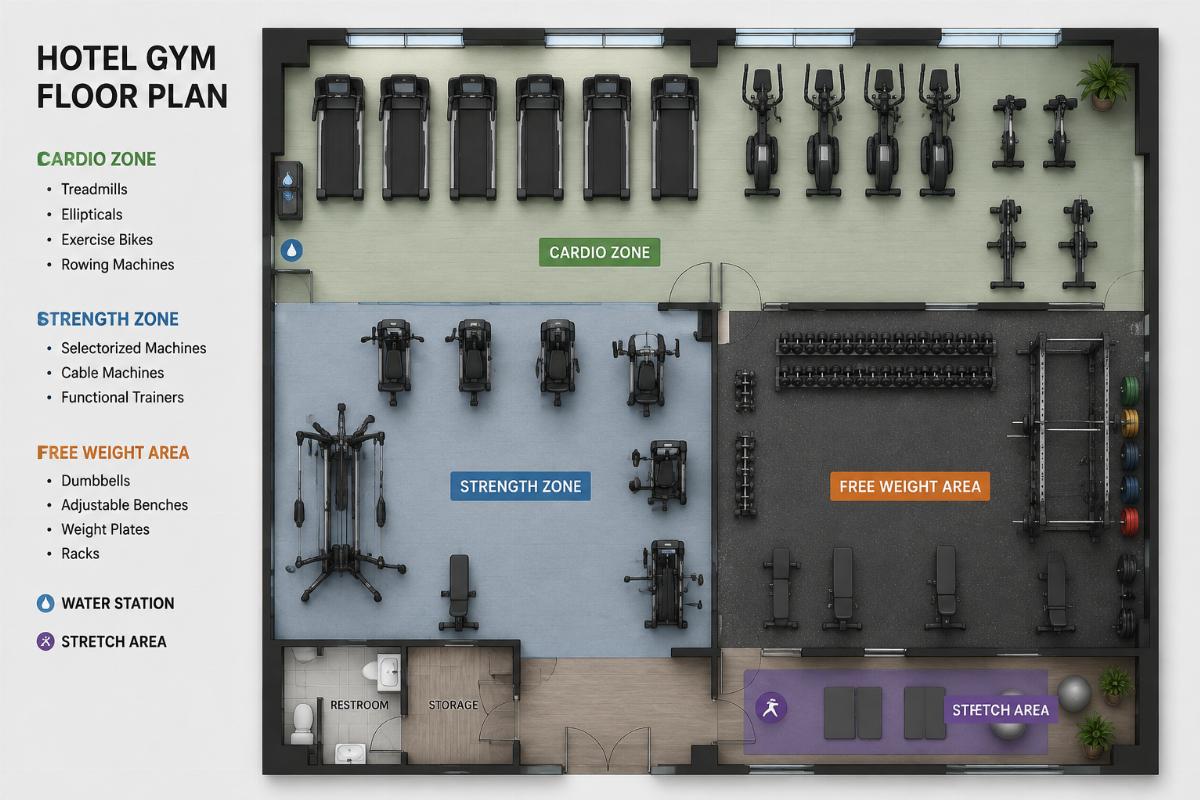
That project reshaped how I approach every hotel gym equipment complete setup today. Below is the framework I now follow — from space sizing and equipment ratios to factory-direct sourcing pitfalls and turnkey package structure.
What Equipment Does a Hotel Gym Actually Need?
The right equipment mix depends on room count, average guest stay length, and whether the hotel serves transit travelers or resort guests. A city transit hotel with 80 rooms and one-night stays needs a compact, high-turnover cardio-focused layout. A beachfront resort with 300 rooms and week-long stays demands a broader strength and free-weight selection because guests train multiple days in a row. [NEED_CITE: hotel guest fitness usage patterns by property type and stay duration]
Here is the configuration logic I apply across projects, scaled by room count:
| Property Scale | Cardio Units | Selectorized Strength | Free-Weight Zone | Functional Area |
|---|---|---|---|---|
| Boutique (under 100 rooms) | Compact treadmills, one elliptical, one spin bike | 2–3 plate-loaded or selectorized stations | Dumbbell set, one adjustable bench, kettlebells | Stretching mat, resistance bands |
| Mid-scale (100–200 rooms) | Treadmill cluster, ellipticals, rowing machine | Smith machine, cable crossover, leg press, lat pulldown | Full dumbbell rack, barbells, plates, benches | Functional trainer, plyo boxes, battle ropes |
| Full-service resort (200+ rooms) | Full cardio wall with varied modalities | Complete selectorized circuit covering all muscle groups | Commercial-grade free-weight station with heavy sets | Dedicated functional turf zone, stretching area |
The critical insight: hotel gym equipment does not need to match a 24-hour commercial gym in volume. Guests use hotel fitness centers at roughly a fraction of the daily traffic that a public gym sees, but they judge the hotel brand heavily on how the equipment looks and feels during that single workout. [NEED_CITE: commercial gym vs hotel gym usage frequency comparison data]
This means you can spec commercial-grade frames with mid-tier upholstery and consoles — the structural durability guests trust, without paying for the touchscreen entertainment modules that commercial chains require. A China factory direct supplier can build exactly this tier, because the production line already serves both markets and simply adjusts the console and trim package.

How to Size Your Hotel Gym Space Correctly?
Overfilling a hotel gym is more damaging than underfilling it. Cramped layouts create safety hazards, frustrate guests waiting for equipment, and increase wear on machines placed too close together. The industry reference for equipment footprint includes not just the machine’s physical dimensions but also the clearance zone around it for safe mounting, dismounting, and towel placement. [NEED_CITE: commercial fitness facility spatial planning standards for equipment clearance]
The sizing method I use breaks the total floor area into three layers:
- Equipment footprint layer — the actual floor space each machine occupies, measured at its widest and longest operational position.
- Circulation and safety clearance layer — minimum spacing between machines, typically wider behind treadmills and Smith machines where users step on and off.
- Functional zone layer — dedicated stretching area, free-weight zone with mirror wall, and entrance transition space.
For a typical mid-scale hotel gym, the cardio zone consumes roughly half the floor area because treadmills and ellipticals require deeper rear clearance. The strength zone takes the next largest share, and the free-weight and functional zone fills the remainder. [NEED_CITE: gym floor area allocation ratio by equipment category]
A common mistake I see in developer briefs is specifying a full selectorized circuit in a space that can only comfortably hold a Smith machine and two plate-loaded stations. The result is either a cramped layout that violates safety norms or a last-minute equipment cut that leaves the gym looking incomplete. The fix is to run the footprint calculation before selecting SKUs, not after.
When sourcing hotel gym equipment from a China factory direct supplier, request a CAD layout based on your actual room dimensions before confirming the order. Reputable manufacturers provide this as part of the turnkey package and will flag clearance conflicts early — saving you from discovering them when the containers arrive on site.

China Factory Direct vs Branded Suppliers: What Is the Real Difference?
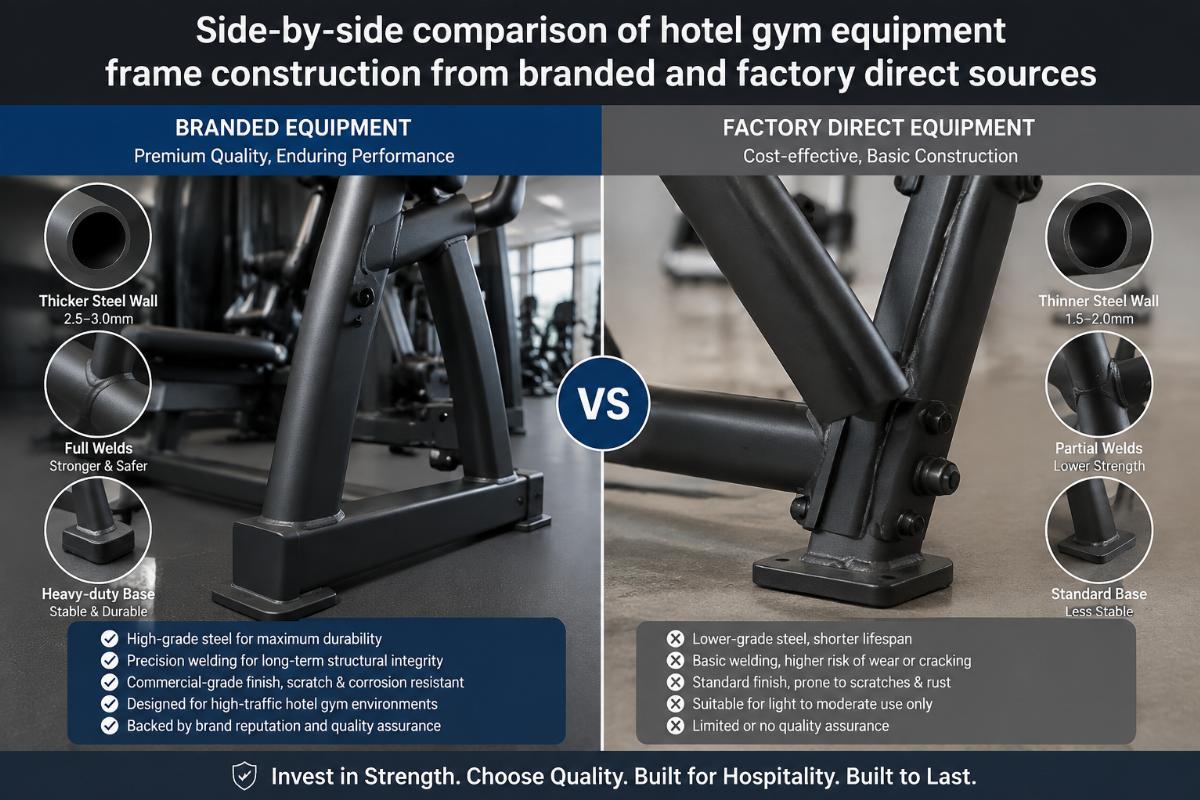
The price gap between a top-tier Western brand and a Shandong factory direct supplier is substantial, but the performance gap is far narrower than most buyers assume. The real difference lies in brand premium, distribution markup, and console technology — not in the steel frame or the bearing quality of the moving parts. [NEED_CITE: commercial fitness equipment cost structure breakdown brand premium vs manufacturing cost]
Here is the comparison matrix I walk every client through:
| Evaluation Factor | Top Western Brand | China Factory Direct Supplier |
|---|---|---|
| Frame steel gauge | Heavy-duty, verified | Heavy-duty, verifiable on request |
| Welding standard | Robotic, consistent | Robotic on main production lines |
| Bearing and pulley quality | Premium grade | Commercial grade, comparable |
| Console technology | Proprietary touchscreen ecosystem | Standard LCD or optional Android tablet mount |
| Warranty structure | Multi-year, region-specific | Multi-year with spare-parts supply |
| Spare-parts availability | Through regional distributors | Direct from factory, faster for custom parts |
| OEM branding | Not available | Full OEM and ODM supported |
| Price positioning | Premium tier | Substantially below premium tier |
The steel frame is where the misconception runs deepest. Buyers assume that a lower price means thinner steel or weaker welding. In reality, the main production facilities in Shandong use the same grade of carbon steel and the same robotic welding cells that supply branded OEM contracts. The difference is that the factory direct channel removes the brand markup and the regional distributor margin. [NEED_CITE: commercial fitness equipment frame steel grade and welding process standards]
What you do sacrifice is the proprietary console ecosystem and the global service network that a top brand maintains. For a hotel operator, this trade-off is usually acceptable — guests care that the treadmill runs smoothly and the Smith machine glides cleanly, not that the console carries a specific brand logo.
The key is to verify before ordering. Request mill certificates for the steel, ask for weld-segment photos from the production line, and confirm the spare-parts catalog covers every wearable component on your selected machines. A reliable hotel gym equipment supplier in Shandong will provide all of this transparently.
How to Avoid Costly Mistakes When Ordering from China?
Most procurement failures in hotel gym equipment are not quality failures — they are specification and logistics failures. The machine itself may be perfectly built, but the wrong labeling, the missing adapter, or the poorly planned container load can delay opening by weeks and inflate the real cost far beyond the invoice price.
Based on repeated project experience, here is the operational checklist I follow on every shipment:
- Pre-production specification lock — Confirm every detail in writing before production begins: weight stack labeling (metric, imperial, or dual), voltage and plug standard, console language, color scheme, and logo placement for OEM orders. [NEED_CITE: international hotel gym equipment specification checklist for cross-border orders]
- Pre-shipment assembly verification — Request that the factory pre-assembles at least one unit of each machine type, photographs the full setup, and sends the images for buyer approval before disassembly and packing. This catches alignment issues, cable routing errors, and finish defects that are invisible in component photos.
- Container load planning — Work with the factory’s loading team to maximize container utilization. A well-planned mixed container — cardio, strength, free weights, and flooring packed together — can reduce per-unit freight cost noticeably compared to shipping dedicated containers for each category. [NEED_CITE: container loading optimization methods for mixed fitness equipment shipments]
- Spare-parts kit inclusion — Pack a spare-parts box with every container: replacement cables, pulleys, seat pads, adjustment pins, and console fuses. The cost is marginal, but having these on site prevents a single broken cable from taking a machine out of service for weeks while waiting for an air-freighted replacement.
- On-site commissioning support — Confirm whether the supplier offers remote technical guidance or can dispatch an engineer for the initial setup. For first-time buyers, this support is invaluable.
A Southeast Asian resort project I worked on illustrates the container planning point. The developer ordered a full gym package — cardio, selectorized strength, free weights, and rubber flooring — and initially planned to ship each category in a separate container. By consolidating into mixed loads with a detailed packing plan, the project filled the same total volume in fewer containers, cutting freight cost substantially without delaying any single zone’s installation.

What Does a Turnkey Hotel Gym Package Include?
A true turnkey hotel gym equipment package covers everything from the initial space plan to the final rubber tile — not just a list of machines. The goal is to hand the developer a single procurement point that delivers a fully operational fitness center, ready for guest use.
The package structure I work with through the Shandong production base includes these layers:
- Space planning and equipment layout — CAD drawings based on the actual room dimensions, with equipment selection matched to the hotel’s room count and guest profile.
- Cardio equipment — Treadmills, ellipticals, exercise bikes, and rowing machines in commercial or light-commercial grade, with voltage and labeling customized to the destination market.
- Strength equipment — Smith machines, power racks, cable crossovers, plate-loaded machines, and selectorized stations covering all major muscle groups.
- Free-weight equipment — Dumbbells, barbells, weight plates, kettlebells, and adjustable benches in the quantities the layout requires.
- Functional training gear — Functional trainers, battle ropes, plyo boxes, and medicine balls for the growing segment of guests who prefer movement-based workouts.
- Gym flooring and accessories — Rubber tiles, mats, mirror installations, and storage racks that complete the space.
- OEM branding and customization — Logo placement, color matching, and console language settings aligned with the hotel’s brand identity.
- After-sales support — Spare-parts supply, remote technical guidance, and warranty coverage backed by the factory.
The advantage of sourcing the entire package from one hotel gym equipment supplier is consistency. Every piece arrives with matching finish quality, compatible warranty terms, and a single point of contact for any post-installation issue. For hotel groups rolling out fitness centers across multiple properties, this consistency extends to standardized guest experience and simplified procurement management. [NEED_CITE: turnkey gym equipment package components and procurement benefits for hotel operators]
A European hotel group I supported used this approach to equip several new properties simultaneously. The package included OEM-branded cardio and strength equipment, matched free-weight sets, and standardized flooring across all locations. Deliveries were staged to match each property’s construction timeline, and the spare-parts system ensured that any maintenance need could be resolved without waiting for cross-border shipments.

Conclusion
A hotel gym is a brand-touchpoint, not an afterthought, and its equipment must be planned as a system — not assembled piece by piece. The right hotel gym equipment complete setup balances guest expectations, space constraints, and procurement economics. Sourcing through a China factory direct channel delivers commercial-grade quality at a fraction of branded pricing, provided the buyer verifies specifications, plans container loads carefully, and partners with a supplier who offers genuine turnkey capability from layout to after-sales support.


