Monkey Bar Rig: Rep Fitness vs China Factory Direct Wholesale Supplier
A monkey bar rig that looks identical to Rep Fitness on the outside can fail within months under dynamic loading — not because of the steel, but because of bolt grade mismatches, weld fatigue, and missing load-test documentation.
Rep Fitness monkey bar rigs deliver polished finishes and third-party dynamic load certification, but China-manufactured monkey bar rig alternatives can match structural performance at noticeably lower cost — provided buyers independently verify weld standards, hardware specs, and dynamic load testing rather than relying on visual similarity alone.
I once stood inside a private training studio in Riyadh watching a buyer point at the weld seam on a cross-member and say, "Your Chinese rigs look just like Rep, but they start wobbling after half a year." That batch was ours. The welds were fine. The real problem was that the buyer had sourced his own bolts from a local hardware store — basic grade, nowhere near the torque spec needed for overhead dynamic loading. After that job, I changed how every container leaves the factory: every bolt, every snap pin, every J-cup goes into the crate, grade-stamped, listed on the packing sheet. No buyer touches a local supply shop. [NEED_CITE: bolt grade and preload matching per ASTM F3503 commercial strength equipment safety requirements]
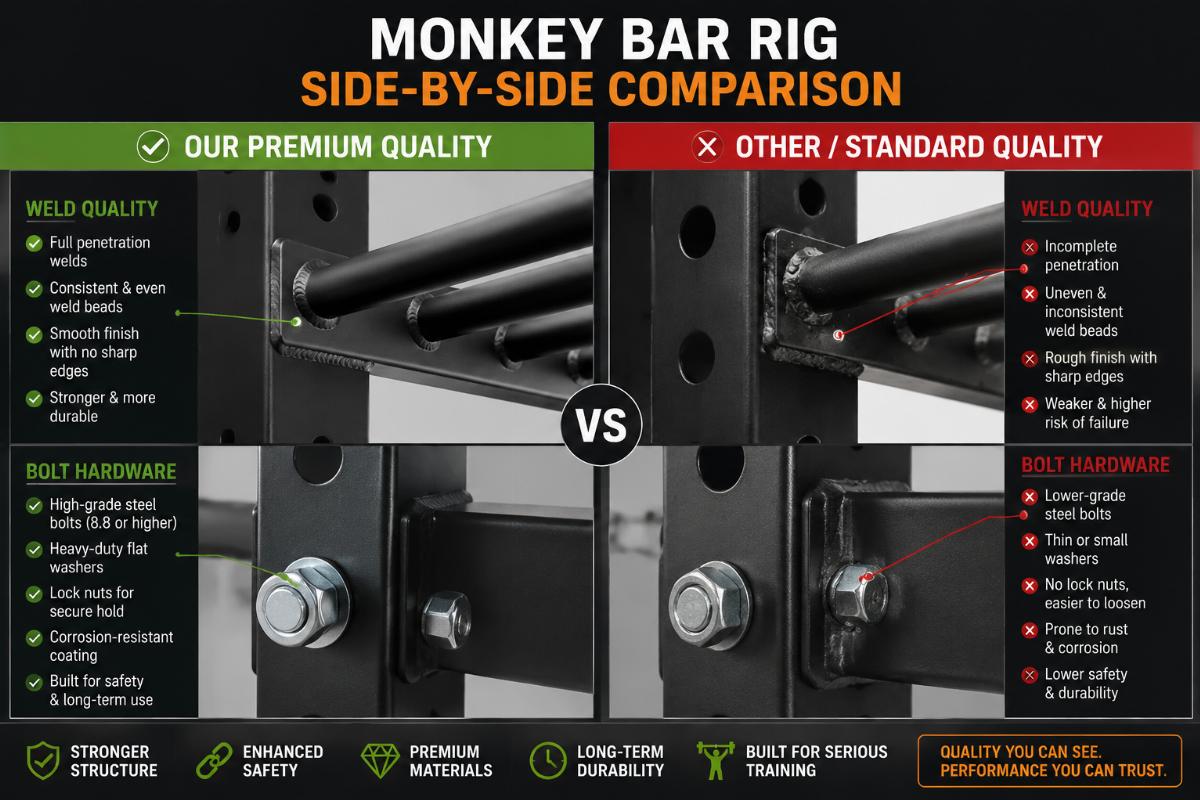
The rest of this article breaks down what actually separates a true commercial-grade rig from a visually similar one, and how buyers in the Middle East, Southeast Asia, and Latin America can source a quality monkey bar rig without paying brand-premium pricing.
What Makes a Monkey Bar Rig "Commercial Grade"?
Wall thickness, weld classification, and dynamic load testing — all three must be present. Visual similarity to a branded rig means nothing structurally.
Most buyers scroll through supplier catalogs and compare tube dimensions. That is the wrong starting point. A monkey bar rig that passes commercial use must satisfy three separate engineering demands, each governed by different standards. [NEED_CITE: ASTM F3503 structural and safety requirements for commercial functional training equipment]
First, the steel frame must resist static deflection under hanging athletes. This is where tube wall thickness and section modulus matter. A thicker wall increases the moment of inertia, reducing sag across long horizontal spans — but only if the steel grade itself is consistent.
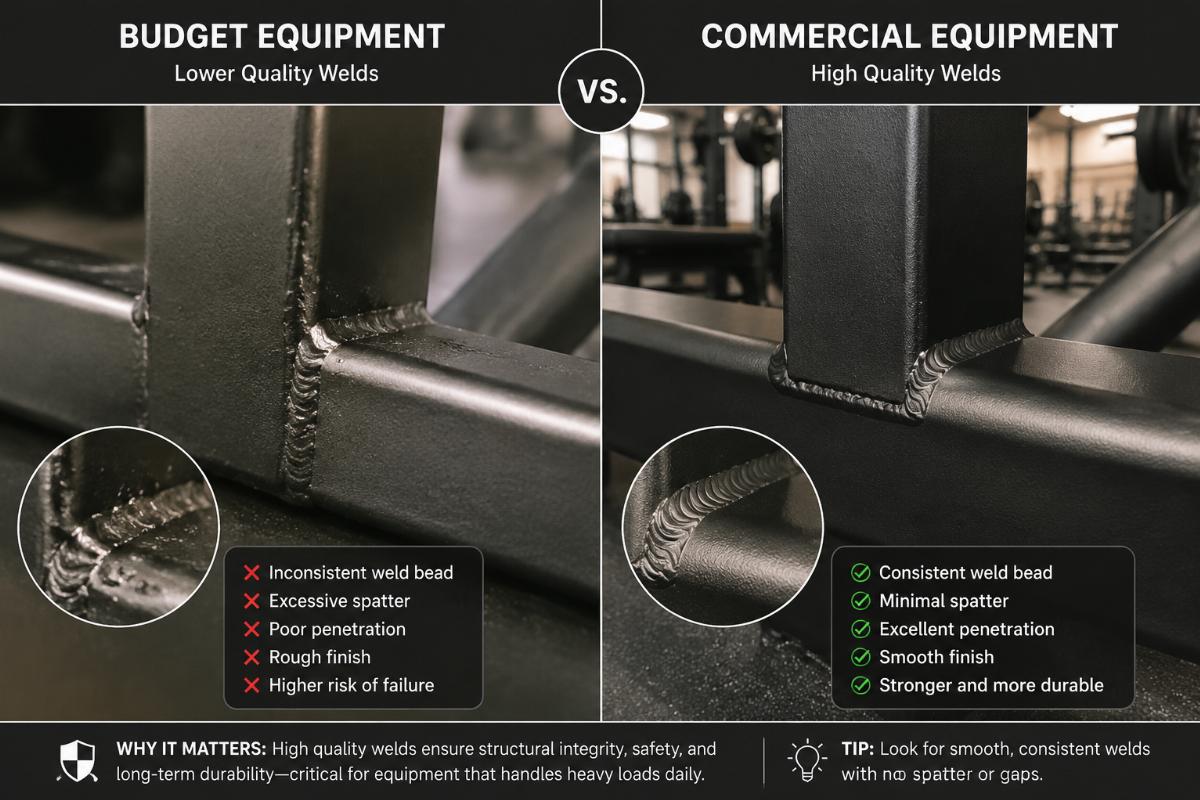
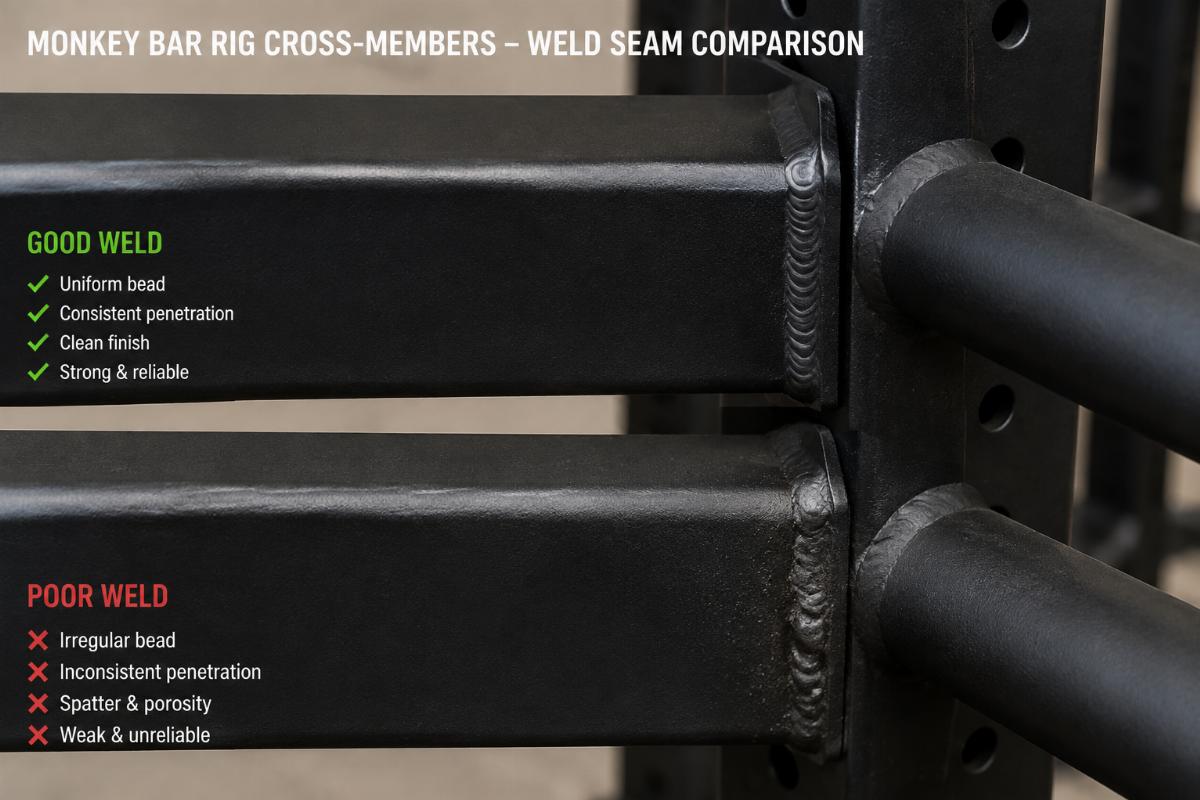
Second, every welded joint must survive repeated dynamic impact. An athlete kipping on a monkey bar rig generates shock loads far exceeding their body weight. The weld metal composition, travel speed, and post-weld grinding all determine fatigue life. Two welds that look identical to the naked eye can differ drastically in internal porosity and fatigue resistance. [NEED_CITE: weld fatigue classification differences between commercial and consumer-grade fitness equipment]
Third, the entire assembly must pass dynamic load testing — not just static. Static load testing measures how much weight the frame holds without bending. Dynamic load testing measures how the frame behaves when that weight is dropped, swung, or kipped. Rep Fitness includes third-party dynamic load reports with their rigs. Many China-based suppliers only provide static test data, which is a fundamentally different claim.
| Criterion | Rep Fitness Rig | Typical Unverified China Rig | Verified China Monkey Bar Rig |
|---|---|---|---|
| Tube wall documentation | Full batch-level | Sample-level | Full batch-level |
| Dynamic load report | Third-party verified | Not provided | Third-party verified |
| Weld inspection standard | Controlled | Uncontrolled | Controlled |
| Hardware grade traceability | Verifiable | Not provided | Verifiable |
| Finish corrosion resistance | Noticeably exten*perator in Dubai once showed me photos of two rigs side by side — one branded, one unbranded — both claiming the same tube size. The branded rig had full mill certificates for every tube batch. The unbranded one had a single test report for the entire order. That single report covered none of the actual beams in his facility. |
Rep Fitness vs China-Manufactured Rigs: A Side-by-Side Spec Comparison
The real gap between Rep Fitness and a China-manufactured monkey bar rig is not the steel itself — it is the quality control workflow and the completeness of the accessory kit shipped in each container.
Rep Fitness has built its reputation on finish consistency and brand presentation. Their powder coating is smooth, their branding is clean, and their documentation package is thorough. That reputation carries a price premium, and buyers are right to ask whether the premium is justified by engineering or by marketing. [NEED_CITE: price premium analysis between branded and factory-direct commercial fitness equipment]
The honest answer is both. The engineering gap is real but narrower than most buyers assume. The marketing gap — documentation, packaging, brand trust — is wider.
Here is where the comparison actually matters for a commercial gym buyer:
| Specification Area | Rep Fitness | China Factory-Direct Monkey Bar Rig |
|---|---|---|
| Steel grade | Standard commercial grade | Standard commercial grade |
| Wall thickness consistency | Controlled | Varies by supplier |
| Powder coating process | Multi-stage, controlled | Multi-stage at verified suppliers |
| Bolt and hardware grade | Verifiable, matched | Must be explicitly requested |
| J-cup and snap pin inclusion | Full kit included | Often excluded unless specified |
| Dynamic load documentation | Third-party included | Available at verified manufacturers |
| OEM branding option | Not available | Full OEM/ODM available |
| Minimum order flexibility | Single unit retail | Full container to single unit |
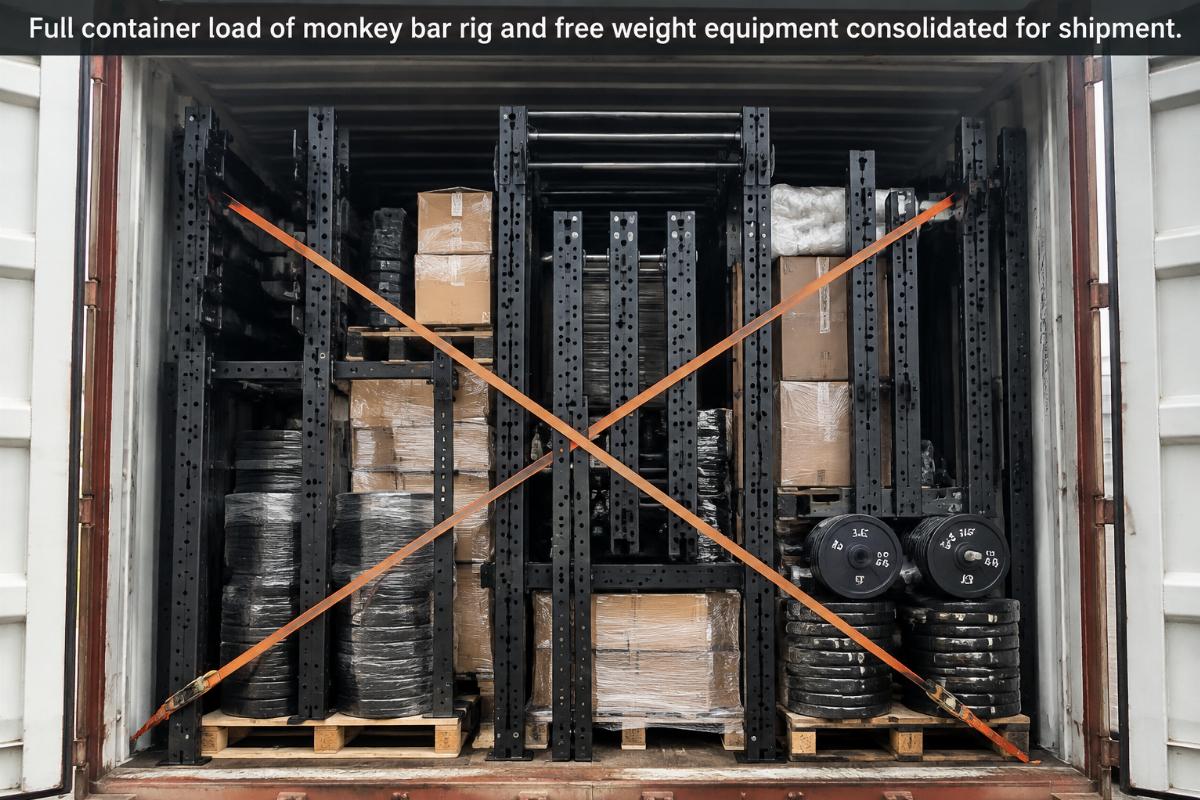
A CrossFit box owner in Southeast Asia once ordered a full container combining a monkey bar rig with a free-weight zone — plates, bars, bumper plates, storage racks. The branded equivalent would have required three separate orders from two different suppliers. The consolidated container saved him a full container-load in freight and simplified his customs clearance into a single shipment. [NEED_CITE: container consolidation cost comparison for multi-category gym equipment orders]
The critical point: a China-manufactured monkey bar rig can match Rep Fitness in structural performance, but only if the buyer locks down hardware specs, demands dynamic load documentation, and verifies that the accessory kit is complete before the container is sealed.
Three Real Field Failures — and How to Prevent Them
Roughly nine out of ten on-site rig problems trace back to connector hardware specs and missing installation guidance — not the main frame structure.
I have walked through dozens of gym installations across the Middle East and Southeast Asia. The frame itself almost never fails. What fails is what connects the frame: bolts, slip joints, pull-up bar sleeves, and J-cup retention pins.
Failure one: buyer-supplied bolts causing cross-member sway.
The Riyadh case I opened with is the textbook example. The frame was sound. The bolts were not. The buyer sourced standard-grade bolts locally, which could not maintain preload under repeated dynamic loading. The cross-member joints developed play within months. The fix required draining the facility, replacing every structural bolt with grade-matched hardware, and re-torquing the entire frame. The downtime cost the gym several weeks of lost membership revenue. [NEED_CITE: bolt preload loss under dynamic loading in overhead fitness structures]
Failure two: pull-up bar sleeves rotating under load.
A hotel fitness center in Latin America installed a monkey bar rig where the rotating sleeves on the horizontal bars were not secured with internal retention rings. Within weeks, the sleeves began to spin freely under athlete grip, creating a safety hazard. The root cause was a missing internal circlip — a part that costs cents but was never specified in the purchase order.
Failure three: J-cup bending under heavy barbell support.
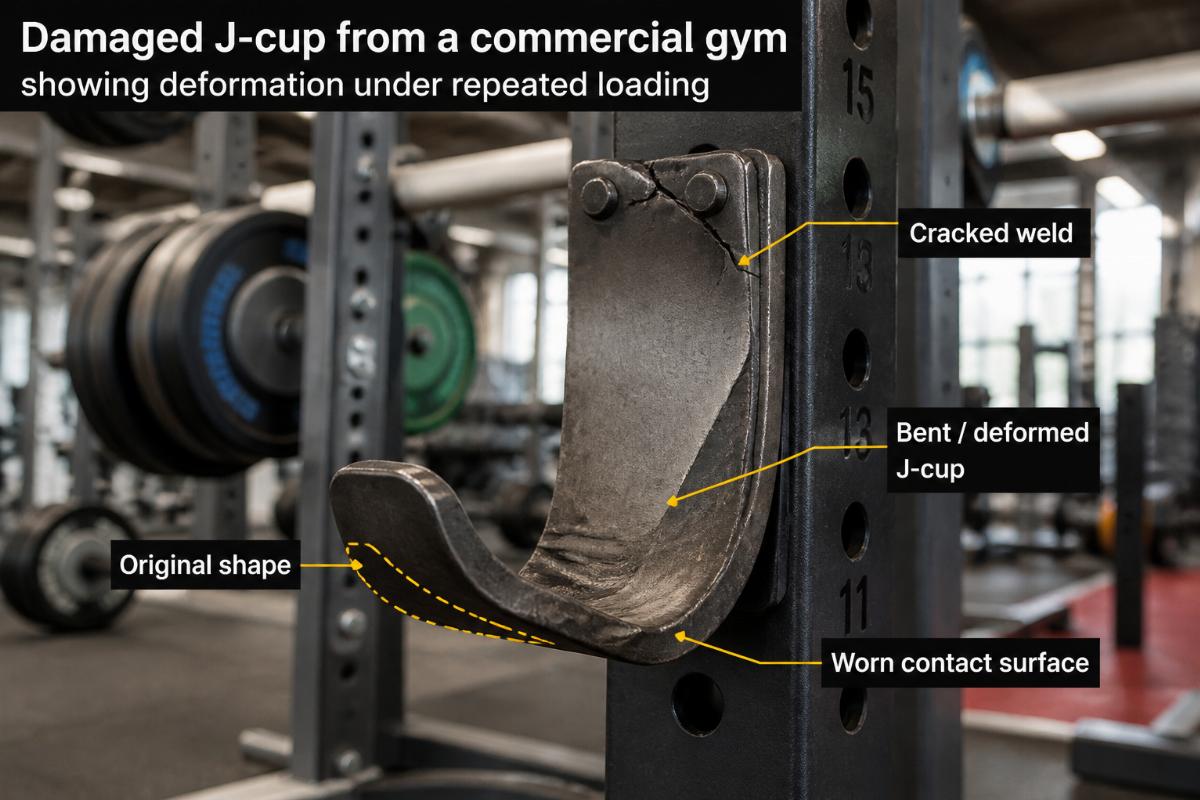
A functional training studio ordered a rig with J-cups for barbell support during squats and presses. The J-cups were visually identical to branded versions but used a thinner gauge steel and lacked internal reinforcement ribs. Under repeated heavy loading, the J-cup lips began to deform. The fix was a full J-cup swap — and the lesson was that accessory hardware must be spec-locked separately from the main frame.
| Failure Type | Root Cause | Prevention |
|---|---|---|
| Cross-member sway | Unmatched bolt grade | Full hardware kit included in container |
| Sleeve rotation | Missing retention hardware | Explicit circlip specification in PO |
| J-cup deformation | Underspecified accessory gauge | Accessory spec locked separately from frame |
How to Source a Quality Monkey Bar Rig from China
The factory audit must focus on weld procedure records and dynamic load test logs — not the showroom samples.
Sourcing a monkey bar rig from China is straightforward. Sourcing one that will survive five years of commercial use requires a different approach. Most buyers visit a supplier showroom, admire the finish, and place an order. That process selects for appearance, not structural integrity.
Here is the verification workflow that separates a reliable supplier from a risky one:
Step one: request weld procedure qualification records.
Every commercial-grade rig should have documented weld procedure specifications — including weld metal classification, pre-heat requirements where applicable, and post-weld treatment. If a supplier cannot produce these records, their weld quality is uncontrolled regardless of how clean the showroom samples look. [NEED_CITE: weld procedure qualification requirements for commercial fitness equipment structural joints]
Step two: demand dynamic load test reports — not static.
Static load testing proves the frame holds weight. Dynamic load testing proves the frame survives impact. Ask for test reports that explicitly state dynamic loading conditions. If the report only mentions static weight capacity, it does not cover kipping, muscle-ups, or athlete dismount impact.
Step three: verify hardware completeness before container sealing.
Request a full packing list showing every bolt, every snap pin, every J-cup, and every safety latch. Cross-reference this list against the installation manual. Any gap between the two is a future field failure.
Step four: arrange third-party pre-shipment inspection.
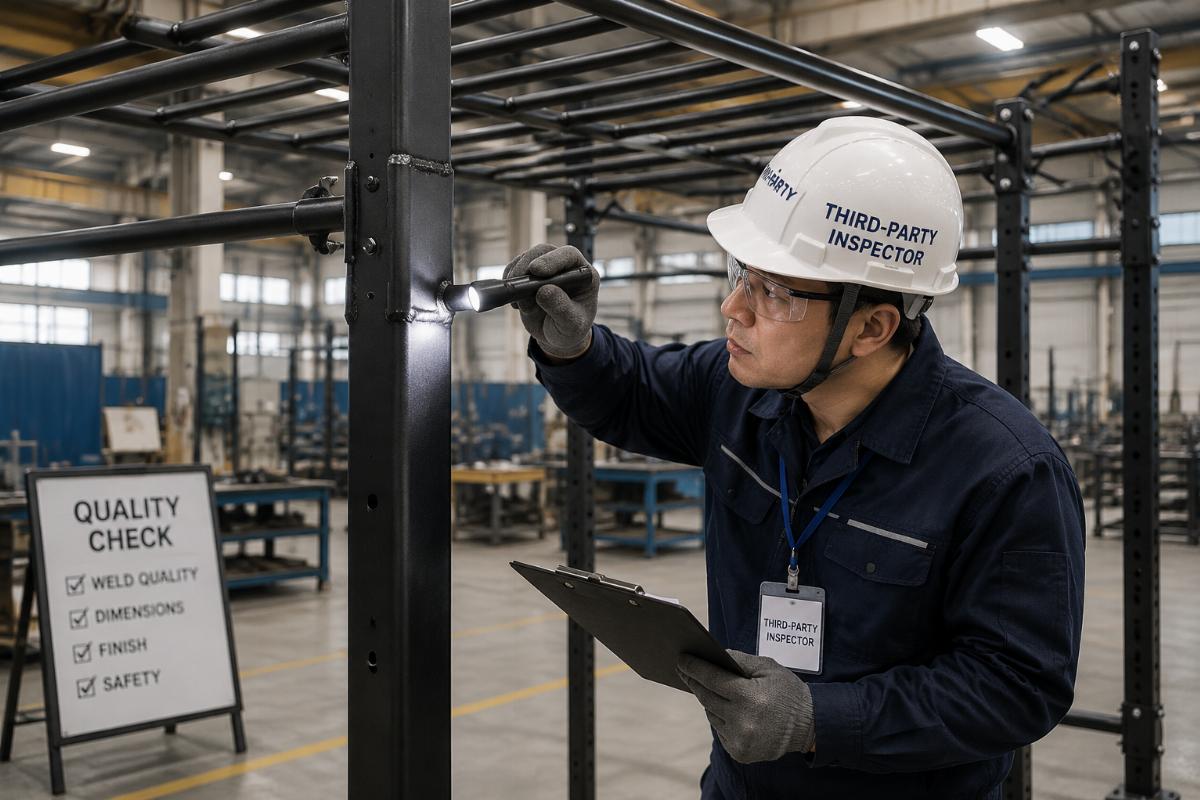
A third-party inspector verifying weld quality, coating thickness, and hardware completeness on the factory floor — not in the showroom — is the single most effective risk reduction step a buyer can take.
A distributor in the Middle East once received a container where the rig frames were perfect but the bolt bags were missing entirely. The installation was delayed by weeks while replacement hardware was air-freighted. That single oversight cost more in logistics than the entire third-party inspection fee would have.
OEM/ODM Options: Can You Get Rep-Level Quality at Factory-Direct Pricing?
Yes — but only if the buyer locks specifications explicitly and builds third-party inspection checkpoints into the production timeline.
A hotel chain in Latin America approached our factory with a clear brief: they wanted a monkey bar rig carrying their own brand, matching the structural performance of a well-known US brand, at a price that made sense for a multi-site rollout. They did not want to pay brand premium across twelve locations.
The project succeeded because three things were handled correctly from day one:
Specification lock-down was written, not verbal.
Every tube dimension, every wall thickness, every bolt grade, every coating thickness was written into the purchase agreement. No specification lived only in a conversation. [NEED_CITE: OEM specification documentation best practices for commercial fitness equipment manufacturing]
Mold and tooling costs were balanced against order volume.
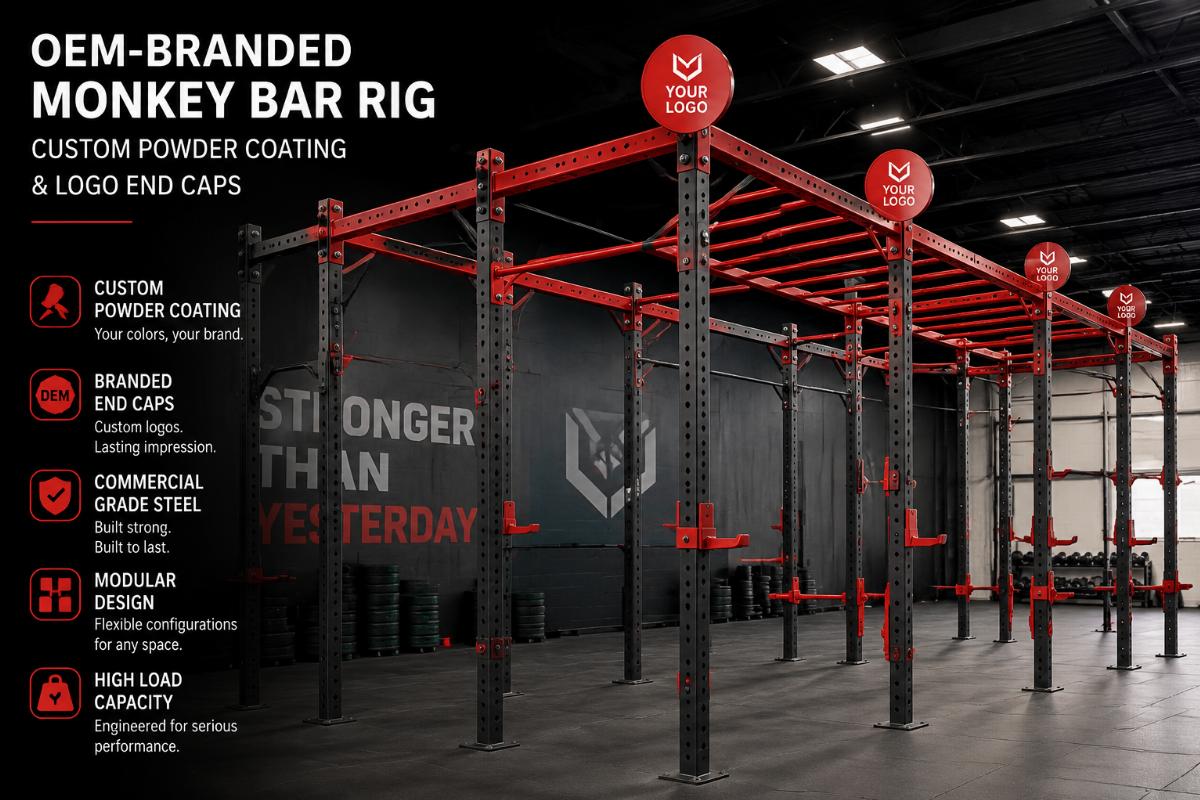
Custom branding on a monkey bar rig involves tooling for branded end caps, custom powder coating colors, and logo application. For a single-site order, those tooling costs are hard to justify. For a multi-site rollout or a distributor building inventory, the per-unit cost drops to a level where branded OEM makes clear financial sense.
Third-party inspection was scheduled at three checkpoints: post-weld, post-coating, and pre-shipment.
Each checkpoint had a pass/fail criterion tied directly to the written specification. No checkpoint was skipped. No shipment left without all three passing.
The result was a monkey bar rig that matched the structural performance of the branded reference at a fraction of the per-unit cost — and carried the buyer’s own brand across every contact point.
| OEM/ODM Factor | Single-Site Order | Multi-Site or Distributor Order |
|---|---|---|
| Tooling cost justification | Difficult | Straightforward |
| Custom coating feasibility | Limited | Full range available |
| Third-party inspection ROI | Moderate | High |
| Per-unit brand premium savings | Noticeable | Substantial |
| Minimum order flexibility | Available | Significantly expanded |
Conclusion
A monkey bar rig is only as strong as its weakest connector, its least-documented weld, and its least-verified test report.
Rep Fitness sets a high benchmark for finish and brand trust. A verified China-manufactured monkey bar rig can match that structural benchmark at a noticeably lower price — but only when buyers shift their focus from showroom appearance to weld records, dynamic load documentation, hardware completeness, and third-party inspection. The difference between a rig that lasts a decade and one that wobbles within months is never the steel. It is the process.